Author Archives: Vironevaeh

A little bookbinding

I really enjoy bookbinding from time to time, especially now that technical writing occupies the bulk of my time. It’s refreshing to complete something and see its completeness. It can be hard to feel holistic satisfaction from writing; there’s always one more thing to fix. Below are some photos of my recent projects.

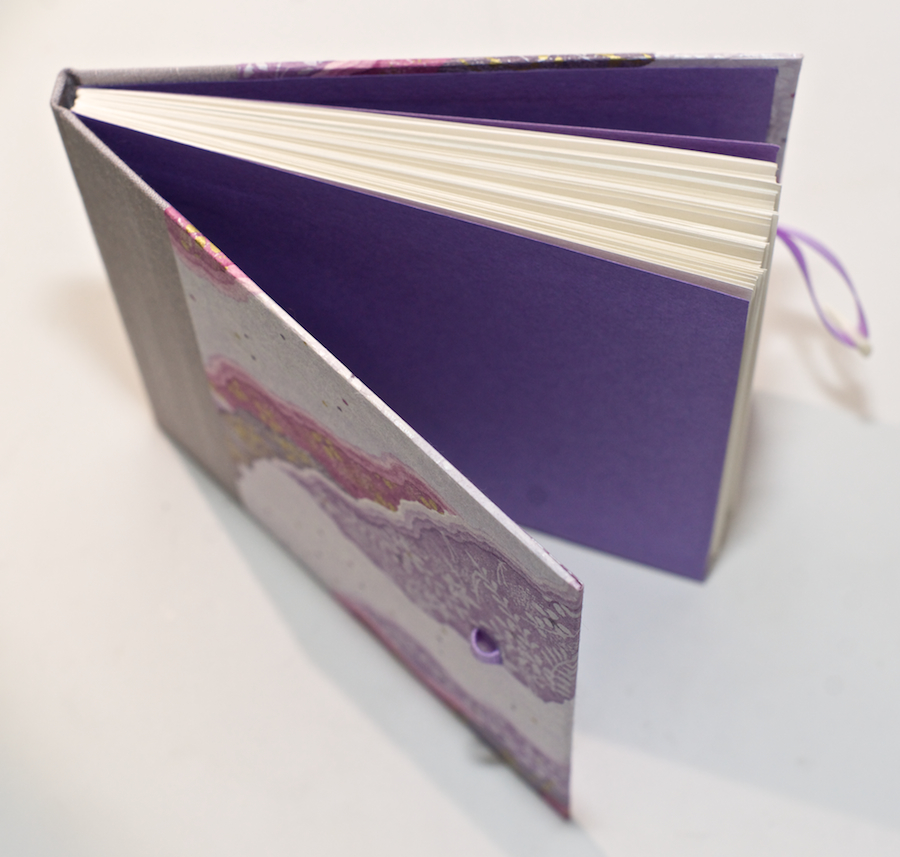
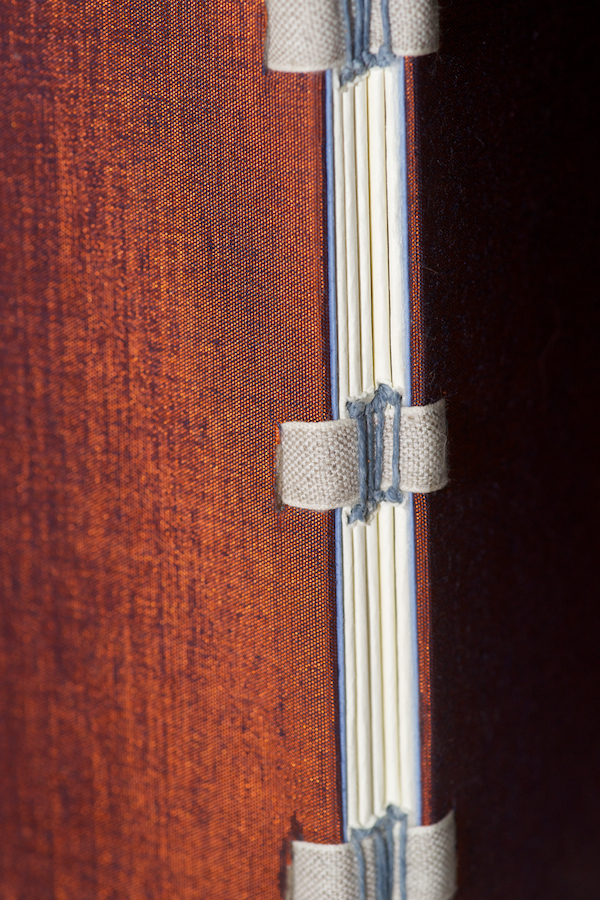
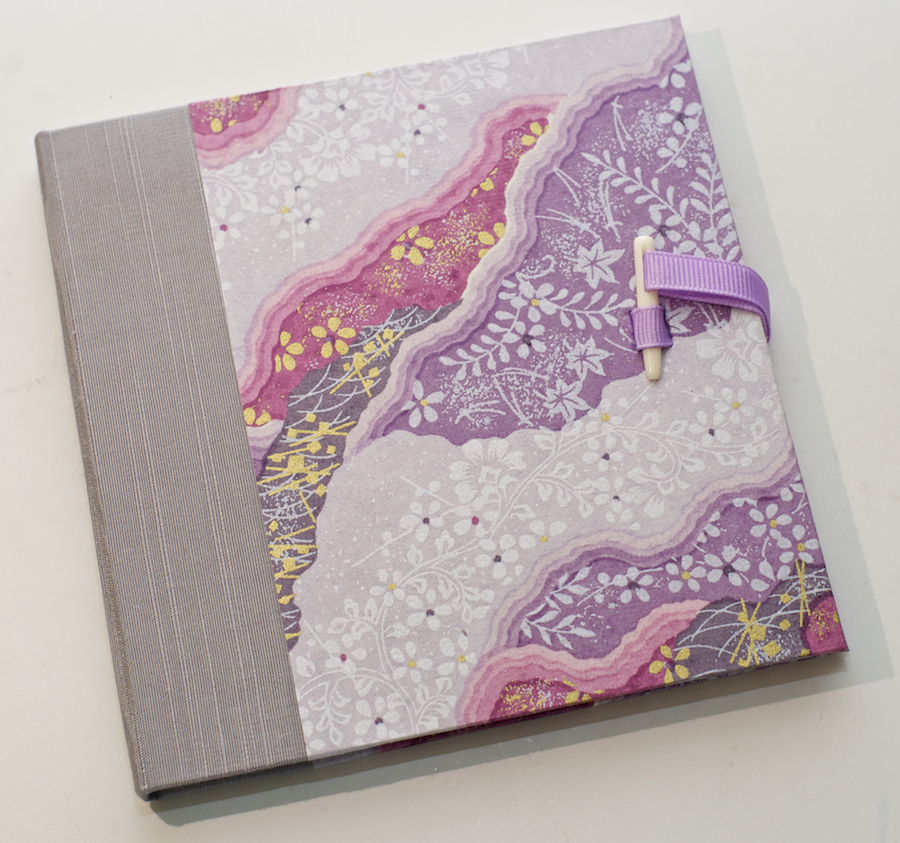
The first two are books I donated to my local writing club, WriterHouse, for a charity raffle. The purple and grey book is a perfect-bound notebook with a bone clasp; it contains linen textured paper. The dusky red book has exposed linen tape to allow for a more flexible spine. It contains a slightly warmer-colored linen textured paper. I made a similar book for myself a few months ago–having something beautiful to take notes in is a great incentive for me.

The third book is a copy of my novel draft to send to a friend who until now has been reading from a pdf. I used a red poppy patterned paper for the endpapers–I love the pattern but it’s a slick paper that can be hard to keep flat. I was pleased with how it turned out. The book’s cover is black imitation leather.

SONY DSCSONY DSCSONY DSCSONY DSCSONY DSCSONY DSC

Writing prompt: “The secret to space poppies is harvesting the right part”

Time: 7 minutes. Click here to go to my list of prompts.

“The secret to space poppies is harvesting the right part”

The secret to space poppies is harvesting the right part. I should know. When teaching on Seti Beta goes to recess in the early summer, I switch to my more lucrative career, harvesting. The seeds contain powerful opiates, conveying all their medicinal and jovial attributes. The petals and the stem each have their own pitfalls. The petals have some quantity of opiates, but also contain some oxidized compounds which, in my opinion, lead to the having of a bad time. Unscrupulous vendors will include the petals in their product, knowing that the vast majority of customers don’t know the difference. I like to think that a more pleasant high leads to customer loyalty. The stem contains potent poisons. Homicidal vendors include them.

They aren’t really related to poppies, nor do they look like them. They’re actually enormous lizard plants. But they yield an opiate, and they have plant parts. Part of the trade is keeping the lizards happy. When they’re unhappy, they bite, and they can accumulate more oxidized compounds. I have three flesh fingers on my left hand, although at least I had plenty of painkiller on hand. Some say that the industry is in danger, with the rise of bioengineering and targeted therapies. This is why I support the rise of pleasure purchases. They are the future.

(This prompt is a bit scattered. I barely had the time to finish it during a lull in teaching in a crowded noisy room. But I really think it’s worthwhile to sit down and write on command. We must learn to accept that not all words we write are golden, but if we do write, there will be more golden words than if we don’t. As Wayne Gretzky said, we miss 100% of the shots we don’t take. And perhaps, one evening when we think we’re brain-dead, we will write something that we love in the morning.)

One year, 125 posts, and beyond

Tomorrow is the one year anniversary of this blog, which I started as a way to improve my writing, to document things that interest me, and to put myself out there. As of this, my 125th (!) post, I have written 18 posts about specific science topics, 7 science fiction book reviews, 5 writing prompts, and a bevy of posts about artists, methods and photography. I wrote an 82,000 word novel draft in April and May (editing pending the completion of my PhD). I’ve written maybe a dozen short stories, and pushed myself to be a hard self editor. I’ve joined writing forums and critique groups like critters.org and youwriteon.com.

I think the results show, at least in the form of determination, which is needed as much as talent in writing. Since I started keeping track in  June, I’ve submitted stories 21 times to 18 venues, many of which I found through the submission grinder, which I describe here. I’ve been rejected 15 times (ouch!) but after months of very little traction, I now have 2 stories in the second rounds of consideration at paying venues. A third story, which has been rejected 5 times, has been called a “good story” by two rejections. Having seen enough rejections, I now know that’s a nice compliment!

Before this last year, I worked on improving my writing, but in aimless, unsystematic ways. Now, in spite of major distractions like finishing up a PhD, I am seeing more progress than ever.  I wonder what I’ll be up to this time next year; I know with the efforts I’ve put forth in the last year, and those I plan to put forth this year, the future will be exciting.

Writing prompt: “What if the creatures in your decor emerged?”

Time: 5 minutes. Click here to go to my list of prompts.

“What if the creatures and peoples in your photos and paintings emerged from them?”

The man riding the communism literacy poster started to look unnervingly three-dimensional. What ABV is this beer, Edna thought to herself. Indeed, all the photos and paintings of beings had taken an on an odd sheen. Then the figures from the images emerged and stood in her living room. Some were fairly benign, like the Mucha women,  posing serenely, showing off biscuits with a bare breast or two.

Others were more problematic. The rider of literacy, 8 inches high but full of nationalistic zest, waved his torch menacingly and kept shouting tovarich* at her. Out the window she heard the cries of her neighbors and the wail of sirens. She glared again at the beer before running into the next room to seek her russian-english dictionary. Based on the sirens, this might be a situation she’d have to handle herself. She congratulated herself for removing that photo of the shadow vessel from Babylon 5. She wondered if it would count as a creature, but even miniature, such a thing would be a problem.

tovarich: comrade, in Russian.

Language and Writing: Russian Poetry

Language critically shapes writing. As someone only fluent in English, I often wonder what it is like to read a translated work in the original language. There are little jokes and references and inflections that are difficult or impossible to translate. When we read Shakespeare, it’s pretty obvious that we don’t hear the words the way people of that day did.

I studied Russian for a year in college, long enough to see that, structurally, Russian is a great language for poetry and rhyming. Much of this advantage arises from the grammatical cases in Russian. A case performs the same task as a part of speech in English. Russian has 6 cases (Hungarian has 7, Finnish has 15!), for things like direct objects, prepositions, negation, possession, and others. When a word is placed in a case, it is altered by the rules for that case, similar to how a verb is conjugated in romance languages. English mostly doesn’t have cases. To give one example where case exists in English: we use “I” or “me” for the personal pronoun depending whether the personal pronoun is the subject or the direct object.

For an example in Russian, take the phrases:

  • “I have a book” is “У меня есть книга” (transliteration: oo menya yest’ k’nee-ga)
  • “I don’t have a book” is “У меня нет книги” (transliteration: oo menya nyet k’nee-ghee)

The word “book” is altered between the two sentences, because it exists in the first and is negated in the second. In terms of cases, “книга” is in nominative (neutral) case in the first, and the genitive case in the second. Changes to words due to case can be more significant for other cases. Just from this example, the sound of the word in Russian is sensitive to its role in the sentence.

Additionally, because words are essentially “tagged” with their role in the sentence, word order is much more flexible than in English. The phrase “книги у меня нет” would still be meaningful in Russian; it would have a slightly different shade of meaning, perhaps an answer to a question. So, words themselves are easier to change, and they can be rearranged more easily. In English, we can barely change our verbs!

I imagine that all languages have their pluses and minuses for artistry and clarity. English has more words than most languages, which allows for finely shaded meaning in those words, which technical writers prefer. But after struggling with poetry assignments as a kid, man, studying Russian made it seem like were doing that bit all wrong!

Writing prompt: “The whirlpool sucked them downwards”

Time: 7 minutes. Click here to go to my list of prompts.

“The whirlpool sucked them downwards”

Aeli floated through the air. The parachute held her aloft, descending unnaturally slowly. Around her, the storm spun, and below her the sea roiled. Angry caps of gray water shot up. They came closer and closer, and she had the distinct feeling that they were reaching for her. Far off, she saw the ship descend in flaming glory into the sea. She would never know what had gone wrong. Blue and green lightning flashed all around.

She floated into the ocean, and the chute came down over her, trapping her against the water. She gasped, trying to pull air and the sea boiled around her. The water began to spin, with a strong clockwise motion. The whirlpool sucked her downwards. She contemplated if she did believe in an afterlife. Her sight began to grow dim, and she felt the burning, salty water enter her nose.

Something wrapped tightly around her ankle—something strong and something living. She imagined it like the tentacle of Ursula from that old Disney movie. The purple tentacle wrapped around her ankle, suction-cup strong, and pulled her down. She imagined she heard the fat villain laughing and peering at her ugly hench fish. Then the world didn’t exist anymore.

#

Aeli woke, coughing sea water, in a cave of crystal. Soft light filtered in from all around her. She was naked, and she was cold.


Science is Creative!

In the US, science is regarded as valuable, but dry and a bit stiff. As a student, it’s easy to get this impression, studying rigid facts first explored centuries ago. The math, chemistry, physics, and biology we learn in high school and college are about recreating long-known answers by well-established methods. But the process of making new science and math is inherently creative, and new ideas require letting the mind run wild a little. In this post, I’ll talk about how I develop my ideas.

I work with populations of oscillators. The idea of this research is that the complexity of the whole (the population) exceeds the complexity of each element (the oscillator). The human brain is a good example of such a system–each neuron is fairly simple and well-understood, but overall brain behavior arising from the interactions of many neurons is not understood. My research tends to work by observation–I notice something I find interesting and I explore that further. Other researchers work on what they suspect they will find, based upon other work. All research works within the context of its field. There are many interesting behaviors I have noted in my experiments, but I explore the ones I might explain. Really random observations are cool, but hard to frame in a way which is meaningful to the community.

The above may not sound particularly creative. But the key to experiments like I do is imagining what might happen when one explores slightly beyond what is known. It requires extrapolating from the areas we know, in the context of the rules we know, to the areas we don’t know. Some of the rules we know are pretty absolute, like thermodynamics, but others may be flexible. (As a note on this point, the stable chemical oscillations I study were once considered thermodynamically impossible. Someone had to bend the established understanding of thermodynamics to explain these oscillations. Einstein had to bend Newton’s Laws for relativity, and he arrived at that conclusion by logic rather than by observation.) In an experimental apparatus like mine, thousands of experiments are possible. It is up to the experimentalist to pick from the possibilities, in the context of what might work in his imagination, to demonstrate something hitherto unknown.

In some ways, the process is similar to writing. There are rules that must be obeyed, and the process of finding something new or interesting is very indirect. With science and writing, I develop some of my best ideas drinking a beer or taking a walk. Sitting at a desk focusing is required at times, but so too is active contemplation. The rules of science are broader and more rigid and take longer to learn, but there are similarities.

A lot of historical scientists were fascinating people, akin to historical artists. Van Gogh got his ear cut off in a fight. Astronomer Tycho Brahe lost his nose in a duel. Salvador Dali shellacked his hair. Electrical engineer Nikola Tesla fell in love with a pigeon. Mathematician Paul Erdos lived itinerantly for decades. In one visit to a colleague, he couldn’t figure out how to open a carton of juice, so he instead stabbed it open (among many, many other oddities). Physicist Richard Feynman used to work on his physics at strip clubs. Artists may share their eccentricities more in their works, but I would argue that scientists have every bit as much oddness.

I hope this post illustrates a little what it is like to be a research scientist, and how science at the cutting edge works. For more science posts, check out my fun science list.

Writing prompt: “What if a disease that causes schitzophrenia became common?”

Time: 7 minutes. Click here to go to my list of prompts.

“What if a disease that causes schitzophrenia became common?”

The man on the far corner screamed at the sky. Little Alicia pointed at him and laughed. “Daddy, that man is funny.” I pull her back from the curb harder than I intend to and she starts to cry. Somebody else will call this one in, probably. I pull Alicia and Tania behind me, against their protests. When they’re older, they’ll understand. I hope, I really hope, that when they’re older, this will just be another terrible chapter in history like the yellow fever of Memphis or the swine flu.

The schitz strikes men more often than women. The latest statistics suggest 5% of adult men have been stricken, and 2.5% of adult women. Nobody really knows why. Only about 10% ever recover. Unlike many more ignorable maladies, the schitz first struck in the wealthier classes. Scientists think it first became widespread through air travel. They say that the sickness doesn’t actually have a gender preference, but that businessmen are more common and thus were more stricken. I’m skeptical. The old disease, schitzophrenia, which this one so strongly resembles, selected for men. I’ve seen many of my old classmates go down to the illness.

I tighten my mask. Alicia’s has slipped down and she is fingering her nose. I swat her hand and pull her mask back up. The kids don’t see it, which is frightening and heartening. Maybe they will make it through these times not much worse for the wear. We walk, rather than take the tram, which is empty, back to the flat on the edge of town.

Book Review: The Invention of Everything Else (Samantha Hunt 2008)

There are no spoilers in this review beyond what you’d find in the first few chapters or the cover blurb.

Rating: 5/5

I absolutely adored “The Invention of Everything Else”. I’ve always meant to read more histories and biographies than I do, but sometimes they can be dry. This book, in many ways, is a fictional biography of Tesla, a famously eccentric inventor who first pioneered AC electricity and radio. To learn more about Tesla, check out this awesome Oatmeal cartoon, which has a lot more detail than I’ll include here. The book also has rich and lovely descriptions about historic New York City. And most of all, this book is a romance of eccentric people, whom I feel get far less respect than they deserve. The characters are pigeon-enthusiasts and hoarders and dreamers and inventors.

The book opens with Tesla as a very old man, broke and largely forgotten. He was a brilliant inventor, but not a businessman like Edison. He lives in a dreamlike state, remembering past glories and failures, and seeking his beloved white pigeon (see the Oatmeal cartoon). The other main character of the story is Louisa, a young vibrant woman who works at Tesla’s hotel. She likes to listen to radio dramas and to study people, so she is naturally fascinated by Tesla. Over the book, we learn a lot about Tesla and Louisa as they orbit one another.

The language of this book is wonderful. The descriptive passages evoked touchable images in my head although the descriptions were fairly brief. I could imagine being in bygone New York, and the distractions and wonders of the characters in that setting. The dirtiness of it, and the perpetual motion of it. Here is a quote from the first chapter that captures some of the loveliness of the language:

“Drawer #42. It sticks and creaks with the weather. This is the drawer where I once thought I’d keep all my best ideas. It contains only some cracked peanut shells. It is too dangerous to write my best ideas down. ‘Whoops. Wrong drawer. Whoops.’ I repeat the word. It’s one of my favorites. If it were possible I’d store ‘Whoops’ in the safe by my bed, along with ‘OK’ and ‘Sure thing’ and the documents that prove that I am officially an American citizen.”

If you are a lover of hard science fiction, this one might not be for you. The genre of this book is subtle, with the fantasy element of dreaming maybe most prominent. It seemed like every character in this book took a jump off of something, imagining they could fly. But if you love characters and setting and eccentricity, then you should like it. I loved it, and I really recommend it.

Writing prompt: “I was playing in the snow when aliens walked out of the woods”

Time: 7 minutes. Click here to go to my list of prompts.

“I was playing in the snow when aliens walked out of the woods”

It was the first snow of the year. It wasn’t a very good snow, with patches of withered yellow grass poking through already, though it was only 10 in the morning. Still, my brother and I ran outside and threw ourselves into it. It melted quickly through our snow pants and gloves. Why is it that when snow is the warmest it’s the coldest? I tried to gather up a ball of snow to throw at my brother. It wouldn’t clump, and it just made my hands cold. Well, it was only December. The prime snow months were still ahead.

My brother ran out of the yard toward the common grounds. The retention pond, almost always empty, has sloped walls that are nice for sledding. He sets his sled on the edge, climbs aboard, and leans forward. Nothing happens. “Cruddy snow!” he shouts. It echoes. The trees are all glistening and dripping in the woods. At least it’s pretty.

Two forms approach us from the woods. I take my brother’s hand and try to pull him off the sled. In school, we learned about adults who hide in woods. They’re called molesters, and they’re bad people.

The men reach us before I can get my brother’s attention. They moved amazingly quickly, and now I am giving Miss Roth a little more respect. I had thought her characterization of molesters exaggerated and cartoonish, but indeed, they move with super human speed. They also look strange. Their skin is rubbery, and their eyes are large and shiny and black. They don’t seem to have elbows or knees, just wobbly limbs like and octopus. They flow along on these things with evil fluid grace. God truly looks down upon these men.

“Oh my god, aliens!” my brother shouts, beaming. “Pew, pew!”

“No, Jake, they’re molesters, and we have to get out of here before they get us.”

Jake shoves me away and runs toward the gray men. “Take me to your leader!”

“H-hell oh,” one of them says slowly. Miss Roth didn’t say anything about them not speaking English. Maybe Jake is on to something.