Author Archives: Vironevaeh

Writing prompt: Chinese New Year

Chinese New Year in Chinatown, 2006.

Time: 10 minutes. Click here to go to my list of prompts.

“Chinese New Year” (This post was inspired by the time I wandered into Chinese New Year in Chinatown when i lived in New Jersey in 2006. It was a beautiful, soaking mess.)

The paper rockets exploded and the streamers coated the wrought iron railings. A dragon head bobbled down the street attended by a great drum. The rain poured from the sky, and the streets and sidewalks were full of umbrellas and vendors with umbrellas to sell, 3 for $5. It was Chinese New Year in Chinatown.

Elsie felt like it was a transformative cultural experience, a fresh excitement in the general excitement of New York.

“This is the year of the goat,” Cynthia said. Elsie was still struggling with her accent. There hadn’t been many Chinese speakers in Nebraska. “The goat is a lucky animal, its year suggests prosperity.”

“I hope,” Elsie said. “This is my year, the year it will all change.” She’d been in the city for a month. So far, she had spent more than she had, walked through gray snow, and tried not to smell aged trash.

Cynthia shrugged. “The goat also means stubbornness, a resistance to change. Maybe for many people, this is what luck is all about, not losing what you treasure.”

Elsie waved the thought away.  The rain was turning to sleet. Elsie jammed her hand back into her pocket.

They followed the parades. Cynthia, smiling, recited facts about various parts of the festival. Elsie mostly didn’t listen.

The street was a mess with paper and debris. But a shiny red envelope caught Elsie’s eye. She picked it up.

Cynthia smiled. “As a child, you get money in envelopes like these. It was very exciting.”

The envelope bore no identifiers or markings. Elsie looked inside. It was full of money. “It is the year of prosperity! I mean, I can’t even try to return it!”

Writing prompt: Blame someone else

Time: 10 minutes. Click here to go to my list of prompts.

“Blame someone else” (This list is an awesome source of completely silly prompts.)


The painting was covered in a thick layer of soot. I read the documentation. For years, it had hung next to a fireplace in a small poorly ventilated room. But the composition and the brushstrokes had the right look. My boss believed it was an authentic Vensammer. Tina the wonder employee, said that it probably wasn’t. When I cleaned this painting up, she’d see.

I looked at the painting for a while. It depicted a middle-aged woman sitting next to a young boy. In my mind, I guessed at the age of the painting and the techniques that would have been used at the time. Which paints would react to which treatments. If it was a Vensammer, we could auction it for twenty times what we bought it for.

I reached for the solvent, but instead I knocked it over onto the painting. I picked the painting up and tried to let it run off. If it had the proper oil finish, it would be okay with such a brief exposure. I turned the painting back over. It was not. Paint ran in ugly rivulets. Vensammer would never have been so reckless. It wasn’t a Vensammer. It was a worthless piece of junk that I had further ruined.

Quickly quickly, I dried the painting. I slid it back into the storage slot. I carefully redacted my name from the sign in list, and put Tina’s in instead. I took another painting that needed light cleaning and hurried off with it. No sir, I’d never touched that Vensammer.

Tina came in later. She studied the log; she seemed puzzled by it. I said nothing. She pulled out the faux Vensammer.

“Mert, what happened to this painting? I didn’t do this, I swear!” Her eyes were wide, pupils dilated.

The boss walked in. I suppressed a smile. “Is that the Vensammer?” she bellowed.

“Y-yes,” Tina stammered. “I can’t explain.” Tina stared at the painting, desperate. Then her face settled. “Wait,” she said. “Do you see this shape underneath this smear?”

The boss leaned in. She grunted.

“There’s another painting under here!” Tina cried. “And I’m even more certain the surface painting wasn’t a Vensammer.” She pulled out several tools and carefully set to work on the painting. “This shade of yellow… I bet this is an Artello!”

“An Artello! That’s better than a Vensammer!”

More bookbinding

Winter is a great time to look outside at the cold rain and bare trees and stay in and bind books instead. Below are three projects from last week.

Book 1

Upholstery fabric makes great book cloth. It’s thick enough that it doesn’t need backing paper to keep the glue from coming through. It’s substantial enough that it doesn’t tend to bubble or warp. And it often has interesting textures that work well for a book cover. I love the fabric for book 1, the way it fits on the cover, the feel, and the sheen. Upholstery fabric can be pricy, but the retail price is similar to prepared book cloth. The fabric for book 1 was an $8 remnant; this project took at most 1/5 of that fabric. That’s not bad at all.

I did a coptic stitch with red waxed linen thread. At $16 a spool, it’s pricey, but it is a lot of thread. I’d estimate one spool could sew very roughly about 50 books of this size.

bookbind-04005

I did my very first box for this project, following this set of videos for guidance. Sage Reynolds YouTube channel seems like an excellent source for book binding expertise. I’m sure I’ll be back there.bookbind-04049 bookbind-04048

Book 2- Dragonfly journal

For Book 2, I did my first long stitch book. For this binding, you simply sew through the spine. It was quick and pretty painless. I added a dragonfly embellishment to the cover, which I designed in illustrator, and had my Silhouette Cameo cut out. Another use for a favored toy. (Read more on the Cameo.)bookbind-04040 bookbind-04037

Book 3- Mad Scientist Lab Notebook

Book 3 features more raised details. Again, I did a coptic stitch. The endpaper I printed using the Silhouette Cameo’s art pen. It took a long time to draw all those paths, but I am in love with the result. The black slipcase (my second box!) features a mushroom cloud, cut with the Silhouette Cameo.

bookbind-04036

The cover features a radioactivity symbol. I’m really excited about the mad scientist theme, so I’ll probably do more of these.bookbind-04034

Writing prompt: National Weatherman’s Day

Time: 10 minutes. Click here to go to my list of prompts.

“National Weatherman’s Day” (This list is an awesome source of completely silly prompts.)

I turned on the news. I took my shower and I brushed my teeth. There had been two homicides overnight, unusual but not unheard of in this town. In fairly suburban neighborhoods. Something domestic I imagined.

The weather outside was crisp. The dew point was low. No clouds in the sky. That always irritated me. The absence of clouds is boring. No stratus, cirrus, or anything. Just blank. The weather station by the front door confirmed the low dew point and said it was 58 degrees. The morning sun glared at me on the commute, and again I wished there were clouds.

“Marty, did you hear?” It was Terry, the senior weatherman, the guy who went on the screen. I just did calculations and measurements.

“Hey Terry, you’re all sweaty and red. You should get into makeup.” It wasn’t the first time he’d come to work hung over.

“I guess you didn’t hear then.” He lowered his voice. His eyes were wide. “Those two homicides overnight? They were weathermen.”

I laughed. It was the only reasonable reaction. I was incredibly jealous of Terry’s job, but I knew well enough that few others cared about it. It was just like him to make a couple of murders all about him. Maybe he’d had more than booze the night before.

“They were,” he defended. “Ed Street from channel 5 and a guy that does the broadcast on a little station in Springfield.”

“It’s a coincidence, I’ll give you that.”

“A Milwaukee weatherman died in hunting accident last night. And in Orlando a guy died in a car wreck.”

I shrugged. “So are you going to do the weather or not?”

He puffed. “Of course!”

“Then get to makeup, you look like a piece of raw meat.”

He glowered. Then he nodded and scurried off.

*

The phone rang before my alarm chimed. It had to be work, it was the only contact that could override my do-not-disturb setting.

“Marty?” It was the producer. “Terry’s dead.” He’d fallen down the stairs. Drunk I bet, no doubt fretting his conspiracy of weathermen. I was going to do the weather today. I was passingly sad to hear about Terry, but it was my big break.

I hung up the phone. Not knowing what else to do, I turned on the radio and hopped in the shower. A weatherman in San Francisco had died.

Suddenly I was less excited to do the weather.

It’s February and I need some greenery, despite the tyranny of groundhogs

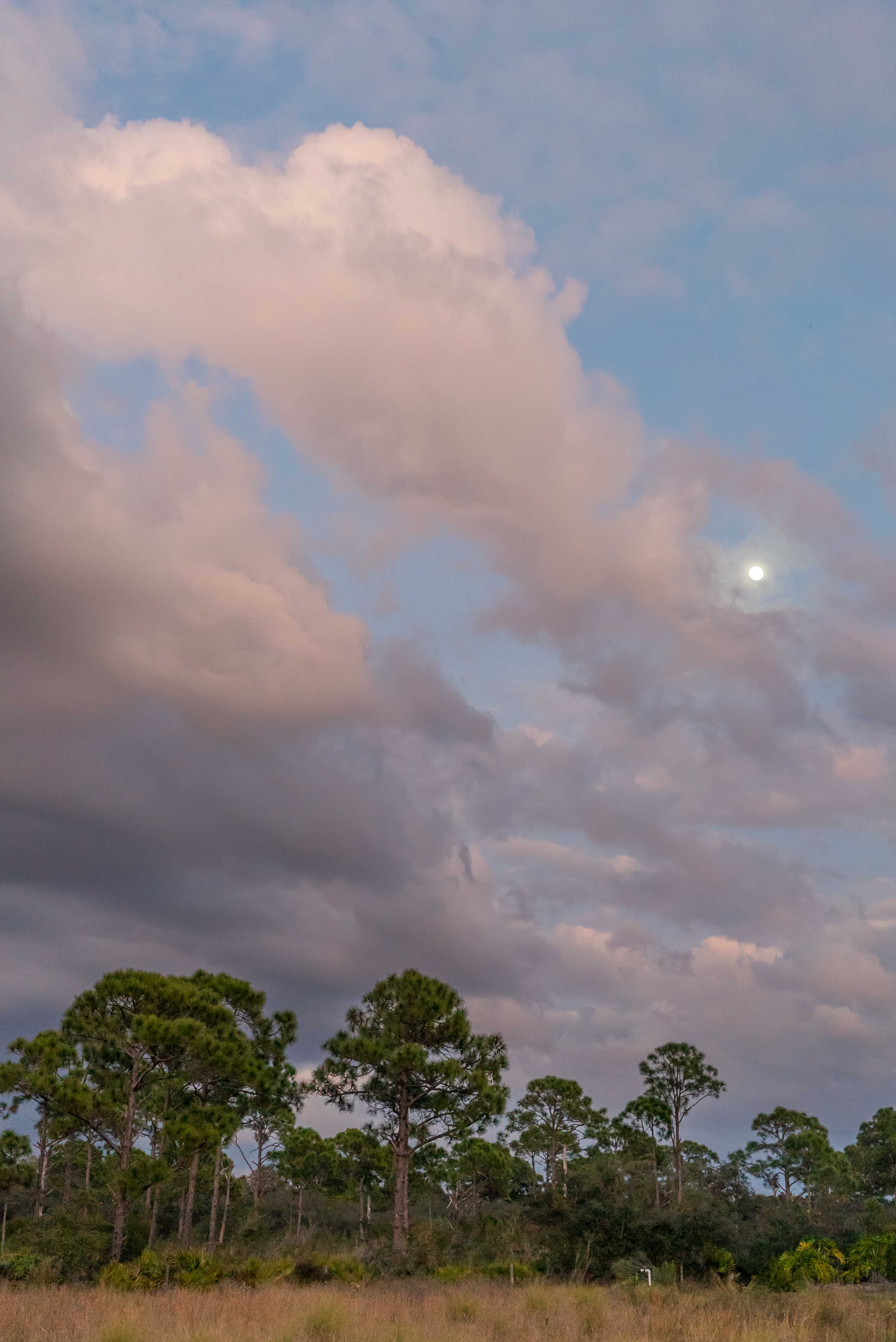
And the day after the Super Bowl. So, I need a pick-me-up to start the week and I bet a lot of other people do too. And thus, a tropic sunset. (If my title doesn’t make sense to the international set, google groundhog day, our least-satisfying holiday.)

florida-03657 florida-03671 florida-03703 florida-03753And after the sun set, the moon came out. The awesome fast sensor on my new camera makes a night shot look like a day shot without graininess distorting the beauty. ISO 2500 and still looks great!


Writing prompt: Puzzle day

Time: 10 minutes. Click here to go to my list of prompts.

“National Puzzle Day” (This list is an awesome source of completely silly prompts.)

Cyn reached the front door at 12:03. She keyed in her entry code. Instead of turning blue, the key pad turned red and displayed a string of text. Who had the lowest average with over one hundred home runs?

“Damn,” Cyn spat. She hadn’t meant to get home after midnight. Some of the puzzles were solvable, but some, like this one, were ancient nonsense. She looked around the street. A few other bewildered people stood at their doors. It was a dangerous night to be on the street. Thousands of other people like her would wander the street. Police cars would challenge their operators too.

Every member of the city dreaded puzzle day. That’s what they called it. Exactly every 400th day, everything that worked smoothly the other 399 days would torture its users.

“Why does this happen?” the inevitable lament would arise. They lived in an ancient city of wonders. Most of the time, they took the functionality for granted. But not on puzzle day.

Cyn started toward Elbie’s house. Public transportation was out of the question. All of their questions were antique unit conversions. It was still quiet this time of night. She’d never been out on puzzle day, but like everyone else, she’d read enough.

Book review: The Dispossessed (Ursula Le Guin 1974)

Rating: 2/5

I first read The Dispossessed in high school. I wasn’t wild about it. But high schoolers lack knowledge of government and people and how we get along together, major topics of the book, so I figured I owed it a reread.

I wasn’t wild about The Dispossessed the second time either. It may be the talkiest modern book I’ve read. With all the talking, I never felt like I emotionally connected with the countries, the characters, or the conflicts. In contrast, Le Guin’s other Hugo and Nebula award winner, The Left Hand of Darkness, is structurally similar and is one of my favorite books.

The Dispossessed takes place on a world and an inhabitable moon, the Earthlike Urras the harsher Anarres. Politically, Urras has rich and poor and countries of different political persuasions. Anarres is inhabited by descendants of anarchists from Urras. On Anarres, the people are equal and they struggle together against the harsh climate. They don’t own anything and they are free because of it. The main character is Shevek, a brilliant physicist from Anarres. The book alternates between Shevek’s childhood on Anarres and Shevek’s visit to Urras. Shevek is the first person from either world to go to the other. The book contrasts to the two societies using Shevek’s eyes, a man who doesn’t quite fit in on either world.

Much of the book describes the society of anarchist Anarres. People work for the good of society. No one is strictly obligated to, but social shame is applied to those who don’t, those who “egoize”.  Everyone, even the physicists, is expected to spend part of their time laboring for society. Men and women are equal, the intelligent and less intelligent are equal too. The book does discuss where these ideals start to break down, but still, I had trouble believing in the Annaresti society. It felt one-dimensional, like its whole purpose was to be a foil to hedonistic, classist Urras, and moreso, hedonistic classist Earth.

Ultimately, I didn’t believe in the book. All the characters orated on social issues, and I often forgot who was who. I didn’t feel for any of the characters. The two different societies never felt real to me, just exaggerations of two extremes. Neither Urras or Anarres was shocking or insightful to me.

I wonder how the book felt in 1974. Roe vs. Wade happened in 1973. Title IX passed in 1972. A book by a female author about equality and respect was probably a breath of fresh air. Today, to me, maybe the story’s equality read a little too like a fairy tale. Too neat and tidy when we see female leaders like Hillary Clinton and Janet Reno pilloried for being ugly. There’s a lot of steps in between 1800’s style ownership of women and the ideal of female equality that the book tidily skips over.

Interestingly, The Dispossessed has a similar structure to The Left Hand of Darkness. A man who exists outside two societies visits and contrasts both of them. But for me, Left Hand has so much more feeling. I felt both cultures, and I loved the main characters. In both Left Hand and in The Dispossessed‘s Anarres, the battle against the elements forces a sort of communal behavior. Both books examine gender in society. But for me, The Left Hand of Darkness works, while The Dispossessed doesn’t.

Writing prompt: Measure your feet day

Time: 10 minutes. Click here to go to my list of prompts.

“Measure your feet day” (Technically, today National Blonde Brownie Day, but I care zip about them and drew a huge blank. So I opted for tomorrow’s, measure you feet day. This list is an awesome source of completely silly prompts.)

“Measure your feet today!” the full-page ad screamed. David had seen this ad, heard this commercial, for weeks, though he’d done his best to ignore it. It was weird that a hoax had so much money.

The shoes of Tutankhamen’s have been found! Top scientists indicate that his reincarnation is living today in our great nation. Measure your feet today… are they regal?

*

“Did you measure your feet?” Andy asked at recess before school.

“No. I’m not simple.”

“I guess there’s no way you’d be regal.”

“Nope,” David said.

Andy twitched. “Come on, where’s your sense of imagination? I’ll do your homework for a week if you measure your feet!”

David sighed. “Well, okay.” There wasn’t any advantage to buying into the hoax, but he could get behind not doing homework.

One of the other schoolboys, in the midst of this craze, of course had a tape measurer that he would loan out for a nickel. Andy paid it and gave David the tape.

As Andy instructed, David measured the length of his foot, the distance around his foot at the arch, the length of his big toe and the length of his second toe. He reported the numbers to Andy.

“Nuh uh!” Andy erupted. “You’re still messing with me!”

David was confused and growing annoyed. “I played along with your stupid game, are you going to honor your part or not?”

“You made those numbers up!” Andy grabbed the tape and David’s foot and proceeded to measure, too fired up to be squeamish now.

“Those numbers…” Andy trailed off. “You have to tell the New Tut organization immediately! Those are all the numbers!”

*

After Andy told David’s father about the measurements, there was no way he could avoid going. His mother dragged him to the regional center. The waiting room was filled with other boys, and even a few girls. Art work of feet in the Egyptian style adorned the wall.

Diversity in Science Fiction: Some Diverse Reads

Science fiction often touts itself as the genre of the future. But science fiction is a reflection of today as much as it is a dream about the future. Science fiction has been too white and too male, both in authors and in protagonists. This is a reflection of the biases in our society.

My own top 20 sci-fi novels list features 18 books by white men, and two books by Ursula Le Guin. The Guardian’s list of top 500 scifi novels featured the names of 18 women. Any scifi reader starting out will hear about Asimov, Heinlein, and Clarke. Too many people get defensive when someone points this out. (See: the Great SFWA Shitstorm.)

The answer is to read widely, and to continue to read widely. So in that spirit, I list below some diverse science fiction*, some of which I have read, and some of which I ought to. For further reading, here is a great article listing a lot of great authors from the LA Times.

  • Lilith’s Brood by Octavia Butler: we destroy ourselves with war and aliens come in and save the survivors, mostly people from South American cultures who avoided the bombs. Oh, and the aliens want weird weird sex. A fun and weird read.
  • Windup Girl by Paolo Bacigalupi: A western man goes to future Bangkok. The native Thais and the genetically-engineered windup girl are the stars of the show, though.
  • The Three-Body Problem by Cixin Liu: One for me to read! A best seller in China, recently translated into English.
  • Downbelow Station and Cyteen by C. J. Cherryh: Distant future novels where women kick ass in militaristic and scientific settings, if you can get past the info-dumping at the front.
  • Who Fears Death by Nnedi Orakafor: Another for me to read! Far future, post-apocalyptic Africa.
  • The Miles Vorkosigan series by Lois McMaster Bujold: I have looked for these for years in used bookstores. I guess they fall into that awkward old-enough-to-be-out-of-print-, not-so-old-as-to-be-reprinted phase. They won a buttload of Hugos. And they feature a disabled protagonist.

*Note: I think it’s currently easier to find diverse fantasy. Maybe this is because it’s straightforward to use alternate mythology to Western mythology. I personally vastly prefer sci-fi. I think diversity in far future sci-fi is a challenge, because our whole concept of diversity is rooted in today’s culture. Just giving everything Chinese-ish names isn’t very satisfying. In LeGuin’s Left Hand of Darkness, Genly is black, but this isn’t relevant to the story at all. But I would like to see more female protagonists!