Author Archives: Vironevaeh

Writing prompt: the spongy place in the yard

Time: 7 minutes. Click here to go to my list of prompts.

“The spongy place in the yard” (As a kid in the northeast, this happened in my backyard. I thought there was something under there, which made a perfect launching point for a prompt.)

Every spring, after the snow melts, the backyard gets spongy. I always knew why, and though I told mom, she laughed and smiled in that patronizing way. I knew there was something underground. The ground just sagged too much, the way the ceiling sagged and my grandmother’s abandoned childhood home. I could tell by the way it looked that it was a sagging ceiling too. I was just seeing it from above.

Then I noticed that the neighbor spends a lot of time in her shed. Hours. She must be about two hundred, hunched and always walking with a hand against the small of her back. Summer or winter, she walks with a throw wrapped tightly over her shoulders.

So last night, I went into her shed. Sure enough, under a sheet of plywood, I found a staircase downward. I turned on my flashlight, and I went down the winding stairs. There must have been fifty, I lost count. At the end of the staircase, I found myself in a huge earthen room, taller than any room in my house. And on the ceiling, they hung, dozens of little people like my neighbor. They were all wrapped up in throws like the woman. Then they noticed me, and I discovered they weren’t throws. They were wings. And they were flying after me.

I panicked, and I ran down a corridor into the darkness. I dropped my flashlight, but I kept running, because duh. I hear the rustle of their wings in the darkness, searching, like the sound of a sheet being snapped again and again.

 

Thoughts of warmer places

Here in the mid Atlantic, last week’s snow melts and compacts on the ground. It looks great when it falls, but it grows messy and treacherous quickly. But it is February, and the days grow longer. Soon they must grow warmer too. But in the meantime, this time of year, I like to fondly review photos from warmer places.

SONY DSC

Old Anglican church on St. Kitts.

Old Anglican church on St. Kitts.

St. Kitts, looking toward Nevis.

St. Kitts, looking toward Nevis.

Jungle in St. Lucia

Jungle in St. Lucia

Food and science: when is food safe?

The milk we get at the store is pasteurized, and we all know that chicken must reach 165 F and pork must reach 145 F. What is the source of these numbers, and what is their purpose?

Raw foods like meat and dairy contain a certain number of pathogens that can make us sick. These pathogens die when heated above about 125 F. So why are cooking temperatures much higher than 125 F? The recommended cooking temperatures are the temperatures your food must reach in order for a large enough portion of the bacteria to die nearly instantaneously. At 140 F, the salmonella in ground beef is reduced by a factor of ten every 5.48 minutes. Salmonella must be reduced by a factor of ten million to one, so you would have to hold this temperature for a while. At 150 F, the salmonella is reduced by a factor of ten every 0.55 minutes, so this is quite a bit faster. At 160 F, the bacteria reduces fast enough that by the time you’ve measured it, enough time has passed. The process of “sous vide” cooking uses lower temperatures applied steadily for long times to cook food. I will discuss this excellent cooking method in a future post.

The process of making food safe by reducing the bacteria is called pasteurization, which you may be more familiar with from the dairy aisle than meat, but the concept is the same. Also in dairy, the time for pasteurization depends upon the temperature. Pasteurized milk is heated to 162 F for at least 15 seconds while ultra-pasteurized milk is heated to 280 F for 1-2 seconds. Eggs are not usually pasteurized, but they can be when heated to 130 F for about an hour.

Douglas Baldwin’s section on food safety in his online guide to sous vide is the source of much of the information I present here. It is full of scientific citations, but is very readable, and I highly recommend it as further reading. Happy Valentine’s Day!

Writing prompt: The special box of chocolates

Time: 7 minutes. Click here to go to my list of prompts.

“The special box of chocolates” (author’s note: I am apparently a terrible Valentine. This was the less horrifying of the two prompts I wrote today. You were warned.)

We’ve come a long way with chocolates, I mused to myself, leaving the confectionary with a gleaming heart-shaped box full of truffles. I’d had the old versions, with just sugar and caffeine as their chemicals of action. They tasted nice, but it was a letdown compared to the modern thrills. I pulled out the guide on the walk home. The one with the ripple caused increased *ahem* blood flow, the one with the white stripe caused relaxation, the triangular one caused a sort of numbness that increased stamina… my favorite was certainly the square dark chocolate one that sort of made you feel like the other person, especially if they had one too. I slipped the guide back into the box, and grinned at the knowing leers as I walked.

My husband’s eyes flickered when I arrived home. “Ha, really John?”

“I get it every year, I know,” I said sheepishly. “But I so look forward to it.”

“I do too,” he said, wrapping his arms around me. For a bit, we needed no chemical excitement at all.

I stumbled out of the bedroom, feeling pleased with myself. But then I saw the beautiful box of chocolates, chewed and gnarled. The dog. Oh my god, he could be poisoned!

The dog, a great, powerful bulldog, came around the corner, and then I realized that poisoning might be the least of my issues. He snorted, and he looked me in the eye. I dashed out the door, half-naked, into February.

Fun science: how does figure skating work?

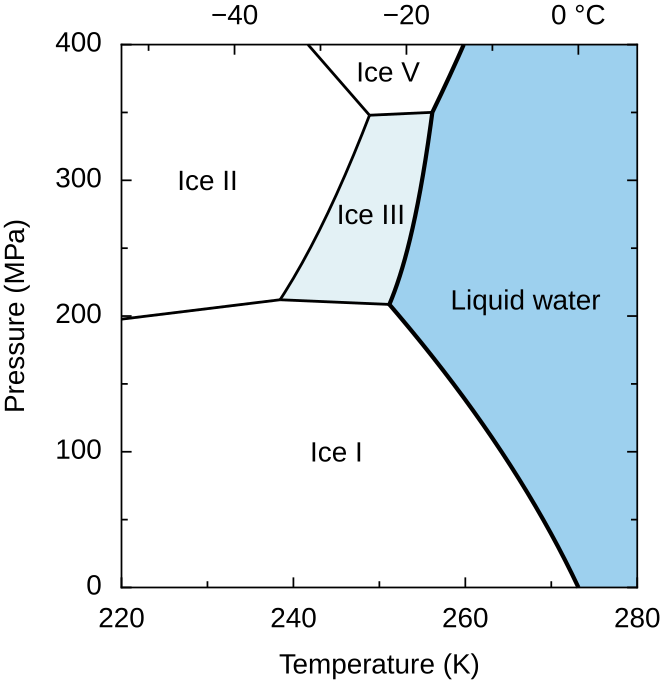
How does figure skating work? In short, we don’t fully know. You may have learned in science class that the pressure of the blade causes the ice to melt. Water does have the unusual property that solid ice is less dense than liquid water, and ice will melt under sufficient pressure. The thing is, the weight of a human body on an ice skate isn’t enough pressure to induce that melting.

Phase diagram for water. At normal atmospheric pressure, water freezes (to ice I, or normal ice) at 32 F or 273 K. At higher pressures, the freezing point is suppressed, as shown by the solid black line between the blue and white regions at the bottom. (Figure credit, Wikimedia)

So, if not the weight of the skater, what allows the blade to slide along? Well, there is a layer of liquid at the interface of the blade which allows the skater to glide. Denizens of very cold climates know that at sufficiently cold temperatures, skates do start sticking and catching on the ice (source: my mom’s many winters in Wisconsin, and science). Our best guess right now is that the surface properties of ice differ from the properties of the bulk. Perhaps at the surface of ice, the pressure *is* sufficient to cause melting (at temperatures near enough to freezing).

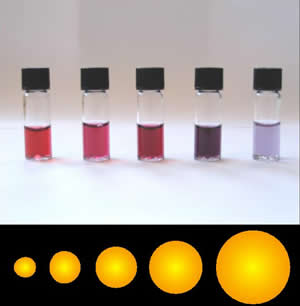
The difference between bulk properties (the properties of a big chunk of something) and surface and scale-related properties is increasingly studied. Nano-scale gold exhibits a wide variety of properties depending upon particle size, as you can see in the image below. Such colloidal gold is used in a variety of medical applications such as tumor detection and drug delivery.

Solution colors change as the gold particle sizes change. (image source Wikimedia).

When things like water and figure skating are still mysterious, who says science doesn’t leave room for wonder? Given the relatively few forces interacting in such systems, I find the richness of variation we observe entrancing. This Olympics, I’ll watch the athletes skate and consider the angstrom-scale world on which our lives glide.

Why I cook: food and science series

I cook a lot. I cook because it’s cheaper, but mostly I cook because I am absurdly lactose-intolerant, with a generally fussy tummy. As a kid, cooking seemed like something girly and irrelevant; food simply appeared. Now I see that eating is something we do every day and it can be either drudgery or exquisite.

This post is the first of a series I will post each Friday. Other posts will talk about specifics: science, recipes, and methods. Today I will talk more about how cooking became something I spend time on, and why cooking matters.

In college, I picked up some kind of food poisoning, probably on dorm food. I started to get sick a lot. I lost weight. I drank bulk-up drinks like body builders do. I became sensitive to milk products; I switched to lactose-free milk, and started drinking whole milk. I couldn’t move after meals, or else I’d get sick. If I ate even a bite too much, I got sick. If I got too hungry, I got sick. My lunches were often half a pizza slice. I bottomed out with a BMI below 18. Doctors seemed disinterested my inability to keep food, but they couldn’t explain the weight loss.

Finally, I started taking probiotics, which seemed to help. Now, seven years after my minimum weight, I’m at my high school weight, with gain more of a concern than loss. I cook most meals for myself, where I have control over my intake. Eating out with others isn’t easy, because I must be picky and inflexible about where and when I eat. I can’t wing it. If I deviate from the rules too much, I will get sick, which directly affects me for up to a day, and destabilizes me for the future. It’s manageable; some people with IBS get sick a dozen times a day, and digestive illnesses like Crohn’s disease can be life threatening.

The gut is understood very poorly, despite its importance. The enteric nervous system, or gut brain, is the site of 90% of serotonin and 50% of dopamine. With my ups and downs, I know well the relationship between gut health and mood. The digestive system is second in neurons only to the brain, and contains more neurons than the spinal cord. It is the engine of our body, and it functions in tandem with more bacteria than there are stars in the galaxy. Yet Americans spend the least time cooking of any country on Earth.

Loads of scientific evidence and my own personal evidence shows that a happy tummy goes a long ways towards a happy person, even in cases less extreme than mine. Good food can be a blissful experience, and in these posts I’ll talk about some methods toward good food. I don’t believe in diets or supplements or shortcuts, just making food that works. Good food can be made in a small kitchen on a limited budget with limited time. The primary ingredient is our own interest and curiosity, which I intend to share here.

SONY DSCMy newly reorganized office. The flat storage cabinet in the corner is a new and much-treasured addition. Now I can organize the flat stuff way better and also keep it safely away from cat feet (they have a sixth sense for stretching on the most expensive piece of paper). Great things are going to happen here. Too exciting not to share.

Writing prompt: The devious cat

Time: 7 minutes. Click here to go to my list of prompts.

“The devious cat”

I lie on my couch and watch my master. I gurgle and roll around, feeling the suede fabric against my fur. This time of year it’s a combination of pleasure and a little pain, with the sound of a thousand static shocks singing out. My roommate turns and smiles at me. She doesn’t know what I am, but that’s okay.

I leap down and saunter over, and my roommate coos. I taste the ground as I walk with the pads of my paws; there is pollen and dust and dead skin cells. I load them into storage for now. When I sleep, I will upload them to the cloud.

I wonder how much longer we will be here. How much data will be enough for the creators? I don’t know how long we’ve been here thus far. My task is a small part of a large one. Sometimes the other gatherer and I talk about the creators, but not often. We are always gathering the same information, he and I; it is hard not to feel competitive.

My roommate pets me. “Oh, who’s a friendly kitty today?” She adjusts my collar. She thinks she owns me. It’s cute, and I don’t discourage it. Time to nap and upload data.

February Reading Review

Every day, new, wonderful works of fiction are published, more than most could ever read. Lately, I’ve tried to read a couple of science fiction or fantasy stories each day. It’s a good way to learn about the magazines, and the state of the genre today. It’s also a way to read some great fiction. In this post, and in the ones like it in following months, I’ll list some of my favorites.

Short fiction:

Longer stuff:

  • Beyond the Glass Slipper: Ten Neglected Fairy Tales to Fall in Love with by Kate Wolford (2012): In this book, Kate Wolford, editor of the fairy tale magazine Enchanted Conversation and teacher of fairy tales at Indiana Southbend, presents ten unusual fairy tales. All are historical, but told less commonly. She offers commentary and discussion about each. I bought this on a whim rather than a purpose, but I absolutely loved it. Her discussions pointed out things I hadn’t considered about fairy tales, and gave me a whole new angle on them. I found it both fascinating and very inspiring.
  • Wonderbook by Jeff VanderMeer (2013): I am still working my way through this book, but thus far I am very pleased with it. This is a guide to writing that actually inspires while you read; I find myself jotting down notes about things to try or aspects of old things to revisit. Often, I find myself feeling somewhat self-conscious and discouraged, no matter how kind the tone of a writing book, so I really found it noteworthy. It is packed with quirky or even absurd illustrations, and lots of visually based diagrams. It is also not only by VanderMeer, who has taught at Clarion workshop, but features essays by writers both super famous (Ursula Le Guin and Neil Gaiman, for two) and unfamiliar to me. I have read 3.5 chapters of 7, so I will have to report as to my final reaction, but so far, so good.

Writing prompt: Red

Time: 7 minutes. Click here to go to my list of prompts.

“Red” (this prompt was inspired by my science fiction group’s monthly theme. Red was chosen relating to February and Valentine’s Day, but we know there are other themes red suits as well.)

I woke to fresh snowfall outside my window, but it wasn’t the glittering field of white that caught my eye, it was the speckles of red in the white. I woke up and pulled on my robe and slippers and blundered into the brilliant glare. There in the snow, not thirty feet from my house, I found the red in the snow. It was clearly blood, and a lot of it. I felt a cold that had nothing to do with the snow. I kicked at the snow. Perhaps, somewhere, there was a clue to what had happened in the field, and yet I couldn’t bring myself to touch the sullied snow.

My dog, Clover, ran out from the house, through the door I’d left standing wide open. He bounded over, initially happy to see me, but after a moment concerned himself with the patch of snow as well. He didn’t have my compunctions about the blemished snow, and instead buried his face into it, seeking the heart of the problem.

He brought his face up, smeared with red and frost. And in his mouth was a pendant, with the sign of a saint I didn’t know.

“Good job, boy!” I said, and Clover dropped the chain in my hand, and proceeded to kiss me with his scarlet smeared mouth. I screamed and ran back into the house, someone or something’s sticky blood all over my hands. Clover cocked his head to the side and followed behind me. I washed my hands and then I went to the computer to look up this saint.