
Author Archives: Vironevaeh

The Science of Snowflakes

If you’ve ever seen a photo of a snowflake up close, you know how beautiful and intricate they can be. People say “no two snowflakes are alike”–this is true, because of the way snowflakes grow. Each snowflake grows according to the crystal structure of ice and the conditions it experiences as it falls to the ground.

From Wikipedia, click for link.

What is an ice crystal?

A snowflake is a single crystal of ice. Many substances are crystalline, but most of the ones we encounter are polycrystalline, or composed of many crystals. Some examples of crystalline materials are metals, bone, ceramics, and jewels. Different kinds of crystals grow in different ways– some are cubic and some are hexagonal. (You can see great crystals in the Smithsonian Natural History Museum in Washington, DC. Some pictures are in this link.) Table salt, for instance, is cubic.
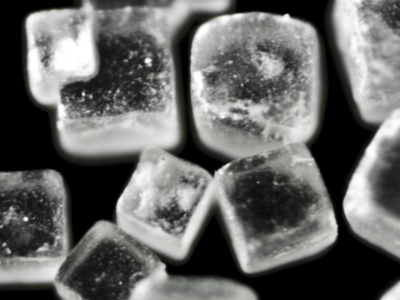
Salt crystals, via Tony Wong on Flickr.

Ice has a hexagonal crystal structure, which is why snowflakes have hexagonal symmetry. A snowflake tends to grow along six vectors (or directions) separated by 60 degrees each. Some particle of dirt nucleates, or initiates, the beginning of a snowflake. The exact mechanism is not known. But once growth has been initiated, the snowflake grows. (If you have ever made rock candy, you create a supersaturated mixture of sugar in water. Then you add a sugar crystal, onto which more sugar crystal grows.)

Snowflakes are unique

Snowflakes are so varied because each snowflake experiences a slightly different environment. Tiny differences in temperature, pressure, and moisture change how each snowflake grows. In the snowflake above, you can even see flaws in tiny parts of the hexagonal symmetry. Even across a snowflake, tiny differences change how the crystal grows. Snowflakes as big as a dime have been documented, but theoretically, there is no size limit.

Learn more!

One of the first photographers of snowflakes was Wilson Bentley. He photographed over 5,000 flakes from his home in Vermont in the 1800 and 1900s. The children’s book Snowflake Bentley describes his life and work.

Ken Libbrecht, a professor of physics at Caltech, also maintains an awesome website about his research on snowflakes. In his lab, he studies how to grow snowflakes, to better understand the conditions under which they form. He has grown crystals up to an inch wide. His Field Guide to Snowflakes is a beautiful and informative resource on snowflakes, accessible to all audiences.

Writing Prompt: Cleaning the Lab

Time: 7 minutes. Click here to go to my list of prompts.

“Cleaning the lab”

Ash scowled at the mess sitting in front of her. What a mess decades of research could produce. Now, as the last student, it was her job to clean all of it, whether she knew what it was or not. What a graduation present!

She started with the stack of archaic computers. No one even knew the passwords to operate them anymore, not that anyone should care to. Top of the line, decades ago. If you need to make a killer cassette recording, this is your machine! She loaded them onto a cart, bringing them batch by batch to the electronic reclamation center. Their problem now. Three cartloads later, and at least that batch of junk was gone. The dust under the pile was incredible. While it wasn’t her job to clean the dirt of the lab, something was too disgusting about this dust not to try to improve. She didn’t have any cleaning implements. She wetted a rag and wiped the worst of it away. Three lines of the dirt remained, sinking into the painted cinderblock walls. They almost looked like a door…

She looked closer, and the cracks were the dirt had stuck seemed to penetrate into the concrete. She thought of the floor plan for the building—was there anything on the other side of this wall? There was an office next door, but it seemed like there was a dead space in between. She would have assumed it was for ventilation, if she’d ever thought of it before, but now she was looking at a tiny, bizarre door, about 2 feet high and 2 feet across. She got a crow bar from across the room and wedged it into the crack. She pulled, and the door yielded. Inside were thousands of tiny sprites, chained to tiny desks, in a room no more than 4 feet by 4 feet.

“What on earth is this?” She exclaimed, more to herself than them.

“We make the science,” one of them said, forlornly, before returning its hands to its intricate task at hand.

Publications and Ph.D.s

Some brief (and exciting) updates!

Check out my first story, “The Alchemist’s Contract”  here at Swords and Sorcery. I’m still adjusting to the notion that something I wrote has been published =).

Then check out this nice review at Black Gate (toward the bottom). It looks like an excellent resource on the recent happenings of medieval and high fantasy. (I’m usually more familiar with the science fiction end of the spectrum, so I’m new to this end– very cool!) Check out their main Black Gate page here.

And on a more personal note, I successfully defended my PhD dissertation on Friday. Hooray, I’m Dr. Vironevaeh! Happy Wednesday, all!

Book Review: Marooned in Realtime (Vernor Vinge 1986)

There are no spoilers in this review beyond what you’d find in the first few chapters or the cover blurb.

Rating: 4/5

Marooned in Realtime by Vernor Vinge is the far future sequel to The Peace War, set on Earth 50 million years in the future. The Peace War introduced the concept of “bobbling”, a scientific discovery where a spherical bobble, impervious to the laws of physics, can be created. Anything inside the bobble doesn’t experience what happens outside of it; a year can pass outside the bobble, but no time passes inside it. The time length for which a bobble exists can be tuned. This was used to great effect in The Peace War as a mechanism for sequestering weapons. In Marooned in Realtime, the people who were bobbled through various circumstances come together and try to reestablish humanity after it was somehow lost.

If you like other Vinge stuff, you’ll probably like this, and it’s a lot shorter than some of his things. I recommend reading The Peace War first, although I think I like this book slightly better. There are some references back to the characters in the first book and a novella written between the two, which got a little annoying eventually. Also, I am not sure if the ubiquitous bobbles and their governing rules would be totally obvious reading this as a stand alone. It has been several years since I read The Peace War, and though I remembered the basics, I found myself wishing I could remember more clearly.

Overall it was  a solid Vinge book, with good hard scifi and far-flung and fun extrapolations. Vinge is a computer scientist, and he makes the most of this background. Don’t expect to read Vinge for the emotions. His forte is playful futurism and making everything go wrong at once. I read Marooned in Realtime easily in three days, and I’m not the fastest reader. It was easy to get into, and the first book I’ve read off my holiday reading list.

Writing Prompt: Monkey Day

Time: 5 minutes. Click here to go to my list of prompts.

“Monkey Day” (This is actually a real thing, every December 14)

Today was Monkey Day, the biggest day of the year for the elevated chimps and tarsiers. Although it originated centuries ago amongst humans as a joke, it was no such thing now. The elevated walkways for the monkeys above the streets were be-decked in glittering tinsel, far more interesting than the lights that glittered below for Christmas. Monkeys swung across the path, throwing toys and playing with tinsel. Not that such things held their mighty intellects anymore, but Monkey Day was a celebration of how far they had come since those days. It was a day where elevated primates had a little joke at themselves, where they had come from. In a way, it was like April Fool’s Day, except the monkeys actually recognized the inherent silliness of all sentient beings, rather than pretending such things were isolated to a few members of the species.

Bananas decked the table of every monkey, and the day started with the shrill, high-pitched laughter one used to hear only in zoos. Beware, humans, it was the Monkeys’ Day!


Which is the fictional critter?

Because nature is weird, and I like science fiction, which is the real creature, and which is the fictional critter?

Critter #1 is 1 mm long critter that:

  • Can survive in space and at the bottom of the Mariana Trench
  • Contains a set number of cells in its body
  • Can be rehydrated after over a century
  • Can survive thousands of times more radiation than a cockroach

Critter #2 is a bird that:

  • The males deliberately sets fires as a mating ritual
  • The males perform this ritual in pairs, in case one catches fire
  • After the fire spreads, the fires leave masses of cooked meat. The birds scrape off their meals with their distinctive, blade-like beaks

So… which critter is real, and which is not? For bonus points, in what book did the fictional critter appear?

Read the Answer

My Reading List for the Holidays

Between preparing my dissertation and doing NaNoWriMo, I haven’t read much lately. My eventual goal is to write excellent science fiction. I feel that reading in the field is essential to writing better in the field. So I try to make sure that I keep up on science fiction reading. Below is the reading list, in no particular order. We’ll see how I do!

Marooned in Realtime by Vernor Vinge– Vinge is one of my favorite authors, and this book is the sequel to The Peace War, which I enjoyed.

Camouflage by Joe Haldeman– Haldeman is another favorite of mine. This novel won the nebula award.

Gateway by Frederick Pohl– I read this over a decade ago. I enjoyed it, but I remember nothing of it, so a re-read is in order. The novel often appears on “best-of” scifi lists.

Starship by Brian W. Aldiss– I enjoy Aldiss, and novelist Ed Lerner recommended it to me at a science fiction seminar. So I definitely should read it.

Cyteen by C. J. Cherryh– Set in the same universe as Downbelow Station, which I loved (see my review here). It’s the size of a bible, but I have high hopes.

The Good Soldier Švejk by Jaroslav Hašek– A classic humorous novel of Czech literature, set during World War I. I keep hearing good things about it and it’s been on the shelf for 5 years. I’ve even been to one of the bars described in the book. Time to read it.

The Innocents Abroad by Mark Twain–  Twain writing about travel. Yes.

Lilith’s Brood by Octavia Butler– I haven’t read anything by Butler yet. People rave about her, so I would be remiss not to try her out.

Writing prompt: the tissue printer

Time: 8 minutes. Click here to go to my list of prompts.

“The printer”

I loaded the file into the printer and made sure all the print cartridges were full—nitrogen, oxygen, hydrogen, carbon… Carbon and hydrogen always went fast, but the cartridge was no bigger than nitrogen or oxygen. The traces array was full enough too. I didn’t want this print-out to pause mid printing, it wasn’t good for the creatures. I made sure the enzyme and synthesis units were at operating temperature and weren’t gumming up. Once I had printed an entire miniature penguin only to find it dead, with damage to the proteins. That’s an expensive mistake.

This time I was printing a fairy. I had slaved for hours on the design, making sure that the wings were sufficiently large to support a creature of the size while still looking appropriate. I borrowed the digestion from a hummingbird, and the wings from extinct, enormous species of dragonflies. She would be six inches tall, beautiful and the color of caramel. I had hoped to start with the colors of the rainbow, but I was worried that yellow might end up looking jaundiced, and I wanted this first one to work. I could sell her to a fantasy novelist for a pretty penny, but it would go better if she was alive and beautiful.

I did a last check on the equipment and hit the go switch. The enzyme cartridge came to life, and soon the print head started on the internal organs, the template spinning around, allowing different angles. With these things, the sequence was also important.

I sat nervously on my stool, while the print head flew around, filling in muscle here and connective fiber there. Several hours passed, and I could see a tiny heart. I couldn’t be more nervous if my (hypothetical) wife were giving birth.

Fun Science: Vacuum and Pressure

Pressure is caused by collisions between particles. Scientists use the term “vacuum” when there are few particles, and thus few collisions. Air in our atmosphere is dense with particles; atmospheric pressure is very high compared to lab vacuum or the vacuum of space. Scientists use vacuum in many ways. Vacuums were used in lightbulbs and vacuum tubes (such as the old CRT or cathode ray tubes of old TVs and computers). Vacuums are used for depositing materials in clean environments, such as on silicon wafers for microcircuitry. Vacuums are used for separating liquids that have different evaporation points. In scientific labs, we can produce pressures billions of times lower than atmospheric pressure, but the pressure in space is still lower.

Atmospheric pressure: Every cubic centimeter (also called a milliliter) of air contains 2.5 x 10¹⁹  air molecules. That’s 25,000,000 trillion molecules, where the US debt is roughly $12 trillion, and a terabyte (TB) hard-drive holds a trillion bytes of information. That is a lot of particles causing a lot of collisions. The average particle travels only 66 nanometers before colliding with another particle. That’s only about 200 times the size of a nitrogen molecule.

On top of Mount Everest: Pressure is roughly 1/3 of the pressure at sea level, and there are 8 x 10¹⁸ molecules of air per cubic centimeter. The average particle travels 280 nm before colliding with another particle.

Incandescent light bulb: The pressure inside a lightbulb is 1 to 10 Pascals (pressure at sea level is 100,000 Pascals). There are still about 1014 molecules/cm3, or 100 trillion molecules. The average particle travels a mm to a cm before a collision. This pressure is too low for plants or animals to survive.

Ultra high lab vacuum: The most sophisticated lab vacuum equipment can produce pressures of 10-7 to 10-9 Pascals, yielding about 10,000,000 to 100,000 molecules/cm3, respectively. Particles travel an average distance of 100 to 10,000 km before colliding with another particle. Such extreme vacuums require highly specialized equipment, including specialized pumps and chambers. Only certain materials can be used; paint, many plastics and certain metals can release gases at very low pressures, making them unsuitable.

Space vacuum: The vacuum of space depends on what part of space you mean. The pressure on the moon is 10-9 Pa, or roughly our highest lab vacuum, with 400,000 particles/cm3. The pressure in interplanetary space (within the solar system) is lower yet, with only about 11 particles/cm3. It is estimated that there is only about 1 particle per meter cubed in the space between galaxies. Still, some microorganisms have survived exposures of days to space vacuum by forming a protective glass around themselves.

Going the other way, there are pressures much higher than the pressure of our atmosphere.

At the bottom of the Mariana trench: Pressure is about 1.1 x 10⁸ Pa, or about 1100 atmospheres. A variety of life has been observed in the Mariana trench.

At the center of the sun: Pressure is about 2.5 x 10¹⁶ Pa, or 2.5 x 10¹¹ atmospheres, or about 100,000 times the pressure at the core of the earth. This pressure is sufficient to fuel the fusion process of the sun, where hydrogen is combined to form helium.

At the center of a neutron star: Pressure is about 1034 Pa, or 1018 times the pressure at the center of the sun. Here, pressure is so high that normal atoms with electrons around a core of protons and neutrons cannot exists. Nuclei cannot exist in the core of a neutron star.

Read about other science topics on my fun science page.

Writing prompt: “Magic Tea”

Time: 7 minutes. Click here to go to my list of prompts.

“Magic Tea”

“Here, drink this, dear,” the old hag said. The darkened growth on her nose shook. “You don’t want to come down with anything.” Leo thought it sounded a little like a threat, but he was cold to the bone after getting lost in the woods. It had been so lucky to find her home, so tucked away from it all.

“Thank you, ma’am. I’m not sure what would have become of me if not for you.” The beverage steamed enticingly. His put his face close to the cup and felt the radiating warmth.

She just smiled, revealing a row of gray and uneven teeth. The ones that she had, that was.

“It smells delicious, what’s in it?”

“Just some tea and some spices. It’s an old family recipe. It’ll heat you right up.”

He blew on it to cool it off. She leaned in, strangely interested. He tilted the cup back and took a deep drink. It felt wonderful, the heat spreading down his body. “This is delicious,” he said.

“Yes,” she said.

He continued drinking the tea. In no time, he didn’t feel any chill anymore. He felt wonderful, and tingly all over. Then black hairs sprung from his arms. “What—what’s happening?”

“Don’t fight it,” she said with a kind but uncomforting smile. He was growing fur!