Author Archives: Vironevaeh

Fun Science: Gravitational waves

Gravitational waves were first predicted in 1916 by Einstein’s general theory of relativity; today we are trying to directly observe them. A gravitational wave is a tiny oscillation in the fabric of space-time that travels at the speed of light; all other findings from general relativity predict its existence. Many objects will create minuscule gravitational waves, and even the largest objects create ones we just barely hope to see (such as binary stars and black holes). From the LIGO wikipedia page “gravitational waves that originate tens of millions of light years from Earth are expected to distort the 4 kilometer mirror spacing by about 10−18 m, less than one-thousandth the charge diameter of a proton.”

What would we gain from this? Astronomers believe that gravitational waves could eventually become another mode of imaging by which to analyze the universe, like gamma ray, x-ray, and infrared imaging.
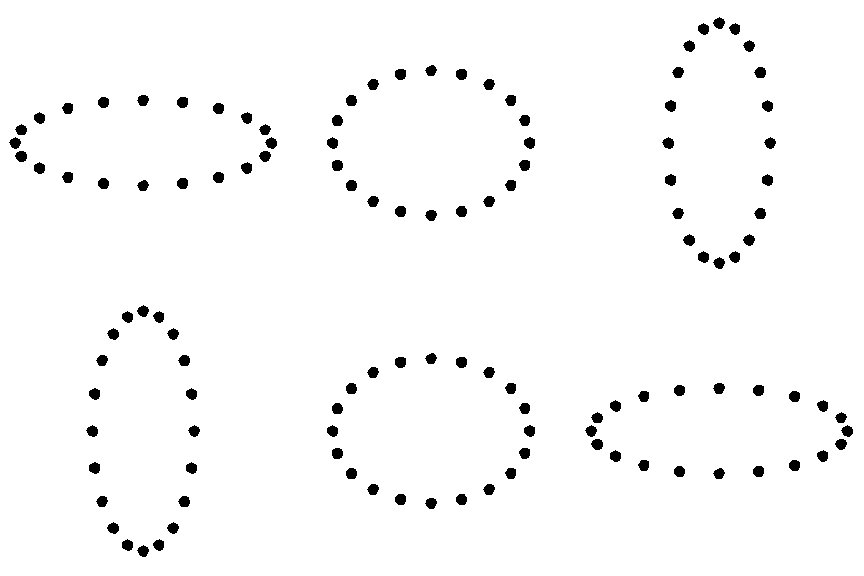
Example of gravitational wave distortions (from wikipedia)

The LIGO (Laser interferometer gravitational-wave observatory) ran from 2002 to 2010; it was unsuccessful in its hunt for gravitational waves. It is being recalibrated to restart in 2014. The two observatories in Louisiana and Richland, Washington record the same events and compare the time at which they arrive. Below is a schematic of this set-up. LISA, the laser interferometer space array, has been discussed for years as an orbiting detector with greater length scales (and therefore greater accuracy) than LIGO; a proof-of-concept is due for launch in 2014.

Laser interferometer set-up (wikipedia)

If you want to learn more, Einstein Online, which is run by the Max Planck Institute, is a great resource (the Max Planck Institute is involved in great cutting edge research, perhaps comparable to NASA). The above link is for info on gravitational waves, but there is also great info on other concepts related to relativity if you are interested.
Writing prompts: “The child yelled at the monkey” Aug/29

Sometimes I want to write, but I don’t have a great idea or I’m not in the mood to write something grand and perfect. I just want to write something. When I was working on my novel draft, I was writing 1500 words a day, and afterwards, I felt like a better writer than before. I learned to be in the habit of just sitting down and getting to it and worrying later.

I felt like I could do the same thing with writing prompts. I scoured the web, and a lot of what I found felt more like writing exercises than prompts– I wanted something to run with and retreat into a brief, if perhaps hastily formed, fictional realm.

So I decided I can make up my own writing prompts.

On different days, I can focus on different aspects of writing–beautiful language, or character development, or world-building, or economy of words, or plain weirdness. And I end up with a couple hundred words I can take and mold into something better, or that I can chuck. I do them on a timer, so far of 5-7 minutes, so I can fit them into any day, no matter how hectic.

Unlike fiction I intend to publish, I can share this with others through the blog. I’d love to see what others do with the prompts too. Just link me so I can enjoy it too.


Today’s 7 minute prompt is “The Child yelled at the monkey”. I’ve posted mine below, for your pleasure. I will post these at noon on Thursdays. (Edited only to remove several horrific typos!)

The child yelled at the monkey, and waved his doughy arms about. I looked around for this tiny miscreant’s guardian. About twenty feet away stood a man, thoroughly absorbed by his hand held electronic device. I watched smugly from my bench, safely out of the radius of any potential mayhem, eating a frozen lemon sorbet. The child’s taunts increased, and so too did the monkey’s rage. This culminated finally in the flinging of certain odoriferous weapons. The many-creased child shrieked and fled. The wayward father scolded him. I smiled slightly. Then the monkey looked me sternly in the eye. I didn’t think it could throw this far, but perhaps I ought to go elsewhere.

I wandered on, and again observed the husky child, his bright yellow shirt now tarnished with certain unpleasant organics. This time he leaned over the tiger pit. He waved, like he had at the monkey. The tigers roared and the air seemed to quaver. Maybe the child had a talent for enraging beasts. Again, the father didn’t seem to notice. He was certainly inattentive, but perhaps the rage of animals around his child simply wasn’t abnormal. Curious, I decided to stalk them a little. Every animal seemed incensed by the existence of this child; the polar bears, the penguins, the giraffes, even the turtles. I had read papers proposing ESP, a sort of ability to read emotions and probabilities. Maybe this kid had a sort of Extrasensory Irritation Factor. I had to admit, upon examination, that watching the kid made my blood boil slightly, and watching the animals hate him was exciting. Perhaps his father could only bear his presence by so dedicatedly ignoring him.

Book Review: The Witling (Vernor Vinge 1976)

There are no spoilers in this review beyond what you’d find in the first few chapters or the cover blurb.

Rating: 3/5

As far as I can tell, “The Witling” is Vernor Vinge’s second novel, and to some extent, it shows. I enjoyed reading it, but it doesn’t have the depths of Vinge’s later works like “A Fire Upon the Deep” or less-known but also good “The Peace War”. The book is only about 175 pages long; I’m not the fastest reader and I finished in two pretty short sessions, also unlike Vinge’s other novels.

The story opens with two humans who have become marooned on an alien world with human-like inhabitants. Only after being captured do the humans realize that the natives have what we would call supernatural abilities: transporting themselves or objects by will of the mind. The magnitude of this ability varies from person to person; those with the least ability are called witlings. The two humans, with no ability, fall into this category. The prince of the realm also happens to be a witling, which is a great source of shame for him. He is intrigued by the humans, especially the woman. The humans must get off the surface, as all the alien foods naturally contain heavy metals, and continued exposure will be fatal.

Although he provides no supporting science for the abilities of the aliens, Vinge does what I like best in sci-fi–he takes a simple premise and runs far with it. With these abilities, how would you imprison someone? How would you travel the world? Would you even need doors? How would you conduct warfare? These issues come up again and again through the book, and each time they are a delight.

Another interesting point touched upon is body image. The book starts with the human male describing the woman, Yoninne, as ugly and unpleasant, too stocky and temperamental. The aliens, who it’s hinted have a slightly stronger gravity, are stockier, and to them, Yoninne is close enough in build, but different enough to be exotic and tantalizing. I haven’t read much sci-fi of this era that deals with such issues of perception; unfortunately, this thread is not continued throughout the book.

The primary reason I rate “The Witling” as a 3/5 and not higher is because I found the ending unsatisfying. I won’t go into specifics in this review. The action was quite good and fun, but it conceptually bothered me.

With that caveat, I would recommend this book, especially to those who have read a lot of other works by Vernor Vinge. It’s interesting to see the form of his early, less perfect work, plus it’s a super quick read.

Fun Science: Enzymes

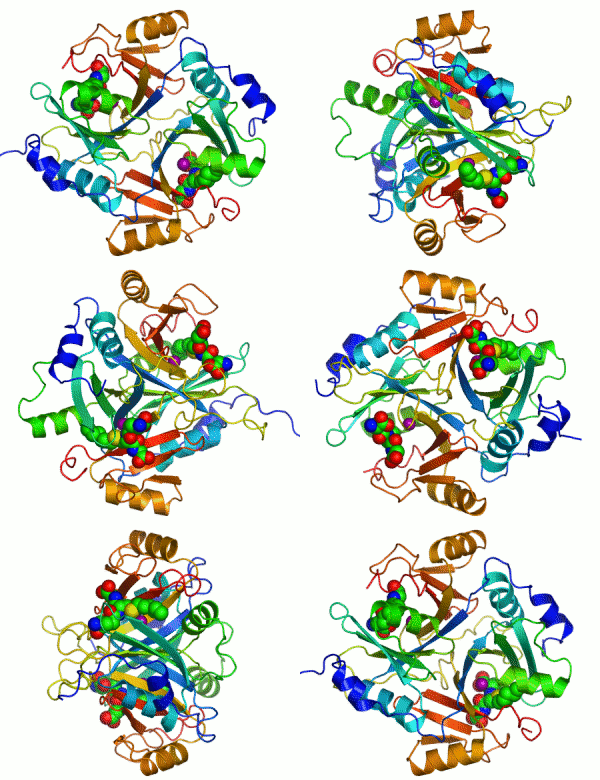
An enzyme. Spirals and sheets and strands indicate different kinds of structures. (from Wikipedia)

Enzymes are the catalysts of the body, helping to facilitate chemical reactions that would be very slow or unfavorable in their absence. In a previous post, I discussed how platinum lowers the activation energy barrier for desirable chemical reactions in a car engine, among other places. Enzymes do the same thing, but they are much more selective. Platinum can act on millions of molecules. Enzymes are shaped so specifically that they act only on one molecule. Because of this, enzyme catalysis is often compared to a lock and key–only one chemical is so perfectly shaped as to fit into the active site of the enzyme.

Enzymes are mostly proteins, which are made of hundreds of amino acids with several layers of structure. Our DNA is coded so that enzymes can be assembled from the instructions. The “primary structure” is the sequence of amino acids strung together. The shape of local groups of amino acids gives the “secondary structure”; some combinations tend to coil, others tend to be flat (see the picture at the top of this post). This is due to interactions between the amino acid groups; for example, ionic groups might attract or repel each other. The “tertiary structure” is the structure of the overall molecule, also called the “folding”. We can reproduce the primary and secondary structures in the lab; the folding is harder, because for most sequences of amino acids, there are several possible structures. In the body, the protein is assembled in such a way that it conforms properly. We are mostly still unable to synthesize proteins and enzymes. We usually use bacteria and fungi to make them, when possible.

Enzymes are essential to life. They aid in digestion. Many diseases are caused by the lack of a single enzyme. People with lactose intolerance lack lactase; the deadly Tay-Sachs disease is caused by the lack of hexosaminidase A. In Tay-Sachs, a waste product of cellular metabolism builds up in the brain. Without the enzyme to accelerate its break-down, the waste product builds up to intolerable levels. We can obtain hexosaminidase A, but we can’t therapeutically deliver it to where it is needed in the brain.

You probably already knew that the human body is a remarkable machine. But I hope this brief overview of enzymes gives an appreciation for this one small aspect. Happy digesting.

The Submission Grinder for writers

Last year I wrote about Duotrope, a website with market information for writers. You can get info on market statistics, and track your own submissions. It went behind a pay wall at the beginning of the year. I was recently mulling whether I should pay their $50 annual subscription fee, or whether I could find something else. One of the things I liked best about Duotrope was their extensive, user-sourced info on rate of response, rate of personal response, time for response, and so forth. Could they possibly offer as much as they had pre-paywall, since they must now have fewer users? Is there an alternative?

I think Submission Grinder is that worthwhile, free alternative. They have great submission statistics, with histograms of when submissions are accepted and rejected as a function of days since submission. Like Duotrope, you can sort by pay, response time, genre, and all that good stuff. It doesn’t have Duotrope’s submission theme calendar (that was a great feature, as I find those themes impossible to keep track of). It also lacks the editorial interviews that Duotrope has, but reading the submission guidelines and reading a market’s website often give similar insights. I put my info into it yesterday, and it was very straightforward.

Before I found Submission Grinder, I found some nice market listings too. It’s as easy as a google search; for example, the search “science fiction markets” turns up great websites in the first handful of results. Here are some great resources for science fiction and fantasy short story writers:

  • Ralan.com– lists markets on different pages by pay. Each market has a helpful blurb with their word requirements, genres, pay, and average response times. They keep up to date on when markets are open or closed or have become defunct.
  • SFWA qualifying market list– the cream of the crop, those markets that pay at the SFWA (science fiction and fantasy writers of America) professional rate. Each listing includes a link to the market’s submission guidelines as well. These are very exclusive markets, and some accept only a handful a year.
  • Flash Fiction Chronicles– a listing of markets under 1500 words, broken into several categories, by length (such as less than 300 words). Some are pay, most are not, and there’s something for every genre. It’s a lot like Ralan’s for flash fiction.

Sites and sources I don’t recommend:

  • Critters black hole– this site is intended to track market acceptance rates and time to response, similar to Duotrope. However, the info is unacceptably out of date. You are as likely to find a dead market from the 90s as an active one. Critters.org is an excellent critique site, but skip this feature.
  • Writer’s Digest Science Fiction Markets- I wondered if I should buy this, recently. When I did the research, it sounds like it has some errors. It’s only $6, but you can do better with the sites I list.
  • Quintamid– A great looking site, but alas, out of date too. I thought this would be a good resource, but I got a helpful tip in the comments about it.

Happy writing! And go join Submission Grinder–the more information it has, the better for all!

Ludicrous Limericks

Limericks are the most light-hearted and least-respected of poetry. Some of them are vulgar or scoffing of grammar, but that makes them more flexible. Perhaps because nothing is beneath a limerick, it can do anything, and that is the beauty of it.

In the last few weeks, I’ve been reading children’s poetry in a class. I found limericks in several anthologies, and I think they are perfect for kids because they’re brief, playful, and often subtly point out the oddities of english. You certainly couldn’t hope for a better example of rhyme and meter to catch a young ear.

Silly as it is, I never noticed that poems have a structured meter. Perhaps that’s because of all the free verse out there now. Limericks have what’s called an “anapest” meter; the stress falls as ta-ta-tum or light-light-strong. The rhyming scheme is harder to miss: AABBA. So below are a couple of favorites, the first by Carolyn Wells and the second by Dixon Lanier Merritt:

A tutor who tooted the flute
Tried to teach two young tooters to toot.
    Said the two to the tutor,
    “Is it harder to toot, or
To tutor two tooters to toot?”

A wonderful bird is the pelican,
His bill will hold more than his belican,
    He can take in his beak
    Enough food for a week
But I’m damned if I see how the helican!

You can see in both the examples above, the stress falls on each third syllable: “a tu-tor who toot-ed the flute”, or “a won-der-ful bird is the pel-i-can”. The first and last stressed syllables don’t have to be the first or last syllables in the line, but all stressed syllables are separated by two un-stressed ones. If you require 100 more examples, Edward Lear’s “Book of Nonsense” should help. They aren’t as humorous as the ones I posted, but there are plenty of them (and free!) on the Gutenberg Project link above.

I got into the spirit and tried one myself. It and a couple of others will go into a project I’m currently working on. Enjoy!

There once were some people on Earth,
Who grumbled that there was no mirth,
    Though some found it daft,
    They built a space craft,
And hunted for somewhere with worth.

Fun Science: The Element Lithium

Lithium is the third element on the periodic table, after hydrogen and helium. It is the lightest metal, and you probably use it every day. The batteries in your phones and laptops and most rechargeable batteries you use are lithium ion batteries.

Lithium is used in batteries because it has the highest electrochemical potential of any element. It is so high that it will split water into hydrogen and oxygen (and violently!). This means there is a lot of energy available to exploit. This is also why laptop batteries can sometimes explode; the batteries are sealed very tightly, but if the seal is broken, air and water vapor will come in contact with the lithium and this is unsafe. 10-15 years ago, there weren’t as many lithium batteries in use, but now they are everywhere. Science has made great strides in improving the configurations of the batteries to give more energy, such as increasing the surface area of the lithium portion. Each time you cycle your battery, the lithium undergoes an electrochemical reaction on the draining and again on the charging of the battery. This is also why batteries become shorter lived over time; the high surface areas of new batteries aren’t thermodynamically favorable, and the lithium will become lower surface area with time. Less available surface area means less available energy.

Lithium ion (Li+) has another, very different use. It is used as a mood stabilizer. It is particularly useful at combatting mania. The linked wikipedia page contains its fascinating medical history. It was first used in the 1870’s as a mood stabilizer. Eventually LiCl was marketed as an alternative to table salt (NaCl), to avoid high blood pressure, and its mood properties were forgotten. Early versions of 7 Up contained lithium. Excessive lithium use was found to be deadly, and it was banned as an additive in the 1940s. Then in Australia, it was again discovered to have mood-stabilizing properties. Its therapeutic dose is quite close to its toxic dose, which is maybe why it took a while to gain approval in the US. Studies suggest that water supplies containing lithium may promote longevity and reduce the occurrence of suicide.

Lithium salts also have another really nifty use: cleansing the air in spaceships and submarines.  Not only does human breathing consume oxygen; it also produces carbon dioxide, which is toxic when present in high amounts. Several lithium salts can remove carbon dioxide from the air. One even adds oxygen to the air when it removes carbon dioxide.

Elemental lithium is highly reactive, and is a member of the alkali metal group (all of whom react very impressively with water). Below is a video of lithium reacting with water. It bursts into bright red flame:

Another video shows more lithium action:

The people who made the second video have a great youtube channel with videos about all the elements done in a university laboratory environment. Most of them have good footage of reactions as well. I just spent an hour watching their videos, they are very entertaining for people with little knowledge, or a lot. If you have a little time to kill, the videos of sodium and potassium are also good, flammable fun.

Writing children’s books

This summer I am taking a class about writing children’s books. I became interested in writing children’s books because I really love writing with illustrations. Before this summer, I hadn’t had the opportunity to just sit down and discuss for hours at a time what the children’s market demands. I probably had wrongly assumed it was pretty easy to write a children’s book, because they are pretty simple books and I think a lot of the books on the market are simplistic and unattractive.

Indeed, it is easy to write a book for children, but it’s a lot harder to sell one. Children’s books have structure I wasn’t aware of (most of them are exactly 32 pages, example), and there is a ton of competition. In 200 words, it’s harder to stand out than in 10,000. An interesting guide-book we have looked at in class is “Writing Picture Books” by Ann Whitford Paul. Her book goes over all the steps necessary to prepare a manuscript for a children’s picture book. We have done some exercises in our class like writing a young child’s concept book or rewriting a fairy tale, both of which have been fun exercises. I still have a little trouble writing as simply as is required for such ages, but we always have something to improve.

I think writing for children can also be of interest to people only interested in writing for adults. Children’s demands aren’t that different from those of adults– snappy language, quick action, relatable characters. In kids books, the author must try to have scenes with visualizable illustrations, and adults like to have mental images of what they read as well. Kids books are often under 1000 words, so they are a very doable exercise length. If you’re interested, I recommend giving it a try. At worse, you’ll just have some fun and feel a bit childish!  =)

thecast 30

Photography in the American West

This week I visited Moab, Utah. I stand-up (and fall-down) paddled on the Colorado River during a thunderstorm, I hiked in Arches and Canyonlands National Parks, and I stargazed. Most of all, I ravenously took pictures.

SONY DSC

Delicate Arch from across a gorge in Arches National Park

SONY DSC

Landscape Arch in Arches National Park

Mesa Arch in Canyonlands National ParkMesa Arch in Canyonlands National Park

Green River overlook in Canyonlands National Park

Green River overlook in Canyonlands National Park

Milky Way over the red rocks in the Colorado River valley

Milky Way over the red rocks in the Colorado River valley

The Colorado River valley

The Colorado River valley

Park Avenue in Arches National Park

The Gossips in Arches National Park

The Gossips in Arches National Park
Arches National Park

Arches National Park