Category Archives: artists and books

Book Review: Cyteen (C. J. Cherryh 1988)

There are no spoilers in this review beyond what you’d find in the first few chapters or the cover blurb.

Rating: 4/5

Cyteen was the winner of the 1989 Hugo Award. It is about neither cyborgs nor teenagers nor cyborg teenagers, despite the name; Cyteen in the name of a planet. Cyteen takes place in the same universe as Downbelow Station (which I reviewed here) in a different culture and time. Like Downbelow Station, this is a book that requires patience up front, but offers great rewards. Cyteen is 750 pages of intricate scheming and counter-scheming, supported by interesting and conflicted characters.

Cyteen is the capital planet of the Union, one of a few major political entities in a future where humans have drifted amongst numerous stars with faster-than-light travel. The economy of Union is largely supported by the production of a cloned working force called “azis”, who are psychologically trained to serve in various capacities. All azis are produced in a research lab/city called Roseune. The book opens with power struggles between the forces of Roseune, the military, and another faction. A murder follows this initial conflict, which weakens the status of Roseune and fundamentally alters the lives of the characters. The continuing power struggles are described through the individuals trying to survive them at Roseune.

My biggest complaint: the book takes too long to develop. The first 20 pages are textbook-style background. Even after that, my progress was slow. It took a while to figure out a lot of the politics, and I didn’t understand what azi were for at least a hundred pages. Additionally, it read slowly, constantly packed with intricacy and detail on each large page of text. I very much enjoyed this book, but it is not light reading. Read this one when you have a solid block of time to set aside.

I would recommend Downbelow Station over Cyteen, although I prefer the characters in Cyteen. Despite a shared universe, the styles of the two books differ substantially. Downbelow Station is a smart space opera, threaded with politics. Cyteen is a personal drama, saturated with politics. If you enjoy hard science fiction and you are patient, you will probably enjoy both of them.

Book Review: Lilith’s Brood (Octavia Butler 2000)

There are no spoilers in this review beyond what you’d find in the first few chapters or the cover blurb.

 Rating: 4.5/5

Lilith’s Brood is a collection of three novels by Octavia Butler published from 1987 to 1989, gathered together in 2000. The set of three books, also called the Xenogenesis trilogy, is about 750 pages long. They were published as three novels, but I would highly recommend reading them back to back as I did. The world that Butler builds over the three novels is complex. I would have had trouble trying to read the second or third novels after a long gap.

Lilith’s Brood was my first book by Octavia Butler. The writing is incredibly readable; I easily covered 50 pages an hour.  Some science fiction novels dump world-building at the beginning;  it can be something the reader has to fight through. Butler does not do this; she develops the main character first and then the environment from the eyes of the main character. The world she eventually develops is intricate and explained in detail, but by the time she got to it, I was engaged.

The trilogy opens with Lilith, a woman who survived World War III on a now ravaged Earth. She is held alone by aliens called the Oankali. Without going into spoiling detail, the Oankali are extremely alien. All three books develop the Oankali, and they are as much of the world Butler builds as anything. The Oakali want something from Lilith, though she is unsure what. Lilith finds them physically frightening, and is uncertain about her future.

Butler approaches situations from the character’s emotional response, rather than from a technical aspect. The book explores themes of gender, sex, humanity, and community–some pretty hefty topics that sci-fi sometimes skirts, especially at the time of its writing. I rate the book as a 4.5/5 partially because of this novelty and distinctiveness. In many stories, I enjoy rooting for a protagonist or a certain course of events. In this story, I didn’t know what I wanted, which was odd, but not bad. My only real criticism of the story is that, while certain aspects of the world were highly developed, it was hard to imagine living in this world. While I enjoyed reading about this world, I think I would find it profoundly dull. Still, I highly recommend reading this, especially if you haven’t read Butler before.

Book Review: Marooned in Realtime (Vernor Vinge 1986)

There are no spoilers in this review beyond what you’d find in the first few chapters or the cover blurb.

Rating: 4/5

Marooned in Realtime by Vernor Vinge is the far future sequel to The Peace War, set on Earth 50 million years in the future. The Peace War introduced the concept of “bobbling”, a scientific discovery where a spherical bobble, impervious to the laws of physics, can be created. Anything inside the bobble doesn’t experience what happens outside of it; a year can pass outside the bobble, but no time passes inside it. The time length for which a bobble exists can be tuned. This was used to great effect in The Peace War as a mechanism for sequestering weapons. In Marooned in Realtime, the people who were bobbled through various circumstances come together and try to reestablish humanity after it was somehow lost.

If you like other Vinge stuff, you’ll probably like this, and it’s a lot shorter than some of his things. I recommend reading The Peace War first, although I think I like this book slightly better. There are some references back to the characters in the first book and a novella written between the two, which got a little annoying eventually. Also, I am not sure if the ubiquitous bobbles and their governing rules would be totally obvious reading this as a stand alone. It has been several years since I read The Peace War, and though I remembered the basics, I found myself wishing I could remember more clearly.

Overall it was  a solid Vinge book, with good hard scifi and far-flung and fun extrapolations. Vinge is a computer scientist, and he makes the most of this background. Don’t expect to read Vinge for the emotions. His forte is playful futurism and making everything go wrong at once. I read Marooned in Realtime easily in three days, and I’m not the fastest reader. It was easy to get into, and the first book I’ve read off my holiday reading list.

Which is the fictional critter?

Because nature is weird, and I like science fiction, which is the real creature, and which is the fictional critter?

Critter #1 is 1 mm long critter that:

  • Can survive in space and at the bottom of the Mariana Trench
  • Contains a set number of cells in its body
  • Can be rehydrated after over a century
  • Can survive thousands of times more radiation than a cockroach

Critter #2 is a bird that:

  • The males deliberately sets fires as a mating ritual
  • The males perform this ritual in pairs, in case one catches fire
  • After the fire spreads, the fires leave masses of cooked meat. The birds scrape off their meals with their distinctive, blade-like beaks

So… which critter is real, and which is not? For bonus points, in what book did the fictional critter appear?

Read the Answer

My Reading List for the Holidays

Between preparing my dissertation and doing NaNoWriMo, I haven’t read much lately. My eventual goal is to write excellent science fiction. I feel that reading in the field is essential to writing better in the field. So I try to make sure that I keep up on science fiction reading. Below is the reading list, in no particular order. We’ll see how I do!

Marooned in Realtime by Vernor Vinge– Vinge is one of my favorite authors, and this book is the sequel to The Peace War, which I enjoyed.

Camouflage by Joe Haldeman– Haldeman is another favorite of mine. This novel won the nebula award.

Gateway by Frederick Pohl– I read this over a decade ago. I enjoyed it, but I remember nothing of it, so a re-read is in order. The novel often appears on “best-of” scifi lists.

Starship by Brian W. Aldiss– I enjoy Aldiss, and novelist Ed Lerner recommended it to me at a science fiction seminar. So I definitely should read it.

Cyteen by C. J. Cherryh– Set in the same universe as Downbelow Station, which I loved (see my review here). It’s the size of a bible, but I have high hopes.

The Good Soldier Švejk by Jaroslav Hašek– A classic humorous novel of Czech literature, set during World War I. I keep hearing good things about it and it’s been on the shelf for 5 years. I’ve even been to one of the bars described in the book. Time to read it.

The Innocents Abroad by Mark Twain–  Twain writing about travel. Yes.

Lilith’s Brood by Octavia Butler– I haven’t read anything by Butler yet. People rave about her, so I would be remiss not to try her out.

Book Review: The Witling (Vernor Vinge 1976)

There are no spoilers in this review beyond what you’d find in the first few chapters or the cover blurb.

Rating: 3/5

As far as I can tell, “The Witling” is Vernor Vinge’s second novel, and to some extent, it shows. I enjoyed reading it, but it doesn’t have the depths of Vinge’s later works like “A Fire Upon the Deep” or less-known but also good “The Peace War”. The book is only about 175 pages long; I’m not the fastest reader and I finished in two pretty short sessions, also unlike Vinge’s other novels.

The story opens with two humans who have become marooned on an alien world with human-like inhabitants. Only after being captured do the humans realize that the natives have what we would call supernatural abilities: transporting themselves or objects by will of the mind. The magnitude of this ability varies from person to person; those with the least ability are called witlings. The two humans, with no ability, fall into this category. The prince of the realm also happens to be a witling, which is a great source of shame for him. He is intrigued by the humans, especially the woman. The humans must get off the surface, as all the alien foods naturally contain heavy metals, and continued exposure will be fatal.

Although he provides no supporting science for the abilities of the aliens, Vinge does what I like best in sci-fi–he takes a simple premise and runs far with it. With these abilities, how would you imprison someone? How would you travel the world? Would you even need doors? How would you conduct warfare? These issues come up again and again through the book, and each time they are a delight.

Another interesting point touched upon is body image. The book starts with the human male describing the woman, Yoninne, as ugly and unpleasant, too stocky and temperamental. The aliens, who it’s hinted have a slightly stronger gravity, are stockier, and to them, Yoninne is close enough in build, but different enough to be exotic and tantalizing. I haven’t read much sci-fi of this era that deals with such issues of perception; unfortunately, this thread is not continued throughout the book.

The primary reason I rate “The Witling” as a 3/5 and not higher is because I found the ending unsatisfying. I won’t go into specifics in this review. The action was quite good and fun, but it conceptually bothered me.

With that caveat, I would recommend this book, especially to those who have read a lot of other works by Vernor Vinge. It’s interesting to see the form of his early, less perfect work, plus it’s a super quick read.

Book review: Beggars in Spain (Nancy Kress 1993)

There are no spoilers in this review beyond what you’d find in the first few chapters or the cover blurb.

Rating: 4/5

“Beggars in Spain” is a science fiction novel written in 1993; it was nominated for the top two awards in the field, the Hugo and the Nebula, though it didn’t win either. (“Red Mars” by Kim Stanley Robinson won both; it is one of the most detailed hard sf books I’ve read.) “Beggars in Spain” is one of those sf books that can be summarized by a what-if– what-if some people didn’t have to sleep at all? How would society react? What kinds of advantages would they have? How would it affect the personality of such a person?

The novel opens with a wealthy man wishing to procure advantageous genetic alterations for his to-be-conceived child in 2008. Though it is still rare, he wants his child to be sleepless. The children who have the trait have proven to be much smarter and always cheerful. Another child is conceived accidentally who is not sleepless (as a small nitpick, the science in this bit seemed fishy, but I am not familiar with what was known in 1993). Leisha is the sleepless daughter, Alice is the sleeper daughter.

Leisha is of course beautiful and brilliant. Much of the novel rotates around how she relates to sleeper people. The characters in the book didn’t always work for me; Leisha is always cheerful as a sleeper, but this is hard to relate to, and hard to imagine how it would even work. Also there is an injection of almost libertarian politics that I wasn’t sure what I thought of. The politics aren’t preachy and are presented as Leisha’s world-view rather than the author’s. I liked the first half of the novel immensely. I didn’t dislike the second half, but I found it less exciting and engaging. One consistently strong point of this book was the writing: I sometimes have to labor through harder science fiction books, which must belabor the description of complicated mechanical things. This book just flew for me, while still attacking the central question of science fiction: what would happen to people if? So if you are a fan of hard sf and only hard sf, it probably isn’t for you.

“Beggars in Spain” was also one of the most female-dominated sf books I’ve read. Most of the principal characters are female. The book is feminist without caring about it or focusing on it; these characters could just as easily be male but they simply aren’t. It’s feminist not in the sense of women’s rights, but simply having women as protagonists and examining their relationships. I’ve read umpteen scifi books with barely a woman on the pages, so this was a welcome change of pace. Nancy Kress is also one of the few premier female names in science fiction, so it also seemed appropriate.

Overall, I found “Beggars in Spain” a very worthy read. It raised a lot of thoughtful questions that even a week after finishing the book, I find myself thinking about. It never came together in a “wow” moment, as a few sf books do for me, but it was pleasant and easy to read, which is not always the rule in sf. This was the first work I’ve read by Nancy Kress, and based on this book, I want to read more from her.

Book review: Dealing with Dragons (Patricia Wrede 1990)

There are no spoilers in this review beyond the first couple chapters.

Rating: 5/5

Dealing with Dragons is a humorous young adult fantasy book, the first in a four book series. I first read it when I was in middle school, and I just recently reread it. I enjoyed it greatly when I was younger and it was a fun little excursion now. I wanted to read something light that wouldn’t distract me too much from my own writing projects. This book was perfect for that.

The main character of the story is Cimorene, a smart and unconventional princess who is tired of the dullness of her life of embroidery and batting her eyelashes. To avoid a marriage to a dull prince, she leaves home to go live with dragons. In this universe, dragons keep princesses as helpers as a status symbol, and this is why princes are always saving princesses from dragons. Cimorene’s dragon sees the advantage to a sharper princess who can actually be a useful helper. Along the way, Cimorene learns about dragons, wizards, witches, and many magical things.

Many of the people Cimorene encounters are hung up on doing things the way they are expected to, often without any real additional reason. The story uses sly humorous references to familiar fairytales, such as sleeping beauty and St. George the dragon slayer, to explain why these various characters feel their obligations. Cimorene often succeeds because she thinks about the best course of action, she doesn’t just do what is expected.

For that reason, I think it would be a good book for kids, like it was for me. Kids get too hung up on how people will think of them, and not always with bad reason. Other kids can be eager to harshly deliver this message. In adulthood, what makes you different is usually valuable. Adults have to help kids resist the pressure to always conform. It’s also a good book for adults because it is a lovely and swift read. The whole book is only 212 pages long, and those are fast-moving pages. It would not be hard to finish this book in an evening.

Victor Horta: Art Nouveau Architect

I pretty much love anything art nouveau. So whenever I go to European cities, I look to see if they have any art nouveau icons. In Prague there is Mucha, in Berlin there is the Bröhan museum, and in Brussels there is Victor Horta. There is a Horta Museum, as well as a number of buildings he and others designed nearby. A bunch of walking tours (like this one with a nice video) can help you cover the various buildings or get a peek from wherever you currently are via the pictures.

Like many architects of the period, he also designed the furniture, wallpaper, and interior structures like staircases. The museum has great examples of these. Alas no pictures were allowed and there aren’t any fair use pics. But if you’re curious you can google for yourself. Here are some pictures of his lovely buildings:

SONY DSC

Hôtel Tassel in Brussels

SONY DSC

Hôtel Solvay

SONY DSC

Horta museum building

SONY DSC

Horta museum building

IMG_0287

Old England building, designed by Barnabé Guimard, closer to the Grand Place in Brussels. (not Horta, but still very cool. This hosts the instrument museum so you can go inside and enjoy that too.

Staircase from Horta museum


Miniature Books!

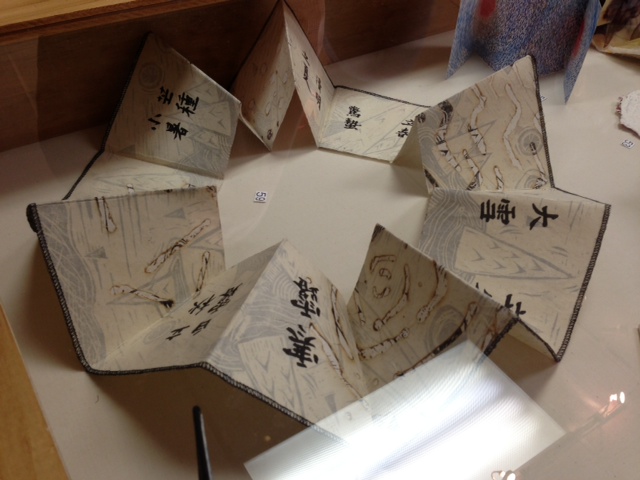
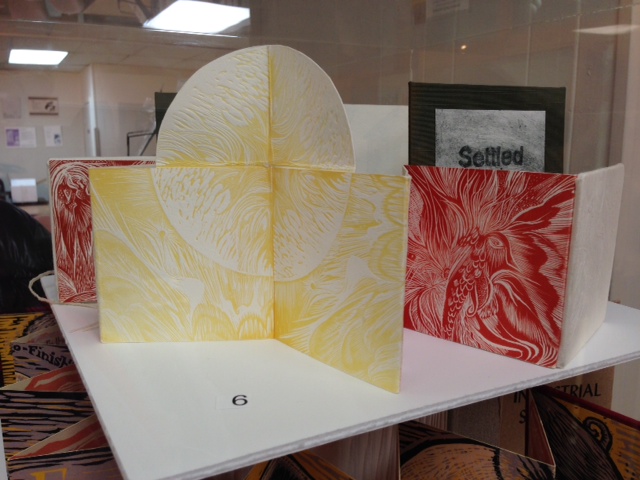
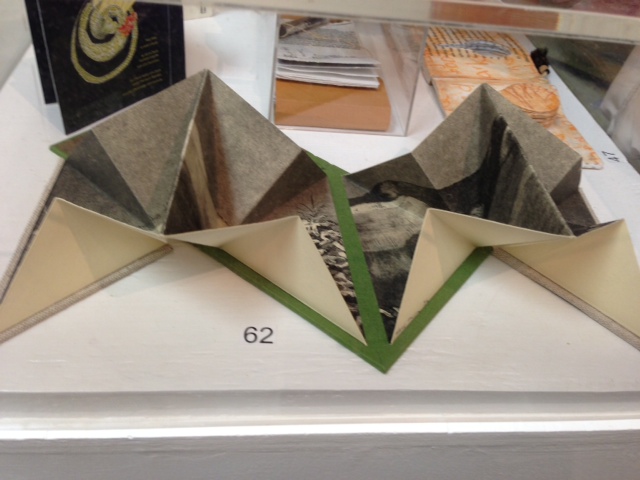
This weekend at the festival of the book, I saw an exhibition about miniature books. The exhibition is a traveling show from the University of Akron including about 80 small or odd books. At the exhibition, Molly Schwartzburg, the curator of the miniature books collection at the University of Virginia, gave a talk about the exhibition and about mini books in general. The university has a collection of several thousand miniature books, which by their definition means no bigger than 3″ in any dimension when closed. Some of the mini books are made for artistic purposes, and others for practical purposes. The Knights of Columbus used to send miniature books containing short stories to soldiers during WW1, packing the tiny books with cigarettes. The Akron exhibit didn’t adhere to the 3″ limit, but all of the books were eccentric.

Below are a few pics from the collection.

photo copy 2

This does fold flat- “Solar Terms” by Ling Luo

photo copy 3

“Altar of Transformation” by Cathie Bleck

photo

A bunch of accordion style mini books.

photo copy

“Pig, hog, bacon” by S. V. Medaris, showing the life cycle of a pig on one side and bacon on the other.

photo copy 4

“I went to the mountains, but they were not there” by Rachel Mausier- a really cool combo of book arts and something more like origami.