Tag Archives: books

My Reading List for the Holidays

Between preparing my dissertation and doing NaNoWriMo, I haven’t read much lately. My eventual goal is to write excellent science fiction. I feel that reading in the field is essential to writing better in the field. So I try to make sure that I keep up on science fiction reading. Below is the reading list, in no particular order. We’ll see how I do!

Marooned in Realtime by Vernor Vinge– Vinge is one of my favorite authors, and this book is the sequel to The Peace War, which I enjoyed.

Camouflage by Joe Haldeman– Haldeman is another favorite of mine. This novel won the nebula award.

Gateway by Frederick Pohl– I read this over a decade ago. I enjoyed it, but I remember nothing of it, so a re-read is in order. The novel often appears on “best-of” scifi lists.

Starship by Brian W. Aldiss– I enjoy Aldiss, and novelist Ed Lerner recommended it to me at a science fiction seminar. So I definitely should read it.

Cyteen by C. J. Cherryh– Set in the same universe as Downbelow Station, which I loved (see my review here). It’s the size of a bible, but I have high hopes.

The Good Soldier Švejk by Jaroslav Hašek– A classic humorous novel of Czech literature, set during World War I. I keep hearing good things about it and it’s been on the shelf for 5 years. I’ve even been to one of the bars described in the book. Time to read it.

The Innocents Abroad by Mark Twain–  Twain writing about travel. Yes.

Lilith’s Brood by Octavia Butler– I haven’t read anything by Butler yet. People rave about her, so I would be remiss not to try her out.
Science and Cooking

I love to cook. As one might gather from this blog, I like to keep my hands busy, and cooking saves money and provides deliciousness. (Many other hobbies have more of a knack for consuming money.) I also happen to be very lactose-intolerant, so cooking for myself also greatly benefits my digestive health.

When I was younger, I was absolutely apathetic to cooking, as I suspect many kids are, feeling that it’s house-wifely and unimportant. Then I got out on my own, and, astonishingly, good food was expensive and I had little currency.  I wanted to improve my cooking, but I really didn’t know the rules. But I knew the next best thing: science. Many recently published books explore the relationship between science and cooking. For those of us that can’t remember the baking soda without knowing its chemical purpose, this is a great thing.

Some recommended books:

  • What Einstein Told his Cook by Robert Wolke. The content is good, especially for those less versed in chemistry. The author wrote a newspaper column about cooking, and this book is mostly the compilation of answers to various questions such as “What is the difference between cane sugar and beet sugar?” It contains several recipes illustrating various points of the book. A major emphasis of the book is clarifying common misunderstandings of food science. As someone who knows a lot of science, I sometimes find the answers too basic, but I definitely learned things reading this book.
  • Molecular Gastronomy: Exploring the Science of Flavor by Herve This. Of the three books I discuss, this is the one I have had the least time to scrutinize. However, I really like what I have read. Wolke’s book covers more conceptual topics, like the differences between various kinds of salts. This’s book covers more specific topics, like why we marinade roasts in red wine rather than white, or how different kinds of truffles are related. This one is probably most strictly for those interested in cooking, with fewer “gee whiz” moments and more “that would be useful” moments.
  • Cooking for Geeks: Real science, great hacks, and good food by Jeff Potter. This one is definitely the most fun of the three! This book is from the publisher O’Reilly, which does a lot of technical textbooks. This book shares its layout with those kinds of book, but its soul is lighter. Its layout is more varied, as textbooks are. Plus, this book has a fun section about hardware like evaporators and sous vide water baths. Sous vide is involves cooking foods in circulating water baths. It is similar to slow-cooking, but the food is kept in a plastic bag and thus not diluted. Foods can safely and extra-deliciously be cooked at much lower temperatures by this method. Low temperatures denature specific proteins, prevent drying, and, when held for a bit, kill bacteria. This book does a great job explaining why and how sous vide works. I just got a sous vide system myself, and this book has given me some confidence about something I knew very little about. Plus it’s very fun to read, and covers tons of other topics in geek-friendly ways.

A little bookbinding

I really enjoy bookbinding from time to time, especially now that technical writing occupies the bulk of my time. It’s refreshing to complete something and see its completeness. It can be hard to feel holistic satisfaction from writing; there’s always one more thing to fix. Below are some photos of my recent projects.

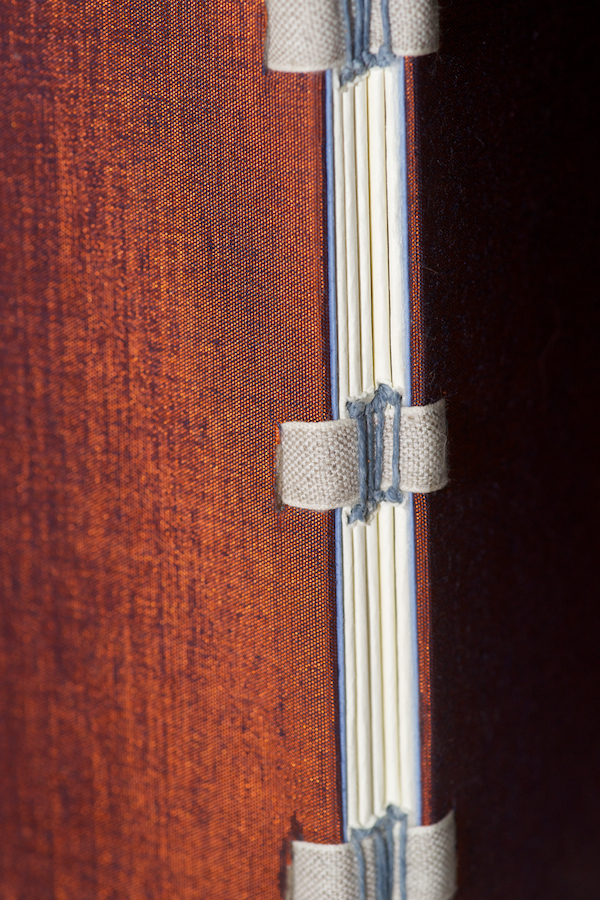
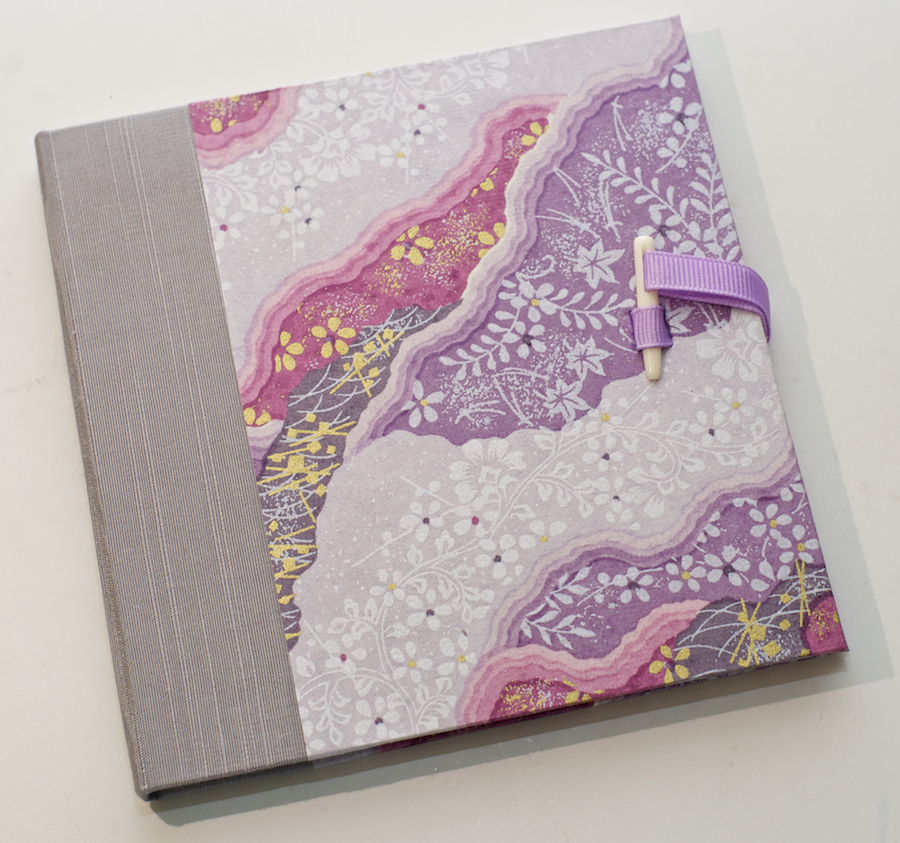
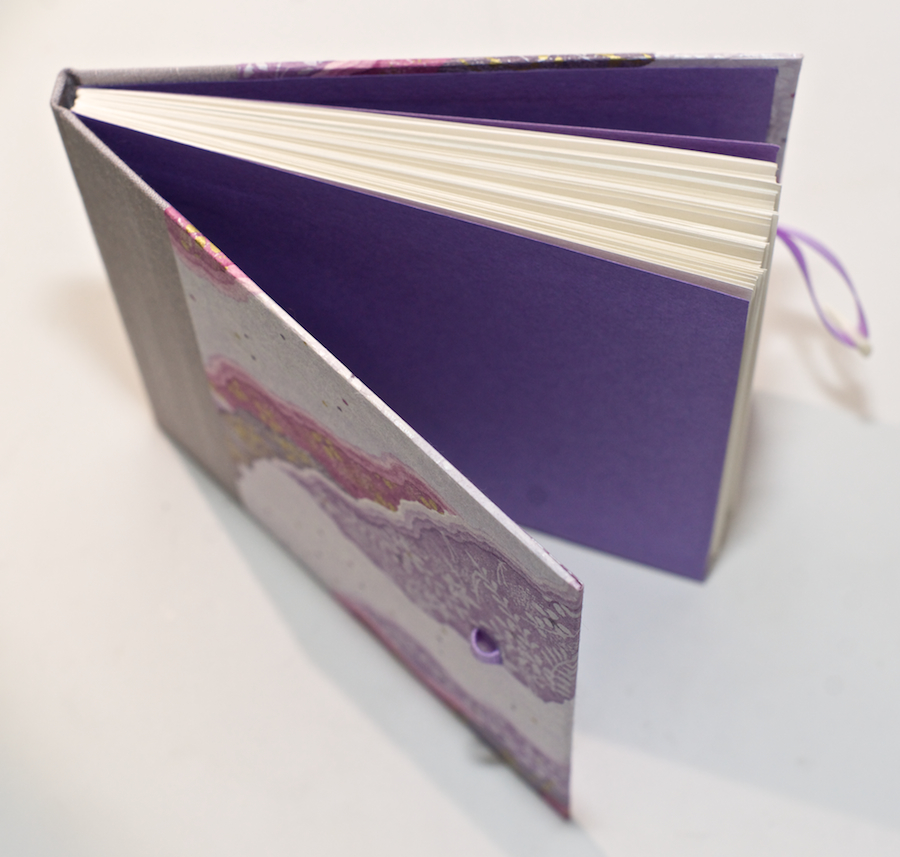
The first two are books I donated to my local writing club, WriterHouse, for a charity raffle. The purple and grey book is a perfect-bound notebook with a bone clasp; it contains linen textured paper. The dusky red book has exposed linen tape to allow for a more flexible spine. It contains a slightly warmer-colored linen textured paper. I made a similar book for myself a few months ago–having something beautiful to take notes in is a great incentive for me.

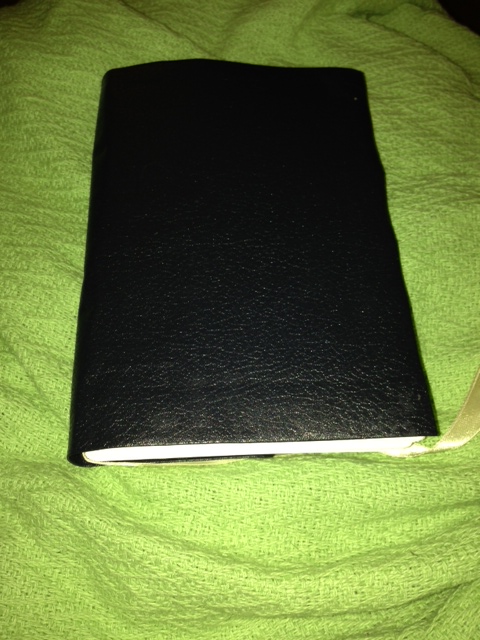
The third book is a copy of my novel draft to send to a friend who until now has been reading from a pdf. I used a red poppy patterned paper for the endpapers–I love the pattern but it’s a slick paper that can be hard to keep flat. I was pleased with how it turned out. The book’s cover is black imitation leather.

SONY DSCSONY DSCSONY DSCSONY DSCSONY DSCSONY DSC

Writing children’s books

This summer I am taking a class about writing children’s books. I became interested in writing children’s books because I really love writing with illustrations. Before this summer, I hadn’t had the opportunity to just sit down and discuss for hours at a time what the children’s market demands. I probably had wrongly assumed it was pretty easy to write a children’s book, because they are pretty simple books and I think a lot of the books on the market are simplistic and unattractive.

Indeed, it is easy to write a book for children, but it’s a lot harder to sell one. Children’s books have structure I wasn’t aware of (most of them are exactly 32 pages, example), and there is a ton of competition. In 200 words, it’s harder to stand out than in 10,000. An interesting guide-book we have looked at in class is “Writing Picture Books” by Ann Whitford Paul. Her book goes over all the steps necessary to prepare a manuscript for a children’s picture book. We have done some exercises in our class like writing a young child’s concept book or rewriting a fairy tale, both of which have been fun exercises. I still have a little trouble writing as simply as is required for such ages, but we always have something to improve.

I think writing for children can also be of interest to people only interested in writing for adults. Children’s demands aren’t that different from those of adults– snappy language, quick action, relatable characters. In kids books, the author must try to have scenes with visualizable illustrations, and adults like to have mental images of what they read as well. Kids books are often under 1000 words, so they are a very doable exercise length. If you’re interested, I recommend giving it a try. At worse, you’ll just have some fun and feel a bit childish!  =)

thecast 30

Achievements!

Today I submitted my second technical paper. I should know its status in a couple of months. I really hope it gets accepted, because I think it has some really good results.

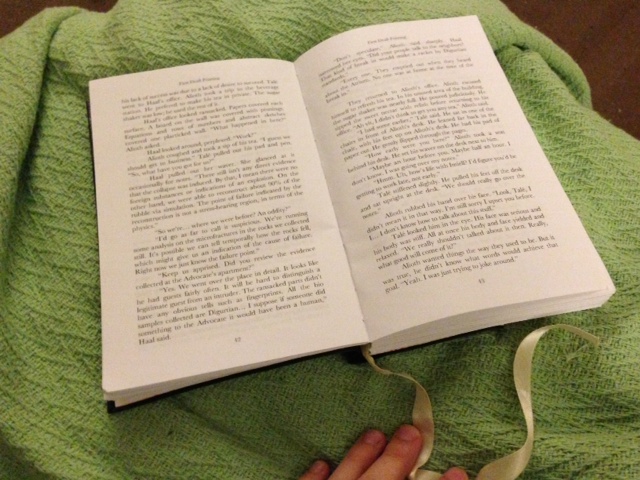
I also finished binding a rough draft of my novel. I finished the draft itself last Thursday =). To reward myself, I bound a copy for myself. Then I’m going to reread the words and mark up alllllll the things that are wrong or that I want to change. I’ve never gotten this far before, though, so I wanted to recognize that achievement with a binding. I’ve included some pics below. 360 pages (including some blank pages for my comments between chapters) and 82,000 words. Hooray! Just simple photos for now, maybe I’ll get around to a nice photo shoot in a few days.

photo-1 photo-2 photo-3 photo

A novel attempt

I finally decided that I will try to write and finish a novel. Of course, I’ve been entertaining such ideas for years, as I suppose a lot of people have. So why do I feel like I can do it now, when I’ve only failed before? You gotta keep trying, but there’s that old Einstein definition for insanity: doing the same thing over and over again and expecting different results. So I am trying again, but I’m doing things differently, and hopefully this will lead to more success.

1. I first wrote the plot arc as a short story. It was originally meant to be a short story but there were so many things I wanted to touch on that I didn’t have time for, even at 7000 words in length. I know how I want the characters to develop, how they feel about each other, and what their motivations are. I know all kinds of societal details that play into the characters actions and motivations.

2. I’m in a writing group now. I know a bunch of people who might have suggestions on how to do better, or what to do if I hit a wall.

3. I’m approaching the writing differently. In the past I said, whelp, 100,000 words, here I go. Around 25k, I got bored, felt like my work was unfocused, and quit. This time I’m thinking of it as a series of short story ish chapters. I have a bunch of little stories to tell in 2-5k words or so. Per point 1, I already have a rough outline of the overall story. As I go, I’m outlining a few chapters forward with further details– what scenes happen in each chapter and where do they happen. So I have a macroscopic outline of everything and a microscopic outline subject to the flow of events. We’ll see how it goes. I’m planning on writing one chapter a week, with weeks off allowed for alternate projects.

I’ll continue to post my progress. It will be interesting to see what works for me and what doesn’t work for me. Any suggestions are welcome too! But basically, it’s time to just write. Chapter 1, here we go…

Miniature Books!

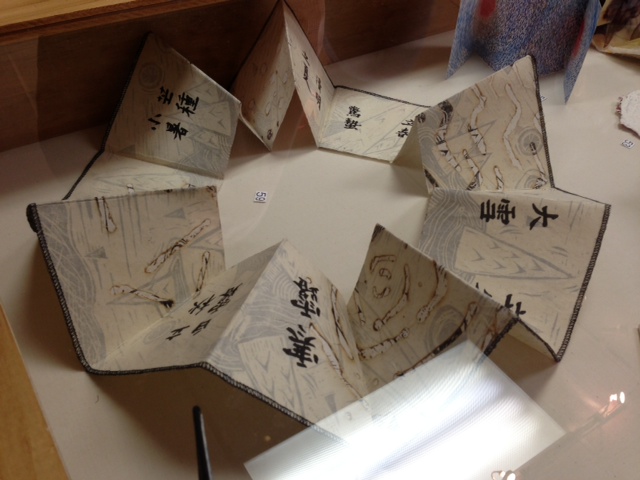
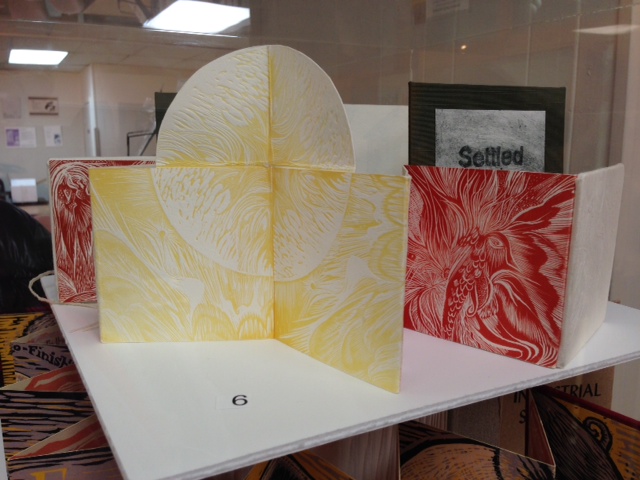
This weekend at the festival of the book, I saw an exhibition about miniature books. The exhibition is a traveling show from the University of Akron including about 80 small or odd books. At the exhibition, Molly Schwartzburg, the curator of the miniature books collection at the University of Virginia, gave a talk about the exhibition and about mini books in general. The university has a collection of several thousand miniature books, which by their definition means no bigger than 3″ in any dimension when closed. Some of the mini books are made for artistic purposes, and others for practical purposes. The Knights of Columbus used to send miniature books containing short stories to soldiers during WW1, packing the tiny books with cigarettes. The Akron exhibit didn’t adhere to the 3″ limit, but all of the books were eccentric.

Below are a few pics from the collection.

photo copy 2

This does fold flat- “Solar Terms” by Ling Luo

photo copy 3

“Altar of Transformation” by Cathie Bleck

photo

A bunch of accordion style mini books.

photo copy

“Pig, hog, bacon” by S. V. Medaris, showing the life cycle of a pig on one side and bacon on the other.

photo copy 4

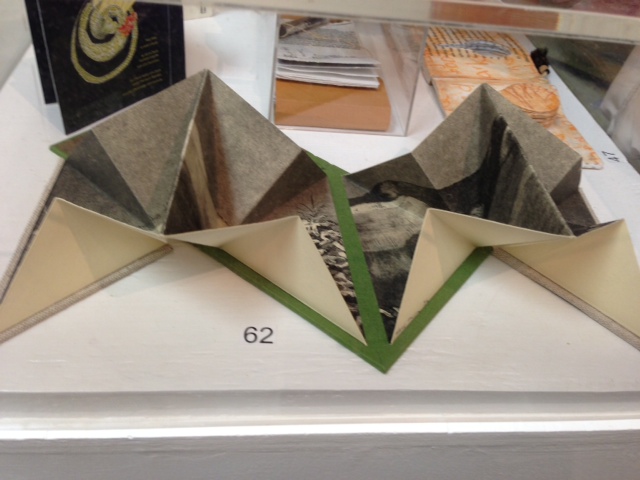
“I went to the mountains, but they were not there” by Rachel Mausier- a really cool combo of book arts and something more like origami.


Learning about Graphic Novels and Publishing from Barbara Slate

As I mentioned in Monday’s post, I attended a talk by comic book writer Barbara Slate (at the VA Book Fest). She was one of the first female comic book writers, and has since branched out to her own graphic novels. After her talk I picked up one of them, “Getting Married and Other Mistakes“. It looks like a lot of fun, and like Slate herself, seems to have a nice sense of humor. She also has a book about how to write graphic novels.

She also spoke about the process of getting “Getting Married” published. She said that she was rejected about 60 times. I didn’t pay attention to that detail much that day. I wrote Monday about my own excitement, that I perhaps had a publisher interested in Zish and Argo. After further research, it looks like one of those pay-to-self-publish rackets, dressed up. I felt so duped! I was so excited, and they misled me. Fortunately, I figured it out quickly and for free. I channeled my frustration to overcome my fear of sending the manuscript off; on Monday after my realization I sent the manuscript to 5 places. Afterwards it occurred to me–if a woman like Slate who is familiar with the industry, knows publishing and knows people takes 60 rejections to place her book– then people aren’t going to be jumping out of bushes to publish me. It will take sober, dull work for me to get published, just like her. As it likely will for all of us. Please, may some eager publisher fall from the sky and praise me, but it’s not something I can expect or even take at face value. So last night I thought up a new story for Zish and Argo, and I will continue the slow marathon towards my goals.

Meeting goals at the Virginia Book Festival

Between attending the book festival and playing a water polo tournament, I had a very busy (but wonderful) weekend.

I went to several of the book festival sessions, which I will write about at greater length later in the week:

But the most exciting day was Saturday. I played a polo game in the morning. Then, reeking of chlorine, I went to the book fair to talk to publishers about Vironevaeh and Zish and Argo. One publisher seemed particularly interested, and I will post updates as I learn more about that. Then I popped back to the pool for some more water polo. The goal of this website and much of my work the last several months has been to get out there and try to publish something, to talk to a wider group of people and engage in a field I’ve cautiously eyed since middle school at least. So this weekend was a big step forward and I’m still high on it all.

Book Review: Downbelow Station (C.J. Cherryh 1981)

Note: I avoid spoilers in this review. Any plot details I mention occur early in the book.

Rating: 4.5/5 stars

I’ve had Downbelow Station on my shelf for a while. It’s 526 pages, so a little on the long side. I’d seen the book on a few “best of” lists, but no one I know has ever mentioned it. It was the 1982 Hugo award winner. So finally I bucked up and read it, and it was excellent.

Although I see “Downbelow Station” described as a hard science fiction book, the technological aspects of the book do not occupy the foreground. The interactions and desires of the characters do that; in some ways it’s a  high-class space opera. I found the style of the book most similar to Vernor Vinge in books like “A Fire Upon the Deep” with a little more militarism. I wonder how much the post Vietnam era affected the portrayal of militarism; the warring elements do not come off positively in this book. Cherryh does a good job developing culture; we can see the cultural differences between Union, Company, Pell, and the Downers. If you like sweeping science fiction, this is a highly worthy read.

Most of the action takes place on Pell Station, a space station orbiting a habitable planet with natives called “Downers” in the year 2352. Humans have expanded into space, one station after the next. At some point in history, humans developed faster than light “jump” technology, so they can spread further yet, into the “Beyond”. The humans in the Beyond have become disassociated with Earth; likewise Earth is somewhat detached from the stations. Pell finds itself between the forces of the Beyond and the renegade forces of Earth. The first 20 pages or so lay down this background; it’s a lot of exposition and it’s confusing and not totally engaging. The beginning is the weak point of this book. Once the ground work is laid, the story takes off.

We arrive at Pell when the Company ships of Earth force the station to take on a bunch of refugees from another station which has been destroyed in the conflict between the Company and the Union of the Beyond. These unregistered people are housed in quarantine, or Q, which is lawless and places a great deal of strain on the station’s resources. Over the course of the book, we watch people from Q, from Pell station, from Union, and from the Company as they vie for the strategically valuable Pell. The people of Pell station I found especially interesting, and their interactions with the Downers.

There are several other books in Cherryh’s Union-Company universe that I look forward to reading. Check out my Top 20 science fiction novels for more science fiction recommendation.