Tag Archives: history

Mimbres Pottery

Although we think of the west as new, it’s only new to the United States. Many native cultures and the Spanish Empire traipsed across the Southwest for centuries and millennia before it was the American frontier, and their legacy remains. As an easterner, nowhere I’ve ever lived had that depth of surviving history. I still have a lot to learn.


The Mogollon (roughly pronounced MUH-guh-yun) Culture was one of three ancient cultures in the southwest, along with the Pueblo and the Hohokam. The Mimbres branch of the Mogollon lived in southwest New Mexico. The people of the Gila Cliff Dwellings only lived there for about a generation, likely driven there by desperation. Compared to Chaco Canyon and Mesa Verde, the Gila Cliff Dwellings are quite small. The culture disappeared from the region shortly thereafter. But their pottery remains influential today, over 500 years after the culture that produced it collapsed.

Mimbres pottery is astonishing. Many southwestern cultures have beautiful pottery with rich design and symbolism. Mimbres pottery is different. It depicts compelling geometric abstractions of animals and people, employing artistic devices not seen in European art until this century.

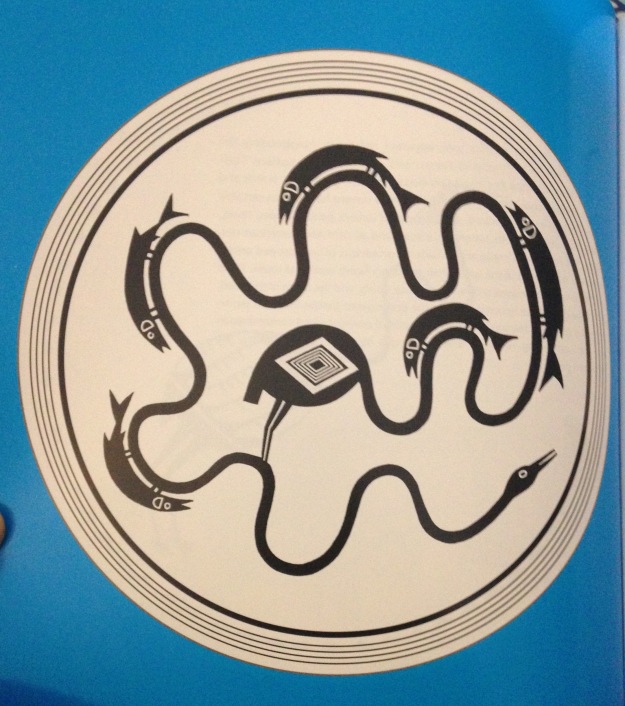
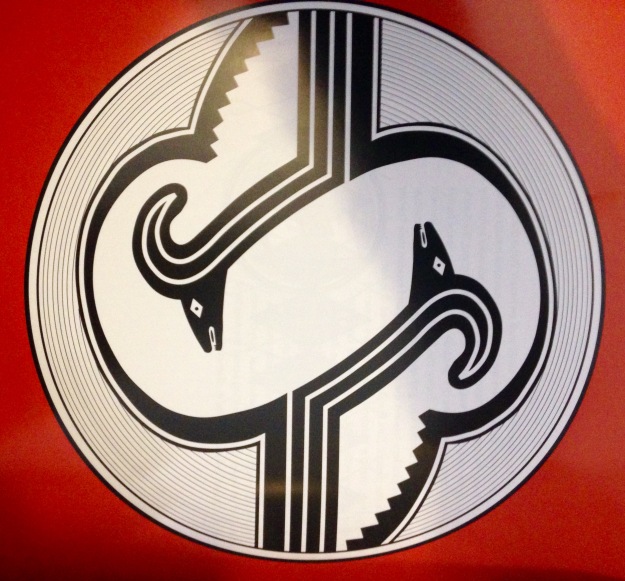
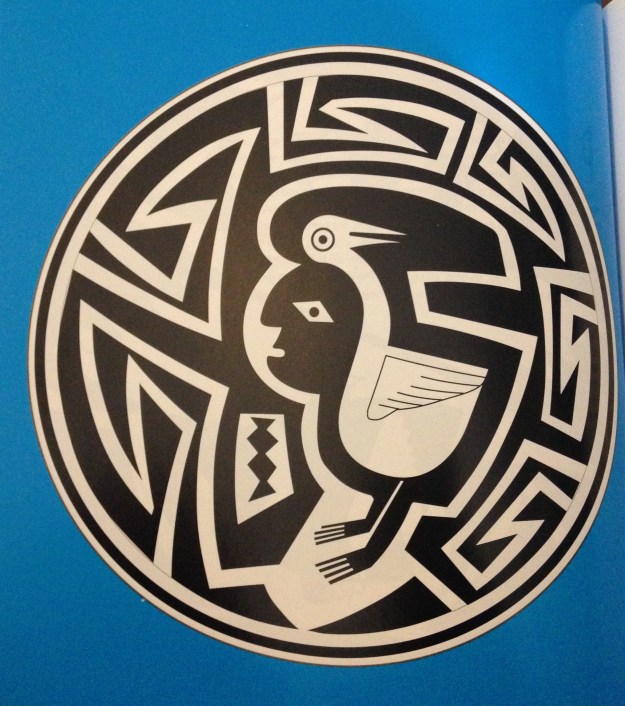
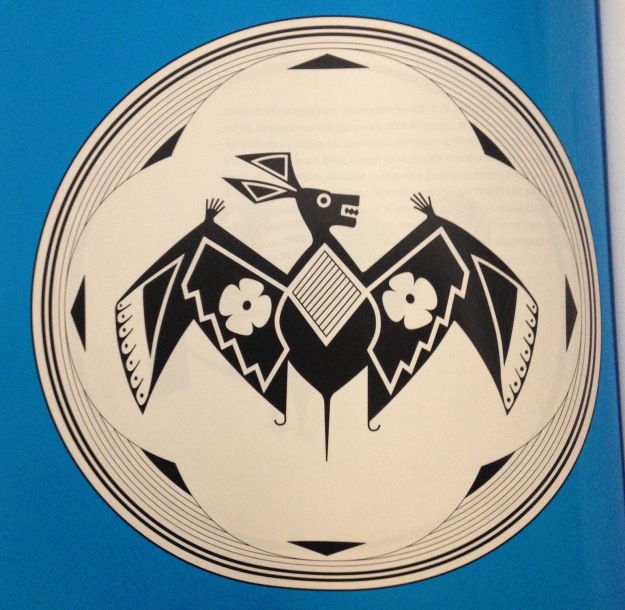
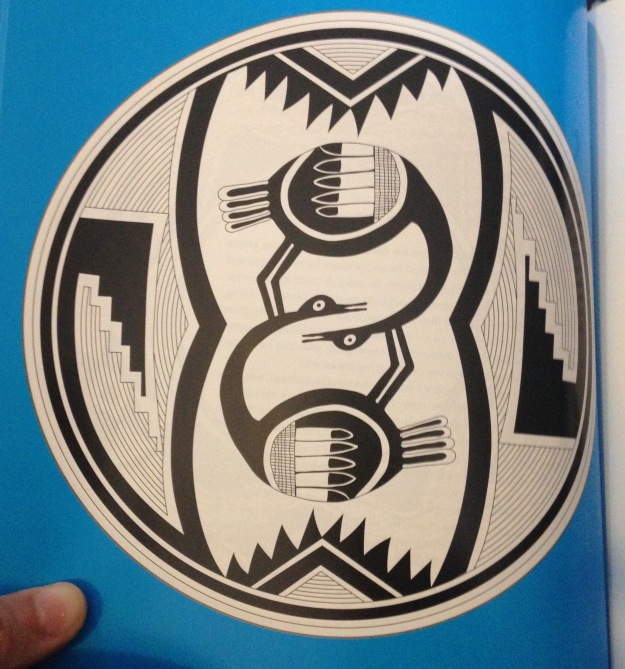
The Maxwell Museum of Anthropology in Albuquerque has a nice collection; I picked up a great book of designs in the gift shop, Mimbres Classic Mysteries by Tom Steinbach Jr. Most books about Mimbres pottery show photographs of the works. This book shows the designs themselves, which are brilliant. All images in this post are from that book.

fullsizerender-13

Sandhill crane design, almost like something from the art deco movement.

fullsizerender-14

Humorous design featuring a great blue heron, with the fishes hiding in the one place the heron’s neck cannot reach.

fullsizerender-15

Intertwined ram’s heads

fullsizerender-16

Man/crane design. The author suggests it looks like a Picasso. I am struck by the use of negative space.

fullsizerender-17

Bat design

Exploring New Mexican Names: Mount Taylor

Mount Taylor is a volcano 80 miles west of Albuquerque, the most prominent feature in the western panorama looking from the foothills of the Sandias. It was named in 1849 for then-President Zachary Taylor. The Navajo call it “Tsoodził” (don’t ask me to pronounce that), and the mountain is important in the beliefs of the Navajo and local pueblo peoples. The mountain is rich in uranium, and was a mine until 1990. In nearby Grants, you can visit a mock uranium mine. Mount Taylor is also the site of the grueling-sounding Mount Taylor Quadrathlon, featuring biking, running, cross-country skiing, and snowshoeing. 

Zachary Taylor was the second and last Whig to be elected to the presidency. Both he and William Henry Harrison were generals, and both died early in their presidential terms. Taylor was mostly apolitical; the presidency was his first elected office. He fought in the War of 1812, against the Black Hawk Indians in what is now Minnesota, and against the Seminoles in Florida. He became known as “old rough and ready.” His daughter married future president of the Confederacy Jefferson Davis, but she died three months into the marriage.

Taylor came to national prominence during the Mexican-American War. This war eventually brought the territory of New Mexico into the union, and is detailed in Amy Greenberg’s A Wicked War. Taylor won famous victories in the Battle of Monterrey and the Battle of Buena Vista. The war was initially popular, and Taylor became correspondingly popular after his victories. Taylor privately opposed the war from its beginning, calling an early troop movement “injudicious in policy and wicked in fact.”

Democratic president James K. Polk (1845-1849), who had almost single-handedly created the war, grew frustrated that Taylor, a whig, was getting credit for what Polk considered democratic achievements. Before the Battle of Buena Vista, Polk stripped Taylor of a portion of his troops, leaving Taylor and his troops more vulnerable to attack from the army of Mexican general Santa Anna. Santa Anna was a busy boy in early Mexican history; he was president 11 nonconsecutive times, and he was the leader of the Mexican forces at the Battle of the Alamo in the Texas revolution. As time passed, the war grew unpopular, and so did Polk. After the invasion of Mexico City, the war stagnated, with US forces harassed by guerrilla warfare. US troops committed atrocities, such as the Agua Nueva Massacre. Polk wanted to annex all of Mexico, and some wealthy individuals in Mexico preferred this to the constant coups that plagued early Mexico. But would this territory permit slavery? And how would dreaded dark skinned Catholics be allowed to become citizens? Eventually, the upper one-third of Mexico’s territory was ceded to the United States in the Treaty of Guadalupe Hidalgo (a treaty that Polk opposed, but grudgingly accepted).

Taylor never saw Mount Taylor nor set foot in New Mexico, as far as I can tell. But he made his mark on the modern state of New Mexico in a couple of ways. The Mexican-American War brought most of the territory of New Mexico into the United States. And during his brief presidency, Taylor opposed Texas’ claims to the eastern half of New Mexico. Thanks in part to President Taylor, I live in New Mexico and not Texas.

Taylor assumed the presidency in March of 1849. Perhaps Polk resented this, but not for long; he had the shortest retirement of any president, dying just three months after leaving office. In the 1800s, presidents took office on March 4th after the election. Because March 4th, 1849 fell on a Sunday, Taylor refused to be sworn in. This led to “President for a Day” David Rice Atchison, who is slightly famous in my home state of Missouri. Taylor lacked specific policies and history considers him to be in the worst 25% of presidents. On July 4th, 1850, President Taylor ate some fruit and milk at a Fourth of July celebration. He became ill and died on July 9th, leaving Vice President Millard Fillmore, who is rated even worse than Taylor, historically. Polk, incidentally, is rated 10th best president, a ranking I suspect the author of A Wicked War disagrees with.

Perhaps someday I will learn how to pronounce Tsoodził, what it means, and the names and meanings of Mount Taylor in the Puebloan languages. Until then, I suppose Old Rough and Ready will have to do. He seems like the sort of person one makes do with.

151114-el-malpais-04235-2


Science fiction worlds and the ancient west

After visiting Chaco Canyon in northwest New Mexico, I read archaeological articles about the region. For a region so full of artifacts, we know little about what life was like. We don’t know what their social structure was. We don’t know why they came to the region around the year 900 or why they left around the year 1300. We think the canyon wasn’t fully occupied most of the year, but archaeologists debate whether the region’s role was more economic or religious. We aren’t even sure if the region could sustain agriculture. There’s plenty of speculation, but little certainty. Events that already occurred can be almost as shrouded and mysterious as the future.

I tried to imagine life at the height of the Chaco culture. Science fiction can be about the extrapolations of technology and travel, but its emotional core explores the human response to extraordinary worlds. The Left Hand of Darkness explores the human response to extreme cold and unusual gender dynamics. A Canticle for Leibowitz explores the response to apocalypse, the assignment of blame, and the attempt to rebuild within poisoned ashes. The Wind-Up Girl looks at human response to bioplagues and the biomechanical future.

Imagining life at Chaco Canyon is arguably more alien than science fiction. Science fiction is written for western audiences with western lifestyles. (This is not a criticism—science fiction is fiction first, and sociology study somewhere down the list.) The social hierarchies are familiar. We quickly understand what is considered important and unimportant. The motivations of characters in science fiction are often less alien to me than customs on our own planet. Russians often find smiling a sign of foolishness. Japanese salespeople so dislike saying “no” that they will ignore the question rather than give such a rude answer. These are tiny examples of different outlooks on life, shadows of structurally different mental organizations. These are cultures extensively connected to my own, living with the same technologies and the same global events. Our very language biases our ability to conceive of and express concepts. Ursula LeGuin explored this concept in The Dispossessed, but of course it is still in English.

By comparison, Chaco Culture is almost Martian; it’s 700 years gone, it was isolated in a draconian environment, and even the statistics of their society are now matters of speculation. But we can infer that they found rhythm and certainty in the sky. They made the Sun Dagger and they aligned so many of their buildings to the patterns in the sky. Reading archaeology felt like holding sand; the very question of whether or not the people grew corn on site was a debate waged hotly across decades. But I could look up at the sky and see their sky.

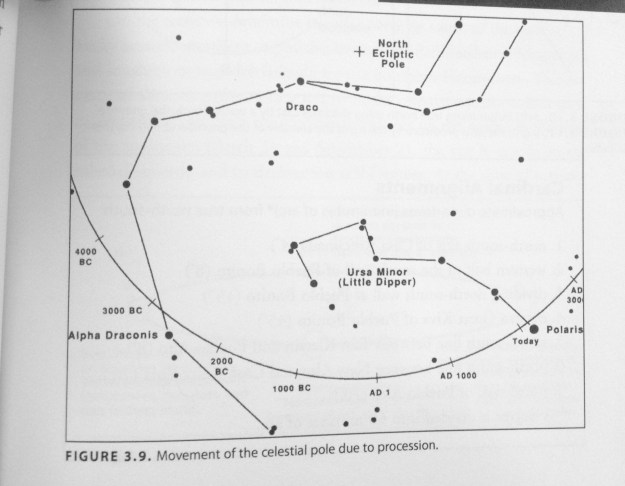
But even the sky we look upon isn’t their sky. Our planet wobbles like a top, and because of that, our window into the stars slowly shifts. Today, the north star, Polaris, is less than a degree from celestial north. (A degree is about the width of your finger when held at arm’s length.) In the year 1200, Polaris was 5 degrees from north. In 900, it was 6.7 degrees from north. We know the sky that they saw, but it’s different than ours. Add in light pollution, planes, and satellites, and it’s very different.

Unlike the stories of time machines, Chaco won’t ever give full answers. In science fiction, we imagine peeling back the fog of both future and past. The lack of answers is really the motivation, though. Science fiction is an expression of human response to things we can barely imagine. It’s an act of exploration, and Chaco reveals how much there is to explore.

FullSizeRender 8.jpg

A map of how the celestial north pole moves with time. I never realized how briefly Polaris had been close to north.

Western Ghost Towns: St. Elmo, Colorado and Chloride, New Mexico

The west contains amazing variety. You can see lava fieldsslot canyons, and dunes of white sand. There’s 400 years of Spanish history, and thousands of years of native history from multiple cultures. Artifacts in the hills and deserts of the west will stay put for a long time. The Animas River Spill led to coverage of abandoned mines in the west, remnants of the 1880s mining boom. This article at least suggests 150,000 abandoned mines, 4,000 of them uranium mines. On a happier note, many of the old mining settlements survive in some form today.

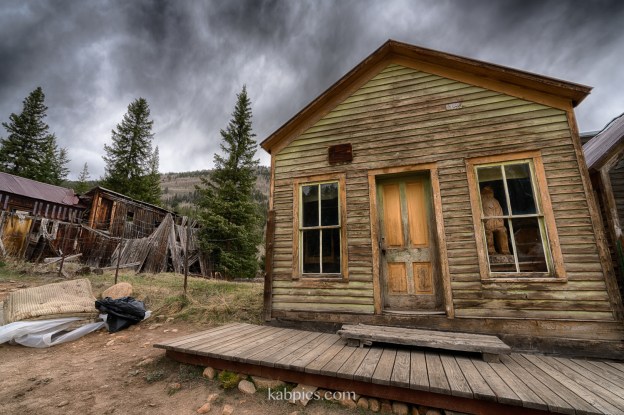
St. Elmo, Colorado is a beautiful little mountain town with nature and scenery. Its wooden buildings have been preserved very well, and are well-suited to photography.

Chloride, New Mexico, had one of the most excellent and unique museums I have visited. Mr. Edmund at the Pioneer Store Museum has spent decades of his life cleaning and documenting the store and the town history. He gave us a wonderful personal tour for over an hour.

St. Elmo, Colorado

St. Elmo is in a remote valley of central Colorado near the Arkansas River headwaters. We stopped by en-route from Great Sand Dunes National Park to Pike’s Peak. St. Elmo is a quintessential mountain ghost town, with beautiful timber construction, moody skies, and looming snowy mountains. Its population peaked at around 2,000 people. St. Elmo had gold and silver mining (over 150 claims in St. Elmo alone). It was near the Historic Alpine Tunnel, an engineering marvel, built in the 1880s and still the highest rail tunnel in the country. (If you want to see that, that requires some walking.)

When the railroad stopped maintaining the rail line in 1910, the town faded. One family stuck around, and today a lot of buildings survive in lovely condition. St. Elmo has mountain biking, an adorable-looking Bed and Breakfast, ATV trails, and more. Also nearby is Mt. Princeton Hot Springs, which looked inviting.

This slideshow requires JavaScript.

Chloride, New Mexico

How can you not adore a name like Chloride for a mining town? Chloride was named for its silver chloride deposits, and was a silver town. At its peak, it reached a population of 3,000 with 9 saloons. (Today, it has 11 residents.) The town collapsed when President McKinley made gold the monetary standard, and silver prices plummeted. Chloride had 42 mines, a crushing plant, and a smelter.

The general store continued on after the mining bust. In 1923, it was boarded up while the son went east to study. He studied physics and moved to California, so the store sat unmolested (except by bats) for 70 years. It is a time capsule rich with history. You can peruse the signatures in the post office book. The museum manager, who restored the building and its contents himself, will show and tell you about the many fascinating items within the store. There are purchase records, old bottles of whiskey, packages of gum, nails, ladies hats, and even a dynamite detonator.

Today, one mine is still active nearby, mining zeolites, which are cool, but a tale for another time.

This slideshow requires JavaScript.


Chaco Canyon: New Mexico’s ancient convention center

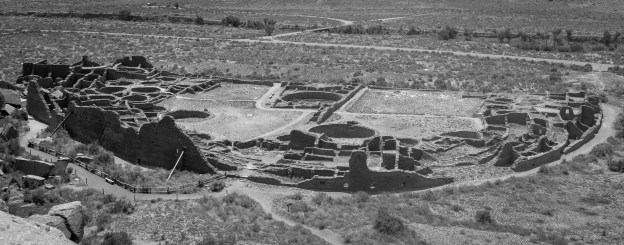
Chaco Culture National Historic Park is in remote northwest New Mexico. The drive will take you on twenty miles of dirt roads and beyond cell range. But in this most remote reach of New Mexico lies the crossroads of an ancient culture. In Chaco Culture National Historic Park lies 3,614 recorded archaeological sites, including many massive great houses. The largest, Pueblo Bonito,  has roughly 800 rooms; visitors may walk through the doors and rooms of Pueblo Bonito. The Chaco Culture also built astronomical features into many of their works; some windows align perfectly with the sun on solstice, and some decorations align with phases of the moon.

When Chaco was discovered in modernity, it was thought to be a vast city. Having walked through it, it feels that way. It feels like it could hold thousands. But archaeological evidence suggests otherwise—there is little garbage, and few burials. Massive Pueblo Bonito may have housed only 70 people on a permanent basis. The guides at the park suggest that Chaco might have been a meeting ground, used for trade and weddings and astronomical ceremonies for a small portion of the year. Remnants of cacao from 1200 miles south have been found at Pueblo Bonito. The bones of macaws, native to eastern Mexico, have been found at Pueblo del Arroyo. They apparently didn’t flourish; only the bones of adults were found. So the astonishing quantity of ruins at Chaco Culture Park may be the remnants of an ancient convention center.

Chaco offers an amazing range of ruins, from the many-roomed grand houses to petroglyphs to astronomical markers to ancient stairs and roads. Like Mesa Verde National Park, not so far to the north, the whole site was abandoned in the 1300s, well before European influence. Like Mesa Verde, archaeologists don’t know exactly why the people left. There is evidence of an ancient drought. Some argue for catastrophic deforestation after all the building at Chaco (because all that construction took a terrific amount of timber, some of which still remains in the structures), though there is not consensus.

I grew up in St. Louis, a town once called Mound City for the mounds left by the ancient Mississippian culture. The massive city at Cahokia was also abandoned around the year 1300. A city of 15,000 abandoned, around the population of London at the time, and we don’t know why. It’s easy to live in the United States and think of it as the new world. But these amazing works of ancient people live on quietly. The inconvenient mounds of St. Louis were largely destroyed; those who did so may not have even realized their origin. But the remnants of the Pueblo culture at Chaco remain, mostly protected by their isolation over the years. Though the journey today is easier than it ever has been, Chaco is still hours from the interstate and quiet. As I took in the ruins, I was filled with the same wonder and questions that Cahokia Mounds always presented. Places like Chaco and Cahokia are reminders of humanity—no matter the size of the structures we build, one day people will view the barren remnants and wonder about us. We will walk the same valleys and cliffs, touch the same stones, but we won’t know each others names or voices or values. Ruins like Chaco remind of us of our place in the universe, and how beautiful and belittling that can be.


This slideshow requires JavaScript.

This slideshow requires JavaScript.

160611-chaco-canyon-0717

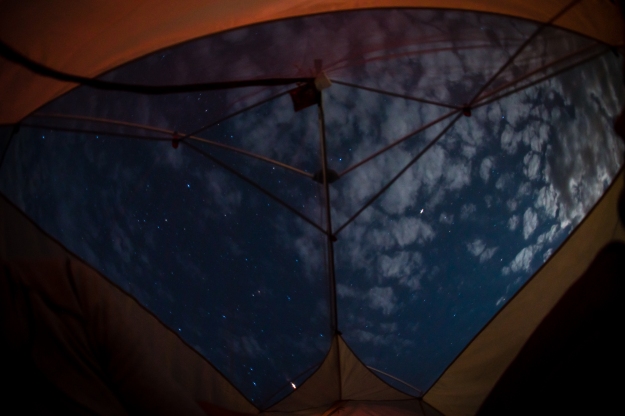
The stars through my tent at Chaco Culture Park. Chaco is one of the night sky parks, where the darkness of the sky is specifically preserved through lighting choices and such. In light of the ancient Pueblo interests in astronomy, it seems appropriate.

160612-chaco-canyon-0877_HDR_1

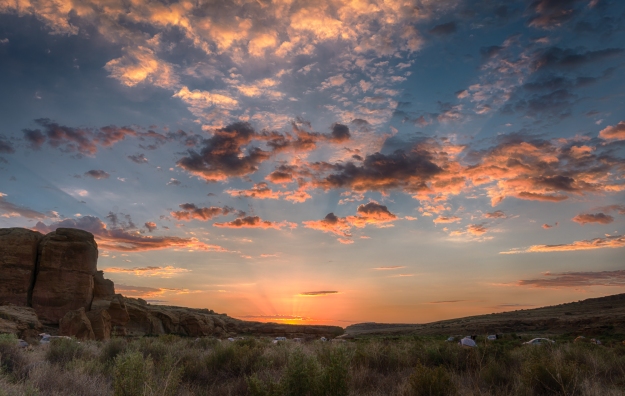
Sunrise at the camp site.

Nature Nearby: Carlito Springs in Albuquerque

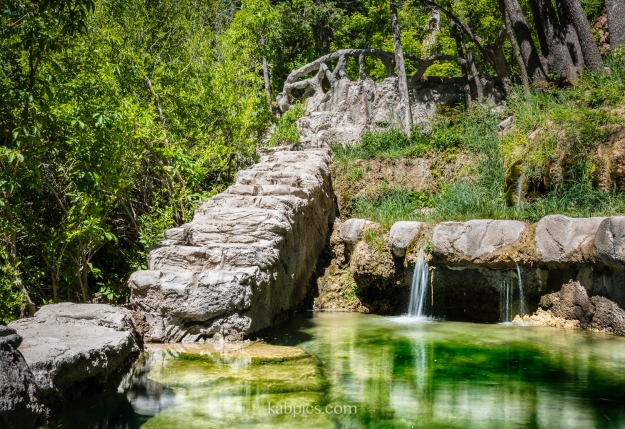
Amidst the many natural wonders of a state like New Mexico, it can be easy to overlook local gems like Carlito Springs. Located just 20 minutes east of downtown Albuquerque, Carlito Springs feels more like the Appalachian Mountains than the southwest. It’s a place with quirky New Mexico history, lush foliage, and inspiring landscaping.
160520-carlito-springs-7125


The History

Carlito Springs was first settled in 1882 by Civil War veteran Horace Whitcomb while he looked for gold. In 1930, it was bought by Carl Magee, editor of the Albuquerque Tribune and patent-holder for the parking meter. He named it “Carlito” for his son, Carl Jr., who died in a plane crash. (This link contains an excellent and more detailed history.)

Of course tuberculosis, America’s deadliest disease at the time, played a role in Carlito’s history. In 1910, 3000 of Albuquerque’s 13,000 residents were people seeking treatment in the dry, high air. Today, Lovelace and Presbyterian Hospitals, two of the largest systems in the city, remain from the tuberculosis treatment days. Magee’s wife was tubercular. The property was used as a sanitorium before Magee’s purchase.

Magee’s daughter married a Sandia atomic scientist, and many of the features of the property date from that time. The pair won many ribbons at the New Mexico State Fair as “master gardeners,” and planted flowers and fruit trees on the property. Today, architect Baker Morrow calls Carlito springs “one of the most amazing landscapes in the southwest.” The property has several cabins, as well as the springs, several highly manicured fishing pools (no longer stocked), fruit trees and flowers. If you’re an engineering nerd like me, you can check out the rusty vintage concrete pourer, which I suppose was used to craft the lovely railings around the ponds.

Carlito Springs was only permanently opened to the public in August of 2014. Because the property is on the steep banks of Tijeras canyon, substantial work went into building the trails that lead to this historic property. They did a great job, and Carlito Springs is a great Albuquerque attraction.

This slideshow requires JavaScript.


The Hike

The hiking loop is about 2.4 miles, with about 400 feet of elevation change. From the parking lot, take the fork left for the most direct route to the cabins and ponds. This is the steepest section of the loop; it follows the springs up the side of the canyon, but it is cool and shady. The trails is good quality, without many rocks or roots to impede footing. The last few hundred feet before the cabins are switchbacks.

On the first leg of the hike, mind the poison ivy which grows near the trail. In May, there was quite a bit of it, neon green and inviting, but the trail is wide enough that it’s easy to avoid. By the cabins and on the second part of the loop, I didn’t see any.

To the left of the cabins (if you are facing them), you can follow a small spur which leads to a view of the valley. It’s a steep walk and you get the view later anyways; when I do the hike again I will skip this spur.

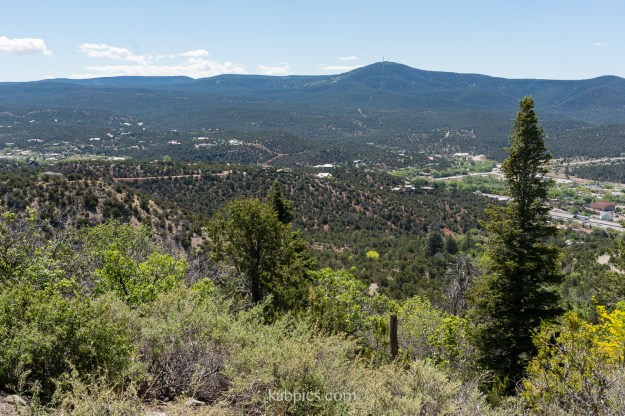
To the right of the cabins (again, as you face them) the loop continues. Just past the largest building, you will find the cement mixer, some various old rusted implements, and a port-o-potty. By the cement mixer, you can look into Tijeras Canyon, this time without the extra vertical effort. It’s a pretty enough view, besides the mining facility (which I omitted from my image).
160520-carlito-springs-6921

The final leg of the loop is sunny and gently sloping. Here, you see red soil and cacti rather than water and poison ivy. In May, the sun was pleasant, but this south-facing trail could be hot later in summer. We had this portion of the trail to ourselves.

May was a great time for this hike. Up by the cabins, peonies and columbines bloomed. Later in the hike, cacti bloomed. We read about wildlife sightings such as bears and deer at Carlito, but on a busy Saturday, we had no encounters.


Extras

Carlito Springs is only a couple of miles from the famous “singing road” portion of Route 66. You can take Route 66 (Central Ave) from Albuquerque, or you can overshoot the Carlito Springs turn and u-turn. The singing portion is only eastbound. It’s silly, but entertaining.

El Morro National Monument

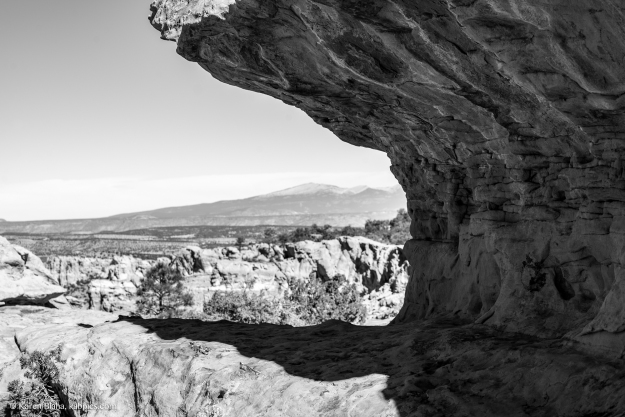
El Morro National Monument is a tiny park tucked in remote western New Mexico. For this reason, it is one of the least visited National Monuments in the west. Ironically, El Morro is a park because it was once a travel hub—a source of year-round drinkable water amongst miles of dry scrub. Over many centuries, visitors came to the oasis and left their mark. Ruins of a 700 year old pueblo sit on the mesa top. Around the base, there are petroglyphs, signatures of conquistadors, and marks of early Americans traveling west. El Morro was scouted for the railroad, but it went 25 miles north. Now El Morro is a quiet place, a sandstone guestbook with centuries of entries.

Don Juan de Oñate

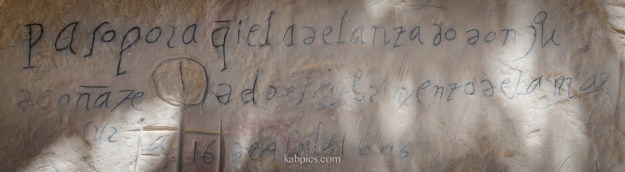
Don Juan de Oñate was the first Spanish colonial governor of New Mexico from 1598 to 1610. He founded the city of Santa Fe in 1610, eleven years before the Pilgrims first Thanksgiving. This carving at El Morro took place on an expedition to the Gulf of California.

Oñate is sometimes called the last conquistador. After the Acoma indians refused to give the Spaniards more food in the winter of 1598, a scuffle erupted that killed 11 Spaniards. Oñate’s retaliation killed 800 Acoma. Oñate enslaved the remaining population; men over 25 had their right foot amputated. Oñate was recalled to Mexico City for cruelty. He resigned his post in 1610 after the founding of Santa Fe. He was banished from New Mexico, although cleared of charges. Acoma Pueblo was rebuilt, and is one of the longest continually occupied places in the country.

Amazingly, people still honor Oñate. El Paso erected a 34 foot statue of him in 2007. Española, New Mexico has an Oñate monument with a bronze statue. In 1998, the 400th anniversary of his arrival in New Mexico, someone removed the statue’s right foot and left the note “fair is fair.” The foot was replaced, but the seam is still visible. Oñate deserves his place in the history books, but multi-million dollar statues seem unnecessary.

Standing in the presence of his carving reminds one of the vast history of New Mexico. The Salinas Pueblo Missions were a generation old at this point, to say nothing of the indian cultures they encountered. We think of the west as new, but this was all before the Pilgrims dined.

160424-el-morro-added-9995

A bit hard to read, but at the end of the first line are the letters “don ju” and at the beginning of the second “de oñate”. This was carved in 1605.

The Camel Corps

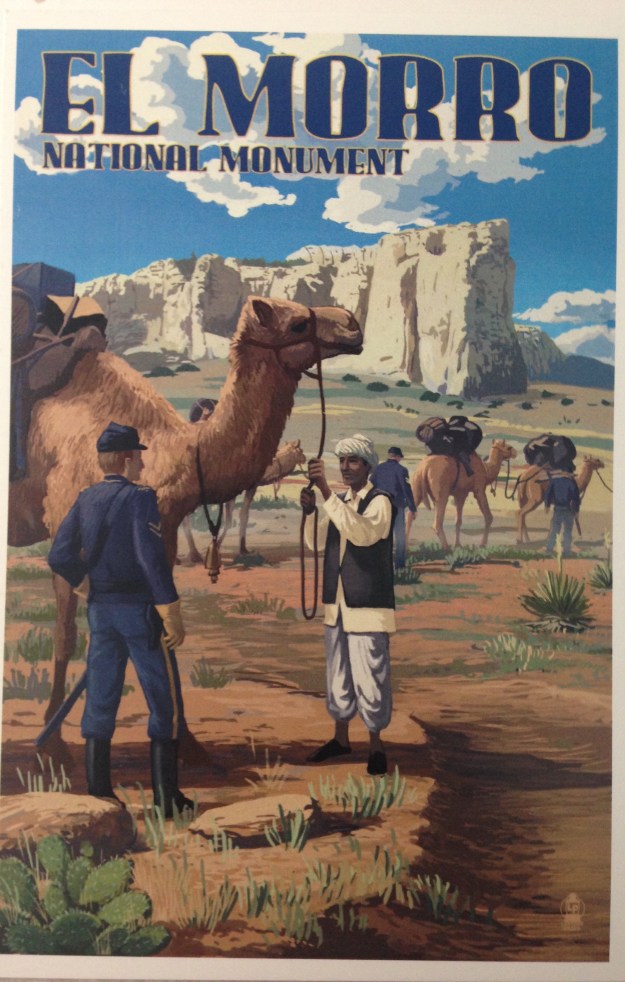
In addition to tragedy, the west is full of quirky, charming history, and the US Camel Corps is one of those bits. Desert animals like camels must have seemed ideal for the deserts of New Mexico. 25 camels traveled through El Morro in 1857.

The US gained the territory of New Mexico after the Mexican American War in 1848. (If you ever want an eye-popping historical read, take a look at the list of Mexican heads of state from 1821 to 1848. I thought US history from Jackson to Lincoln was chaotic, but wow. It makes telenovelas look plausible. It’s amazing the US didn’t take more land from Mexico considering the utter disarray of their government.)  Several early expeditions took place, mostly with the goal of figuring out what to do with New Mexico.

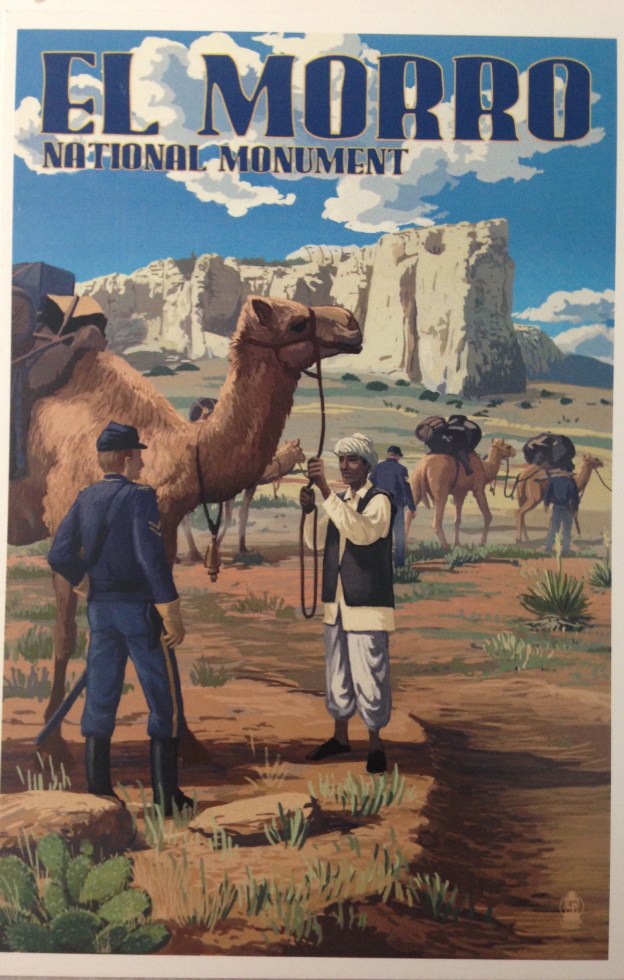
The camels went to Camp Verde in Texas, which was taken by the Confederates at the beginning of the Civil War. Some of the animals were sold at auction, some went to zoos, some went to circuses, and some escaped. Camel sightings were reported in the west until the early 1900s. This charming postcard memorializes the Camel Corps’ visit to El Morro.

FullSizeRender 2


The walls of El Morro are full of inscriptions, tiny slices in the lives of people who altered the west, for better and for worse. Though they are just gouges in sandstone, it is humbling to stand and look at the names and know what extraordinary efforts those people took to reach this oasis. And I consider it a bit inconvenient because it’s 2 hours from Albuquerque. We who pass through are still altering the west, though we are warned not to do it by carving El Morro. If you really must, they have a sacrificial chunk of sandstone by the visitor’s center.

This slideshow requires JavaScript.

Old stuff out west: The Palace of the Governors in Santa Fe


From Wikimedia Commons.

When we think of old buildings in the United States, we think of the east: Boston, Philadelphia, Jamestown. Instead, we should think of the Southwest. Taos and Acoma Pueblos are pre-Columbian and still occupied today. And the New Mexico Governor’s Palace in Santa Fe was built in 1610 and housed local leaders until 1909.  By contrast, Thomas Jefferson’s Monticello was built in 1772. The Palace of the Governors has a century and a half on it. New Mexico is the fourth youngest state, gaining statehood in 1912. I’ve always thought of the southwest as a new area, barring poorly recorded native activity, a region discovered in the era of Cowboys and Ranches and the Indian wars of the 1800s. Visiting the Palace of the Governors reminded me what a rich history our southwest has.

The Spanish came to New Mexico in 1598. They established the capitol in Santa Fe in 1609, building the Governor’s Palace in 1610. New Mexico was a part of Spain until 1821. It was then part of Mexico until 1848, when it became a part of the United States following the Mexican-American War. So New Mexico was a part of Spain for half a century longer than it’s been a part of the US.

Much of this tumultuous history revolves around the Governor’s Palace. In 1680, the Pueblo Indians’ revolted against Spanish Rule and took the Palace for 12 years. Governor Lew Wallace wrote Ben Hur as the sitting governor of New Mexico Territory in the Palace. This video tells the tale of Bernardo López de Mendizábal, territorial governor from 1659-1660, and his wife, Teresa de Aguilera y Roche. After criticizing the Spanish government, the Inquisition arrested them on suspicion of being crypto-Jews (this term is another wild piece of history all by itself). He died quickly in custody in Mexico City, Teresa wrote about her life in New Mexico.

Today, the palace is a history museum. You can see the various ways the palace has been modified over the years. You can look at the exhaustive list of governors that ruled from the palace. It’s impossible not to feel the immensity of the history in that list. New Mexico was the frontier for a long time, not just in the United States. And living in New Mexico today one feels that spirit.

Book review: The Electric Life of Michael Faraday (Alan Hirshfeld 2006)

Rating: 5/5

Michael Faraday is the man who showed that light, electricity, and magnetism were interconnected forces. The farad is named after him; you know a scientist is important when they’ve got their own unit. He had no formal math training or university education. He made his discoveries through dogged experimentation, humility, and curiosity. And because he was the son of a blacksmith, he almost didn’t even get the chance.

The Electric Life of Michael Faraday is an excellent professional biography of Faraday*. Hirshfeld, a physicist, details Faraday’s motivations in addition to his discoveries. We learn about the books, people and thoughts that motivated Faraday. We see how Faraday coped with the endless failures that precede an experimental success. We also see how Faraday fought for his ideas against the incorrect prevailing notions of the day. We get all this in a compact and readable 200 pages. (The Cosmos episode “The Electric Boy”, covers many of the facts of Faraday’s life, though less of the motivation, and is and excellent companion to this book. And it’s free to stream on Netflix!)

The way we are taught science as children is so different from the way science comes into being. For example, the power of the electron was harnessed well before it was discovered in 1897. Volta invented the battery in 1800; the dynamo, which converted mechanical energy into electricity, was built in 1832. Scientists like Humphry Davy isolated and named elements decades and centuries before we had any idea what made elements different. When a scientist does science today, they also have incomplete information. We learn science as a set of facts and rules, rather than the procedures for learning those facts and rules. The Electric Life excellently illustrates the difference. This book, accompanied with some simple experiments and videos, could make a rich and beautiful teaching example.

Hirshfeld also touches on a social issue that’s as relevant today as it was in Faraday’s time: scientific literacy. Speaking about the Victorian pseudoscience of table-moving, Faraday said

I do not object to table-moving itself… though a very unpromising subject for experiment; but I am opposed to the unwillingness of its advocates to investigate; their boldness to assert; the credulity of the lookers-on; their desire that the reserved and cautious objector should be in error; and I wish, by calling attention to these things, to make the general want of mental discipline and education manifest.

In Faraday’s day, there was no science education. Today, I would argue that while we teach scientific fact, we still don’t teach enough scientific reasoning. The above statement could apply to vaccines, global warming, GMOs, evolution, among others.

I would have liked to learn more about Faraday’s personal life. We learn almost nothing about Faraday’s wife Sarah, or anyone else in his family, or whether he even had children (he didn’t). But again, the book is short, and does such a good job with its chosen issues that this is more of an observation than a criticism.

I whole heartedly recommend this book to anyone, scientist or not. You’ll learn about an interesting man of history. You’ll learn how science happens now and two centuries ago. And I think you’ll simply enjoy it.

* I should note that my copy was an advance reading copy from a used book store, so it may vary from the final book in small details.

Book Review: Train (Tom Zoellner 2014)

Rating: 3/5

In Train, author Tom Zoellner rides the rails of the world. He discusses the history, the current state, and the future of rail. Growing up in suburban St. Louis, I rarely saw trains. Now I live 100 feet from active rail tracks and walk along them every day. I take the Amtrak to DC and Baltimore and New York. This summer, I went to the O. Winston Link rail photography museum in Roanoke, Virginia. So I was eager to learn more about the history of rail– such a backbone to our economy, but often viewed as an anachronism.

I was disappointed by Train. It was a pleasant enough read; I didn’t have trouble turning the pages as I basked at the pool. But it felt like junk food.

At its best, the book gave interesting perspectives on the psychology of rail: how we have stories of hero sea captains, drivers, and pilots, but not of train conductors. That we both love and hate the rail, such an engine of commerce, but also hugely representative of collectivism that’s been dominated by robber barons.

I enjoyed the chapters on foreign rail much more than the ones about the U.S. and Britain. The chapter on India was fascinating and horrifying. Some rails in India corrode ten times faster than normal because the tracks are constantly covered in human excrement. This is because the trains don’t have storage tanks for the toilets, but also because people living by the tracks preferentially potty on the tracks.  As you can imagine, the job to replace the tracks isn’t nice; Zoellner’s conversations with the workers are interesting. Zoellner suggests that India wouldn’t be a single country without the railways installed by the British. This chapter solidified my view that I would rather read about India than visit it.

Overall, too much of the text was devoted to Zoellner’s conversations with random train passengers, upon which he congratulated himself loudly and often. I didn’t care about the guy taking the train to West Virginia hoping to find work in a coal mine, nor did I care about the young man reuniting with his estranged mother. I would have tolerated some of this, but the chapter on American rails was a bloated 90 pages, compared to 30 pages each for Russia, China, and Peru. The chapter on America wasn’t more informative; it was more pointless. The chapter on Britain was also packed full of useless conversations.

When I was preparing to write this review, I noticed that Zoellner is an English professor. And that’s what the book feels like: an English professor waxing nostalgic about the majestic railways and their heroic riders, with sprinklings of historic details. I hoped to read something more focused on history. Train passes the time nicely, but I found it unsatisfying. Maybe it would be a better read for someone who already knows the history and wants to read the stylish praises of another rail enthusiast.