Tag Archives: science fiction

Writing prompt: “What if the creatures in your decor emerged?”

Time: 5 minutes. Click here to go to my list of prompts.

“What if the creatures and peoples in your photos and paintings emerged from them?”

The man riding the communism literacy poster started to look unnervingly three-dimensional. What ABV is this beer, Edna thought to herself. Indeed, all the photos and paintings of beings had taken an on an odd sheen. Then the figures from the images emerged and stood in her living room. Some were fairly benign, like the Mucha women,  posing serenely, showing off biscuits with a bare breast or two.

Others were more problematic. The rider of literacy, 8 inches high but full of nationalistic zest, waved his torch menacingly and kept shouting tovarich* at her. Out the window she heard the cries of her neighbors and the wail of sirens. She glared again at the beer before running into the next room to seek her russian-english dictionary. Based on the sirens, this might be a situation she’d have to handle herself. She congratulated herself for removing that photo of the shadow vessel from Babylon 5. She wondered if it would count as a creature, but even miniature, such a thing would be a problem.

tovarich: comrade, in Russian.

Writing prompt: “The whirlpool sucked them downwards”

Time: 7 minutes. Click here to go to my list of prompts.

“The whirlpool sucked them downwards”

Aeli floated through the air. The parachute held her aloft, descending unnaturally slowly. Around her, the storm spun, and below her the sea roiled. Angry caps of gray water shot up. They came closer and closer, and she had the distinct feeling that they were reaching for her. Far off, she saw the ship descend in flaming glory into the sea. She would never know what had gone wrong. Blue and green lightning flashed all around.

She floated into the ocean, and the chute came down over her, trapping her against the water. She gasped, trying to pull air and the sea boiled around her. The water began to spin, with a strong clockwise motion. The whirlpool sucked her downwards. She contemplated if she did believe in an afterlife. Her sight began to grow dim, and she felt the burning, salty water enter her nose.

Something wrapped tightly around her ankle—something strong and something living. She imagined it like the tentacle of Ursula from that old Disney movie. The purple tentacle wrapped around her ankle, suction-cup strong, and pulled her down. She imagined she heard the fat villain laughing and peering at her ugly hench fish. Then the world didn’t exist anymore.

#

Aeli woke, coughing sea water, in a cave of crystal. Soft light filtered in from all around her. She was naked, and she was cold.


Writing prompt: “What if a disease that causes schitzophrenia became common?”

Time: 7 minutes. Click here to go to my list of prompts.

“What if a disease that causes schitzophrenia became common?”

The man on the far corner screamed at the sky. Little Alicia pointed at him and laughed. “Daddy, that man is funny.” I pull her back from the curb harder than I intend to and she starts to cry. Somebody else will call this one in, probably. I pull Alicia and Tania behind me, against their protests. When they’re older, they’ll understand. I hope, I really hope, that when they’re older, this will just be another terrible chapter in history like the yellow fever of Memphis or the swine flu.

The schitz strikes men more often than women. The latest statistics suggest 5% of adult men have been stricken, and 2.5% of adult women. Nobody really knows why. Only about 10% ever recover. Unlike many more ignorable maladies, the schitz first struck in the wealthier classes. Scientists think it first became widespread through air travel. They say that the sickness doesn’t actually have a gender preference, but that businessmen are more common and thus were more stricken. I’m skeptical. The old disease, schitzophrenia, which this one so strongly resembles, selected for men. I’ve seen many of my old classmates go down to the illness.

I tighten my mask. Alicia’s has slipped down and she is fingering her nose. I swat her hand and pull her mask back up. The kids don’t see it, which is frightening and heartening. Maybe they will make it through these times not much worse for the wear. We walk, rather than take the tram, which is empty, back to the flat on the edge of town.

Book Review: The Invention of Everything Else (Samantha Hunt 2008)

There are no spoilers in this review beyond what you’d find in the first few chapters or the cover blurb.

Rating: 5/5

I absolutely adored “The Invention of Everything Else”. I’ve always meant to read more histories and biographies than I do, but sometimes they can be dry. This book, in many ways, is a fictional biography of Tesla, a famously eccentric inventor who first pioneered AC electricity and radio. To learn more about Tesla, check out this awesome Oatmeal cartoon, which has a lot more detail than I’ll include here. The book also has rich and lovely descriptions about historic New York City. And most of all, this book is a romance of eccentric people, whom I feel get far less respect than they deserve. The characters are pigeon-enthusiasts and hoarders and dreamers and inventors.

The book opens with Tesla as a very old man, broke and largely forgotten. He was a brilliant inventor, but not a businessman like Edison. He lives in a dreamlike state, remembering past glories and failures, and seeking his beloved white pigeon (see the Oatmeal cartoon). The other main character of the story is Louisa, a young vibrant woman who works at Tesla’s hotel. She likes to listen to radio dramas and to study people, so she is naturally fascinated by Tesla. Over the book, we learn a lot about Tesla and Louisa as they orbit one another.

The language of this book is wonderful. The descriptive passages evoked touchable images in my head although the descriptions were fairly brief. I could imagine being in bygone New York, and the distractions and wonders of the characters in that setting. The dirtiness of it, and the perpetual motion of it. Here is a quote from the first chapter that captures some of the loveliness of the language:

“Drawer #42. It sticks and creaks with the weather. This is the drawer where I once thought I’d keep all my best ideas. It contains only some cracked peanut shells. It is too dangerous to write my best ideas down. ‘Whoops. Wrong drawer. Whoops.’ I repeat the word. It’s one of my favorites. If it were possible I’d store ‘Whoops’ in the safe by my bed, along with ‘OK’ and ‘Sure thing’ and the documents that prove that I am officially an American citizen.”

If you are a lover of hard science fiction, this one might not be for you. The genre of this book is subtle, with the fantasy element of dreaming maybe most prominent. It seemed like every character in this book took a jump off of something, imagining they could fly. But if you love characters and setting and eccentricity, then you should like it. I loved it, and I really recommend it.

Writing prompts: “The child yelled at the monkey” Aug/29

Sometimes I want to write, but I don’t have a great idea or I’m not in the mood to write something grand and perfect. I just want to write something. When I was working on my novel draft, I was writing 1500 words a day, and afterwards, I felt like a better writer than before. I learned to be in the habit of just sitting down and getting to it and worrying later.

I felt like I could do the same thing with writing prompts. I scoured the web, and a lot of what I found felt more like writing exercises than prompts– I wanted something to run with and retreat into a brief, if perhaps hastily formed, fictional realm.

So I decided I can make up my own writing prompts.

On different days, I can focus on different aspects of writing–beautiful language, or character development, or world-building, or economy of words, or plain weirdness. And I end up with a couple hundred words I can take and mold into something better, or that I can chuck. I do them on a timer, so far of 5-7 minutes, so I can fit them into any day, no matter how hectic.

Unlike fiction I intend to publish, I can share this with others through the blog. I’d love to see what others do with the prompts too. Just link me so I can enjoy it too.


Today’s 7 minute prompt is “The Child yelled at the monkey”. I’ve posted mine below, for your pleasure. I will post these at noon on Thursdays. (Edited only to remove several horrific typos!)

The child yelled at the monkey, and waved his doughy arms about. I looked around for this tiny miscreant’s guardian. About twenty feet away stood a man, thoroughly absorbed by his hand held electronic device. I watched smugly from my bench, safely out of the radius of any potential mayhem, eating a frozen lemon sorbet. The child’s taunts increased, and so too did the monkey’s rage. This culminated finally in the flinging of certain odoriferous weapons. The many-creased child shrieked and fled. The wayward father scolded him. I smiled slightly. Then the monkey looked me sternly in the eye. I didn’t think it could throw this far, but perhaps I ought to go elsewhere.

I wandered on, and again observed the husky child, his bright yellow shirt now tarnished with certain unpleasant organics. This time he leaned over the tiger pit. He waved, like he had at the monkey. The tigers roared and the air seemed to quaver. Maybe the child had a talent for enraging beasts. Again, the father didn’t seem to notice. He was certainly inattentive, but perhaps the rage of animals around his child simply wasn’t abnormal. Curious, I decided to stalk them a little. Every animal seemed incensed by the existence of this child; the polar bears, the penguins, the giraffes, even the turtles. I had read papers proposing ESP, a sort of ability to read emotions and probabilities. Maybe this kid had a sort of Extrasensory Irritation Factor. I had to admit, upon examination, that watching the kid made my blood boil slightly, and watching the animals hate him was exciting. Perhaps his father could only bear his presence by so dedicatedly ignoring him.

Book Review: The Witling (Vernor Vinge 1976)

There are no spoilers in this review beyond what you’d find in the first few chapters or the cover blurb.

Rating: 3/5

As far as I can tell, “The Witling” is Vernor Vinge’s second novel, and to some extent, it shows. I enjoyed reading it, but it doesn’t have the depths of Vinge’s later works like “A Fire Upon the Deep” or less-known but also good “The Peace War”. The book is only about 175 pages long; I’m not the fastest reader and I finished in two pretty short sessions, also unlike Vinge’s other novels.

The story opens with two humans who have become marooned on an alien world with human-like inhabitants. Only after being captured do the humans realize that the natives have what we would call supernatural abilities: transporting themselves or objects by will of the mind. The magnitude of this ability varies from person to person; those with the least ability are called witlings. The two humans, with no ability, fall into this category. The prince of the realm also happens to be a witling, which is a great source of shame for him. He is intrigued by the humans, especially the woman. The humans must get off the surface, as all the alien foods naturally contain heavy metals, and continued exposure will be fatal.

Although he provides no supporting science for the abilities of the aliens, Vinge does what I like best in sci-fi–he takes a simple premise and runs far with it. With these abilities, how would you imprison someone? How would you travel the world? Would you even need doors? How would you conduct warfare? These issues come up again and again through the book, and each time they are a delight.

Another interesting point touched upon is body image. The book starts with the human male describing the woman, Yoninne, as ugly and unpleasant, too stocky and temperamental. The aliens, who it’s hinted have a slightly stronger gravity, are stockier, and to them, Yoninne is close enough in build, but different enough to be exotic and tantalizing. I haven’t read much sci-fi of this era that deals with such issues of perception; unfortunately, this thread is not continued throughout the book.

The primary reason I rate “The Witling” as a 3/5 and not higher is because I found the ending unsatisfying. I won’t go into specifics in this review. The action was quite good and fun, but it conceptually bothered me.

With that caveat, I would recommend this book, especially to those who have read a lot of other works by Vernor Vinge. It’s interesting to see the form of his early, less perfect work, plus it’s a super quick read.

The Submission Grinder for writers

Last year I wrote about Duotrope, a website with market information for writers. You can get info on market statistics, and track your own submissions. It went behind a pay wall at the beginning of the year. I was recently mulling whether I should pay their $50 annual subscription fee, or whether I could find something else. One of the things I liked best about Duotrope was their extensive, user-sourced info on rate of response, rate of personal response, time for response, and so forth. Could they possibly offer as much as they had pre-paywall, since they must now have fewer users? Is there an alternative?

I think Submission Grinder is that worthwhile, free alternative. They have great submission statistics, with histograms of when submissions are accepted and rejected as a function of days since submission. Like Duotrope, you can sort by pay, response time, genre, and all that good stuff. It doesn’t have Duotrope’s submission theme calendar (that was a great feature, as I find those themes impossible to keep track of). It also lacks the editorial interviews that Duotrope has, but reading the submission guidelines and reading a market’s website often give similar insights. I put my info into it yesterday, and it was very straightforward.

Before I found Submission Grinder, I found some nice market listings too. It’s as easy as a google search; for example, the search “science fiction markets” turns up great websites in the first handful of results. Here are some great resources for science fiction and fantasy short story writers:

  • Ralan.com– lists markets on different pages by pay. Each market has a helpful blurb with their word requirements, genres, pay, and average response times. They keep up to date on when markets are open or closed or have become defunct.
  • SFWA qualifying market list– the cream of the crop, those markets that pay at the SFWA (science fiction and fantasy writers of America) professional rate. Each listing includes a link to the market’s submission guidelines as well. These are very exclusive markets, and some accept only a handful a year.
  • Flash Fiction Chronicles– a listing of markets under 1500 words, broken into several categories, by length (such as less than 300 words). Some are pay, most are not, and there’s something for every genre. It’s a lot like Ralan’s for flash fiction.

Sites and sources I don’t recommend:

  • Critters black hole– this site is intended to track market acceptance rates and time to response, similar to Duotrope. However, the info is unacceptably out of date. You are as likely to find a dead market from the 90s as an active one. Critters.org is an excellent critique site, but skip this feature.
  • Writer’s Digest Science Fiction Markets- I wondered if I should buy this, recently. When I did the research, it sounds like it has some errors. It’s only $6, but you can do better with the sites I list.
  • Quintamid– A great looking site, but alas, out of date too. I thought this would be a good resource, but I got a helpful tip in the comments about it.

Happy writing! And go join Submission Grinder–the more information it has, the better for all!

Book review: Beggars in Spain (Nancy Kress 1993)

There are no spoilers in this review beyond what you’d find in the first few chapters or the cover blurb.

Rating: 4/5

“Beggars in Spain” is a science fiction novel written in 1993; it was nominated for the top two awards in the field, the Hugo and the Nebula, though it didn’t win either. (“Red Mars” by Kim Stanley Robinson won both; it is one of the most detailed hard sf books I’ve read.) “Beggars in Spain” is one of those sf books that can be summarized by a what-if– what-if some people didn’t have to sleep at all? How would society react? What kinds of advantages would they have? How would it affect the personality of such a person?

The novel opens with a wealthy man wishing to procure advantageous genetic alterations for his to-be-conceived child in 2008. Though it is still rare, he wants his child to be sleepless. The children who have the trait have proven to be much smarter and always cheerful. Another child is conceived accidentally who is not sleepless (as a small nitpick, the science in this bit seemed fishy, but I am not familiar with what was known in 1993). Leisha is the sleepless daughter, Alice is the sleeper daughter.

Leisha is of course beautiful and brilliant. Much of the novel rotates around how she relates to sleeper people. The characters in the book didn’t always work for me; Leisha is always cheerful as a sleeper, but this is hard to relate to, and hard to imagine how it would even work. Also there is an injection of almost libertarian politics that I wasn’t sure what I thought of. The politics aren’t preachy and are presented as Leisha’s world-view rather than the author’s. I liked the first half of the novel immensely. I didn’t dislike the second half, but I found it less exciting and engaging. One consistently strong point of this book was the writing: I sometimes have to labor through harder science fiction books, which must belabor the description of complicated mechanical things. This book just flew for me, while still attacking the central question of science fiction: what would happen to people if? So if you are a fan of hard sf and only hard sf, it probably isn’t for you.

“Beggars in Spain” was also one of the most female-dominated sf books I’ve read. Most of the principal characters are female. The book is feminist without caring about it or focusing on it; these characters could just as easily be male but they simply aren’t. It’s feminist not in the sense of women’s rights, but simply having women as protagonists and examining their relationships. I’ve read umpteen scifi books with barely a woman on the pages, so this was a welcome change of pace. Nancy Kress is also one of the few premier female names in science fiction, so it also seemed appropriate.

Overall, I found “Beggars in Spain” a very worthy read. It raised a lot of thoughtful questions that even a week after finishing the book, I find myself thinking about. It never came together in a “wow” moment, as a few sf books do for me, but it was pleasant and easy to read, which is not always the rule in sf. This was the first work I’ve read by Nancy Kress, and based on this book, I want to read more from her.

Submit Something Somewhere

This weekend, my scifi writing group held a group event called “Submit something somewhere”. The premise of this event was for everyone in attendance to submit at least one piece to at least one publishing venue. We all know that the easiest way not to get published is to not submit for publication. I know I don’t try as often as I should, and almost every writer I’ve met doesn’t either. So we got together and did some research together about venues and submitted together. It was a good activity; since we pooled our findings, I think it could be good for any group of writers.

Mostly we looked at the SFWA (scifi writers of america) professional markets (aim high =) ). This is a great website for sff market info, if you ignore the 90s-ness of it. However I also found a list of all-genre short fiction markets by length that I thought was pretty awesome.

I submitted two pieces. Hopefully they will go better than my last submissions, but I know they won’t do worse. Each time I try I get better, and I’ll eventually get there.

So go submit something somewhere! It’s better to try and fail than not to try at all!

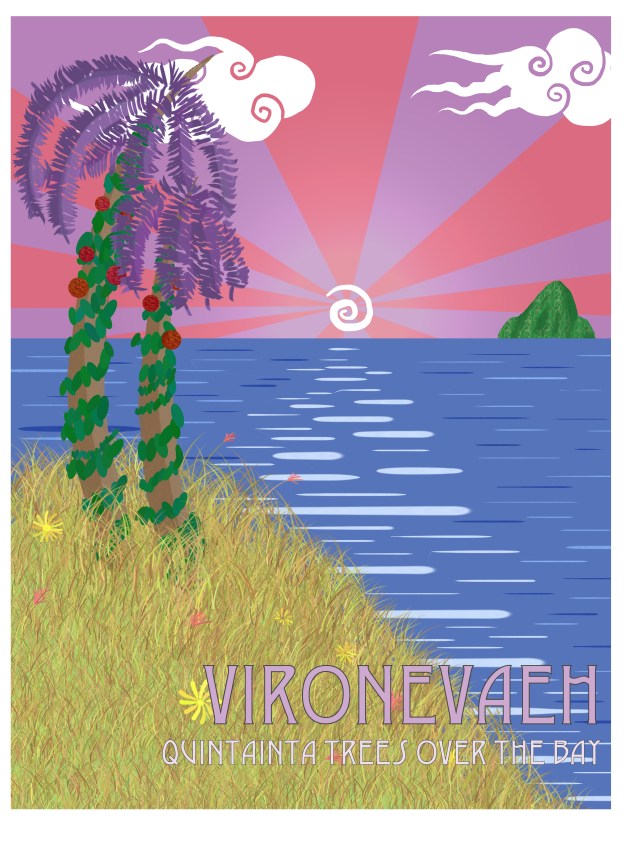
Happy 16th Anniversary, Vironevaeh!

Sixteen years ago I first started writing about Vironevaeh, the extraterrestrial city that is the namesake for this website. In middle school I was that kid– I told everyone who would listen that I was an alien. I was so bizarre kids didn’t know how to bully me, not that they didn’t try. I happily kept inventing my world.

In high school I started to read the classics of sci-fi (my top 20 scifi books). Before that, I think Vironevaeh was an alter-ego–I had a different identity there, and knew different people. Advanced having of imaginary friends. The classics gave me a different perspective, the perspective of world-building. I’ve been slowly plugging away ever since. There’s a spreadsheet with a thousand years of history, some more densely detailed than others. There’s a list of the 1027 first Vironevaeh. There’s a ton of pointless info, as there is so much pointless info in life. But all of it was a labor of love, through all the years of perplexed looks.

For your delight, some of the works from over the years. It is good to pause at times and review the path. I’ve posted a lot more recent works on this blog; here are some oldies. Drawing for Vironevaeh forced me to push myself. (Many other illustrations are also available in Vironevaeh: Science Fiction Fairy Tales, which is free on the iPad.) Some things are worth the long-haul.

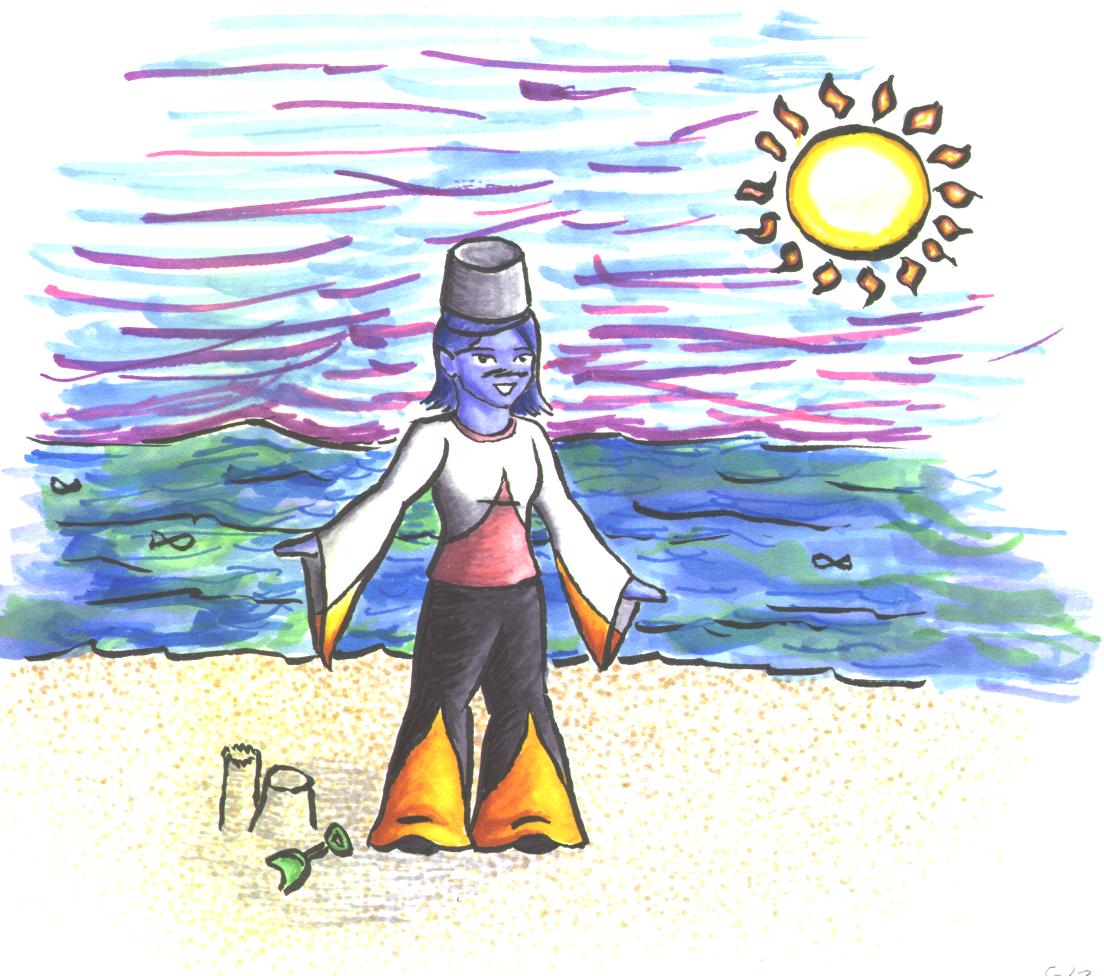
Jainus Aillette Torwin Trarce at beach_marker

My alter-ego, Jainus. From 2004.

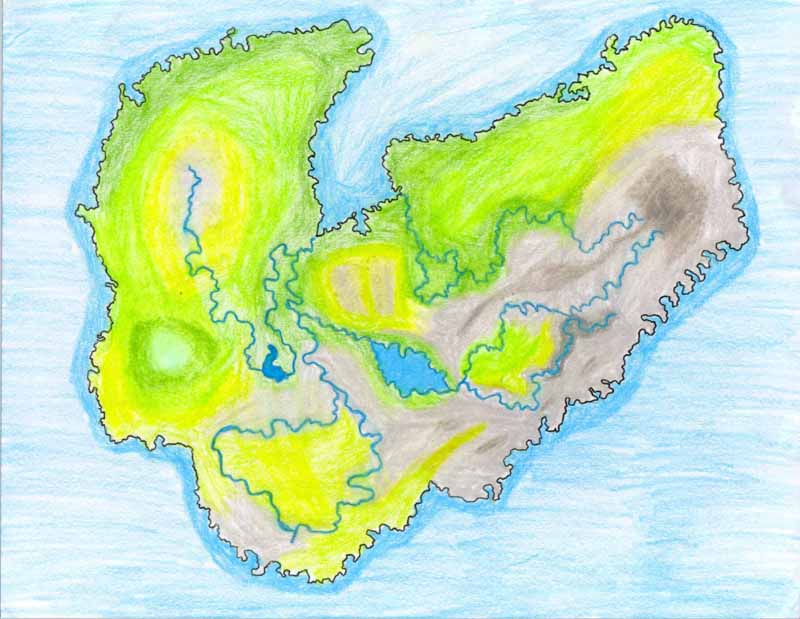
Vironevaeh relief map 800pix

Map of the island of Vironevaeh, from 2004 or before.

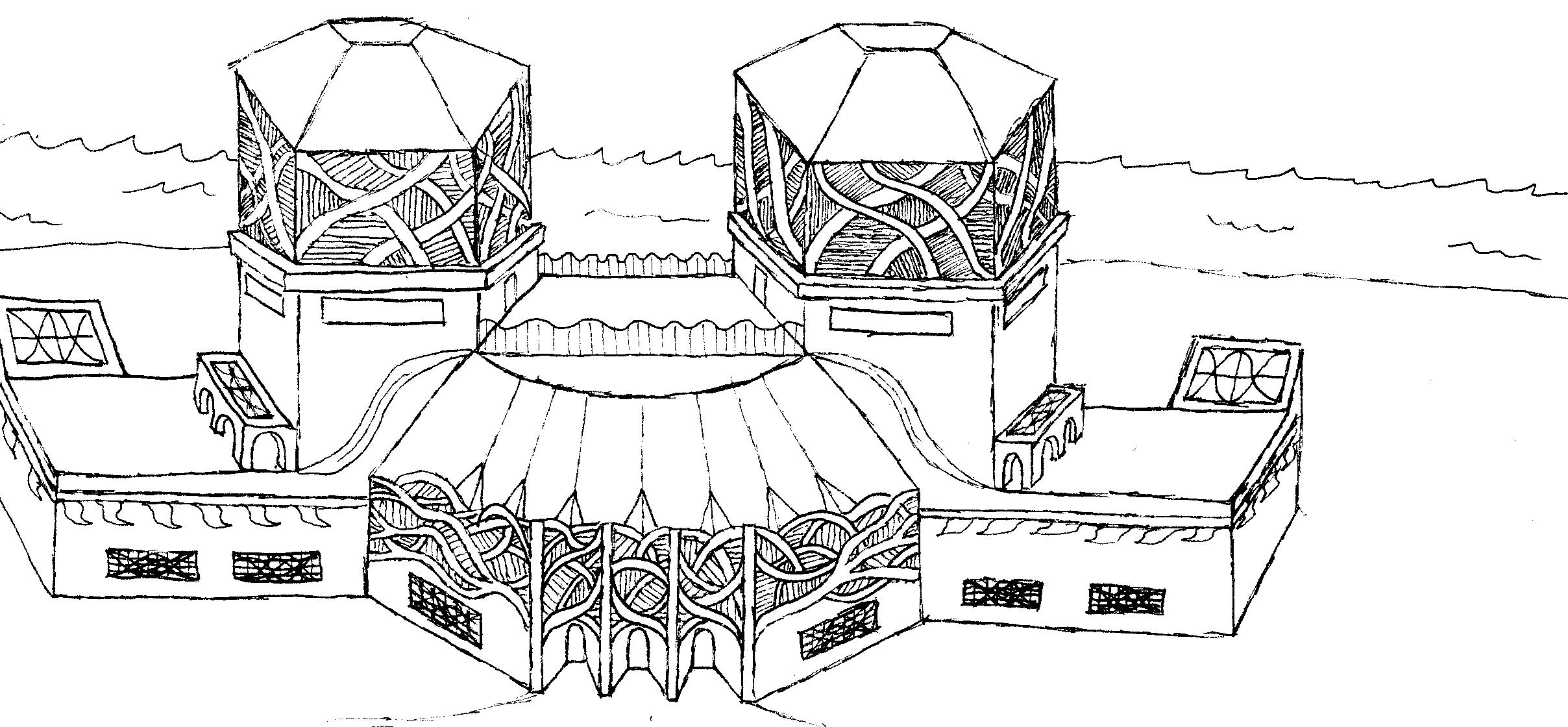
building Palace_at_Vironevaeh_Proper

Palace, 2003.

clothing1 v2

Clothing from one historical period, 2007.

ChibiTempest

One of Jainus’ sisters, 2001.

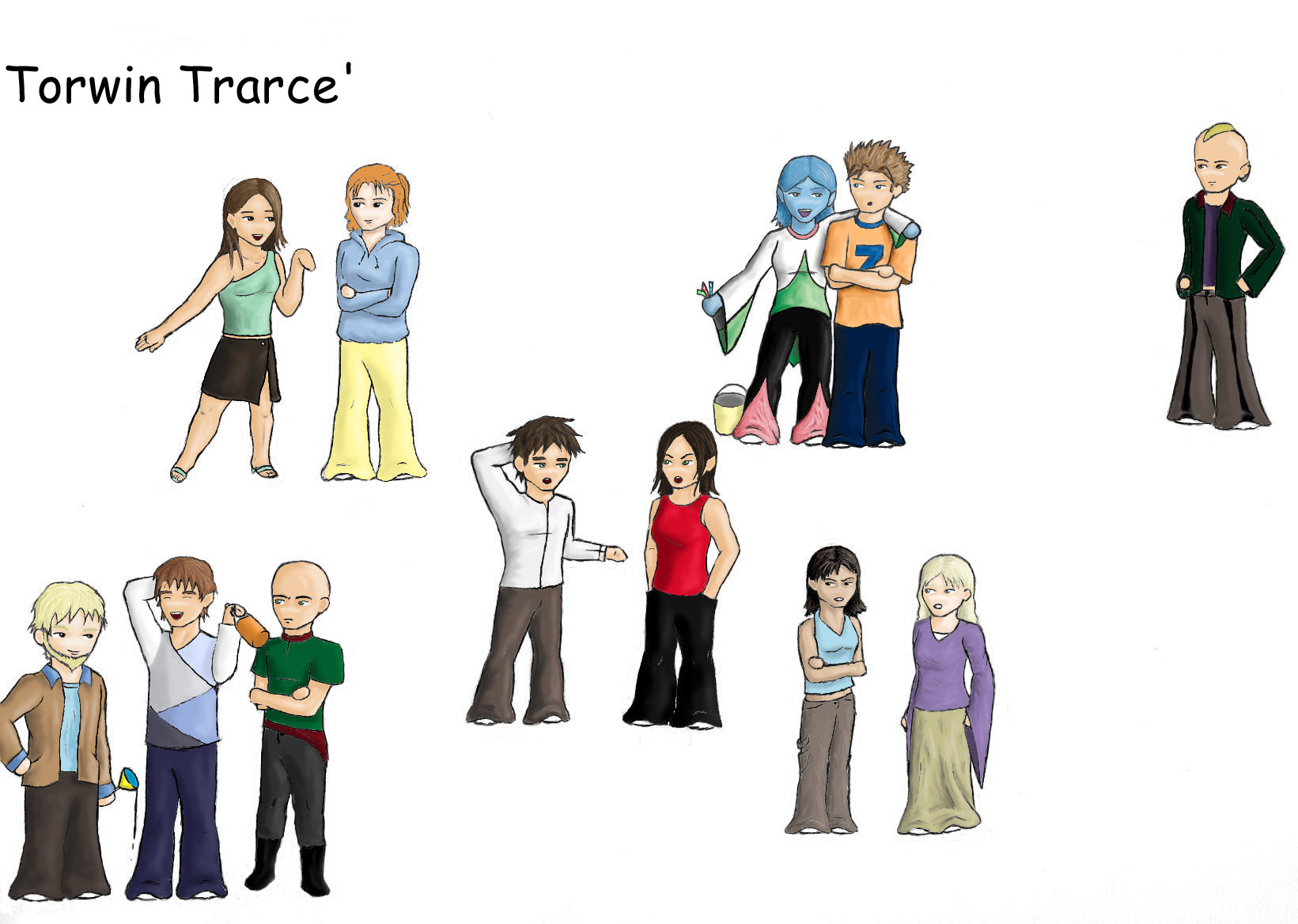
Torwin Trarce chibi pencil tablet

Jainus and her 11 siblings, 2004.

Kolo Kolo Whit in Color

Kolo, a notorious political traitor, 2004.

wormhole invention

Wormholes!, 2011.

Jait Anda Torwin_psd

One of the first Vironevaehns, 2004.