Tag Archives: science fiction

Writing prompt: Pop-up People

Time: 7 minutes. Click here to go to my list of prompts.

“Pop-up people”

Light speed was a drag—it left the far colonies as alien to us as Victorians from Flappers. So when GE broke the barrier, a cheer went up. There was more celebration than when Lindbergh crossed the Atlantic. But the scientists soon realized the limitations to their ©SuperWarp Field. No space more than a cubic millimeter could exceed light speed. We had communication, but no transportation.

Every attempt to spread the field beyond a cubic millimeter failed, often disastrously. Finally another idea arose—if the field couldn’t grow larger, maybe the object could grow smaller. The nucleus is compact enough, but around it, electrons swim in a luxuriant, and frankly wasteful, vacuum.

Using the repulsive nature of dark matter, Sandia devised a way to compress matter as in a neutron star. Suddenly, a cubic millimeter was a damned fine amount of space. We sent little grains of rice to the colonies, full of a thousand people and a multitude of machinery in compression stasis.

The pop-up people went to the stars.

Writing prompt: I’ve never seen one, but how hard could it be?”

Time: 7 minutes. Click here to go to my list of prompts.

“I’ve never seen one, but how hard could it be?” (This prompt inspired by the Erie Canal, built by four men who hadn’t even seen a canal when they set out to build one.)


“I’ve never seen one before, but how hard could it be?” Emmaye Cevluss said. “They built them practically in medieval times, it’s just a ditch full of water.”

*

Three months later and how she regretted those words. Without construction equipment, how did she remove the dirt? Without drafting software, how did she visualize the project? How would she calculate stress loads? On this new world, where would she find the materials for good concrete? For good steel?

How hard could it be? A canal connecting the bay to the western part of the peninsula with the quarries and mines. It might as well be a space elevator. Since they had arrived on this world, every day was a day spent learning to adjust to all the things it didn’t have.

Their ship, the Neva, was supposed to help with many of these things. Instead it sat broken, useless, to the west. All the energy it held was devoted to cold storage, to keep biological samples like seeds and useful fungi and bacteria until they could be properly used. And now the cold storage was having issues.

And it was starting to rain a lot. Especially a lot for a supposed desert region.

It was going to be a while before there was a canal.

Writing prompt: foraging

Time: 7 minutes. Click here to go to my list of prompts.

“Foraging” (This prompt inspired by the well-known Danish foraging restaurant, top-rated Noma.)


“Announcing the release of the Forage 1000! For the low price of $1000, you can virtually eliminate grocery costs!”

Sylvia showed Tanisha the ad. Tanisha couldn’t share Sylvia’s enthusiasm. For one thing, she didn’t have nearly the shares in the product. But for another thing, Tanisha always felt a little sad when scientific breakthroughs went toward such short-sighted uses. And there was that third thing…

“So what about when everyone has one?” Tanisha asked. She had helped write the software that finally allowed machines to approximate an animal sense of taste. “Then these foragers won’t find much of the cheap grasses and fungi and bugs you’re promoting it for.”

Sylvia shrugged. “I think that’s a pretty good problem to have. Then we up the price. Or make a new one that finds things the old one didn’t.”

Tanisha sighed. She had to say it, she knew it. But it was hard giving bad news to funders. “You can’t.”

Sylvia crossed her arms. “Spit it out.”

“We still have this little problem,” Tanisha said. “It’s not perfect about identifying poisons.”

Sylvia sat.

“The body is complex. Something can taste good but have trace amounts of toxin or parasites or bacteria. Or just be bad for you like antifreeze. We didn’t know until a few weeks ago when we started to use a larger sampling range. Two dead mice.”

“We can fix that, right?” Sylvia said hopefully. “You’re going to fix this.”

Tanisha nodded, and Sylvia left, already on the phone. She turned to the ad. “How am I going to fix this?”

Another Fairy Tale at last


When I released my collection of science fiction fairy tales, it was the start of a push to creatively engage with the world. I finally finished a project and put it out there, doubtless non-perfect like everything. Since then, I’ve submitted my short works nearly 90 times (with 3 acceptances). I’ve joined a writing group and participated in critiquing groups to work on my writing. I’ve studied Adobe’s Photoshop and illustrator, and recently painting, to improve my artistic skills. I’ve studied Indesign and book layout. I started posting regularly on this site, as I have for nearly two years now. The first set of fairy tales started all of this self-improvement.

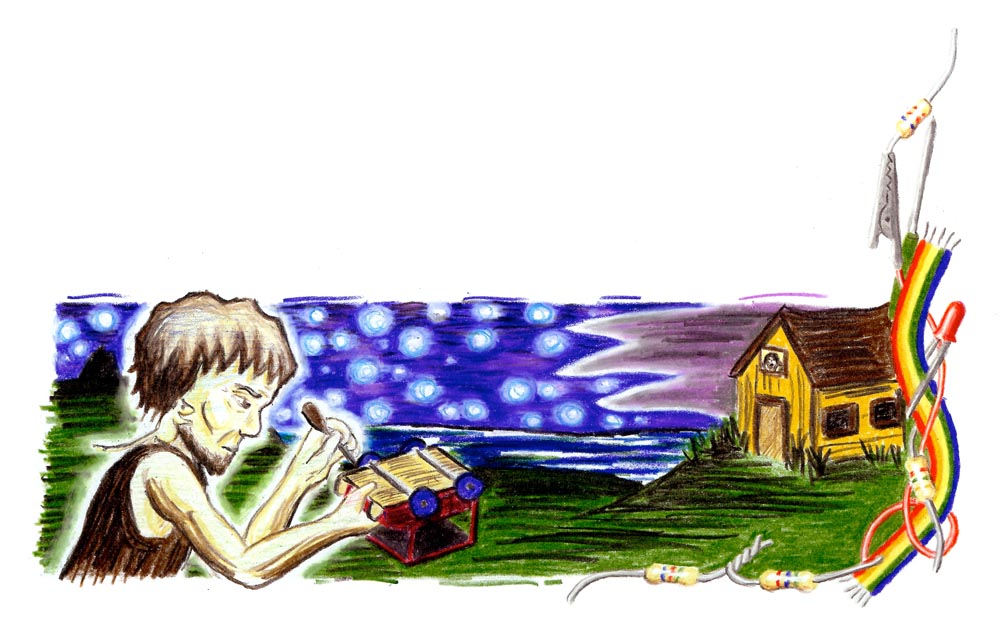
I always intended to do another collection of fairy tales. I recently finished the first story, “The Lonely Man on the Ship”, about a man trapped alone for years on a spaceship during  terrible storms. I did the art with Prismacolor color pencils (which I intend to use for the rest of the eventual collection).

Now I’m coding the fairy tale for the kindle. Once I do, “The Lonely Man on the Ship” will be available free on the kindle and on the iPad. Much of the last two years’ studies has gone into this work. I used Indesign and illustrator for layout work. I used Photoshop to make sure my scanned art work was as attractive as possible. I think the writing is stronger than in the first fairy tales. As the first fairy tales inspired new studies, to release this work properly I’m learning CSS and HTML coding.

So until I finish this last step, enjoy a couple of illustrations!

abenn_ghost-small letterhead-small

Writing prompt: Driftless

Time: 7 minutes. Click here to go to my list of prompts.

“Driftless” (If anyone’s curious, the driftless region is in Southwest Wisconsin. It is indeed full of valley and caves and unwashed hippies. And Holsteins.)

They call this region the Driftless region, a region around which the glaciers split so they didn’t drift the soil. It’s rough and wild, unlike everything else around. As a kid, I always assumed driftless refered to the quality of the region. It didn’t drift. Nothing changed. You came to the region and didn’t leave, and the less washed you were, the more likely you were to arrive.

But the geological reason made sense, too. Still, I wondered, how do glaciers just go about splitting? It seems like you’d need some force to split glaciers. We don’t have high mountains or great volcanos.

We also have a ton of caves around here. I started to wonder, between massive glaciers splitting and rendings in the Earth, well, was there something below? So I read what I could on Wikipedia and packed for a journey under the Driftless region.

I’m stuck down here now. I’m writing down why I came here, as if I don’t make it, hopefully these records do. Small bipedal creatures are running up to me and stealing food from my bag. At least, I think that’s what’s happening. I have no light, and they glow, and either this is a hallucination or I’m onto something really exciting. Either way, I’m not sure about the odds of my survival.

Bizarre Tales from the Three Notch’d Road


Bizarre Tales from the Three Notch’d Road is a collection of  eight science fiction and fantasy stories celebrating the 5th anniversary of our SFF writing group. It’s now available for the kindle here.

All the contributors are local to central Virginia, with stories from tropical islands, snowy oblivions, the distant past and the distant future. The name for this volume honors the Three Notch’d Road, which runs through central Virginia and dates back at least 300 years.

So check it out! It’s the first anthology our group has produced, and we’re very excited and proud!

first-cover

Writing prompt: invasive species

Time: 7 minutes. Click here to go to my list of prompts.

“Invasive species”

Years ago, I watched time-lapse photography of plants growing. Plants move and respond to stimuli and avoid pain like animals, the narrator said. They just do it on a different time scale. That documentary made me wonder what the world seems like to a plant.

Reading the news the other day, that documentary came to mind. The tenta plant has been making its way up from Mexico. Here in the Shenandoah we knew we’d be safe; we have winters here after all. Plants adapt over time, but winter is a mighty thing.

Somehow, the tenta adapts faster. Scientists are fascinated by it the way they always are by hazardous things, like a kitten with a grenade. Some have compared it to reverse transcription viruses like HIV, somehow it has some ability to incorporate genetic attributes of other plants. Surrounded by winter-hardy plants, ten thousand of these plants could try ten thousand combinations.

There are indications of new traits to the plant, as it grows further into more densely settled regions. It was never an irritant like poison ivy, but now it is. Some have nettles.

I remember watching those vines frantically reach toward the light, in some way we can’t understand knowing and feeling what they wanted. Or the ficus tree, slowly growing the life out of its host. I couldn’t help but wonder if the tenta plant had such an awareness to accompany its novel new ability, and what that might hold for the future.

Writing prompt: Lie detector

Time: 7 minutes. Click here to go to my list of prompts.

“Lie detector”

Blood flows in the face indicate certain emotions. Rage is one pattern, confusion another, fear (perhaps of getting caught in a lie) yet another. Some cameras could detect subtle changes in face color from the blood flow, but better yet were cameras that reached into the infrared, to see the heat of that blood flow.

Trish first loved the science of this technology, but after she was denied tenure for lacking funding, she found a new purpose to it. Business.

With google glasses so common as they were, it wasn’t much of a trick to fit hers out with the additional infrared range camera and write the code to show the blood flows overlaid upon their face. She became a human lie detector, able to fox out the lies and bluffs of all but the sociopathic (who incidentally had their own telltale patterns). Perhaps the preponderance of the sociopathic shouldn’t have come as a surprise, but it did.

Still, the funding came in now, and she started up a company. Not with her own special technology, of course. It was her ticket to a bright future. Some other good but less phenomenal idea.

That was, until the meeting with Ms. Teller, who seemed oddly apt at dissecting Trish’s own lies and sidesteps. Reading up on her, Trish discovered Teller’s background in pattern processing and optics. Suddenly, the marketplace had grown just a little more crowded.

To Trish, the solution was obvious—she had to destroy Teller or join with her.

Writing prompt: A door that goes anywhere

Time: 10 minutes. Click here to go to my list of prompts.

“You discover a door in your house/apartment that will lead to any door in the world that you want it to.” (I found this writing prompt through the Reddit Writing Prompts sub forum. Check it out for hundred of writing prompts on all kinds of topics, including this one.)

It was strange coming back to my childhood home after so many years, but probably not so strange as living with my parents after I’d gone forth into the world, expecting my obvious greatness to be recognized. Instead, I was 30, in debt, and back with the folks in rural Missouri. It was humiliating. What I wouldn’t give to be back in Belgium at the chocolate shop or in New York in central park. But most of all, I thought, I’d like to be away from people—Moab. But I didn’t have money, so these thoughts stayed dreams.

In the five years since I’d returned home, mom had redone the kitchen and redecorated my bedroom into a hobby room and dad had given away a good portion of my toys to cousins kids. I don’t think they were thrilled to have me back either. The heavy bookcases of the living room were gone, and I realized I’d never seen that wall. The old wallpaper behind where they had stood was brighter, showing their outline.

Hold on, I thought to myself, noticing another line in the wallpaper. I went closer. It was a seam in the paper, about 7 feet high and 3 feet wide. A door? There was a dent at about the right place for a handle. I pushed, tentatively at first, but when I felt give, I pushed harder.

The door popped open. Moab’s grand orange arch stood in front of me, the blazing hot and dry summer air pouring through the door. I stood and gawked, and several dozen tourists turned and snapped my picture, looking delighted. I pulled the door shut with a slam. Why was there a door to Moab in my childhood home?

The whole front of my body still seared. I could feel the beads of sweat form, half from apprehension I think. I pushed the door open again, bracing myself for the heat. Instead, a rocky coast full of fog and mist stretched before me. Canon Beach in Oregon. The air was refreshingly cool, and then it occurred to me that the door was taking me where I wanted to go. I closed the door.

“Prague, Wenceslas Square,” I said, and opened it again. The square stretched before me, with tinges of twilight falling over it and the National Museum and the Jan Palach memorial. I shut the door again.

“Gabriel, what are you doing in there?” My mother rushed in. “Get away from that wall!”

Writing prompt: Feeling spooked while camping

Time: 7 minutes. Click here to go to my list of prompts.

“Feeling spooked while camping”

I’m not really a camper. But still, I couldn’t turn down an invite from a friend to go camping in the newly opened Blue Ridge preservation area. Even with trees designed to sequester radiation, no one but researchers and workers had been allowed in for nearly 200 years, after the one that missed DC. Now my researcher friend had passes for the soft opening, and what could I say? The Appalachian Mountains were nearly 500 million years old, and I’d never seen them except in pictures of spooky decaying ruins—Monticello falling into the Earth and the old Blue Ridge Parkway cracked beyond recognition in some vids online.

Jaden set up the tent. He’d camped before, but not in this area of course. Tonight and this week, 500 people tested the park, carrying dosimeters and basically giving things one last look-over. I helped Jaden build the fire that night, and I imagined eyes watched us from the trees. I’m sure they weren’t, and I focused instead on what a tricky cooking medium fire and charcoal could be. I couldn’t even tell the cooking temperature.

Insects began as twilight grew deeper, unnerving and yet exciting. These must be the eyes I imagined watching me.