Author Archives: Vironevaeh

November means NaNoWriMo, but with a Twist for me

It’s November and thus it’s NaNoWriMo. Generally this means you write 50,000 words of a novel. I did that last year. This year I’m doing things a little differently. I’m going to do two 15,000 word stories and 24 illustrations. After all, a picture is worth a thousand words?

As of today, I’m at 7,265 words and 7 illustrations. That’s behind pace, but mostly due to a water polo tournament, which has a way of reducing one’s concentration to jelly for a few days (which is not unrelated to the shortness of this post).

I’m glad I did the traditional NaNoWriMo last year, to prove to myself that I could. But this year is about making the wonderful NaNo collective spirit work for me. I feel really inspired, and really excited about my eventual final product. I have two novel drafts that need reworking, and the prospect of another hulking chunk of words sitting around wasn’t very exciting. With the lower word count, I spend more time editing and creating a tighter first draft. I will come out of this month with something new to be proud of, which to me is the goal at the heart of NaNoWriMo.

Print jainus-pjs toys

Writing prompt: Jump forward in your Nano project

Time: 10 minutes. Click here to go to my list of prompts.

“For Nanowrimo: Jump ahead to some future part of your story that excites you and write about that”

Gainarain went into the room. Jainus could hear him speaking over the link, but she couldn’t make out the words. They sounded serious, as Gainarain so rarely was. Everything seemed so serious these days. Terran sat next to her on the couch nearest the door and leaned against her, trying to eavesdrop as well, but also seeking company.

Gainarain stopped talking and came back out. “The queen’s been deposed,” he said.

“Deposed?” Jainus said. In an instant, too many ideas filled her mind. Was there still a monarchy? If so, who was monarch? And if not, who would rule and what would become of them? Terran clearly did the same calculations, she could feel him grow tense and adopt that wide-eyed look that until last week had been reserved for especially large insects.

Gainarain saw their faces and seemed to register their fear. “Oh, no, it’s not a coup or anything. By Terrigan, her brother,” Gainarain said.  “Things shouldn’t change too much otherwise, but of course it’s a big deal.”

They all nodded, but Jainus at least couldn’t calm down enough to figure out the ramifications of it.

“Why?” Dielel asked, dancing her bear around a miniature chair. She didn’t understand any of it, but she saw everyone else’s unease, which prompted her to ask questions.

“Well,” Gainarain said. He seemed uncomfortable. Jainus had a sense it was going to be something personal to them, rather than something for the whole planet. “Terrigan’s your great-grandfather. The next in line after him is your grandfather, and next after him is your mother.” He stopped as if the conclusions were obvious. To Jainus, at least, they were not. She looked around, confused.

Tempest took on a superior look. “We’re directly in line now, not some distant relation anymore.”

Gainarain looked pained. “Yes. So this means no more wandering off of the safe zone, and a lot more supervision. Especially right now, that we’ve been attacked and we’ve changed monarchs.”

Tempest stopped looking superior. “So nothing fun,” she sneered.

Gainarain rolled his eyes. “No, nothing fun.”

Book Review: Ancillary Justice (Ann Leckie 2013)

Note: in this review, I spoil nothing beyond the first few chapters or back cover blurb.

Rating: 4/5 stars

Ancillary Justice by Ann Leckie grabbed me quickly, with tight writing and careful and intriguing word choice. The winner of both the 2014 Hugo and the 2014 Nebula Awards, the most prestigious in sci-fi, it clearly had this effect on others. Only on page 3, we get the wonderful phrase “She was probably male”. The novel reminded me a lot of C. J. Cherryh’s Cyteen, with high space opera and sophisticated scheming. The protagonist, Breq, is a semi-human fragment of an artificial intelligence. I found Breq interesting in expression and nature, and she was easy to root for.

You will notice gender in this book. Breq is from the Radch Empire, where gender is not determinable from appearance nor is it important to try, and thus everyone, male or female, is referred to as “she”. Surprisingly, this totally achieved gender anonymity for me. In Ursula LeGuin’s The Left Hand of Darkness, all pronouns are male, which left me picturing every character as male even though some of them are physically ungendered. Perhaps because female doesn’t seem like the default pronoun, using “she” didn’t feel the same. We know that Breq is a female human and her companion Seivarden is a male human, but we don’t know the gender of most of the characters.

Unlike Left Hand, Ancillary Justice doesn’t dwell on gender. The Radch convention is what the characters use, unless they are speaking in another language, and that is that. We never find out why the Radch in particular ignore gender in a way that must have been a determined effort at that level. Have their sexual proclivities evolved with their language too? I wondered. In a way, not knowing answers to questions that had inspired such curiosity in me bothered me. But in a way, it was in keeping with the Radch Culture– gender wasn’t important there and it wasn’t important in the book, and it was my hang-up only that kept it there. Why did anyone’s gender matter to the story?

I suppose it’s strange to devote such a chunk of my review to something that the book doesn’t dwell on. But still, in the contexts of our language, it was a major choice on the part of Leckie. It makes my brain itch in such a delightful way.

The novel has several other nifty science fiction ideas. Breq’s current sentience versus her life as an AI is wonderful. Leckie uses music to characterize Breq in a way I really enjoyed. The Radch Empire is also pretty interesting, though it sounds obnoxious. They run around and brutally conquer and are filled with narcissistic oligarchs like Seivarden. The empire is run by several thousand clones of the same person, Anaander, who for some reason I kept on picturing as Edna Mode from The Incredibles, but that weird detail is almost certainly on me as a reader.

I ended up giving the book a 4/5, though I still debate myself over the rating. A book that I read in a day and a half because I was so enthralled, a book that still has me thinking a week later should be a 5/5. But I felt like the book didn’t quite come together for me at the end, like it was all sweetness and no substance. I didn’t ever feel uncomfortable or uncertain as to the outcome. That said, I would read it again, and recommend it to others. Read it yourself and see what you think.

Writing prompt: Expand a detail from an existing story

Time: 7 minutes. Click here to go to my list of prompts.

“Write in about a small detail from another story as its own story” (In this case, another story mentions the excitement caused by a two-headed snake.)

People from the next three hollows over agreed that the two-headed snake was the most amazing thing they’d ever seen. Only old Alvin Teek, always crazy but growing more combative as he aged, was unimpressed. But then he thought there were buildings made of glass taller than any tree and invisible light that could cook food. Whatever hollow he originally came from must have died out for lack of practicality. The man couldn’t even catch his own food.

After the bomb, it was common to see animals with growths or legions. They were usually pretty sick. The most interesting ones were always dead. Teek said it was the radiation, some relative of his magic cooking light. But the two-headed snake was alive, and mad as hell that we’d caught it. It bit one of the honored blue men, and the other blue men were jealous that he’d grown closer to the hills until his wound grew infected and he lost the hand. One only wanted to be so close to the hills.

Lately we’ve been seeing things in the sky. Teek says they’re planes, full of people. They look like slow-moving shooting stars. They’re not full of people, but they do seem full of meaning. First lights in the sky, now a two-headed snake. They’re omens for sure. Times are going to be changing. The land we live on is older than the world, but we aren’t. The elders say the land is preparing to shed us once more.

Uriah P. Levy: American badass and savior of Monticello

Uriah P. Levy was the first Jewish commodore of the Navy. He abolished corporal punishment in the Navy. He was the subject of six court-martial trials, a navy record. He bought Monticello after Thomas Jefferson’s death; he and his nephew preserved it for us today. When I ran across his story, I couldn’t believe I’d never heard of this remarkable man.

Levy ran away from home at age ten to sail, but returned home at 12 for his bar mitzvah. He fought in the War of 1812, and was imprisoned by the British. He chose the navy over more profitable merchant work; he knew the discrimination he would face, but felt an obligation to serve, for his country and for his fellow Jews.

In 1816, an anti-Semitic crewmate named Potter challenged Levy to a duel with pistols. They walked twenty paces, then Potter fired and missed. Levy had tried to talk Potter out of the duel; he fired into the air. Potter would not be placated. Four more times, they reloaded, Potter missed and Levy fired into the air. On the sixth round, Levy killed Potter. He was eventually found not guilty on charges of dueling and exonerated in his court-martial hearing. He had five more court-martial hearings in his career, each for incidents fueled by anti-Semitism.

Levy bought a decrepit Monticello in 1836, ten years after Jefferson’s death. In that day, Jefferson’s defense of religious freedom wasn’t held in high esteem; in 1840 a visiting Episcopal clergyman called Monticello a “fitting monument” to Jefferson. Levy’s family had fled the Spanish Inquisition in Portugal. He repaired the house and purchased land that had been sold to satisfy Jefferson’s debts to rebuild the estate.

Levy’s first commission in the navy was the first ship in the navy without floggings for discipline. Levy played a role in the passage 1850 anti-flogging bill in Congress.

Upon his death in 1862, Levy willed Monticello to the American people. His will was broken, and the property was divided amongst relatives. Monticello fell into disrepair. Animals were stabled in the house.

In 1879, Levy’s nephew Jefferson Levy bought the house. He restored it, and sold it to a memorial foundation in 1923. The 1943, the navy commissioned the U.S.S Levy.

I had never heard of Uriah Levy before I found his name in an essay, even after living in Monticello’s shadow for six years and attending Jefferson’s university. He bravely served the country even when his country didn’t serve him. His is a remarkable and American story, and we should tell it more often.

Fun and inspiring: The Library of Congress online archives

My trip to the Library of Congress building later led me online to explore their equally amazing catalog of images. They have thousands of high-resolution images, from baseball cards to Japanese prints to Spanish civil war posters. And that’s just the prints and photographs section.

I preferred the collection of WPA posters. They combine beautiful design with period topics that can seem wacky today. Ride the El! Get tested for syphilis! Beat the Germans! Children’s piano competition! Over 900 governmental exhortations paint a vivid picture of 1930s life. I was amazed by the number of posters for illness: tuberculosis, syphilis (31 posters alone!), diphtheria, scarlet fever.

The posters are also great sources of design inspiration. Most have playful typography and engaging graphics. Many of them are available as high-resolution TIFFs, so you can print them out and have instant decor. My bathroom now has posters about syphilis and pneumonia. I’m sure my guests will feel safer.

And without further ado, some favorites:

As old as creation, Syphilis is now curable.

pneumonia strikes like a man eating shark led by its pilot fish the common cold.

The Art Institute of Chicago international exhibition of water colors

An orderly line is a safe line!

Stop and get your free fag bag– careless matches aid the Axis.

14th Illinois Cattle feeders meeting.

Art and Math: Poemotion (Takahiro Kurashima)

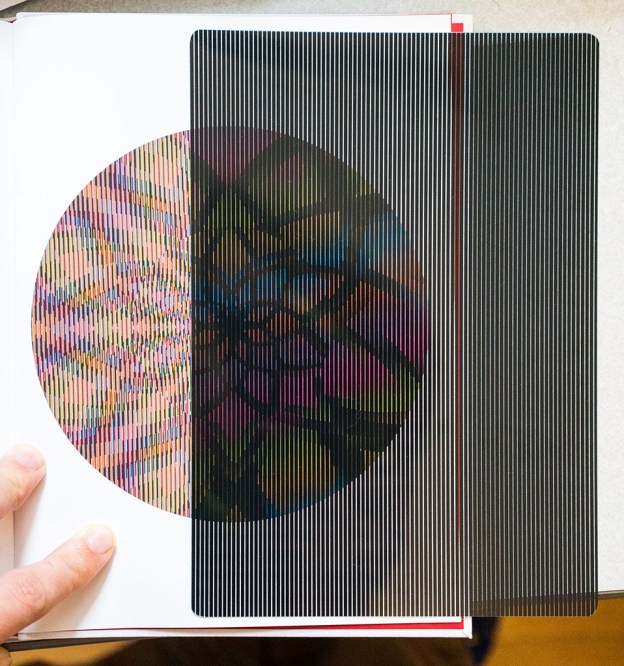
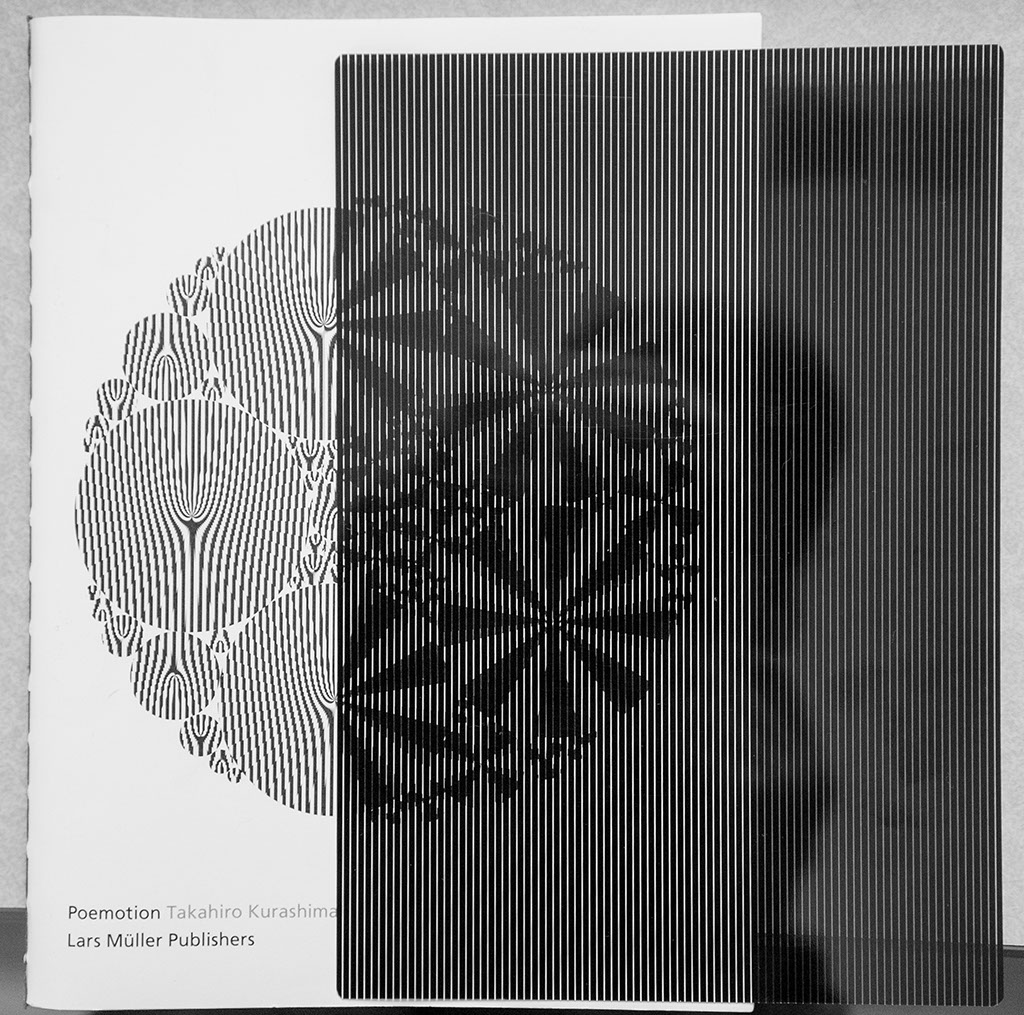
Poemotion and Poemotion 2 books of astonishingly beautiful patterns. They are beautiful because they are so simple and yet I struggle to describe them here. The book comes with a lined overlay, and when the images of the book combine with the overlay, they dance and amaze.

These dancing patterns arise from something called a Moiré pattern, a creature of math and physics. These kinds of patterns naturally arise when two patterns are overlaid.

Moire pattern (wikipedia)


You’ve probably seen Moiré patterns when people wear busy patterns on tv:

We usually associate Moiré patterns with annoying visual artifacts, but science has found several ways to exploit them. Moiré patterns can be used to measure strain in materials. They can also be exploited to take microscope images at high magnification. The little lines on US dollars are designed to create Moiré lines when scanned, as a mechanism for defeating counterfeiters.

Kurashima’s Poemotion (just in black) and Poemotion 2 (in color), contain dozens of Moiré patterns. Every time I look at them, I feel such simple joy. The patterns are so deeply familiar and yet I had never consciously noticed them before. These books made me look at the world differently.

DSC00928 DSC00933 DSC00935

Writing prompt: An elderly diatribe

Time: 7 minutes. Click here to go to my list of prompts.

“An elderly diatribe”

“The children are not ready to inherit this planet. By their age, I had my second doctorate and a dozen papers. It isn’t their fault that no universities exist on this compromise of a planet, and yet none do. They are experienced at excavating and earth works and weatherproofing, but so was my general contractor in Seattle. I would not choose to leave the fate of a civilization in her hands.

“The young will say, who, then? Us. It still has to be us. The masters of physics and chemistry and psychology and metallurgy and meteorology. These aren’t fields where hunches suffice.”

I paused. I rubbed my aching, weary hands. My grandmother hadn’t looked this bad at 110, and I was only 80. So many from my generation had already died. We didn’t have real universities, and we didn’t have real hospitals. These things hadn’t occurred to us when we left Earth, full of vigor and zeal. Now what I wouldn’t give for an anti-inflammation treatment at an Appalachian spa.

We would have to hand over the reins at some point. But everything seemed so perilous still. Food supplies were a constant concern, weather still dominated every day, and the foggs were still deadly in the east. As my generation died, the next struggled to replace their skills. They were failing.

Book review: One Summer- America 1927 (Bill Bryson 2013)

Rating: 5/5

In One Summer, I learned a ton about a period I didn’t care about. I care now. I’m from St. Louis, and I didn’t care about The Spirit of St. Louis or Lindbergh. Last week, I saw his plane in the Smithsonian. I tried to imagine flying for 33 hours with a single engine, a pen and paper to chart my course, protected from the elements by canvas. I tried to imagine landing in Paris, the field mobbed with people, with a plane without any forward-facing windows. Apparently it was beyond the imagining of even his contemporaries–they favored multi-engine planes with multi-man crews. In that tiny plane, Lindbergh flew better than any of them, and his flight ignited an aeronautic industry in the US which had badly languished.

One Summer centers around the summer of 1927, the summer of Lindberg’s transatlantic flight, of Babe Ruth and Lou Gehrig’s home run battle, of the execution of Sacco and Vanzetti, and more. The summer of ’27 is the primary focus, but Bryson weaves in details from decades before and after, covering Warren Harding’s mega-corruption, Herbert Hoover’s relentless self-promotion, and Henry Ford’s remarkable stupidity and racism.

One Summer does what I wish my history classes would have– it gives not just the facts and the names, but a sense of the 1920s versus today. In one 20s baseball double-header, the first game lasted 50 minutes, and the second lasted an hour and 15 minutes. As a lifelong fan of baseball, I had no idea that baseball even could be so brief. Neither did any of my friends. I was shocked. On one hand, the 20’s reveled in public gatherings and the wonder of radio broadcasting Lindbergh’s return. On another, they suffered the anxiety of mass immigration, anarchist bombings, and prohibition.  In short, One Summer relates the wonder of a world rapidly transitioning from an isolated one to an interconnected one.

I can’t imagine who I wouldn’t recommend this book to. It’s light enough to fly by, but full of unconsidered things. In a world of ISIS and shitty politics and Mexican immigration, it’s somehow relieving that the ’20s dealt with Italian anarchists, the worthless Harding administration, and eastern European immigration. Those who don’t remember the past may or may not be doomed to repeat it, but remembering the past surely puts the present in context.

Writing prompt: Farming the Death Valley

Time: 7 minutes. Click here to go to my list of prompts.

“Farming the death valley”


Dad said I was a hero. Mom wouldn’t speak to me. I was going to go farm in the Death Valley, so neither of their reactions were really at the top of my mind. I went to the City Works, excited and nervous.

“These are the seeds you’ll take. I see you’ve done work in the local farms, so you probably know what you need to. Still, we have a training course for you. The conditions in the valley are a little different. Wetter. You’ll have to watch for rot more, but things grow there.” The representative spoke in slightly awed tones. Everyone seemed to.

“Different conditions… and different critters,” I remarked.

“Yes, different critters. That’s part of the course. I… didn’t want to be grim. You know most of the farmers survive, come back very profitable. The valley is supposed to be beautiful, like a paradise.”

“Most. So… more than 50%? How much more than 50%?”

She looked away. I snorted softly.

“It’s a good thing to do,” she said, with softness that spoke of conviction rather than the propaganda associated with her office. My sister went.” She paused, and I felt like she didn’t return. “The yields they can get in the valley… people like you keep children from starving.”

“That’s not why I’m doing it,” I said.

“Well, that’s not up to me,” she replied. “But we try to prepare you for the valley as best we can.”

“It’s mist. It comes in under the doors and takes you in the night. Is there a preparation for that?”

She looked away again.