Author Archives: Vironevaeh

Writing prompt: What if there was no Bering Land Bridge?

Time: 7 minutes. Click here to go to my list of prompts.

This new world is an untamed wilderness, with not a man in sight. What are in sight, or at least in mind, are the terrible beasts that roam the wilderness. They are easily killed by daylight, but at night, we are the quarry. The cheetahs and the lions are the most fearsome. We see nothing, we hear nothing, but in the morning there are paw prints, and another man or horse is gone.

Michael says he hears spirits in the hills. He says that where there are no men, the ghosts of men must roam, that perhaps we have sailed to purgatory or something like it. I didn’t believe him. But then we saw a group of dark-skinned men in boats. They have no villages, and they sow no crops. They seem lost, like us or like spirits. Maybe we are dead too.

I don’t know if these are good spirits or evil spirits, but Michael says they are low and savage either way. He says that we should claim this land for the crown.

I don’t see much to claim, besides forests and beasts. We don’t know what to eat, we have not yet found gold or spice or empire. There is space to settle, but such a prospect seems daunting indeed. Perhaps we must take it, if only to rid it of evil spirits and the Dutch.

Guns, Germs and Steel: An Excellent Science Fiction Resource

For the last few weeks, I have been reading Jared Diamond’s Guns, Germs, and Steel. I would recommend it; there are over 1600 reviews on amazon that can tell you as much. Significantly for me, I found Guns, Germs, and Steel to be an excellent science fiction resource.

I am often skeptical of social sciences. Unlike math or physics, the simplest, most beautiful solution is often not the correct one in sciences describing human behavior. Guns, Germs, and Steel does an excellent job arguing a difficult central thesis. It does this by approaching the question from a bevy of angles, and asks what we would expect to be true in alternate scenarios. I am not an expert in this field, so I wouldn’t know if the book is overlooking any key angles, but I found the arguments convincing and honestly laid-out.

“Guns, Germs, and Steel” is the author’s shorthand for why Eurasian societies ended up defeating Australian and American societies. The majority of the book discusses prehistory such as the acquisition of crops, domestic animals, societal structure, the means by which Eurasian societies obtained guns, germs and steel so disproportionately to other societies.

This book is a must read for any science fiction author. Especially during the first half, I was mesmerized at the possibilities posed by this book.

Take one simple argument: Eurasian societies had a built-in advantage over American societies because Eurasia is oriented in an east-west direction, while the Americas are north-south. Crops domesticated in one part of Eurasia, such as the Fertile Crescent, could easily spread to other areas with similar climates, such as Italy. In the Americas, corn domesticated in central America took millennia to reach north America, because the central American corn was not ideal for northern climates. Only when a hardier corn came about did the corn spread north.

In another example, the author suggests that most plants are not suited to domestication; by chance, some of the plants most suited to domestication were in the Fertile Crescent. Regions with less suitable plants took longer to convert to farming, which delayed other advances. Present-day hunter-gatherers are experts on the properties of local plants, so along with other evidence, we can infer the lack of plant domestication in some areas was due to the lack of suitable candidates. Even in modern times, the only Australian plant domesticated is the macadamia nut, suggesting that the lack of crop-ready plants kept aboriginals as hunter-gatherers, rather than any biological differences amongst peoples.

So why does this suggest sci-fi? Much of the book is concerned with how environment shapes peoples. How would a society marooned far from Earth either thrive or degenerate back to more primitive ways? Much of it would have to do with the available resources, which would be shaped by the planet. In an alien society, which sub-group would tend to have which advances? If the land-bridge to the Americas was at a lower latitude, how would history have proceeded? If American societies had large domesticated animals, would they have resisted western invasion more, with diseases and beasts of war of their own? If the Cape of Good Hope had had suitable crops for domestication and thus supported a more advanced society, would the Dutch have gained a base of operations with which to fight the Xhosa?

Many possibilities suggest themselves for alternate histories, alien histories, or arcs of human colonization. The best books are ones that inspire and stimulate the imagination– this one did for me, and thus I strongly recommend it.

Writing prompt: the newt and the cat

Time: 7 minutes. Click here to go to my list of prompts.

“The newt and the cat” (This prompt inspired by my highly predatious cat, Erg, who happened upon a very unlucky blue-tailed skink in the house. I helped the skink to escape, more or less intact, but Erg was inconsolable.)

I collapsed onto the chair inside the door. Summer was here, and wow, I was sweaty. I looked over and noticed that the door of the cage was open.

“Oh no oh no oh no,” I muttered to myself and I bolted upright. I wasn’t supposed to have brought the newt home in the first place, but I’d gotten attached to it. I wanted to see how a super intelligent newt would react to a new environment, and maybe I had become a little too emotionally invested.

I heard a clatter from the dining room.

Jaws stood, body absolutely taut, staring between two stacks of books.

“Bad kitty!” I shouted. Newton looked up at me, both terrified and accusing. In that moment, Jaws decided to lunge, and the stacks of books collapsed into chaos. Newton shot out from the pile and behind a pile of papers. I chased after Jaws, but under the furniture I was no match in speed for him or Newton.

Jaws pounced again, and Newton darted to another stack of debris. For once, I was thankful for my shabby bachelor digs and cleaning regimen. I went and got the compressed air, Jaws’ arch nemesis. I sprayed and him and he ballooned into a fluff of fur, but he would not abandon the hunt, and evaded any attempts I made to contain him.

I would be finding out just how smart my modified newt had become.

Playing with Paper Cutting on a Silhouette Cameo

On Friday, my Silhouette Cameo came in the mail. This device cuts paper according to an image file; analogously, a printer lays down ink according to an image file. Until a couple of months ago, I had no idea that such a device existed, but now I am full of ideas for it.

When I researched the Cameo online, repeated complaints spoke of how useless the software was. The software that ships with it is woefully inadequate, and, from what I could see, only much good for making circles and rectangles. Silhouette has a wide variety of templates available for purchase, but I don’t want to pay for everything I print, and I want to design my own things.

Fortunately, there is a plug-in available for Adobe Illustrator that allows you to build vector graphics in Illustrator and then export them to the Silhouette Connect program. Unfortunately, this plug-in costs $40. However, to use the machine properly, this plug-in is basically a must, so I treated it as part of the purchasing cost. This plug-in only came out in December, and the previous plug-in was apparently quite out of date.

With this plug-in, I found the Cameo really easy to use. For comparison, it is much easier to work with than a basic desktop printer. You just set the blade to a height appropriate for the paper (thick card stock will obviously require a taller blade than thin printer paper), export the vector graphic to Silhouette Connect, and select the layer you want to cut based upon. You can cut around printed designs; you simply have to include some marks on the print out to help the Cameo optically align.

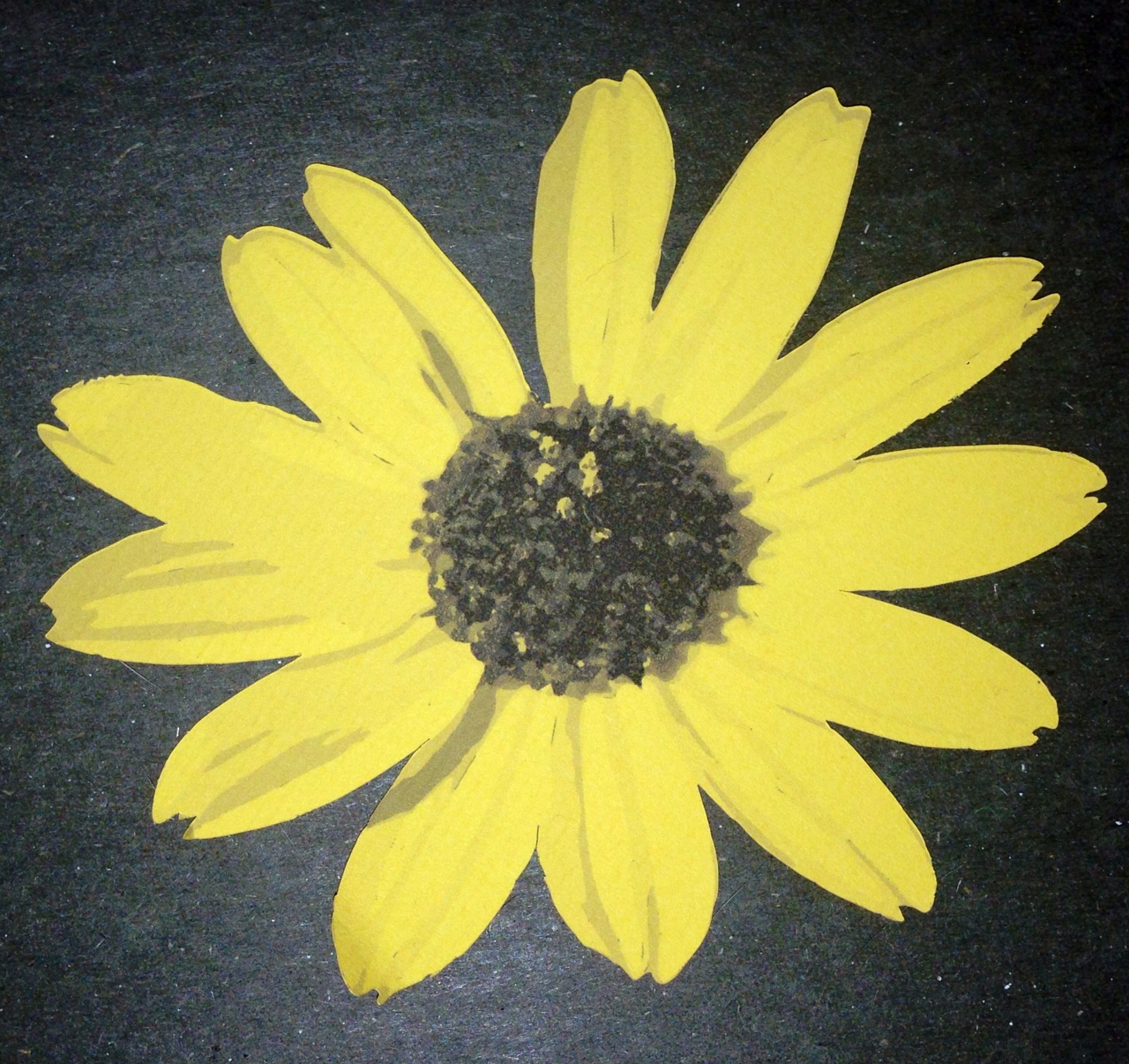
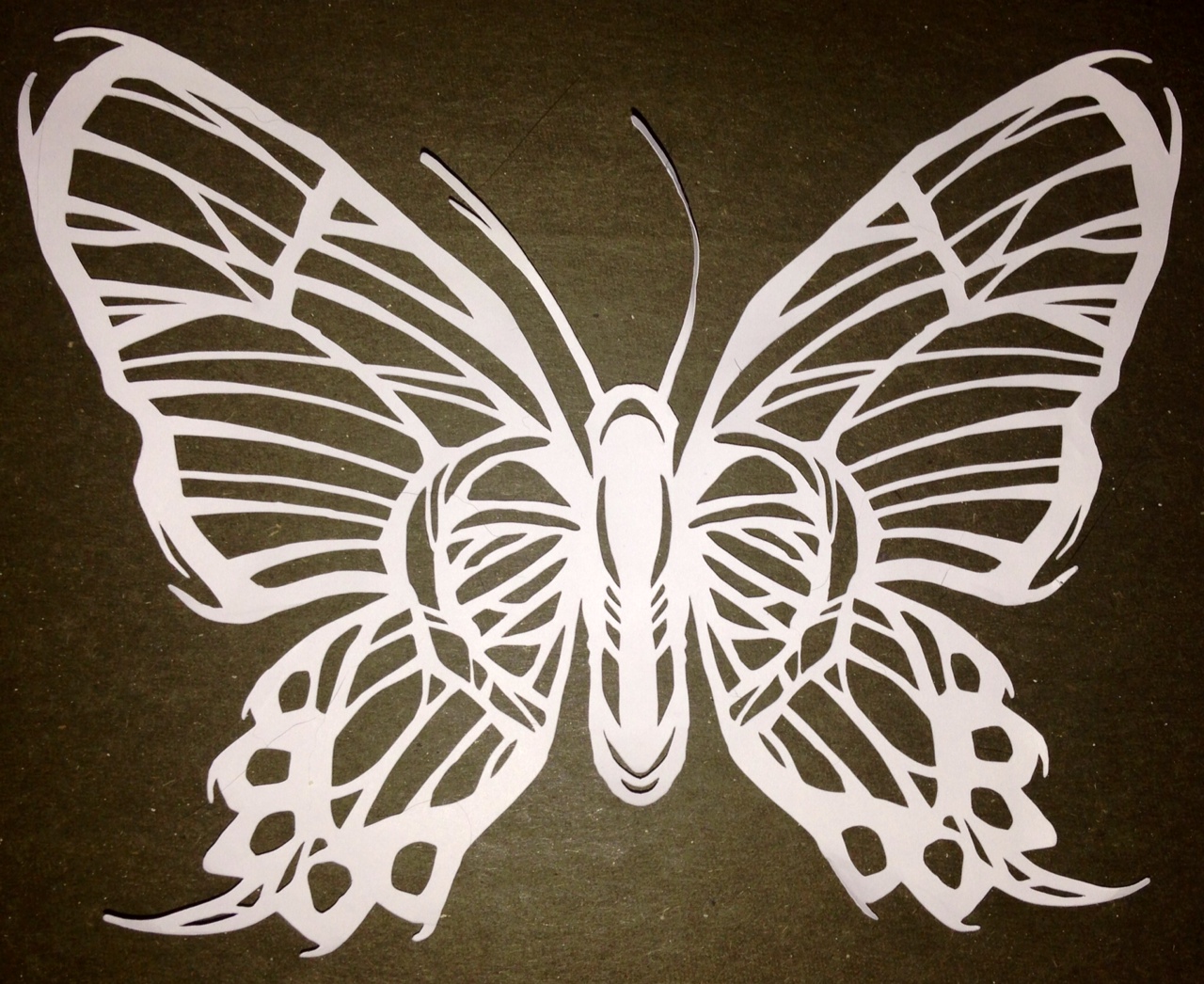
So, below are some of my first works. The butterfly is not my own design work, but came from a Lynda.com tutorial video; it seemed like a robust test of the Cameo’s accuracy. The second has a design printed onto a yellow background which was then cut out by the Cameo.

photo 1-1 photo 2-1


There are tons of exciting options for the future. I mentioned my enthusiasm for pop-up books many months ago, but it was too hard to reproduce the work. Now the process of making copies is easy. Additionally, I have always loved paper dolls, which seems right up the Cameo’s alley. I admire bookbinding techniques that allow interactions between the pages through cut-outs; this device is perfect to obtain the reproducible results I would want.

Final conclusion… this thing really makes me want to get a CNC machine.

Or at least a 3D printer.

Writing prompt: The Shortcut

Time: 7 minutes. Click here to go to my list of prompts.

“the shortcut”

Angie knew all the steam tunnels under campus. They were for maintenance, and students weren’t supposed to use them, but Angie did anyways. She used them because they were convenient and because they didn’t pile with snow and mostly because they made her feel special. She didn’t always make as many friends or attend as many parties as her classmates, but she understood the university and the campus in a way that they didn’t. It was their college experience, not hers, that was stunted.

She first discovered the tunnels by accident her freshman year. A door leading into a hillside, normally a nondescript metal thing, stood wide open. She went inside. And found a secret world coexisting with the world above, with scrawls upon the wall and interesting pipes and strange words. She’d begun to draw maps of the pipes, as well as she could work them out in her head.

Today she wasn’t here to get to class quicker or avoid the rain. Today she was here because a door in the north tunnel and a door in the south tunnel looked strangely similar and very old, with marks and carvings like she’d occasionally seen elsewhere in the tunnels. And if they connected, they would take her to an unexplored area. And they would make an awesome shortcut from chemistry to econ. She pulled the door, and with a great squeal, it came open.

She heard chanting. Did others know of the tunnel? She didn’t know if she was jealous or if she’d just found a group of people to whom she could truly belong.

Heroes, Villains, Anti-Heroes, and Sadsacks

Heroes and villains populate our fiction and our imaginations: Batman and the joker, cops and robbers, the Allies and the Nazis. Not every central character fits the standard hero or the standard villain, though; the anti-hero shows up too, with the BBC’s Sherlock or Yossarian from Catch-22.

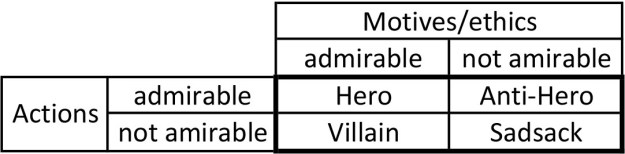
Last weekend at Ravencon, I went to a panel called “writing believable villains” with T. Eric Bakutis, Tim Burke, Andy Beane, Kate Paulk and Gregory Smith. One of the panelists briefly summarized anti-heroes and villains: the anti-hero does the right thing for the wrong reason, and the villain does the wrong thing for the right reason.

That is, the anti-hero does things we would consider good, but not for altruistic reasons. Han Solo transports Luke and Obi-Wan from Tatooine because he is paid, not because he is trying to help them or take a stand against the Empire. Conversely, a satisfying villain does things we consider bad, but motivated by ethics or values of his own. Nurse Ratched in One Flew Over the Cuckoo’s Nest does horrible things, motivated by her belief in order and conformity. The villain in the latest James Bond movie, Skyfall, is motivated by his obsession with M.

We often disagree with the villain’s ethics, but they are present, and can make them even more dangerous. Hitler wasn’t so damaging because he wanted to kill millions of people; he was dangerous because the mythos he used to support that goal drew others in.

Clearly, then, the hero is a character who does the right things for the right reasons, like Luke Skywalker or Superman or Frodo. The boundaries between each character type is complex, and these categories are more food for discussion than iron-clad designations. One story’s hero is another’s villain.

Still, I thought that the anti-hero/villain comparison above invited a fourth category: the sadsack. The sadsack does the wrong things for the wrong reasons. We are emotionally compelled to root against the sadsack, and feel a sense of satisfaction when they fail or face justice. A lot of newer characters fall in this mold for me: basically every character from “It’s always sunny in Philadelphia”, Lester Nygaard in the new “Fargo” TV series, as well as the main character in “Being John Malkovich.”

What do you think? What are some other examples of good villains, anti-heroes, and sadsacks?

Workbook2

Writing prompt: The rain man

Time: 7 minutes. Click here to go to my list of prompts.

“the rain man”

I rolled into Pittsburgh around 3 PM; by 5, the rain had begun. I can travel at 400 miles an hour 30,000 feet above the ground—it’s called a jet airplane. Those hours gazing out the window at the blue sky and the bright sun, and those first few minutes on the ground in a new place, the beams of sun warming my skin and the green leaves of trees shining—those are rare and special moments in my life. Because where ever I go, the rain follows me. At the least, the clouds follow.

The rain followed my father too. He told me that we have an obligation to keep to the road. He was a travelling salesman, and I didn’t see him too often. I didn’t understand at the time what he meant. Now I do, and I travel and sell too. He said there were other people of the rain, that we were the origin of rain dances, special men who, more attuned to nature, could turn the rain on and off with a focus of concentration and desire.

I wonder if maybe everybody’s got it, and maybe my switch just won’t turn off. Dad said his father learned to control his own curse, over many years, or maybe his curse just weakened with age. Dad died last year in a flash flood outside Las Vegas. He probably thought he was safe there. I’m so tired and I’m so alone, and more than anything, I want to stop running.

A Weekend at Ravencon

This weekend I went to my first science fiction convention, Ravencon in Richmond, and what a weekend it was.

The weekend started with a bang when our hotel had a fire alarm during a tornado warning. The hotel staff tried to gather us into a large glass atrium. As a Midwesterner, I refused indignantly.

I heard Elizabeth Bear read from her One-Eyed Jack book set in Las Vegas. I took Allen Wold‘s fiction writing glass and got so excited I could hardly calm down to write a hundred words for him. I went to two Jonah Knight concerts featuring scifi/fantasy acoustic guitar songs. I was also intrigued by authors R. S. Belcher, T. Eric Bakutis, and Lana Krumwiede.

So basically, I met a ton of people, had a great time, and feel quite motivated and inspired regarding science fiction. When I got back last night with a throbbing headache, I managed to bang out a first draft of a story about a pool that’s possessed by a spirit. It’s a bit incoherent, but it’s spontaneous and joyful, and I don’t sit down and write 2600 words as much as I should.

Still exhausted today, and it’s raining, which feels like nature’s way of telling me to take it easy. Will do, nature, will do. So that’s all I can manage to say today, but what a weekend.

(Oh, and check out my story “Ephemerality” at The Colored Lens about a girl who ages very quickly who falls in love with a boy who doesn’t. This one is my favorite story I’ve published thus far.)

Writing prompt: The dream weaver

Time: 7 minutes. Click here to go to my list of prompts.

“the dream weaver”

I slipped the electrodes onto the ports behind my ears and at my hairline, shuddering slightly at the slight tingling. I leaned back into the bean bag chair and set the timer to 30 minutes. No, it was already 2 AM. I dialed it back to 20 minutes. I had six hours and desperately needed to come up with an idea and fully develop it in that time. I positioned myself so that nothing would go numb or fall awkwardly, and I pressed the remote control and I entered the dream weaver.

The first thing I always dream about is heights, damn them. Each time I have to cross a bottomless canyon or climb a tree or something like that. I can’t decide if my fear is growing stronger or weaker with these constant reminders. I need an idea. I remember the words of my instructor, to try to visualize the landscape. I see the glow on the horizon of idea. I walk in that direction.

Once I read a story about a woman who went mad using a dream weaver—she had to face the things that frightened her most, and when she couldn’t, she simply shorted out. I sometimes wonder if it was true. Maybe it was something that someone thought up using a weaver. On a distant hill, I see a man with a strange intensity to his eyes. He holds a knife. I suppress unease, and I walk toward him; this is the focal point for today. They can’t all be comfortable.

Learning, learning, learning

A couple of weeks ago, I signed up for an online service, Lynda.com, where you can watch videos to learn about various software. I’ve been watching the things non-stop, especially to learn about InDesign and Illustrator. In a way, the videos have been exhausting; I am so curious about the topics that I sometimes watch until I’m absolutely frazzled. There’s nothing more exciting than learning new skills. Then I took my learning to my projects. I had another bookbinding marathon last week, putting together copies of three books-in-progress.

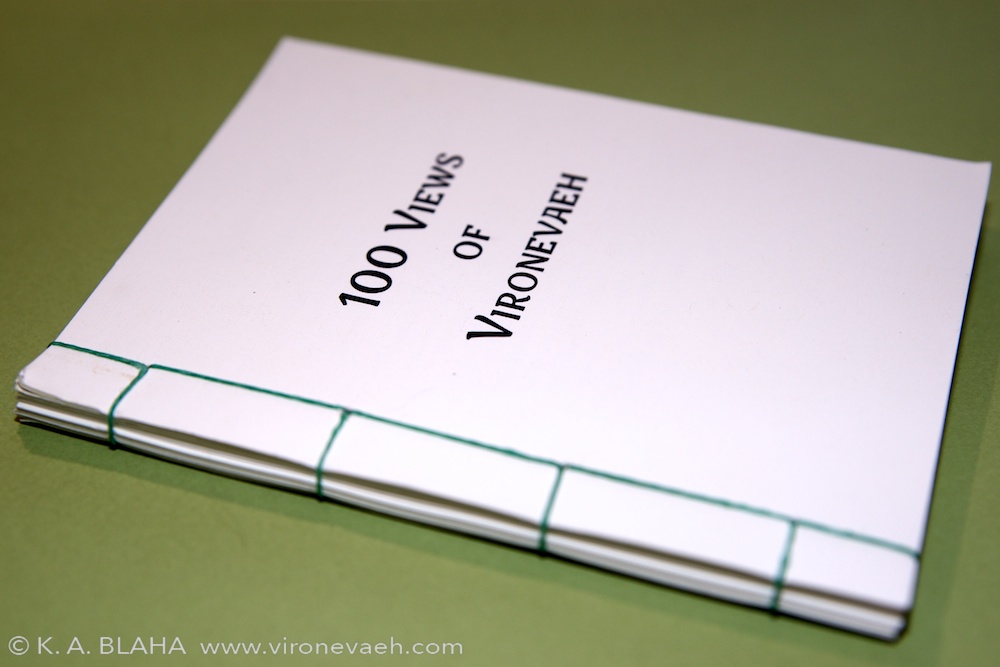
Project #1: loosely based on Hiroshige’s “100 views of Edo.” This 4″ x 6″ book contains the first 25 scenes of the city of Vironevaeh, along with historical context. Harkening back to Hiroshige, I bound this book using Japanese stab binding.

SONY DSC SONY DSC


Project #2: A project I first started a year and a half ago, I re-visited “The Galactic Adventures of Zish and Argo”, with my new knowledge about layout and so forth. I improved the cover, and all around tightened things up.SONY DSC SONY DSC

Project #3: A collection of science fiction stories by the members of my writing group. Assembled in InDesign, also taking advantage of my new skills. Soon to be available on the kindle.

SONY DSCAnd now back to projects. More to post later, undoubtedly.