Author Archives: Vironevaeh

Soviet Comedy Movies

Soviet comedy movies are surprisingly awesome and funny. They also provide a window into a culture that was otherwise pretty cut-off from the west. A rather groomed and cultivated window, but still a window. And you can watch them on youtube, since they have no formal distribution in the west. This link contains a whole list of them; I will discuss a couple specific ones in this post.

The Diamond Arm (Russian: Бриллиантовая рука, Transliteration: brilliantovaya ruka) (number 6 on the playlist): A slapstick style comedy. Criminals conspire to smuggle jewels into Russia. The protagonist wins a vacation abroad, and due to a mix-up, unwittingly becomes a mule for the jewels.

The Irony of Fate, or Enjoy Your Bath! (Russian: Ирония судьбы, или С лёгким паром!, Transliteration: Ironiya sudby, ili S lyogkim parom!) (Number 9 on the playlist): This is the “it’s a wonderful life” of Russia. They apparently play it all the time for New Year’s. A group of men go get very drunk at a bath house, before one of them flies out in the morning. They are still drunk in the morning, and accidentally put the wrong man on the plane. The man, who has been passed out, does not realize he is in the wrong city. He takes a cab to his street and building, and his key even opens the door, even though he is now in Leningrad, not Moscow. This is a spoof of the homogeneity of the Russian building style at the time. All the same street names, all the same buildings, even the same locks. The man gets a glimpse at how his life could be different.

The video below is a charming song from the movie called “esli u vas”. It’s an interesting study in Russian optimism. Basically, the lyrics of the song are about the things that can’t happen to you if you don’t expose yourself to them, but then you will have never experienced life. If you don’t have a dog, your neighbor can’t poison it (!), if you don’t have a house, you won’t fear house fires, if you don’t have friends, you won’t fight with them, etc. I couldn’t find a link with a nice translation.
 

Kid at Heart: Playing with Dolls

This weekend I was going to be good and productive. Work on some technical writing, workout, do some science fiction writing. Then I looked at my bin of dolls and nope. I played with dolls well into high school. I picked it up again a couple of years ago and discovered, yup, it’s still fun. As a decided introvert, there’s something about the dolls that lets you be maniacal and crazy, just a little.

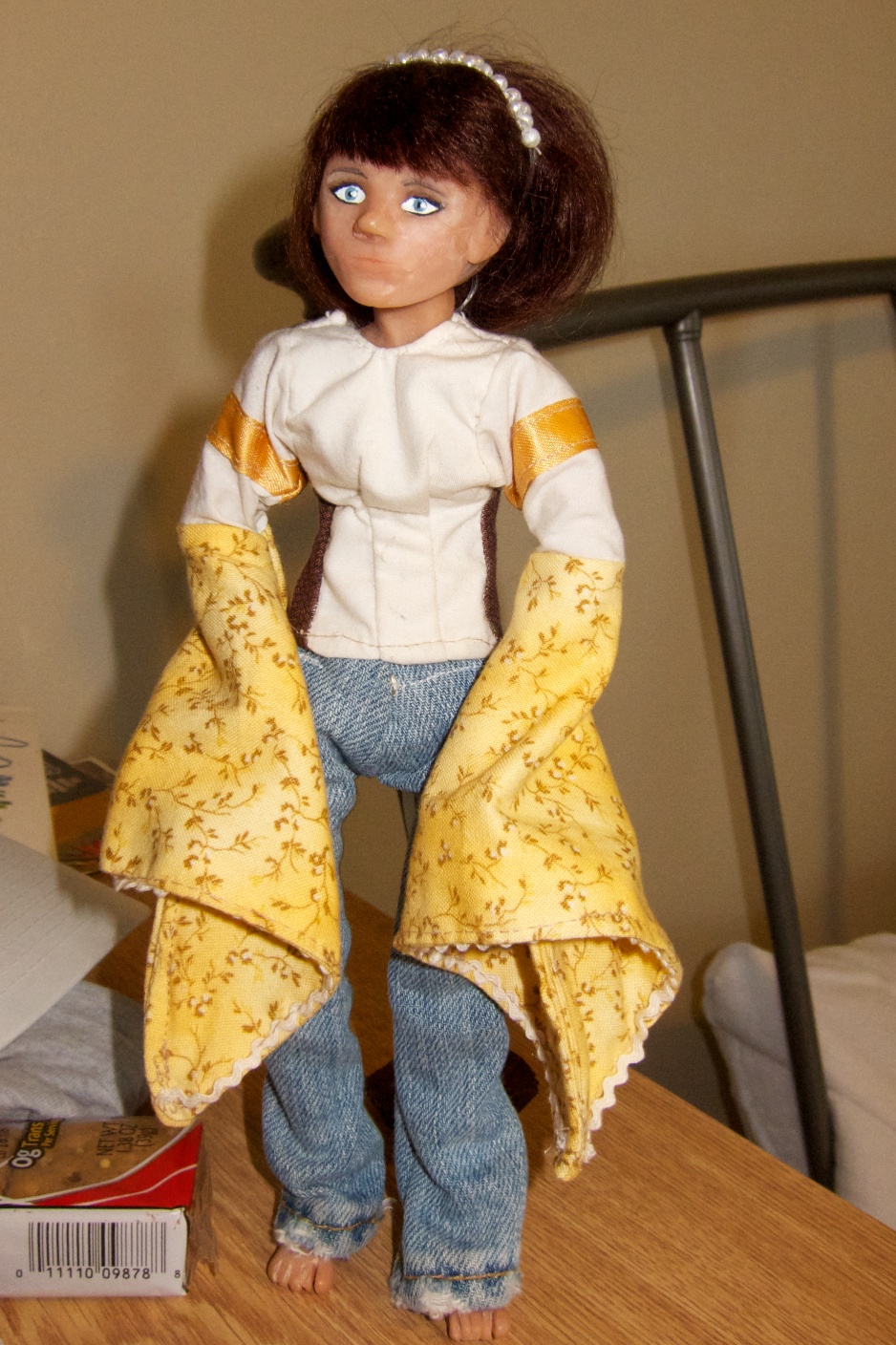
When I picked the habit back up, I decided to try something I hadn’t as a kid: make a doll. I found this tutorial about making ball-jointed dolls. It took forever, but I made Calliope, shown below. By no pre-planning, she ended up almost exactly barbie sized (1/6 scale). I made everything shown below but the wig. She has two left feet (literally, oops), and is a bit gangly, but I still love to play with her.

IMG_0011 - Version 2


Sometimes it’s tempting to feel like it is a waste of time to do things like play with dolls. Doubtless many would agree with that statement. I think this kind of play has been an invaluable resource for my writing projects, especially the kid oriented ones. And still, it’s just fun. And fun is as important as productivity.

Fun Science: Astronomical

I first became interested in science when my brother told me there was a black hole under his bed (this was a ploy to prevent me from snooping there– this is how nerd children fight). Once I could read, I wanted to know if this could be possible; one should be skeptical of information provided by siblings. Frustratingly, none of the books I read discussed if an event horizon could be put under a bed. Pretty shoddy science. There was much discussion of micro-blackholes, with some description of their size. But what the heck was a nanometer? Bigger or smaller than a bed?

Even now, the scales of the universe boggle my mind. A human is so small. The diameter of the Earth (a small planet), is roughly 7 million times the height of a typical person. If you lined up every person in the state of Virginia head to toe, you would roughly approximate the Earth’s diameter. The diameter of the Sun is 100 times bigger (two orders of magnitude) than the Earth. If you lined up every person in the United States head to toe, you’d only get to half of the Sun’s diameter. The red giant Betelgeuse (the reddish star that is Orion’s left shoulder) is 700 times bigger than the sun.

The solar system is bigger yet–Neptune is 30 times as far from the Sun as Earth, at about 3200 times the radius of the Sun. It takes light 4 hours to reach Neptune. The Oort cloud, the farthest reach of our solar system and the hypothesized source of most comets, is a light year from the Sun.

From Wikipedia

Our solar system sits on one branch of the Milky Way, which is a galaxy 100,000 light years across (7×10¹¹ times the diameter of the Sun–a meter is roughly 1012 times as big as a hydrogen atom). Our galaxy is 2.5 million light years from the nearest galaxy, Andromeda. Our galaxy is one of more than 50 galaxies in the Local Group. This piece of the universe is about 10 million light years in size. Wikipedia suggests there may be 100 billion galaxies in the universe. We have observed as far as 47 billion light years away, but the universe might be bigger (more intimidating statistics here).

And all of these things are slowly interacting. With all that, how could we not write science fiction?

Book Review: The Absolute at Large (Čapek 1922)

The Absolute at Large was written in 1922 by Czech author Karel Čapek (free web translation to English here). It is about the advent of a machine called the Karburator. The Karburator split atoms into two parts: useful work and a mysterious force called the “absolute”. The absolute is a god force which causes intense religiosity in people, and allows them to perform miracles. As the Karburator spreads across the planet, so does the absolute, and the book describes what follows.

I really enjoyed this book, and I would highly recommend it. First, it’s smart science fiction. In 1922, forces such as radiation were pretty recent science. Radium was discovered in 1898. Čapek describes something very like fission well before its invention. Second, this book is subtly very funny. Through the book, Čapek lampoons religion, communism, and nationalism at least. Third, the book is a short and simple read. My copy was about 200 pages with large print and lots of white space. If you enjoy this book, you can try out Čapek’s possibly more famous work, R.U.R., the book in which the word “robot” was created (derived from the Czech word for serf labor). I haven’t gotten around to that one yet myself.

I had a special reaction to The Absolute at Large, which is largely set in Prague. I was lucky enough to spend a summer in Prague, during which time I was able to talk at length with older residents. The Absolute at Large captures a certain essence of the Czech spirit. The Czechs are cynical in a very witty way. They’ve had religion thrust upon them (read about Jan Hus, the Hussites, and the First Defenestration of Prague). They’ve had nationalities thrust upon them (read about the Second Defenestration of Prague). In 1922, Czechoslovakia had been an independent country for only 3 years following the fall of the Austria-Hungarian empire. Unlike the Poles, who seem to resist forcefully, and the Hungarians and their patriotic sorrow, the Czechs have resorted to humor to endure their less-than-dominant place in geopolitical events. A few years ago, the Czechs held a contest to vote for the greatest Czech ever. The Czechs voted for Jara Cimrman, a fictional man who had no official face (the sculpture had become smooth, they couldn’t find him in this photo of a few hundred, etc). However, fictional Cimrman was credited with many wonderful feats: he suggested the Panama Canal, he was briefly an obstetrician, he consulted with Zeppelin, Eiffel, Mendeleev and Curie. If you are ever in Prague, there is a free museum to Cimrman under the Petřín Tower.

The Absolute at Large has a similar sense of humor to Cimrmanology; Čapek lampoons the inevitable powers of the world and their effect on the Czechs. And how appropriate that the Karburator should be invented in Prague… perhaps Cimrman lent a hand.

Zish and Argo Artwork

My biggest goal over the holidays was to complete painting for the Zish and Argo book. Last night I finished the last painting! Hooray! Champagne! Zish and Argo has 13+ full size color illustrations, painted in water colors. The picture below shows the ones I finished during the holidays. For reference, they are about 8 inches tall. In the next couple of weeks, I will pull together the art and put up book details. The featured image shows the tentative cover that I just finished as well.

Tomorrow I head back north to new projects and adventures.

SONY DSC


Exotic Florida: A Zoo of Lost Pets

I’m late posting today, because we went up to Sarasota and had a photo expedition. We went to Sarasota Jungle Gardens, a private zoo garden with birds and reptiles and nice foliage. Most of the animals in their collection were the cast offs of collectors who lost their interest. A good reminder to be responsible when you choose a pet! Thankfully, the garden takes good care of their critters and we get to enjoy the aspects that make them so alluring (and then we can leave the parrots and their shrill greetings).

SONY DSC SONY DSC SONY DSC

Artists: Walter Crane

I love to go to art museums to new style ideas. On a recent trip to the Virginia Museum of Fine Arts (VMFA), I visited the art nouveau section and saw a piece by English artist Walter Crane:

Walter Crane plate at VMFA.

The plate mentioned that Walter Crane did children’s books.

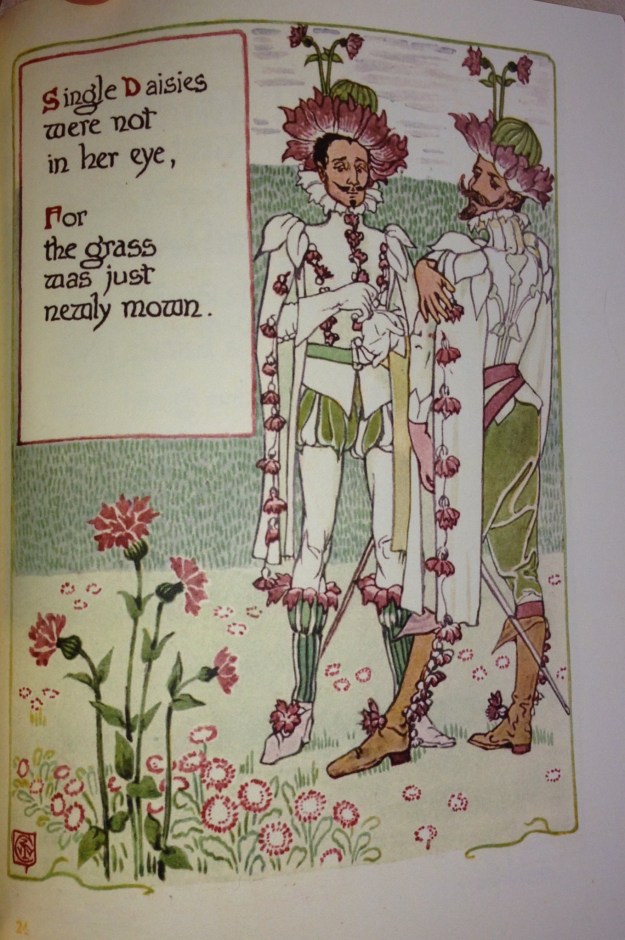
So I went home and ordered a couple of his books. A Floral Fantasy in an Old English Garden anthropomorphizes the flowers of the gardens in beautiful art nouveau fashion. Below is a photo of one of the pages. This page depicts bachelor’s buttons. All the little details, down to their boots, are done to match the characteristics of the plant. Another panel shows a battle between a thistle knight and a snapdragon. Walter Crane has several children’s books besides this one. Since Walter Crane died in 1915, his works have entered the creative commons, and they can be had very cheap, especially digitally.

photo

Walter Crane also did more adult works. Neptune’s Horses reminds me of the scene in Lord of the Rings where the elf summons up the waters to fend off the nazgul, but it was painted over a century before.

Soviet Holiday Cards

Boingboing had a cool post yesterday about Soviet “Christmas” cards. Actually most of the cards say “s novum godom”– “to the new year”. I love all the science and rocketry themes. I also find it interesting how many things we associate with Christmas have been co-opted for a holiday the soviets found safer: New Year’s. You can find the original website for the cards here. Below are a few of my favorites, which can all be found at www.mazaika.com/postcard01.htm.