Category Archives: artists and books

Learning about Graphic Novels and Publishing from Barbara Slate

As I mentioned in Monday’s post, I attended a talk by comic book writer Barbara Slate (at the VA Book Fest). She was one of the first female comic book writers, and has since branched out to her own graphic novels. After her talk I picked up one of them, “Getting Married and Other Mistakes“. It looks like a lot of fun, and like Slate herself, seems to have a nice sense of humor. She also has a book about how to write graphic novels.

She also spoke about the process of getting “Getting Married” published. She said that she was rejected about 60 times. I didn’t pay attention to that detail much that day. I wrote Monday about my own excitement, that I perhaps had a publisher interested in Zish and Argo. After further research, it looks like one of those pay-to-self-publish rackets, dressed up. I felt so duped! I was so excited, and they misled me. Fortunately, I figured it out quickly and for free. I channeled my frustration to overcome my fear of sending the manuscript off; on Monday after my realization I sent the manuscript to 5 places. Afterwards it occurred to me–if a woman like Slate who is familiar with the industry, knows publishing and knows people takes 60 rejections to place her book– then people aren’t going to be jumping out of bushes to publish me. It will take sober, dull work for me to get published, just like her. As it likely will for all of us. Please, may some eager publisher fall from the sky and praise me, but it’s not something I can expect or even take at face value. So last night I thought up a new story for Zish and Argo, and I will continue the slow marathon towards my goals.

Book Review: Downbelow Station (C.J. Cherryh 1981)

Note: I avoid spoilers in this review. Any plot details I mention occur early in the book.

Rating: 4.5/5 stars

I’ve had Downbelow Station on my shelf for a while. It’s 526 pages, so a little on the long side. I’d seen the book on a few “best of” lists, but no one I know has ever mentioned it. It was the 1982 Hugo award winner. So finally I bucked up and read it, and it was excellent.

Although I see “Downbelow Station” described as a hard science fiction book, the technological aspects of the book do not occupy the foreground. The interactions and desires of the characters do that; in some ways it’s a  high-class space opera. I found the style of the book most similar to Vernor Vinge in books like “A Fire Upon the Deep” with a little more militarism. I wonder how much the post Vietnam era affected the portrayal of militarism; the warring elements do not come off positively in this book. Cherryh does a good job developing culture; we can see the cultural differences between Union, Company, Pell, and the Downers. If you like sweeping science fiction, this is a highly worthy read.

Most of the action takes place on Pell Station, a space station orbiting a habitable planet with natives called “Downers” in the year 2352. Humans have expanded into space, one station after the next. At some point in history, humans developed faster than light “jump” technology, so they can spread further yet, into the “Beyond”. The humans in the Beyond have become disassociated with Earth; likewise Earth is somewhat detached from the stations. Pell finds itself between the forces of the Beyond and the renegade forces of Earth. The first 20 pages or so lay down this background; it’s a lot of exposition and it’s confusing and not totally engaging. The beginning is the weak point of this book. Once the ground work is laid, the story takes off.

We arrive at Pell when the Company ships of Earth force the station to take on a bunch of refugees from another station which has been destroyed in the conflict between the Company and the Union of the Beyond. These unregistered people are housed in quarantine, or Q, which is lawless and places a great deal of strain on the station’s resources. Over the course of the book, we watch people from Q, from Pell station, from Union, and from the Company as they vie for the strategically valuable Pell. The people of Pell station I found especially interesting, and their interactions with the Downers.

There are several other books in Cherryh’s Union-Company universe that I look forward to reading. Check out my Top 20 science fiction novels for more science fiction recommendation.

Japanese Art: Hiroshige

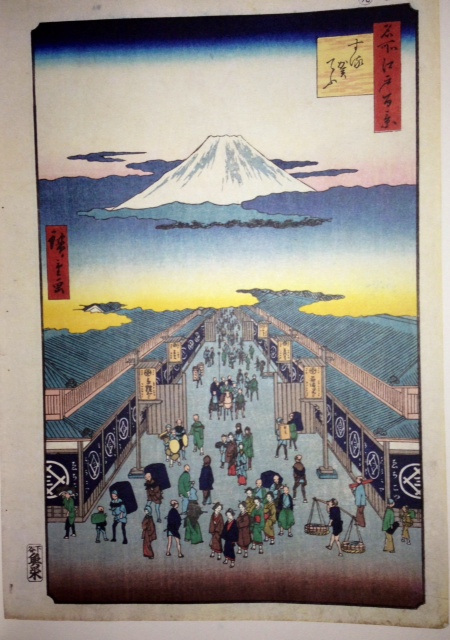
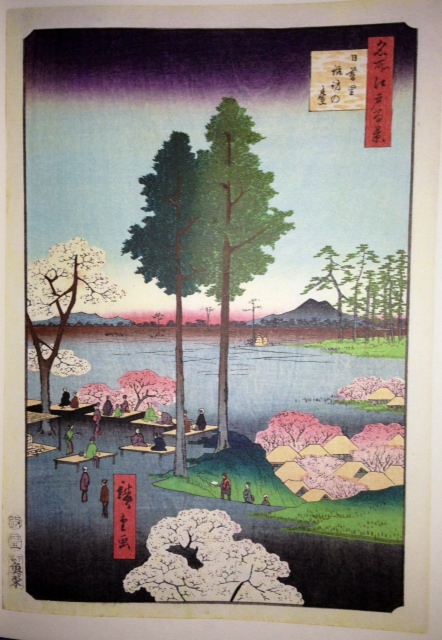
I have a beautifully bound book of the paintings of Edo by Hiroshige I found a few years ago. Since that acquisition, I have grown fond of the style of Hiroshige. He is an artist in the ukiyo-e style, or woodblock prints of daily life from 1800s Japan. The composition style is quite different from contemporary western works. A lot of Hiroshige’s works can be found online as part of the public domain. Wikipedia has a number of images in its gallery.

Vincent van Gogh drew stylistic inspiration from the works of Hiroshige. Below are nearly identical paintings by van Gogh (right) and Hiroshige (left). Many of van Gogh’s paintings have composition reminiscent of the ukiyo-e style.

Below are three of my favorite paintings from “one hundred famous views of Edo”.

photo photo1 photo2

Great kids books, great sources of inspiration

Whenever I go to a museum, I like to look at the kids book section. Often times, there are several really engaging and pretty books relevant to the museum’s collection. They’re often more fun and compact than the books in the adults section. I don’t need a coffee table book for every artist I like. I like to have little pieces of inspiration about my office, though. With my interest in writing children’s books, it’s even better.

The Smithsonian museums in DC have nice gift shops too. Many of the books are award-winning, and seeing them in person makes it easier to judge the book. Plus I don’t mind paying money to the Smithsonian. Below are a few of my finds:

  • Snowflake Bentley— A kid’s book biography of the guy who first photographed snowflakes (he has his own museum even). Beautifully illustrated, with a tone that appreciates science. If you like this book, there are also books of photos of snowflakes; those are great fun too. Below is one of the illustrations from the story (from childrensbookalmanac.com).

  • Oceanology— this one was in the Natural History Smithsonian. It’s a very interactive book written from the perspective of a teenager on “20,000 leagues under the sea”‘s the Nautilus. It’s written to resemble a logbook something like Darwin’s logbook from his journeys.
  • The Legend of the Lady Slipper–I found this one at the American Indian Museum (which, if you are ever in DC, has a great cafeteria). Like the cover, the illustrations have a lovely sense of movement, and nice colors. One of the artists is known for painting people dancing; this comes across in the people of the story, who are always in subtle motion.

Beautiful Books: “Radioactive: Marie & Pierre Curie”

I first saw “Radioactive: Marie & Pierre Curie: A Tale of Love and Fallout” in an expat bookstore in Belgium. The book is vibrant and colorful and intriguing. After I got back, the book was still on my mind, and I purchased it. The book is an art-collage biography of Marie and Pierre Curie, and their Nobel-prize winning work on radiation. Their work is so influential that they named several elements (radium and polonium). A unit of radioactivity, a Curie, bears their name, and the element Curium was named for them.

Every page of this book is truly beautiful. The colors are deep and wonderful. Somewhere in the book, the author describes the techniques she used, and how they were specifically inspired by radioactivity, but I have not found this description on the web. This book is much more beautiful than most graphic novels, and I love that it is about science. The book makes Marie Curie especially relatable. She’s still the most famous female scientist a century after her great discoveries. She comes across as driven but human.

Here, then, is the big caveat in my review. The author relates a mostly negative view of radioactivity and nuclear advances. The damage to Marie and Pierre’s bodies, as well as their daughter, is given in detail. The bombing of Japan, the three-mile island incident, and Chernobyl are covered in great detail.

I found it incredibly saddening reading about Marie Curie, the most recognized female scientist perhaps ever, and then to read essentially a condemnation of the outcomes of her work. I also think this condemnation was unfair. To write the story of coal or gasoline would be to include tales of mesothelioma, ground water pollution, and air pollution bad enough in many parts of the century as to blot out the sun. The motors of wind power require mining for difficult-to-acquire materials, which comes from messy mining. No form of power comes without its evils just yet. That’s why we have scientists like the Curies, to keep stabbing away at the problem. Nuclear energy frightens people more than other forms of energy, but I think this is mostly an irrational fear. A simple Geiger counter reveals any stray radiation. Do you know when there are trace amounts of benzene about (a common hydrocarbon in oil)? Or other carcinogens? Hundreds of Superfund sites exist across the USA, many of them from hydrocarbon contamination. These sites can take decades to remediate.

Nonetheless, this book is beautiful and worth reading. The writing about Marie and Pierre Curie as people was wonderful. For those unfamiliar with the science of radioactivity, perhaps it will be a more inspiring read than it was for me.

My Top 20 Best Science Fiction Novels

Following my post last week about my top 5 science fiction novels, I’ve been getting a lot of hits on search engines. I too scour the web for good scifi lists, so I thought I’d add my top 20 science fiction novels to the mix. I weighed a little towards including some less-common mentions, so while I enjoyed both “Hitchhiker’s Guide” and “Hothouse”, two incredibly different books, nobody needs help in hearing about “Hitchhiker’s Guide”. So without further ado, my top 20 science fiction novels in no particular order.

Top Five (see last  week for longer descriptions of each)

The Rest

  • The Moon is a Harsh Mistress (Robert Heinlein 1966)- The inhabitants of the moon attempt to revolt from the oppressive Earth with the help of a supercomputer named Mycroft. Mycroft is an awesome central character. The best of the grown-up Heinlein novels. 1967 Hugo Award winner.
  • The Demolished Man (Alfred Bester 1953)- How does one get away with murder when telepathy is common place? Fast moving and surprisingly modern, the winner of the first Hugo award.
  • The Absolute at Large (Karel Čapek 1922)- See a longer review I did here. The author hypothesizes that when the atom is split (a new concept at the time) that energy is released, as well as a pervasive religious fervor. As the atom-splitter spreads due to its phenomenal energy production, so too does the side effect of religiosity.
  • The Lathe of Heaven (Ursula LeGuin 1971)- When one man dreams, his dreams can become reality. He fears this awesome power; when he enters therapy, his therapist begins to use his gift, imagining he will fix the world.
  • Mathematicians in Love (Rudy Rucker 2006)- Totally awesome and wacky. Mathematics grads students compete to find the equation of everything, and win the affections of a cute girl. And there are enormous sentient venomous conch shells, intergalactic mathematicians, and parallel universes.
  • Worlds (Joe Haldeman 1981)- A woman from a communist orbiting asteroid visits New York City on a scholarship. I love everything by Haldeman, but this is my favorite after “Forever War”. Very heartfelt and emotionally gripping. The rare female protagonist, and done phenomenally. This is the first of a trilogy, but I think it’s the best and stands alone just fine.
  • The Door into Summer (Robert Heinlein 1957)- My favorite of Heinlein’s “children’s” books, which are all very intelligent, but have less of some of Heinlein’s more alarming interests like incest. A man is duped by his business partner, who steals the company and puts him into cold sleep. He awakens after 30 years, and tries to figure out how to get his life back. One of the main characters is the protagonist’s cat, always a plus.
  • Snow Crash (Neal Stephenson 1992)- cyberpunk done properly with a sense of humor. A pizza delivery man, Hiro Protagonist, and a 15-year-old girl start investigate the propagation of a mysterious internet drug, snow crash. The plot line of this one gripped me less than the excellent fun had with a future world.
  • Tau Zero (Poul Anderson 1970)- A crew on a near light speed ship is on a five-year journey to another planet. During the voyage, the deceleration mechanism is damaged. As they continue to go faster and faster, the time dilation grows and they travel farther. The best hard scifi book I’ve read.
  • A Fire Upon the Deep (Vernor Vinge 1992)- The best and most intelligent space opera I’ve read. Different laws of physics exist in different parts of the galaxy. People create a malevolent higher intelligence near the rim of the galaxy and must flee into the galaxy where the laws of physics preclude such an entity. They get stuck on a planet of sentient creatures composed of several animals in constant communication with one another. They are called the Tines, and they are hands-down the best alien I’ve read in scifi. Also read anything by Vernor Vinge. 1993 Hugo Award winner.
  • Stand on Zanzibar (John Brunner 1968)- At first I found this book a bit confusing; the chapters jump around to relatively random people doing random things as part of the world building. But after 50 pages or so you get your bearings. The world is over-populated, and child-limits have been instituted. The plot is complex and rich. The style is grimly funny. Hard to describe, and requires some effort to read, but one of the greats. 1969 Hugo Award winner.
  • Hothouse (Brian W. Aldiss 1962)- Also called “The Long Afternoon of Earth”. In the distant future, the sun is bigger and hotter, and one side of the earth always faces the sun. Plant life, with so much energy available, has evolved in many ways, and all but overruns this half of the earth. There are plant birds, plant predators, and plant just about everything. A small group of humans tries to survive in this near-apocalypse Earth. Chock full of great imaginings. Aldiss doesn’t have the most sparkling characters, but he has engaging concepts, somewhat like Asimov. “Helliconia Spring” is another worthy read by Aldiss, but it is somewhat longer.
  • The Caves of Steel (Isaac Asimov 1954)- My favorite Asimov book, partially because it is self-contained and relatively succinct. People of an overcrowded Earth live under steel domes, and never go outside. The story is set around the investigation of a murder.
  • The Windup Girl (Paolo Bacigalupi 2009)- The 2010 Hugo Award winner. A biopunk story set in Bangkok. After the world has been devastated by engineered illnesses and crop-plagues, society is finally mostly recovered. Carbon emissions are strictly limited, so energy-efficient methods are desirable. The main character is an employee working at a start-up energy company as a front, but for one of the bio-engineering firms that creates genetically modified species actually. A rich world that incorporates biology well.
  • Red Mars (Kim Stanley Robinson 1993)- A group of 100 brilliant hand-picked scientists is selected and sent to Mars to live there and begin terraforming it. These scientists are strong-minded, and don’t always agree how to go about things; political fractures form. The first book follows the political developments of the first 100 martians. “Red Mars” is followed by “Green Mars” and “Blue Mars” which occur over the course of a couple of centuries. Mars itself is the main character of the whole trilogy, and is described in the best scientific detail available at the time. Sometimes a bit long-winded, but very realistic, and an interesting exploration of terraforming.

Happy reading!!

Tennyson’s “The Lotos-Eaters”: a public domain work

[A side note: US copyright law changed in 1976. Consequently, we miss out every year on works that would have entered the public domain. In another article, you can see that stronger copyright laws don’t correlate to more creativity. I believe in artists profiting from their works, just as companies profit from patents. But US copyright law is something different from that now. Support the public domain!]

Below is one of my favorite poems by Alfred Tennyson, a 19th century poet. All of his works are public domain, so if you enjoy, check him out! The text, below, and an audio copy of “The Lotos-Eaters” can be found here.

The Lotos-Eaters

Alfred Tennyson

“Courage!” he said, and pointed toward the land,
“This mounting wave will roll us shoreward soon.”
In the afternoon they came unto a land
In which it seemed always afternoon.
All round the coast the languid air did swoon,
Breathing like one that hath a weary dream.
Full-faced above the valley stood the moon;
And like a downward smoke, the slender stream
Along the cliff to fall and pause and fall did seem.

A land of streams! some, like a downward smoke,
Slow-dropping veils of thinnest lawn, did go;
And some thro’ wavering lights and shadows broke,
Rolling a slumbrous sheet of foam below.
They saw the gleaming river seaward flow
From the inner land: far off, three mountain-tops,
Three silent pinnacles of aged snow,
Stood sunset-flush’d: and, dew’d with showery drops,
Up-clomb the shadowy pine above the woven copse.

The charmed sunset linger’d low adown
In the red West: thro’ mountain clefts the dale
Was seen far inland, and the yellow down
Border’d with palm, and many a winding vale
And meadow, set with slender galingale;
A land where all things always seem’d the same!
And round about the keel with faces pale,
Dark faces pale against that rosy flame,
The mild-eyed melancholy Lotos-eaters came.

Branches they bore of that enchanted stem,
Laden with flower and fruit, whereof they gave
To each, but whoso did receive of them,
And taste, to him the gushing of the wave
Far far away did seem to mourn and rave
On alien shores; and if his fellow spake,
His voice was thin, as voices from the grave;
And deep-asleep he seem’d, yet all awake,
And music in his ears his beating heart did make.

They sat them down upon the yellow sand,
Between the sun and moon upon the shore;
And sweet it was to dream of Fatherland,
Of child, and wife, and slave; but evermore
Most weary seem’d the sea, weary the oar,
Weary the wandering fields of barren foam.
Then some one said, “We will return no more”;
And all at once they sang, “Our island home
Is far beyond the wave; we will no longer roam.”

Choric Song

I

There is sweet music here that softer falls
Than petals from blown roses on the grass,
Or night-dews on still waters between walls
Of shadowy granite, in a gleaming pass;
Music that gentlier on the spirit lies,
Than tir’d eyelids upon tir’d eyes;
Music that brings sweet sleep down from the blissful skies.
Here are cool mosses deep,
And thro’ the moss the ivies creep,
And in the stream the long-leaved flowers weep,
And from the craggy ledge the poppy hangs in sleep.

II

Why are we weigh’d upon with heaviness,
And utterly consumed with sharp distress,
While all things else have rest from weariness?
All things have rest: why should we toil alone,
We only toil, who are the first of things,
And make perpetual moan,
Still from one sorrow to another thrown:
Nor ever fold our wings,
And cease from wanderings,
Nor steep our brows in slumber’s holy balm;
Nor harken what the inner spirit sings,
“There is no joy but calm!”
Why should we only toil, the roof and crown of things?

III

Lo! in the middle of the wood,
The folded leaf is woo’d from out the bud
With winds upon the branch, and there
Grows green and broad, and takes no care,
Sun-steep’d at noon, and in the moon
Nightly dew-fed; and turning yellow
Falls, and floats adown the air.
Lo! sweeten’d with the summer light,
The full-juiced apple, waxing over-mellow,
Drops in a silent autumn night.
All its allotted length of days
The flower ripens in its place,
Ripens and fades, and falls, and hath no toil,
Fast-rooted in the fruitful soil.

IV

Hateful is the dark-blue sky,
Vaulted o’er the dark-blue sea.
Death is the end of life; ah, why
Should life all labour be?
Let us alone. Time driveth onward fast,
And in a little while our lips are dumb.
Let us alone. What is it that will last?
All things are taken from us, and become
Portions and parcels of the dreadful past.
Let us alone. What pleasure can we have
To war with evil? Is there any peace
In ever climbing up the climbing wave?
All things have rest, and ripen toward the grave
In silence; ripen, fall and cease:
Give us long rest or death, dark death, or dreamful ease.

V

How sweet it were, hearing the downward stream,
With half-shut eyes ever to seem
Falling asleep in a half-dream
To dream and dream, like yonder amber light,
Which will not leave the myrrh-bush on the height;
To hear each other’s whisper’d speech;
Eating the Lotos day by day,
To watch the crisping ripples on the beach,
And tender curving lines of creamy spray;
To lend our hearts and spirits wholly
To the influence of mild-minded melancholy;
To muse and brood and live again in memory,
With those old faces of our infancy
Heap’d over with a mound of grass,
Two handfuls of white dust, shut in an urn of brass!

VI

Dear is the memory of our wedded lives,
And dear the last embraces of our wives
And their warm tears: but all hath suffer’d change:
For surely now our household hearths are cold,
Our sons inherit us: our looks are strange:
And we should come like ghosts to trouble joy.
Or else the island princes over-bold
Have eat our substance, and the minstrel sings
Before them of the ten years’ war in Troy,
And our great deeds, as half-forgotten things.
Is there confusion in the little isle?
Let what is broken so remain.
The Gods are hard to reconcile:
‘Tis hard to settle order once again.
There is confusion worse than death,
Trouble on trouble, pain on pain,
Long labour unto aged breath,
Sore task to hearts worn out by many wars
And eyes grown dim with gazing on the pilot-stars.

VII

But, propt on beds of amaranth and moly,
How sweet (while warm airs lull us, blowing lowly)
With half-dropt eyelid still,
Beneath a heaven dark and holy,
To watch the long bright river drawing slowly
His waters from the purple hill–
To hear the dewy echoes calling
From cave to cave thro’ the thick-twined vine–
To watch the emerald-colour’d water falling
Thro’ many a wov’n acanthus-wreath divine!
Only to hear and see the far-off sparkling brine,
Only to hear were sweet, stretch’d out beneath the pine.

VIII

The Lotos blooms below the barren peak:
The Lotos blows by every winding creek:
All day the wind breathes low with mellower tone:
Thro’ every hollow cave and alley lone
Round and round the spicy downs the yellow Lotos-dust is blown.
We have had enough of action, and of motion we,
Roll’d to starboard, roll’d to larboard, when the surge was seething free,
Where the wallowing monster spouted his foam-fountains in the sea.
Let us swear an oath, and keep it with an equal mind,
In the hollow Lotos-land to live and lie reclined
On the hills like Gods together, careless of mankind.
For they lie beside their nectar, and the bolts are hurl’d
Far below them in the valleys, and the clouds are lightly curl’d
Round their golden houses, girdled with the gleaming world:
Where they smile in secret, looking over wasted lands,
Blight and famine, plague and earthquake, roaring deeps and fiery sands,
Clanging fights, and flaming towns, and sinking ships, and praying hands.
But they smile, they find a music centred in a doleful song
Steaming up, a lamentation and an ancient tale of wrong,
Like a tale of little meaning tho’ the words are strong;
Chanted from an ill-used race of men that cleave the soil,
Sow the seed, and reap the harvest with enduring toil,
Storing yearly little dues of wheat, and wine and oil;
Till they perish and they suffer–some, ’tis whisper’d–down in hell
Suffer endless anguish, others in Elysian valleys dwell,
Resting weary limbs at last on beds of asphodel.
Surely, surely, slumber is more sweet than toil, the shore
Than labour in the deep mid-ocean, wind and wave and oar;
O, rest ye, brother mariners, we will not wander more.

The Best of Science Fiction

I began reading science fiction novels almost by accident. One day I saw an Alfred Bester book on the shelf at a book store. Viewers of Babylon 5 (the best TV show ever) will recall a character by this name. I had read many Star Wars, Star Trek, and Babylon 5 books, and I followed science fiction TV with ardor. So I assumed this book was in the same vein. It was not. The B5 character was named for a writer from the 50s.

Alfred Bester is best known for two novels: The Demolished Man and The Stars My Destination. They’re both amazing, and I recommend them. “The Demolished Man” works on a simple premise: how would someone go about getting away with murder in a society in which telepaths existed? “The Stars My Destination” (loosely based upon the Count of Monte Cristo) explores what would happen if people could transport themselves at will. How would prisons work? How would you prevent theft? “The Demolished Man” won the first Hugo Award in 1953. “The Stars My Destination” has been credited as perhaps the creator of cyberpunk.

After Bester, I was hungry for more. I scoured the web for lists of the best science fiction novels. Here is one good list of the top novels, though it is somewhat weighted towards older books. I also tried to read the winners and nominees of the Hugo and Nebula awards (you can find a list of wins by author here). Wikipedia lists the Hugo Award wins according to year here. I personally strongly prefer the Hugo Award books to the Nebula Award books, but you may find differently.

So after all that hunting, here are my top 5 science fiction novels:

  • The Left Hand of Darkness (Ursula LeGuin, 1969)– A human envoy visits an alien world, hoping to convince them to join an alliance. The aliens have no set gender, but phase in and out of male, female, and neuter. The book explores the culture of this planet, both due to the unusual gender of its people, and the extremely cold climate. For whatever reason, men tend to be unimpressed with this book, but women I’ve recommended it to like it. The book explores gender and cultural topics without getting heavy-handed or obvious. The two main characters are amazingly drawn. The book is filled with little amazing legends and folklore from the culture.
  • A Canticle for Leibowitz (Walter M. Miller, 1960)– A post-apocalyptic story with a very different twist. Broken into three parts at very different times, the first part opens in a Catholic abbey in Nevada several centuries after a devastating nuclear war. The novel has a charming humor and levity despite the settings. It explores religious themes (not very common in scifi).
  • The Forever War (Joe Haldeman 1974)– A story about a man involved in a space war. As the battles are waged, centuries pass, and the man is isolated from his own life by a questionable war. Haldeman was a vietnam vet, and it shows. I have read at least a dozen novels by Haldeman, and I would recommend every single one. He writes science fiction with a focus on heart. “The Forever War” is one of the best science fiction love stories I’ve read.
  • The Stars My Destination (Alfred Bester 1956)– discussed above.
  • Camp Concentration (Thomas Disch 1968)– a dark and twisted “Flowers for Algernon”. A conscientious objector is sentenced to prison. He is then subjected to experiments that greatly increase his intellect, along with a number of other prisoners. This book is very literary to the point of sometimes being maddening. I skipped through some of the literary aspects that I didn’t relate to. But the story and the science fiction and the humor are spot on and excellent.

You may notice the heavy slant to the 50s and 60s. This is no accident. These books are old enough to be reprinted and therefore available, but old enough for the reprints to be available used (used books are so wonderfully inexpensive!). Some more modern very awesome scifi books are “Snow Crash“, “Mathematicians in Love“, “A Fire Upon the Deep“, and “The Windup Girl“.

If you are looking for more reading suggestions, check out my top 20 science fiction novels.

I could talk all day about science fiction, so drop a comment!

Drawing Books: Andrew Loomis

I always find a good drawing book to be very motivating. When I draw, I do best when I have a good visual aid, especially when posing people. Alas, I have no models living in my attic to call upon for posing when the need arises. So a good book of poses is the best substitute I have.

Andrew Loomis was as illustrator in the middle part of the 20th century. He wrote several drawing instruction books as well. These books were very well-regarded and popular, but they went many years without being reprinted. Old copies of the books would sell for over $100 on eBay.

Happily, his books started being reprinted a couple of years ago. They are lovely hard-cover reproductions, available for about $25 each on Amazon.com. I believe four have been released:

  • Figure Drawing for All It’s Worth– A book about drawing the figure. I’ve found in the past many figure books are more men than women (which I always thought was strange). If anything, this book has more female figures, but men are covered as well, as well as various proportions, and the proportions of children.
  • Drawing the Head and Hands– About drawing the head and hands. As you’d expect, this covers the head and hands from all kinds of angles, for different ages and backgrounds.
  • Successful Drawing– I don’t have this one. I find its title vague. I like to imagine I can already draw. But if anyone has read it, I’d be curious to hear.
  • Creative Illustration– I just got this one, but I haven’t had a chance to go through it in much detail. This is the one I’ve been anticipating most, based upon the title. I have observed many heads and hands and figures, but illustration is a way of interpreting the scene to make it more engaging.

Book Review: Holy Fire (Bruce Sterling 1996)

Note: in this review, I spoil nothing past the first 20-30 pages or so. You can see more reviews and an excerpt of the book here.

Rating: 4/5 stars

I really enjoyed “Holy Fire”. Though it is high-tech, low life in the fashion of cyberpunk, I found the characters much more believable than most cyberpunk books. The characters still have ambitions and hopes and don’t just spend their time dwelling on how awful life is (any more than we do now). The book is set about 100 years in the future, in a society where the very elderly call the shots and society is about collectively minimized risk and efficiency. The main character, Mia, is an elderly woman who partakes in a medical procedure to extend her life, and her subsequent adventures. Mia struggles with the effect on the young of a society dominated by the old and her own risk-averse tendencies. Along the way she meets a lot of fun people.

Before I read “Holy Fire”, I was aware of Bruce Sterling and his reputation as a cyberpunk author. I had read the canonical cyberpunk work “Neuromancer” by Gibson, and I was not impressed. Cyberpunk seemed just like rebranding dystopia. But a friend (check out her well-received science fiction work here) loaned me “Holy Fire” by Bruce Sterling, so I read it.

The book is also populated with cool gadgets that are irrelevant but colorful. Sterling doesn’t dwell on any particular one, and the book is peppered with fun droplets of future tech. There is a dog that has been technologically enhanced to be able to talk, but in the fashion that a dog might. There are cities built of edible bio-materials. There are programmable wigs.

Ultimately, I’m not sure if the book hangs together fully in the end for me. I’m not sure if the tales of Mia add up to say something to me. So perhaps it is not a masterpiece. But I enjoyed it thoroughly the entire time I was reading it, which is a rarity. Also a vivid female protagonist is nice (this was actually why my friend recommended the book). To anyone interested, I would definitely recommend a read.