Category Archives: Books

Diversity in Science Fiction: Some Diverse Reads

Science fiction often touts itself as the genre of the future. But science fiction is a reflection of today as much as it is a dream about the future. Science fiction has been too white and too male, both in authors and in protagonists. This is a reflection of the biases in our society.

My own top 20 sci-fi novels list features 18 books by white men, and two books by Ursula Le Guin. The Guardian’s list of top 500 scifi novels featured the names of 18 women. Any scifi reader starting out will hear about Asimov, Heinlein, and Clarke. Too many people get defensive when someone points this out. (See: the Great SFWA Shitstorm.)

The answer is to read widely, and to continue to read widely. So in that spirit, I list below some diverse science fiction*, some of which I have read, and some of which I ought to. For further reading, here is a great article listing a lot of great authors from the LA Times.

  • Lilith’s Brood by Octavia Butler: we destroy ourselves with war and aliens come in and save the survivors, mostly people from South American cultures who avoided the bombs. Oh, and the aliens want weird weird sex. A fun and weird read.
  • Windup Girl by Paolo Bacigalupi: A western man goes to future Bangkok. The native Thais and the genetically-engineered windup girl are the stars of the show, though.
  • The Three-Body Problem by Cixin Liu: One for me to read! A best seller in China, recently translated into English.
  • Downbelow Station and Cyteen by C. J. Cherryh: Distant future novels where women kick ass in militaristic and scientific settings, if you can get past the info-dumping at the front.
  • Who Fears Death by Nnedi Orakafor: Another for me to read! Far future, post-apocalyptic Africa.
  • The Miles Vorkosigan series by Lois McMaster Bujold: I have looked for these for years in used bookstores. I guess they fall into that awkward old-enough-to-be-out-of-print-, not-so-old-as-to-be-reprinted phase. They won a buttload of Hugos. And they feature a disabled protagonist.

*Note: I think it’s currently easier to find diverse fantasy. Maybe this is because it’s straightforward to use alternate mythology to Western mythology. I personally vastly prefer sci-fi. I think diversity in far future sci-fi is a challenge, because our whole concept of diversity is rooted in today’s culture. Just giving everything Chinese-ish names isn’t very satisfying. In LeGuin’s Left Hand of Darkness, Genly is black, but this isn’t relevant to the story at all. But I would like to see more female protagonists!
 

Book Review: Train (Tom Zoellner 2014)

Rating: 3/5

In Train, author Tom Zoellner rides the rails of the world. He discusses the history, the current state, and the future of rail. Growing up in suburban St. Louis, I rarely saw trains. Now I live 100 feet from active rail tracks and walk along them every day. I take the Amtrak to DC and Baltimore and New York. This summer, I went to the O. Winston Link rail photography museum in Roanoke, Virginia. So I was eager to learn more about the history of rail– such a backbone to our economy, but often viewed as an anachronism.

I was disappointed by Train. It was a pleasant enough read; I didn’t have trouble turning the pages as I basked at the pool. But it felt like junk food.

At its best, the book gave interesting perspectives on the psychology of rail: how we have stories of hero sea captains, drivers, and pilots, but not of train conductors. That we both love and hate the rail, such an engine of commerce, but also hugely representative of collectivism that’s been dominated by robber barons.

I enjoyed the chapters on foreign rail much more than the ones about the U.S. and Britain. The chapter on India was fascinating and horrifying. Some rails in India corrode ten times faster than normal because the tracks are constantly covered in human excrement. This is because the trains don’t have storage tanks for the toilets, but also because people living by the tracks preferentially potty on the tracks.  As you can imagine, the job to replace the tracks isn’t nice; Zoellner’s conversations with the workers are interesting. Zoellner suggests that India wouldn’t be a single country without the railways installed by the British. This chapter solidified my view that I would rather read about India than visit it.

Overall, too much of the text was devoted to Zoellner’s conversations with random train passengers, upon which he congratulated himself loudly and often. I didn’t care about the guy taking the train to West Virginia hoping to find work in a coal mine, nor did I care about the young man reuniting with his estranged mother. I would have tolerated some of this, but the chapter on American rails was a bloated 90 pages, compared to 30 pages each for Russia, China, and Peru. The chapter on America wasn’t more informative; it was more pointless. The chapter on Britain was also packed full of useless conversations.

When I was preparing to write this review, I noticed that Zoellner is an English professor. And that’s what the book feels like: an English professor waxing nostalgic about the majestic railways and their heroic riders, with sprinklings of historic details. I hoped to read something more focused on history. Train passes the time nicely, but I found it unsatisfying. Maybe it would be a better read for someone who already knows the history and wants to read the stylish praises of another rail enthusiast.

Book Review: The New Jim Crow

The New Jim Crow: Mass Incarceration in the Age of Colorblindness by Michelle Alexander discusses the racist similarities between the Jim Crow Era and the War on Drugs. A non-fiction book about social justice is a bit afield of this blog’s usual science fiction fare. But as with Guns, Germs, and Steel, this book provides insight into how societies do, and sometimes don’t, work.

Science fiction is often concerned with the other. Science fiction can never truly be alien–as with all fiction, if it isn’t plausible, it doesn’t enchant. In a current project, I write about two alien species living together in a city, but apart, one above ground and one below ground. If I wanted to write about racial and class segregation, I figured I should read further about it in the real world. How would the two species feel about each other? What would they say about each other? I had them growing together after intense fighting– how could they plausibly do that?

That silly motivation convinced me to read the book, rather than say “that sounds interesting” and read something else. I’m glad I read it. It’s an important American topic that we remain quiet about, due to indifference or discomfort or lack of knowledge. I knew that our country imprisons an insane percentage of the population. I knew that many of these prisoners were black or brown, but I assumed this was because blacks and browns are statistically more likely to be poor and unemployed. I found that unfortunate, but not racist or alarming.

The New Jim Crow’s central thesis is that the War on Drugs, and the subsequent mass incarceration, has been enforced in a racist manner. Whites and blacks use drugs at similar rates, but blacks end up in prison far more often for it. Since the War on Drugs was declared in the early 80s, the prison population has increased from 400,000 to 2 million. During this period, decisions by the legislature and the Supreme Court have destroyed constitutional protections such as the 4th and the 14th amendment. This allows conscious and unconscious bias to target blacks. Police departments have enormous financial incentive to make arrests, and so they do, and minorities bear the brunt of it.

The book addressed my skepticism and convinced me. This is an issue that the left and right should be united on: it’s a violation of human decency and it’s expensive. To me, the main thing sustaining the War on Drugs and mass incarceration is the appeal of punishment; it’s easier to sell being tough on crime than helping criminals. We also don’t appreciate the scope of the problem.

I strongly recommend this book. I hear people debate racial issues so often. I participate too. But to be honest, this is my first long form read on the topic in today’s society. Because I read this, I better understand a complicated topic. I think if more people read this book, we would have a more intelligent conversation about this important issue that only grows more important. Oh, and it also might help you write about aliens.

Three beautiful books that inspire

I’m always looking for design inspirations. Whenever I find myself in an art museum or an interesting shop, I always look to see what kinds of design books they have. Today I included three very different commercially available favorites in my little collection.

Waterlife by Rambharos Jha

A stunningly beautiful book by Indian folk painter Rambharos Jha. The critters come alive with the wiggling and colorful lines. Each page is silk-screened by hand onto hand-made paper. You can see the difference from ordinary printing methods immediately. Striking. This is also one of the best smelling books. Every time I open the book, the smell of ink and paper hits me, I’m looking at this book. My only criticism is that the binding method prevents the book from opening as flat as I would like. I love to look at this book when I’m trying to feel energy in my work.


beauty-books-02737beauty-books-02739

Carl Larsson’s A Farm: Paintings from a Bygone Era

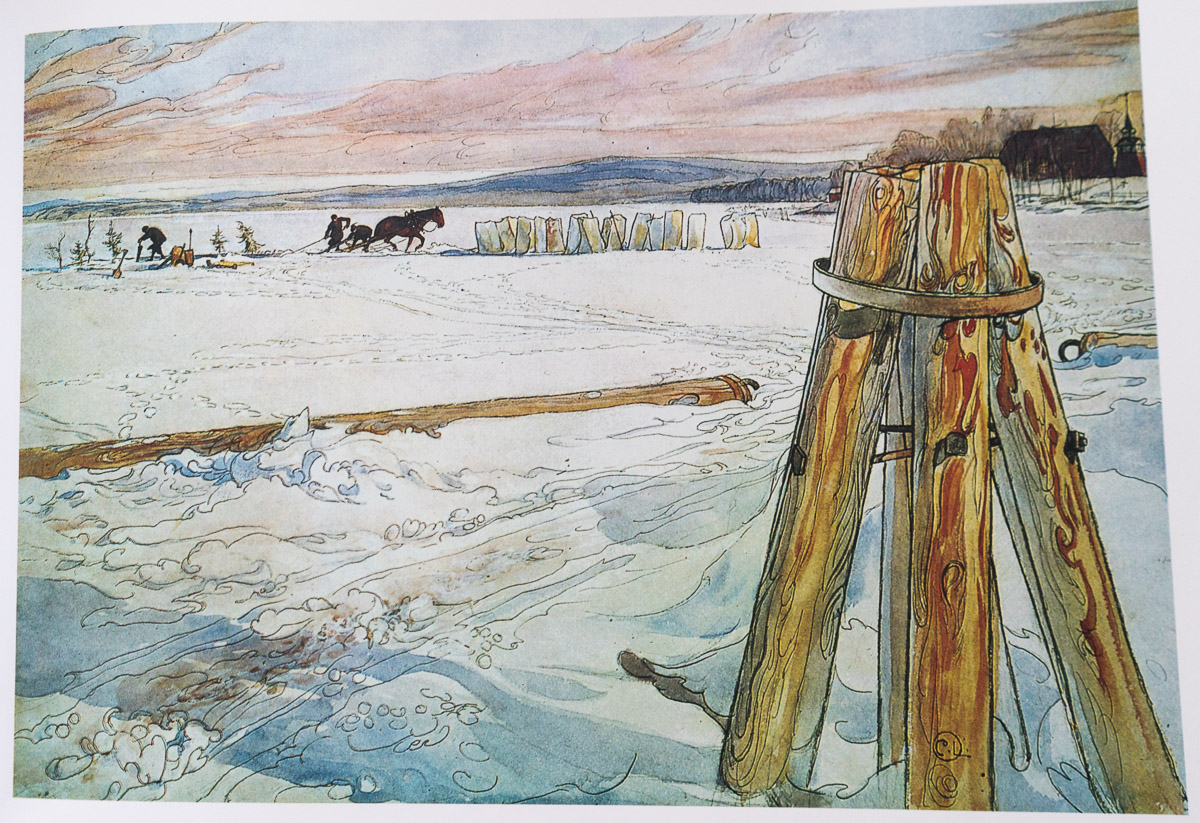
A collection of 19th century Swedish painter Carl Larsson‘s farm paintings. His calendars are a staple with the Scandinavian branch of my family. His work makes me think a bit of Norman Rockwell– beautiful and flowing, but with crisp lines that give a feel of illustration. I love to look at his work for inspirations in depictions of the ordinary, the pastoral, the family.

beauty-books-02733beauty-books-02743

Radioactive: Marie & Pierre Curie, A Tale of Love and Fallout by Lauren Redniss

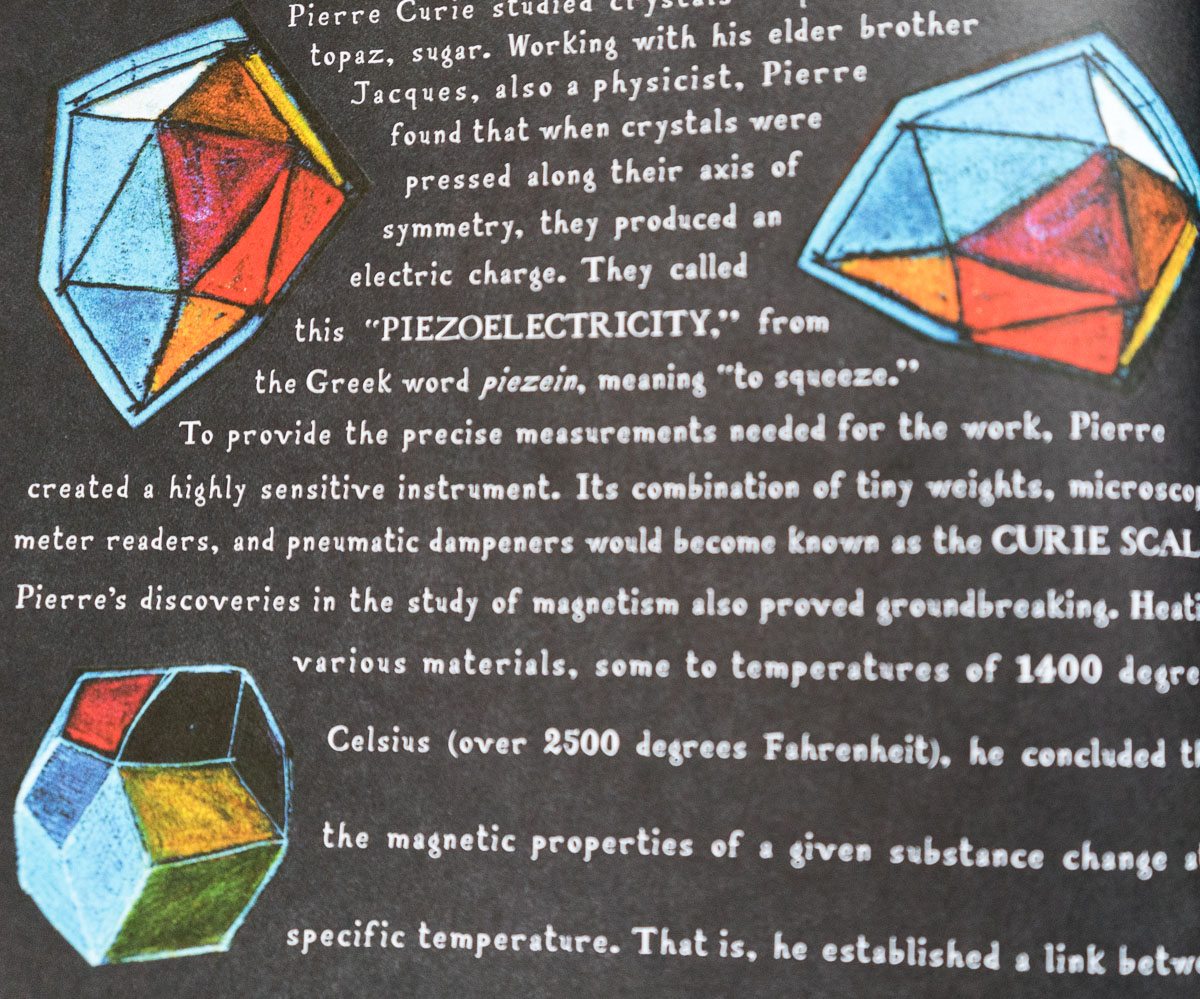
I previously reviewed this book here. I’m not in love with the writing in this book (see the review), but I am in love with the art. I love the way it connects to the science and is elevated by it. The typography for this book is also divine. Redniss even created a special typeface called Eusapia LR for this book, and it works beautifully. This book is an inspiration in marrying art and science.

beauty-books-02736beauty-books-02741

Bizarre Tales from the Three Notch’d Road


Bizarre Tales from the Three Notch’d Road is a collection of  eight science fiction and fantasy stories celebrating the 5th anniversary of our SFF writing group. It’s now available for the kindle here.

All the contributors are local to central Virginia, with stories from tropical islands, snowy oblivions, the distant past and the distant future. The name for this volume honors the Three Notch’d Road, which runs through central Virginia and dates back at least 300 years.

So check it out! It’s the first anthology our group has produced, and we’re very excited and proud!

first-cover

Guns, Germs and Steel: An Excellent Science Fiction Resource

For the last few weeks, I have been reading Jared Diamond’s Guns, Germs, and Steel. I would recommend it; there are over 1600 reviews on amazon that can tell you as much. Significantly for me, I found Guns, Germs, and Steel to be an excellent science fiction resource.

I am often skeptical of social sciences. Unlike math or physics, the simplest, most beautiful solution is often not the correct one in sciences describing human behavior. Guns, Germs, and Steel does an excellent job arguing a difficult central thesis. It does this by approaching the question from a bevy of angles, and asks what we would expect to be true in alternate scenarios. I am not an expert in this field, so I wouldn’t know if the book is overlooking any key angles, but I found the arguments convincing and honestly laid-out.

“Guns, Germs, and Steel” is the author’s shorthand for why Eurasian societies ended up defeating Australian and American societies. The majority of the book discusses prehistory such as the acquisition of crops, domestic animals, societal structure, the means by which Eurasian societies obtained guns, germs and steel so disproportionately to other societies.

This book is a must read for any science fiction author. Especially during the first half, I was mesmerized at the possibilities posed by this book.

Take one simple argument: Eurasian societies had a built-in advantage over American societies because Eurasia is oriented in an east-west direction, while the Americas are north-south. Crops domesticated in one part of Eurasia, such as the Fertile Crescent, could easily spread to other areas with similar climates, such as Italy. In the Americas, corn domesticated in central America took millennia to reach north America, because the central American corn was not ideal for northern climates. Only when a hardier corn came about did the corn spread north.

In another example, the author suggests that most plants are not suited to domestication; by chance, some of the plants most suited to domestication were in the Fertile Crescent. Regions with less suitable plants took longer to convert to farming, which delayed other advances. Present-day hunter-gatherers are experts on the properties of local plants, so along with other evidence, we can infer the lack of plant domestication in some areas was due to the lack of suitable candidates. Even in modern times, the only Australian plant domesticated is the macadamia nut, suggesting that the lack of crop-ready plants kept aboriginals as hunter-gatherers, rather than any biological differences amongst peoples.

So why does this suggest sci-fi? Much of the book is concerned with how environment shapes peoples. How would a society marooned far from Earth either thrive or degenerate back to more primitive ways? Much of it would have to do with the available resources, which would be shaped by the planet. In an alien society, which sub-group would tend to have which advances? If the land-bridge to the Americas was at a lower latitude, how would history have proceeded? If American societies had large domesticated animals, would they have resisted western invasion more, with diseases and beasts of war of their own? If the Cape of Good Hope had had suitable crops for domestication and thus supported a more advanced society, would the Dutch have gained a base of operations with which to fight the Xhosa?

Many possibilities suggest themselves for alternate histories, alien histories, or arcs of human colonization. The best books are ones that inspire and stimulate the imagination– this one did for me, and thus I strongly recommend it.

Learning, learning, learning

A couple of weeks ago, I signed up for an online service, Lynda.com, where you can watch videos to learn about various software. I’ve been watching the things non-stop, especially to learn about InDesign and Illustrator. In a way, the videos have been exhausting; I am so curious about the topics that I sometimes watch until I’m absolutely frazzled. There’s nothing more exciting than learning new skills. Then I took my learning to my projects. I had another bookbinding marathon last week, putting together copies of three books-in-progress.

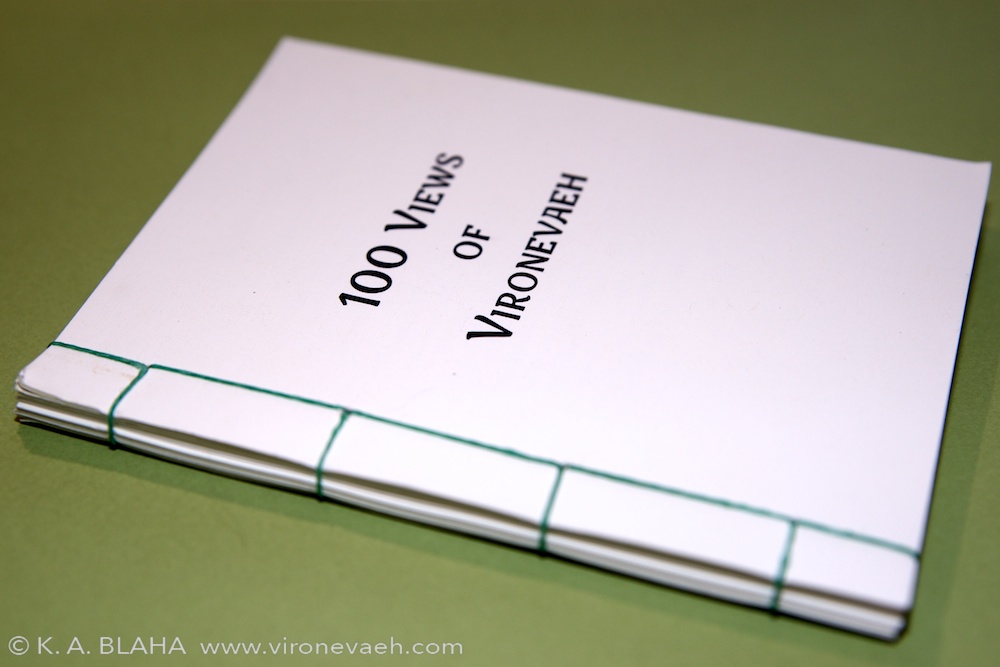
Project #1: loosely based on Hiroshige’s “100 views of Edo.” This 4″ x 6″ book contains the first 25 scenes of the city of Vironevaeh, along with historical context. Harkening back to Hiroshige, I bound this book using Japanese stab binding.

SONY DSC SONY DSC


Project #2: A project I first started a year and a half ago, I re-visited “The Galactic Adventures of Zish and Argo”, with my new knowledge about layout and so forth. I improved the cover, and all around tightened things up.SONY DSC SONY DSC

Project #3: A collection of science fiction stories by the members of my writing group. Assembled in InDesign, also taking advantage of my new skills. Soon to be available on the kindle.

SONY DSCAnd now back to projects. More to post later, undoubtedly.


Which is the fictional critter?

Because nature is weird, and I like science fiction, which is the real creature, and which is the fictional critter?

Critter #1 is 1 mm long critter that:

  • Can survive in space and at the bottom of the Mariana Trench
  • Contains a set number of cells in its body
  • Can be rehydrated after over a century
  • Can survive thousands of times more radiation than a cockroach

Critter #2 is a bird that:

  • The males deliberately sets fires as a mating ritual
  • The males perform this ritual in pairs, in case one catches fire
  • After the fire spreads, the fires leave masses of cooked meat. The birds scrape off their meals with their distinctive, blade-like beaks

So… which critter is real, and which is not? For bonus points, in what book did the fictional critter appear?

Read the Answer

My Reading List for the Holidays

Between preparing my dissertation and doing NaNoWriMo, I haven’t read much lately. My eventual goal is to write excellent science fiction. I feel that reading in the field is essential to writing better in the field. So I try to make sure that I keep up on science fiction reading. Below is the reading list, in no particular order. We’ll see how I do!

Marooned in Realtime by Vernor Vinge– Vinge is one of my favorite authors, and this book is the sequel to The Peace War, which I enjoyed.

Camouflage by Joe Haldeman– Haldeman is another favorite of mine. This novel won the nebula award.

Gateway by Frederick Pohl– I read this over a decade ago. I enjoyed it, but I remember nothing of it, so a re-read is in order. The novel often appears on “best-of” scifi lists.

Starship by Brian W. Aldiss– I enjoy Aldiss, and novelist Ed Lerner recommended it to me at a science fiction seminar. So I definitely should read it.

Cyteen by C. J. Cherryh– Set in the same universe as Downbelow Station, which I loved (see my review here). It’s the size of a bible, but I have high hopes.

The Good Soldier Švejk by Jaroslav Hašek– A classic humorous novel of Czech literature, set during World War I. I keep hearing good things about it and it’s been on the shelf for 5 years. I’ve even been to one of the bars described in the book. Time to read it.

The Innocents Abroad by Mark Twain–  Twain writing about travel. Yes.

Lilith’s Brood by Octavia Butler– I haven’t read anything by Butler yet. People rave about her, so I would be remiss not to try her out.

A little bookbinding

I really enjoy bookbinding from time to time, especially now that technical writing occupies the bulk of my time. It’s refreshing to complete something and see its completeness. It can be hard to feel holistic satisfaction from writing; there’s always one more thing to fix. Below are some photos of my recent projects.

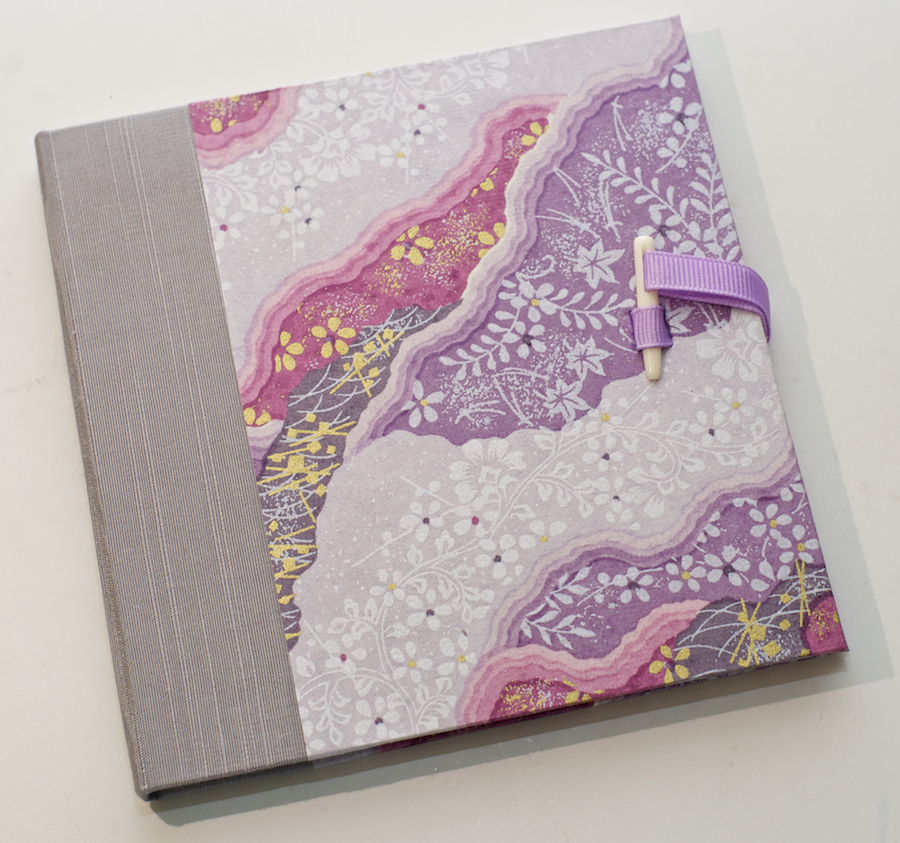
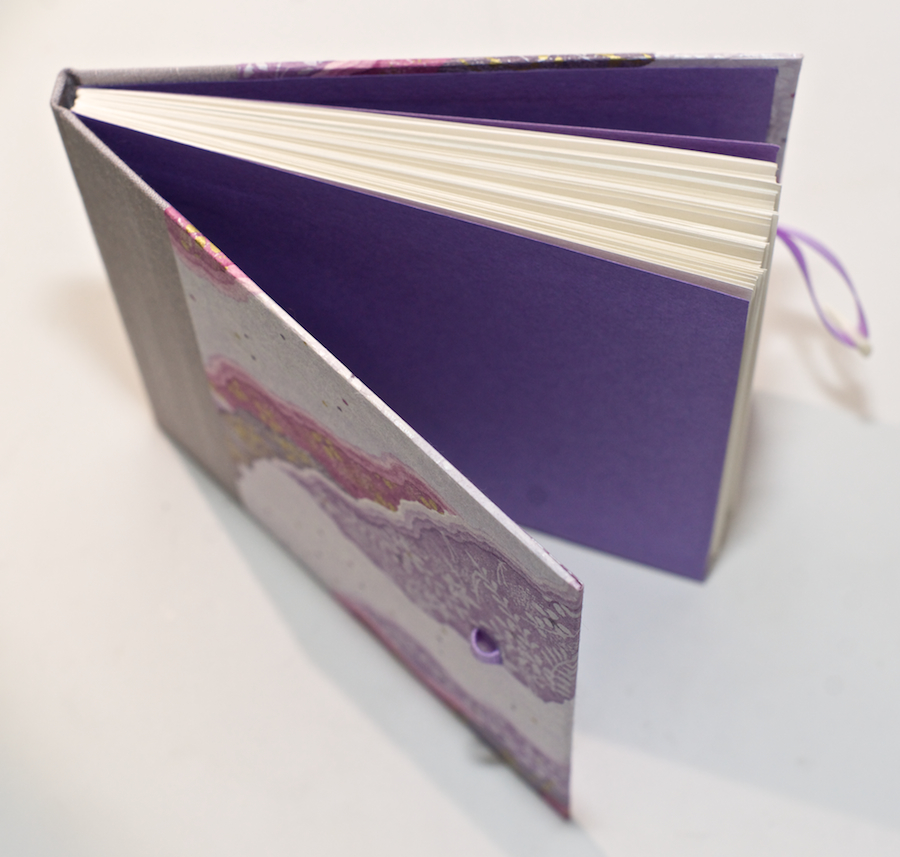
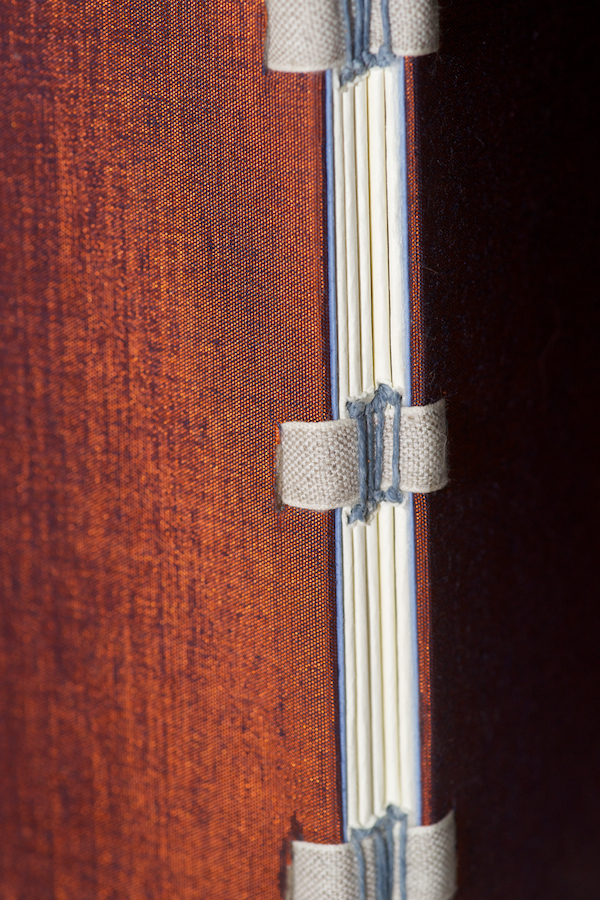
The first two are books I donated to my local writing club, WriterHouse, for a charity raffle. The purple and grey book is a perfect-bound notebook with a bone clasp; it contains linen textured paper. The dusky red book has exposed linen tape to allow for a more flexible spine. It contains a slightly warmer-colored linen textured paper. I made a similar book for myself a few months ago–having something beautiful to take notes in is a great incentive for me.

The third book is a copy of my novel draft to send to a friend who until now has been reading from a pdf. I used a red poppy patterned paper for the endpapers–I love the pattern but it’s a slick paper that can be hard to keep flat. I was pleased with how it turned out. The book’s cover is black imitation leather.

SONY DSCSONY DSCSONY DSCSONY DSCSONY DSCSONY DSC