Category Archives: Contemplation

Achievements!

Today I submitted my second technical paper. I should know its status in a couple of months. I really hope it gets accepted, because I think it has some really good results.

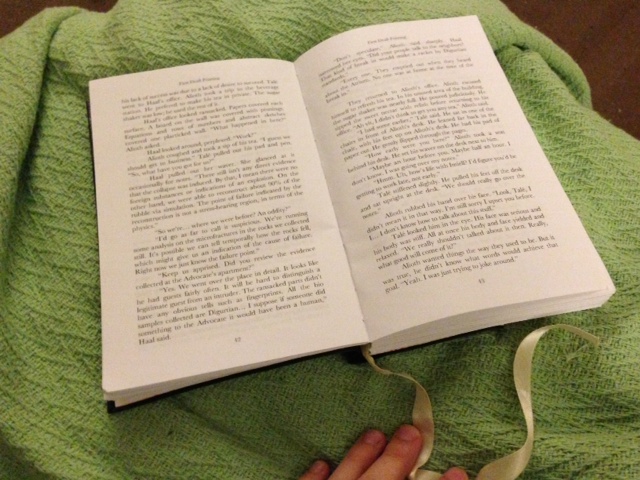
I also finished binding a rough draft of my novel. I finished the draft itself last Thursday =). To reward myself, I bound a copy for myself. Then I’m going to reread the words and mark up alllllll the things that are wrong or that I want to change. I’ve never gotten this far before, though, so I wanted to recognize that achievement with a binding. I’ve included some pics below. 360 pages (including some blank pages for my comments between chapters) and 82,000 words. Hooray! Just simple photos for now, maybe I’ll get around to a nice photo shoot in a few days.

photo-1 photo-2 photo-3 photo

Science in Progress

Today I proposed my PhD and passed, which means only one test remains in a few months. So hooray for me. I’ll soon finish the first draft of the novel, and I just got back from vacation. I’ll post some pics of that later this week and finish the 100 facts post at last. Unfortunately the blog has suffered, but the worst has passed.

It’s been hectic, but the maximum pressure has relaxed a bit. The professors said the quality of my writing was very good, so here’s to the blog for improving that for me. Here’s to more improvement yet!

Interesting facts: 50-75

Today I post interesting facts 51-75. These last weeks have been incredibly intense, and it’s been tough meeting my 100 fact challenge celebrating reaching 100 posts. I will follow with the last 25 later this week or next Monday. The blog has had to take a backseat to work and to my book writing efforts; I will hit 70,000 words tomorrow and I am closing in on the finish. And without further ado, more facts!


51. Earth’s magnetic poles switch every few hundred thousand years, as a result of natural movements in iron in the crust. I wondered how this might affect migratory species using magnetic senses, but there isn’t enough evidence from the last switch 41,000 years ago to tell.

52. The creator of Kellogg’s cornflakes was at war with sexuality. The cornflakes were a part of this, as an unstimulating food. He was a strong advocate against masturbation– advocating circumcision and application of acid to the genitals.

53. Left-handed people are at a higher risk for numerous ailments, including schizophrenia, ADHD, and depression. I am what they call mixed-handed– I do some tasks with my right hand (writing), and some with the other (sports).

54. Eta Carinae is sometimes one of the brightest stars in the sky, and sometimes not. It is a system including a luminous blue variable, which grows a coat of obscuring gas, and then periodically blasts it off. In 1843, it was the second brightest object in the sky. It currently cannot be seen with the naked eye.

55. George Washington did not have wooden teeth. His dentures were made of gold, hippopotamus ivory, lead, and human and animal teeth (including horse and donkey teeth).

56. Goldfish actually have memories of about three months. As anyone who ever owned a goldfish should know.

57. Alfred Tennyson was troubled and interested by the science of his time. Themes about evolution and references to the contemporary phrase “ontogeny recapitulates phylogeny” (a since debunked scientific concept which claims an organism develops in vitro according to its phylum order) can be found in his poetry, specially In Memoriam.

58. Water-induced wrinkles are not caused by the skin absorbing water and swelling. They are caused by the autonomic nervous system, which triggers localized vasoconstriction in response to wet skin, yielding a wrinkled appearance. This may have evolved because it gives ancestral primates a better grip in slippery, wet environments.

59. Eating nuts, popcorn, or seeds does not increase the risk of diverticulitis.These foods may actually have a protective effect.

60. The Coriolis effect does not determine the direction that water rotates in a bathtub drain or a flushing toilet. The Coriolis effect induced by the Earth’s daily rotation is too small to affect the direction of water in a typical bathtub drain. The effect becomes significant and noticeable only at large scales, such as in weather systems or oceanic currents. Other forces dominate the dynamics of water in drains.

61. Abner Doubleday did not invent baseball.

62. Nikola Tesla was a badass scientist. Thomas Edison isn’t as great as you thought. Tesla pioneered AC current distribution and the lightbulb. Edison stole ideas from Tesla and attempted to undermine him to increase his own profits.

63. Paul Erdös wrote over 1500 math papers. If you’ve heard of six degrees of Kevin Bacon, this was originally known as the Erdös number, the number of degrees of separation from publishing a paper with Erdös. He was very eccentric. For years, he lived out of his suitcase, traveling across the world and collaborating on papers. He didn’t know how to open juice containers and used amphetamines to give him energy. His epitaph was “I’ve finally stopped getting dumber.”

64. Catherine the Great was the longest-ruling female monarch in Russian history. She was actually prussian, and married Peter the Great’s grandson. She probably conspired in his assassination, and took the throne. Her son changed Peter the Great’s succession laws to exclude women from rule.

65. Marie Curie was the first woman to win a nobel prize, and the only person to win in multiple sciences. She discovered polonium and radium and x-rays. She used x-rays to help diagnose injuries in WW1. She eventually died due to radiation-related illness.

66. Ramanujan was an indian-born mathematical genius. With little formal instruction, he devised many theorems that are still being incorporated into mathematical theory. He died at 32.

67. Michael Faraday was a pioneering scientist in electromagnetism, although he also received little formal education. He discovered benzene, and discovered the relationship between light and magnetism. He knew little math beyond trigonometry. The unit of capacitance, Farad, is named after him, as well as numerous constants and devices.

68. the symbol pi, π, originally referred to the perimeter of a circle. only in 1706 was it used to mean the ratio of perimeter to diameter.

69. James Tiptree Jr., a prominent science fiction writer, was actually a woman. She wrote under the pseudonym for two decades until she killed her husband and then herself.

70. In the early years of the Soviet Union, a type of genetics besides Mendelian genetics became accepted as correct, known as Lysenkoism. In Lysenkoism, the way you raised a crop determined its outcome, not the type of seed. Widespread starvation occurred in the Soviet five-year plans, partially due to Lysenkoism.

71. There are over 20,000 species of orchids, or four times the number of mammalian species. Many of them are epiphytes, meaning they grow above the ground in tree-borne habitats.

72. East germans could only buy Trabant cars. Used Trabants were more expensive than new ones, because the waiting line was shorter.

73. A girl in Sweden survived her body temperature dropping to 55 F (13 C) in 2010.

74. Hypothermia is highly correlated to age. Older people suffer hypothermia at a much higher rate.

75. The Cape Hatteras lighthouse is the tallest base to tip lighthouse in the United States. Due to shore encroachment, it was moved in 1999. Its light can be seen 20 miles out to sea.

Blog changes and milestones

This post is my 99th blog post, so obviously the next one will give the big 100. I will be posting that on Monday, in the form of 100 things I find interesting. It should be fun.

I must switch to posting on this blog twice a week instead of three times a week. Work has suddenly sped up a lot, and I need to use my time (slightly) better. But I will still post a long post every Monday, and a shorter one every Wednesday or Thursday. As I approach 100 posts, I can hardly claim any kind of celebrity status, but I appreciate the people who come by and like or comment. Yesterday I reached 50,000 words on my novel draft (that just sounds crazy!). I can tell that forcing myself to sit three times a week and write about something I find interesting and trying to be clear has really improved my writing on demand. To me, it seems that this is a large component to writing a novel: shut up, stop reading writing help sites, and shackle yourself to that desk.

So I shall see you all on Monday, with 100 super awesome facts. I’ll end this post with the first fact of the next:

1. People from different cultures differ in what colors they perceive. As a simple example, english speakers deem pink as a different color than red. Russian speakers don’t, but they have a fundamentally different word for dark and light blue. In chinese, red and pink are red and pastel red, and likewise with blue. Perhaps by Monday I will find an additional example I had in mind, where 2 sets of colors are shown. In one set, Westerners can distinguish the different color 99% of the time; in the other, their success is much lower. Cultures in Africa exhibit the reverse ability to distinguish.

Join the bone marrow registry from your couch

A couple of weeks ago I read about a shot-putter at University of New Hampshire named Cameron Lyle. He is giving bone marrow to a critically ill 28-year-old; unfortunately because he is a senior, donation will end his shot-putting career at the school. I’m glad to hear that the guy didn’t even think of it as a question. He knew he had to donate.

Lyle was found for donation because he was in the bone marrow donor registry, as part of a drive run by UNH. I was really glad to hear this. Perhaps I just don’t get out enough, but at my two universities, I’ve never heard of such things.

How to join

In this post, I wanted to make sure that people knew that it is so easy to join the registry at marrow.org. It’s free (if you are under age 45), and involves no needles unless you match, which happens for about 1 in 540 people. You sign up on the marrow.org website. This is basically giving them your address, and a contact’s address so they don’t lose you in the future. A pack of q-tips come in the mail. You swab them in your cheeks, and send them back. And then you’re in the registry.

What to expect if you get selected, from my experience

I donated marrow several years ago to a family member. Most times, but not always, stem cells are induced into the bloodstream through a series of shots. Then when the stem cells are in your blood, you hook up to a machine which takes the stem cells out and puts the rest of your blood back in you. That separation process is called pheresis, and if you’ve ever given plasma, it’s a similar procedure. An out needle in one arm, and an in needle in the other. The biggest problem with this method, as one who experienced it, is using the restroom, because they want you well-hydrated and it takes a while. For young people, the stem-cell shots can cause some aches. I turned into the princess and the pea, sleeping on all the pillows in my house for a couple of days, but apparently that isn’t typical.

Sometimes they still do the old-fashioned big needle in the hip bone marrow transplant method. They often show this procedure on TV shows, but it’s less common than the stem cell donation I described above. It sounds like the shot-putter might be doing a marrow transplant, which would explain why he can’t shot put for a few weeks.

The point

But basically, it something that you can do for free with very little inconvenience. In the unlikely event you get selected, it’s still not terribly involved. Minorities and people of mixed background are especially needed. There are FAQs and other info at marrow.org, too. Hopefully this will give you the info and motivation to join the registry, or encourage others to join.

Happy 16th Anniversary, Vironevaeh!

Sixteen years ago I first started writing about Vironevaeh, the extraterrestrial city that is the namesake for this website. In middle school I was that kid– I told everyone who would listen that I was an alien. I was so bizarre kids didn’t know how to bully me, not that they didn’t try. I happily kept inventing my world.

In high school I started to read the classics of sci-fi (my top 20 scifi books). Before that, I think Vironevaeh was an alter-ego–I had a different identity there, and knew different people. Advanced having of imaginary friends. The classics gave me a different perspective, the perspective of world-building. I’ve been slowly plugging away ever since. There’s a spreadsheet with a thousand years of history, some more densely detailed than others. There’s a list of the 1027 first Vironevaeh. There’s a ton of pointless info, as there is so much pointless info in life. But all of it was a labor of love, through all the years of perplexed looks.

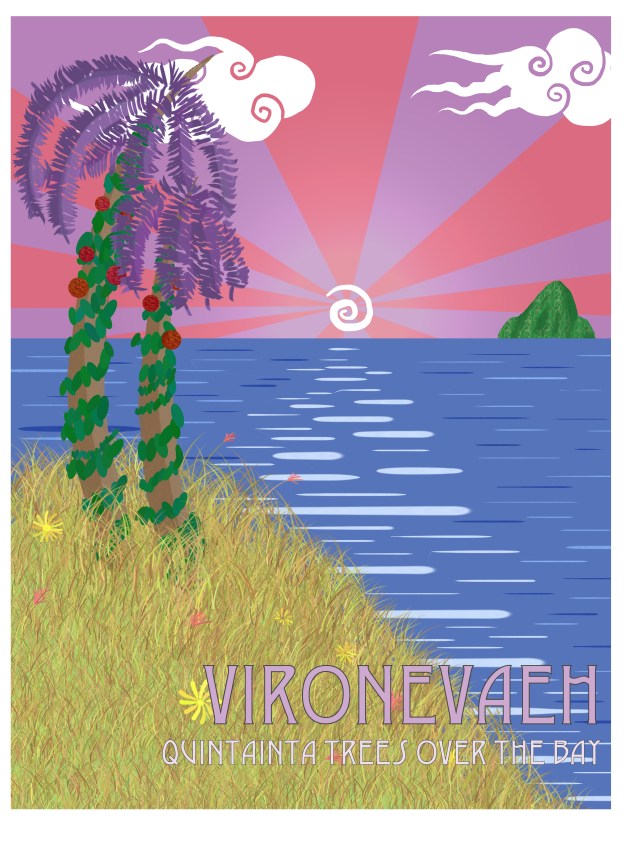
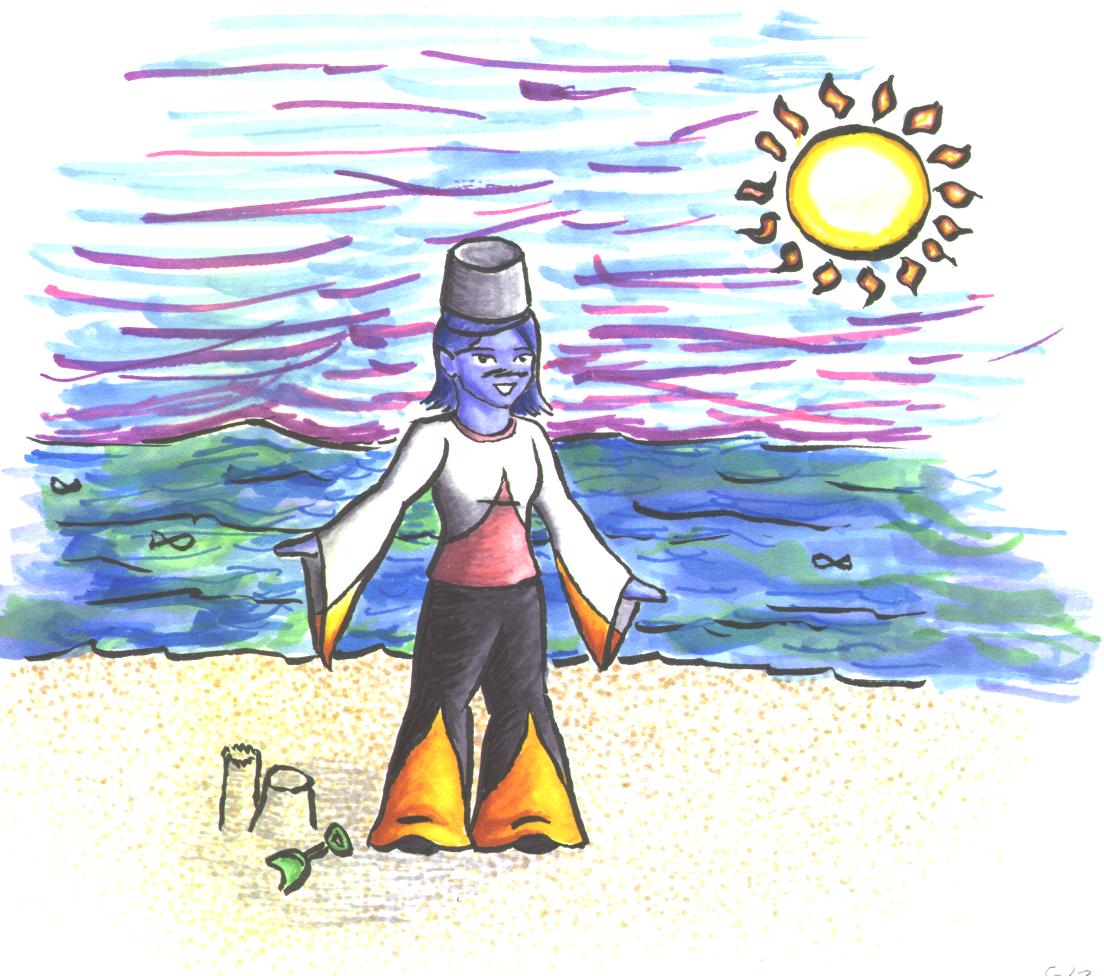
For your delight, some of the works from over the years. It is good to pause at times and review the path. I’ve posted a lot more recent works on this blog; here are some oldies. Drawing for Vironevaeh forced me to push myself. (Many other illustrations are also available in Vironevaeh: Science Fiction Fairy Tales, which is free on the iPad.) Some things are worth the long-haul.

Jainus Aillette Torwin Trarce at beach_marker

My alter-ego, Jainus. From 2004.

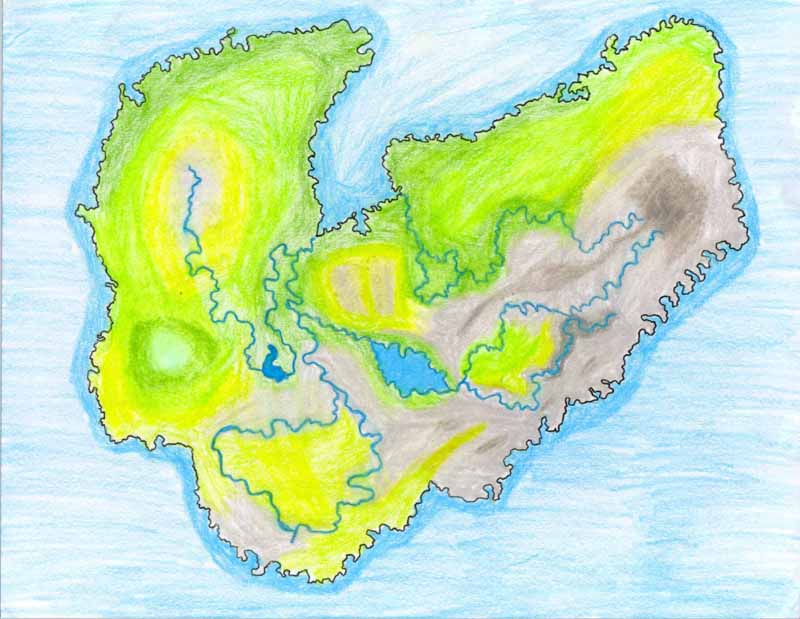
Vironevaeh relief map 800pix

Map of the island of Vironevaeh, from 2004 or before.

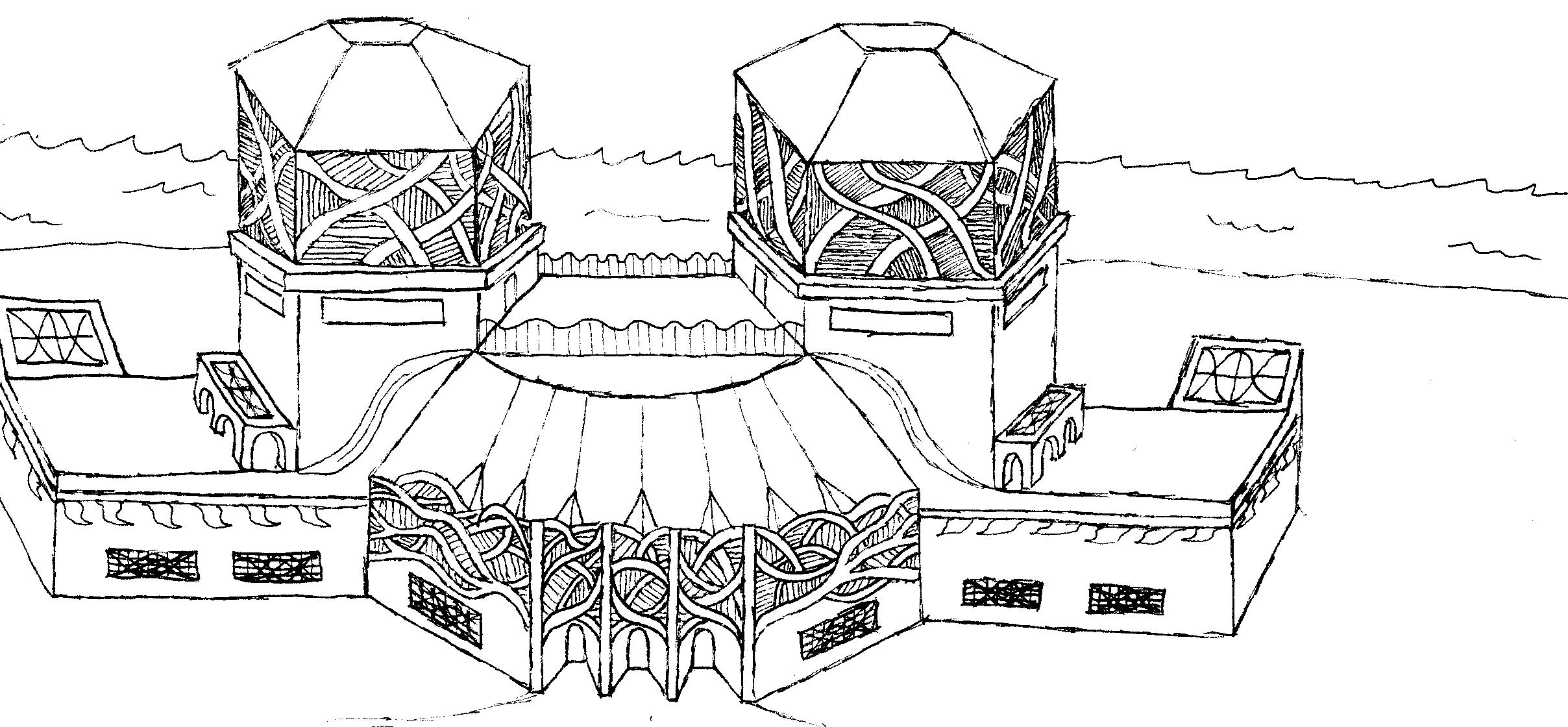
building Palace_at_Vironevaeh_Proper

Palace, 2003.

clothing1 v2

Clothing from one historical period, 2007.

ChibiTempest

One of Jainus’ sisters, 2001.

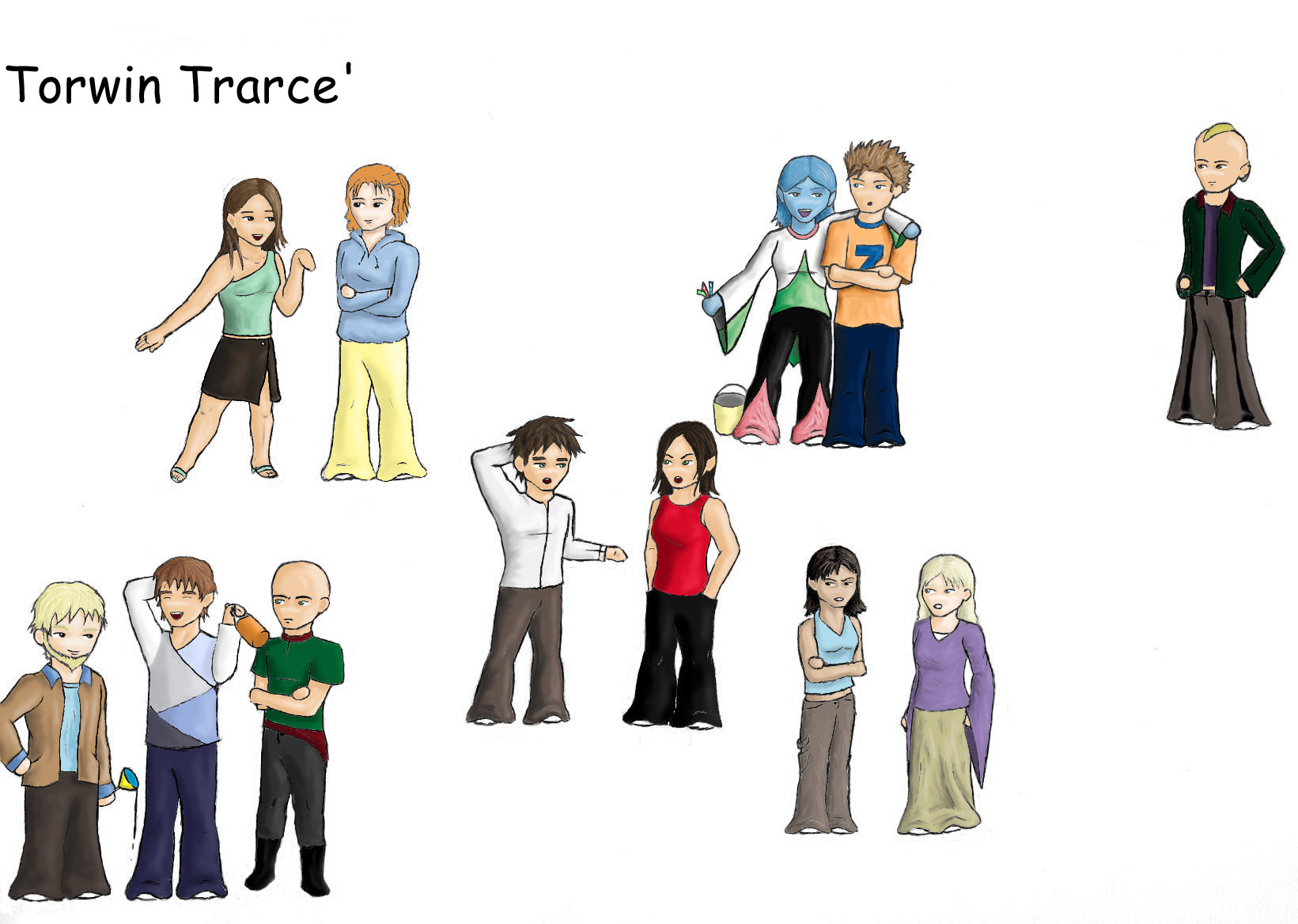
Torwin Trarce chibi pencil tablet

Jainus and her 11 siblings, 2004.

Kolo Kolo Whit in Color

Kolo, a notorious political traitor, 2004.

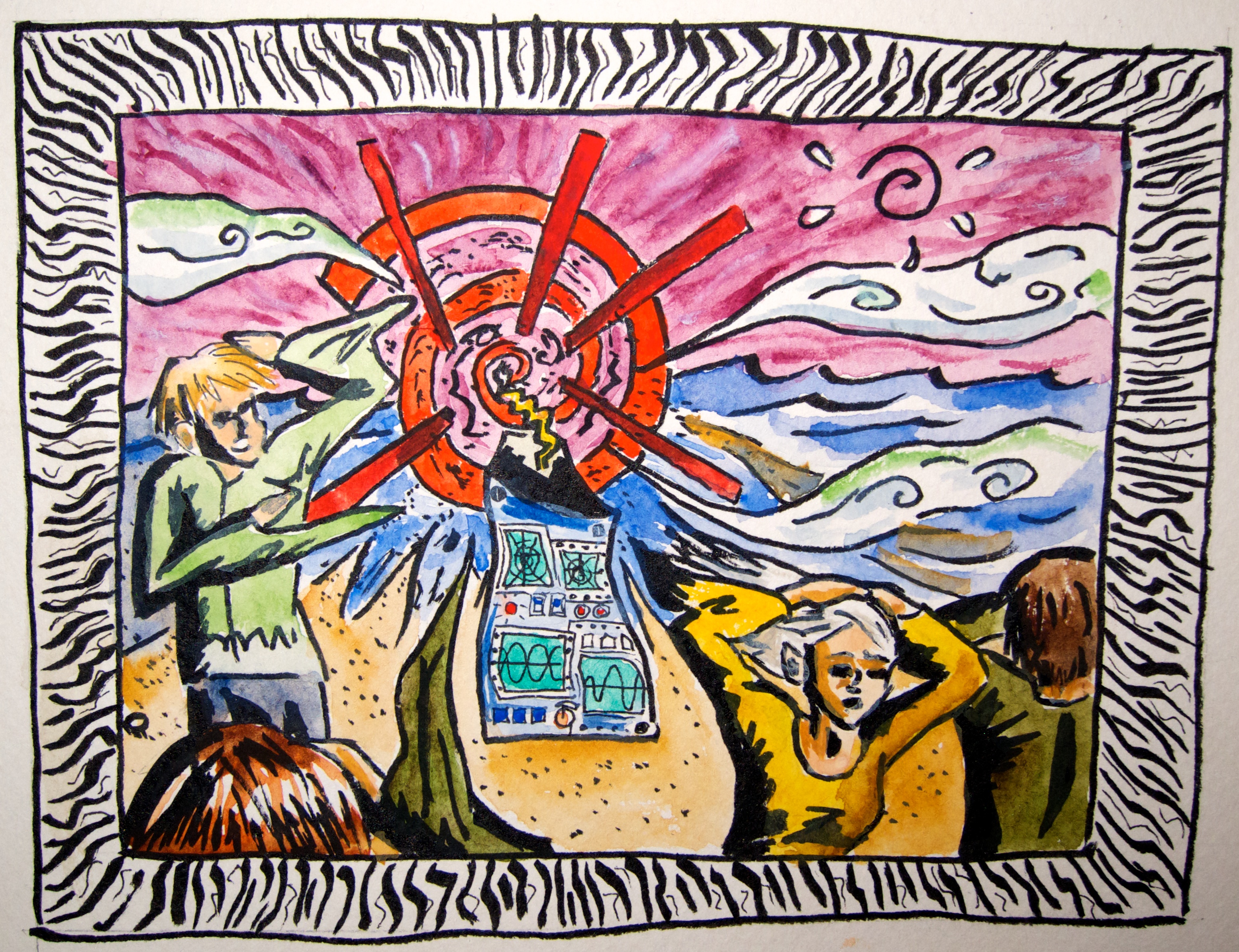
wormhole invention

Wormholes!, 2011.

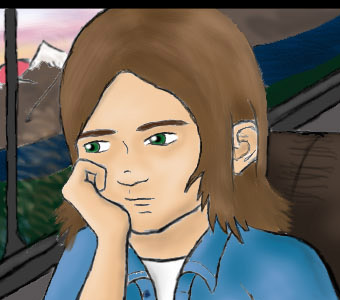
Jait Anda Torwin_psd

One of the first Vironevaehns, 2004.


Sources of Sci-Fi Inspiration: City Culture of Prague

Setting is a critical element to most stories. It frames the actions of the characters and provides a rich and interesting backdrop. Often the environment motivates the character. As most portraits of people would be less interesting on a white backdrop, most stories of people would less interesting without the setting. New Orleans gives Ignatius a good playground in “A Confederacy of Dunces;” “White Fang” would be reduced hugely without the north, and “One Flew Over the Cuckoo’s Nest” would be slightly different without the asylum.

As a writer of science fiction, setting is both a problem and one of my favorite things. How do you draw in the culture and idiosyncrasies of a place that doesn’t exist? They have to be imagined, and imagined plausibly, by the writer. All of my favorite science fiction books have strong settings: In “The Left Hand of Darkness“, we learn about the sexual culture of a differently gendered humanoid species. Through their myths and traditions, we get to learn how they eat, how they like their weather, what is taboo, and what is an insult. In “A Canticle for Leibowitz“, we start at a Catholic abbey in post-apocalyptic New Mexico several centuries in the future. In “The Moon is a Harsh Mistress“, the setting is a lunar colony that feels bullied by earth. We learn about their principles, their marriages, and their aspirations. They can be a little closer to home, too. In “Holy Fire“, the protagonist travels from future San Francisco to future Munich to future Prague. Some sci-fi stays closer yet to home, but I find that I love crazy settings; thus I prefer Vernor Vinge’s “A Fire Upon the Deep” to his “Rainbow’s End“. (For others see my top 20 scifi books post.)

When I write my stories, I don’t want the settings to feel like the Midwestern United States plopped onto Mars or Alpha Centauri. I want them to feel like products of their interstellar, future environments. So I try to understand how settings influence culture currently and historically. I spent a summer in Prague, and in that brief time I tried to learn what I could about the culture. I tried to go where the Czechs go, eat what they ate, and read what they read. My host in town was a retired Czech professor who liked to talk (derisively) about the communist days. I worked half days at a chemistry lab out in suburban Prague. One of my coworkers smoked at her desk only feet from various chemicals and dressed like a 60-year-old teenager. I took frequent walks to Vyšehrad, an ancient fortress in Prague (pictured below).

I most appreciated the Czech sense of humor. As a country often conquered, the country developed a strange sense of absurdism. Under the Petrin Tower in Prague, there is a museum to Jara Cimrman, the best Czech man, who never existed. I can hardly say I understand everything there is to know about Prague and Czech culture, but a few months there certainly showed me a type of people I hadn’t seen before. Hopefully this will aid me in constructing a people we haven’t met before.

Some worthy Czech reading:

Side note: No post this past Friday; I broke my toe and then I had a lot of traveling to do this weekend. Happily, the toe is already much improved, and today it’s 80 F (25 C) out.

Learning about Graphic Novels and Publishing from Barbara Slate

As I mentioned in Monday’s post, I attended a talk by comic book writer Barbara Slate (at the VA Book Fest). She was one of the first female comic book writers, and has since branched out to her own graphic novels. After her talk I picked up one of them, “Getting Married and Other Mistakes“. It looks like a lot of fun, and like Slate herself, seems to have a nice sense of humor. She also has a book about how to write graphic novels.

She also spoke about the process of getting “Getting Married” published. She said that she was rejected about 60 times. I didn’t pay attention to that detail much that day. I wrote Monday about my own excitement, that I perhaps had a publisher interested in Zish and Argo. After further research, it looks like one of those pay-to-self-publish rackets, dressed up. I felt so duped! I was so excited, and they misled me. Fortunately, I figured it out quickly and for free. I channeled my frustration to overcome my fear of sending the manuscript off; on Monday after my realization I sent the manuscript to 5 places. Afterwards it occurred to me–if a woman like Slate who is familiar with the industry, knows publishing and knows people takes 60 rejections to place her book– then people aren’t going to be jumping out of bushes to publish me. It will take sober, dull work for me to get published, just like her. As it likely will for all of us. Please, may some eager publisher fall from the sky and praise me, but it’s not something I can expect or even take at face value. So last night I thought up a new story for Zish and Argo, and I will continue the slow marathon towards my goals.

Meeting goals at the Virginia Book Festival

Between attending the book festival and playing a water polo tournament, I had a very busy (but wonderful) weekend.

I went to several of the book festival sessions, which I will write about at greater length later in the week:

But the most exciting day was Saturday. I played a polo game in the morning. Then, reeking of chlorine, I went to the book fair to talk to publishers about Vironevaeh and Zish and Argo. One publisher seemed particularly interested, and I will post updates as I learn more about that. Then I popped back to the pool for some more water polo. The goal of this website and much of my work the last several months has been to get out there and try to publish something, to talk to a wider group of people and engage in a field I’ve cautiously eyed since middle school at least. So this weekend was a big step forward and I’m still high on it all.

Why you should join the bone marrow registry

Tomorrow my brother Brian would have turned 31. When he was 25, he died of leukemia. I was his bone marrow donor.

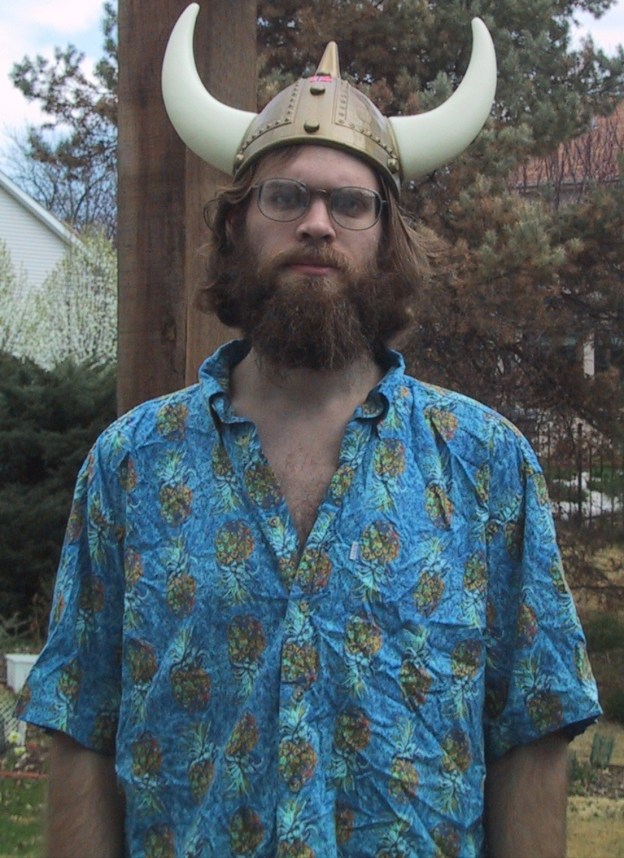
He was a quiet and smart person. He was working on his doctorate in computer engineering when he got his diagnosis. He liked computer gaming and anime and was a complete geek without caring at all about the designation. He first introduced me to chaos when I was in high school by showing me the logistic map. “That’s nice,” I said, and went on to other things, only to take up research in the field after his death. He played racquetball somewhat poorly; he was too laid back and unaggressive to play as boldly as the game required. He wore Hawaiian shirts and shorts year round. He liked to be different and to ignore the puzzlement of others. He once had a bad review as a TA because he failed to button his shirt. He was 6’5″ and looked like a viking.

When he got sick he lost his hair and his burliness. He didn’t complain. I donated marrow stem cells once, and some other cell in a similar procedure another time. I complained a lot. He kept trying to work on his research. His greatest vexations in the hospital were getting switched rooms constantly and the poor quality of internet access. When things went bad he entered hospice, again, without drama. His gums would bleed, he was covered with bruises and he hallucinated often. It never broke his spirit. He kept watching anime and kept playing computer games and didn’t complain. He was obviously often upset; once when they made him switch rooms he was so frazzled he cried. But he didn’t complain and he did his best to be helpful to the nurses and document his medication well. Leukemia does not define my memories of my brother but it certainly curtailed them.

Not everyone has the luck to have a bone marrow donor when they need one.  When I was matched with my brother, I was told there is only a 25% likelihood of matching for each pair of siblings. The odds of matching go down significantly beyond sibling relationships. A little less than 50% of marrow donations in 2006 came from a non family member. Matches can be especially hard to find for minorities. We need more donors.

So join the bone marrow registry at marrow.org. It is totally free to join, and you are eligible if you are between 18 and 60 (I tried to look if this extends beyond the US; it should, but I couldn’t find it on their website). They will send you a free kit with several q-tips. You swab your cheeks with the q-tips and then send them back.

There is a 1 in 540 chance you will be selected to donate, but even then, you are not required to do so. When you donate, they sometimes still draw marrow from the hip like you may have seen in TV shows. More often, the donor is given a drug for several days that causes marrow stem cells to circulate in the blood stream. Then they draw blood and separate out those stem cells, and put the rest back. It’s a lot like giving blood except the procedure takes a few hours. If you have more questions, marrow.org has a lot of helpful information. Please join, and thanks!