Category Archives: Methods

Writing prompt: Don’t Cry Over Spilled Milk Day

Time: 10 minutes. Click here to go to my list of prompts.

“Don’t cry over spilled milk day” (Inspired by this list of silly holidays.)

The warning message on my phone had been accurately dire. Only the charred beams of the house remained. I saw Bella and Sadie out in the yard, doting upon a firefighter with a bag of treats. I pulled up behind the firetruck.

“It’s a total loss, ma’am,” one of the firefighters approached me, bearing forms.

“So the message said,” I sighed. “Do you know what caused it?”

“Electrical short, we think. We won’t know until the simulation results are in, and they run overnight. You probably know what I’m going to ask next.” He looked apprehensive. He glanced at the dogs, and back to me.

“I back up every week,” I said.

He relaxed noticeably. “Thank goodness. You don’t know how many fires I see where the family hasn’t backed up in five years. It’s devastating.”

“I bet.”

“Do you know how to initiate the rebuild?” he asked. I shook my head and he walked me through the process.

“By next week, your house will be back at the state of your last back-up. A few details might be less current, say you hadn’t scanned a closet for a while. The insurance will put you up at a hotel until it’s ready.”

I looked over the ruins of my home, ruins of my memories. In a week, they’d all be back. Maybe not the same piece of paper I’d received at graduation, not the same toy my dogs loved to fight over. But nearly. I sighed.

“Are you all right ma’am? It’s a lot to take in,” the fire fighter said.

“No use crying over spilled milk.”

Writing prompt: create a vacuum day

Time: 10 minutes. Click here to go to my list of prompts.

“Create a vacuum day” (Inspired by this list of silly holidays.)


“Aren’t you the asshole that wiped out Charlottesville?” the woman said, spotting me from across the diner. She walked over.

“Well, technically no, it wasn’t me,” I rubbed my arm. I felt eyes study me from all around.

“Your work then. Whatever. I didn’t think I’d ever see you in person, or at least not without a fake beard.”

“I’m not ashamed of what happened,” I said. “Regretful, yeah, but not ashamed.”

“How do you work that out? Wiping out thousands of homes and businesses because you did something stupid?”

She looked genuinely curious. I was used to being berated. But maybe she would understand. I launched into the speech I’d recited in my head so many times. The speech no one ever let me speak. “Have you ever seen a vacuum chamber setup? A real, scientific one? For trying to create nothing, the suckers are enormous. And chock full of specialized equipment, like pumps that can literally be destroyed if they have to push thousands of atoms rather than tens. Frankly, I thought it was all a mess. I thought I could do better,”

She cocked her head to the side. She looked like she thought I was nuts, but she didn’t look angry.

“It was a wild idea,” I continued. “So wild I didn’t tell my advisor. But I didn’t need to tell him, I had the materials to get it done on the cheap.”

“Yea, yea, yea,” she waved her hand. “You decided to make a black hole in one instead, I watch the news. And trust me, no matter how you tell that part, it won’t sound clever to someone who lost a house to it.”

I looked away. “I can’t do anything about that now. I ran simulation after simulation that looked fine. I still don’t know what happened.”

“You got it wrong.”

“I really don’t think I did,” I said. “And I’m not afraid to be wrong—really, go find my undergraduate biology professor. I don’t have any data, it all got destroyed, but something other than just a black hole happened that day.”

She frowned. “You got it wrong. Apparently you are afraid to admit it. How sad that you can’t even see that.”

She walked away.

“Excuse me,” an elderly woman with a colorful scarf said from a booth nearby. “I can’t help but have overheard your conversation. And I have a theory about what went wrong that I’ve entertained for a while. Are you willing to try to reproduce your experiment?”


Writing prompt: Hugging Day

Time: 10 minutes. Click here to go to my list of prompts.

“Hugging Day” (Inspired by this list of silly holidays.)


Every species we knew said the Zagadins were the most caring and advanced species in the galaxy. When we finally managed to encounter them, it was with a sense of excitement. At last, we were friends with the cool species.

Cool be damned, thought the military—the Zagadins had technology, and they liked to share. For decades, other species had been able to travel faster than us, able to make ships we could only dream of. And when we asked for or demanded their technologies, they shrugged (or whatever a shrug was to their species) and said it came from the Zagadins. We could finally fleece the galaxy’s biggest hippy chumps and become king of the ant hill.

The Zagadins diplomatic arrival was all over the News Nets. They wanted to meet everyone! Secretary of state, president, secretary of the navy, senators, mayors, professors—for them, it was the more the merrier. They wouldn’t hear of restricting the event. Thousands of people came.

And the Zagadins introduced themselves with their cultural tradition—hugging. The military knew they had these hippies now. Everyone at the arrival got a hug from a Zagadin. And as promised, the Zagadins sent the government files full of technology afterwards.

But a strange thing happened. Those who had met the Zagadins didn’t care about using the technology to conquer. They just wanted to hug, and then the people they hugged became peaceful as well.

We asked other species. They shrugged some more. That’s how the Zagadins work. Their hugs transmit resequencing retroviruses that promote peacefulness. The Zagadins won’t meet a species until they work out the retroviruses necessary. Perhaps it’s a little invasive, but let’s hug it out, the aliens said.

A few hugless humans remained, and they were horrified. They fled to Io and founded a hugless colony. But they should really loosen up. Too bad they can’t hug it out.


Writing prompt: dress up your pet day

Time: 10 minutes. Click here to go to my list of prompts.

“Dress up your pet day” (Inspired by this list of silly holidays.)


My alarm sounds. I hear the pitter-patter of soft feet racing to the bed, and feel those feet step on the softest parts of my torso and groin.

“Good morning, kitty,” I croak. I reach over and slap the alarm. I open my phone. Euler purrs like a bulldozer and nearly nuzzles my phone out of my hand.

“Oh kitty, did you not want me to see today’s notifications?” I coo. I scroll through the day’s appointments and reminders. “Today is Dress Up Your Pet Day.” Euler head butts my hand. In his opinion, I should be using that hand to make him happy. I scratch his butt. He flops over and kneads the air.

“You’re happy now,” I say to him, “but we’ll see about later.”


On the way back from work, I swing by WalMart and go to the baby clothes aisle. My mom would love a picture of Euler dressed as a sailor.

Before I even open the door, Euler is crying to see me. I feel bad that he spends so much time alone, but hey, he’s a cat and I work to put food in his bowl. My guilt is not remarkably deep.

I open the door, and Euler jumps on my shoulders. “Kitty!” I shout, dismayed. It’s really my fault, I haven’t trimmed his claws lately.

Whelp, I’ve bled on this shirt now, I think. I take it off, put stain remover on the spots, and switch shirts. Euler purrs and slithers on the bed.

“Dress your pet day,” I say. “And it’s you who’ve made me change outfits. I’m your pet, aren’t I?”

Euler straightens. I’m sure it’s just my imagination, but there is a glint in his eye. A knowing glint. A cold shiver rushes up my spine.

Euler leaps at from from the bed, pushing me into the closet. The last thing I see before I black out is cats holding garments.

Writing prompt: Old rock day

(It’s the new year and I going to restart my weekly prompts! Hooray! I slacked a bit this fall, which means I’m chock full of inspiration, right?)

Time: 10 minutes plus a 5 minute edit. Click here to go to my list of prompts.

“Old rock day” (Inspired by this list of silly holidays.)

After I went to an exhibit on Mars rocks, I was determined to find my own chunk of Mars. I dropped $1500 on a Pocket Geology GC™ Field Testing Kit. The Pocket GC could vaporize a small chunk of rock and run it through a tiny analyzer. Based upon the composition and structure, it could access an online database and tell you how the rock formed, where it was from, and how old it was. Crowd sourcing meant better data every day. If you really needed to be sure, you could send it off for authentic geological testing by certified scientists… for a price.

Only a handful of Mars rocks have ever been found because most rocks just look like rocks. Peering into their history isn’t something human eyes were made for. But since the Pocket GC hit market, the number of samples had grown by 50%.

I drove throughout the southwest. I studied the circumstances of other rock finds. I kept looking. I kept failing, but I was keeping busy, which is important, right?

I found it, appropriately enough, in City of Rocks State Park in New Mexico. It wasn’t a Mars rock; it was something else. I only went there for the scenery; the rocks there are way too young to find a Mars rock. But, so accustomed to fiddling with my hands, I tested an unassuming chunk of rock.

“Origins: Unknown, age: unknown,” my phone displayed, followed by a mess of chemical data. The Pocket GC didn’t return “unknown” too often these days. Sometimes scientists in the lab with new substances stumped it, but after 5 years of crowd supplied data, it had seen almost everything. So I had found something wonderful: a puzzle. I knew I should send it in for the extra testing. But I decided to keep it intact for a few days as a trophy. It was almost a compulsion, I couldn’t stand to hurt it more than I already had for the testing.

I set the rock on the bedside table as I went to bed that night. In the morning, I woke tired. The dreams crept up on me slowly over the next few nights.

Writing prompt: bald and free day

Time: 7 minutes. Click here to go to my list of prompts.

“bald and free day” (Inspired by this list of silly holidays.)

I opened my eyes. I reached up to feel my head. It was smooth and hairless, slick and fast. Then I realized my fingers were different too. I lowered them and inspected them. They looked slightly blurry, but they were wider, flatter. Webbed.

“You’re completely hairless, now,” the technician said. “This new body has a number of modifications for your new lifestyle. You have more subcutaneous fat, to deal with the water temperature. You have a dorsal fin. You might notice your vision is a little blurry. That’s from the extra eyelid. It’ll help you see underwater.”

Across from me sat a motionless creature covered in hair. It’s tail hung limp. The last vestige of my last adventure. I had run with the wolves. Well, human-wolves. I wasn’t actually interested in hanging out with real wolves. Too much violence, not enough conversation. But since Ed had dumped me, I got tired of wolves quick. Finally I wanted to explore my first love, whales.

I’d always been fascinated by the sea. But the ocean is still not fully tamed. It’s intimidating. You have to sign a lot of wavers to do the whale experience. A lot of whale people never come back home. They don’t know if it’s by preference or if they die. They made me get a GPS chip, for tracking. It sounded undignified to me, but that was the only way.

“Where will I sleep?” I asked. My voice sounded odd. I wondered if that was due to modifications to my voice or to my ears.

“Your new body is modified to mimic sea mammalian species. Part of your brain will always be awake. This brain sleeps in shifts.”

“That sounds unhuman.”

The tech shrugged. “Isn’t that the goal?”

Another tech rolled my wolf body away. I knew from past adventures it would be mulched. My tech rolled my chair out of the room. I realized my legs were fused into one. Now it was real. I was going to be free.

Tutorial: Playing with Fireworks (in Photoshop)

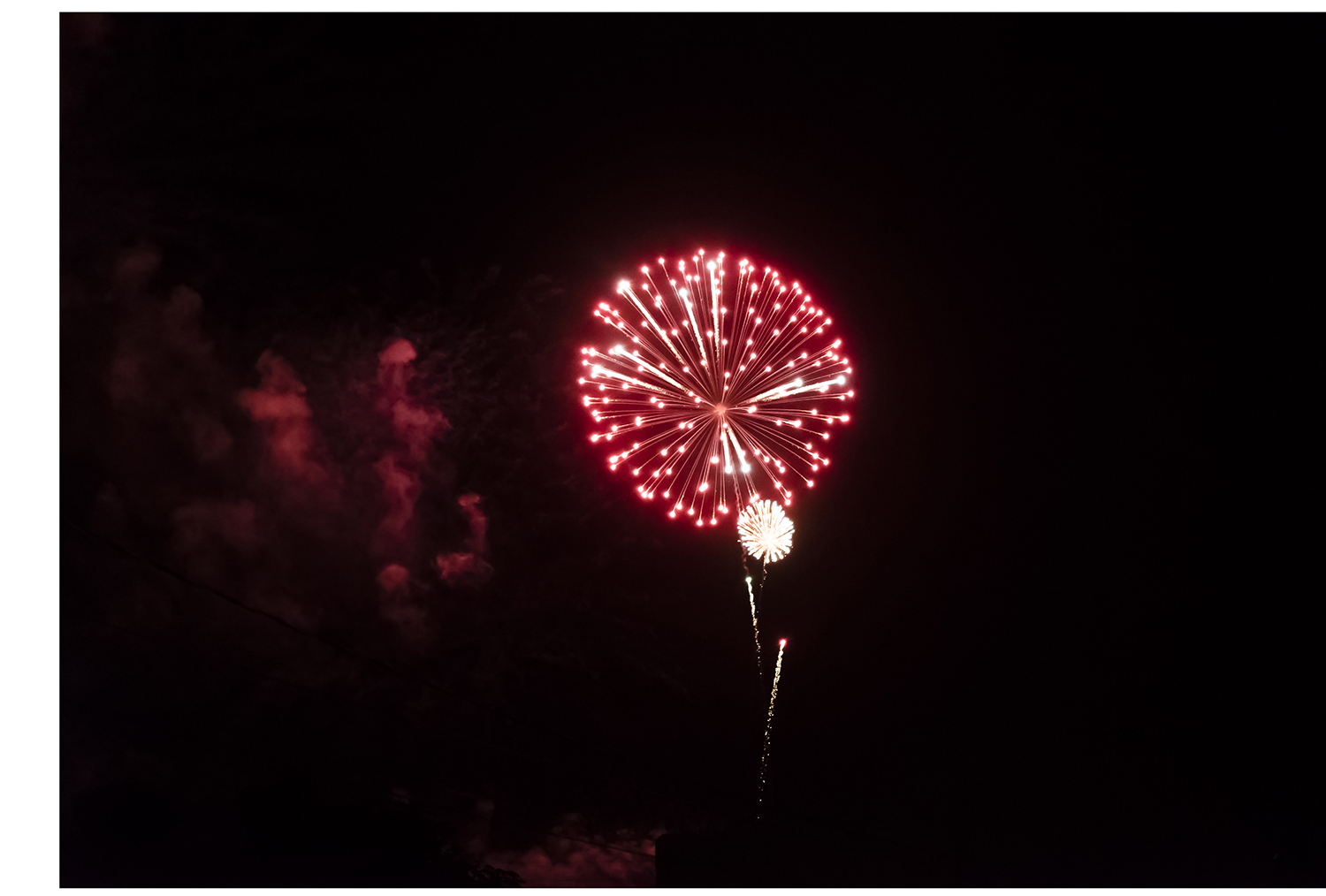
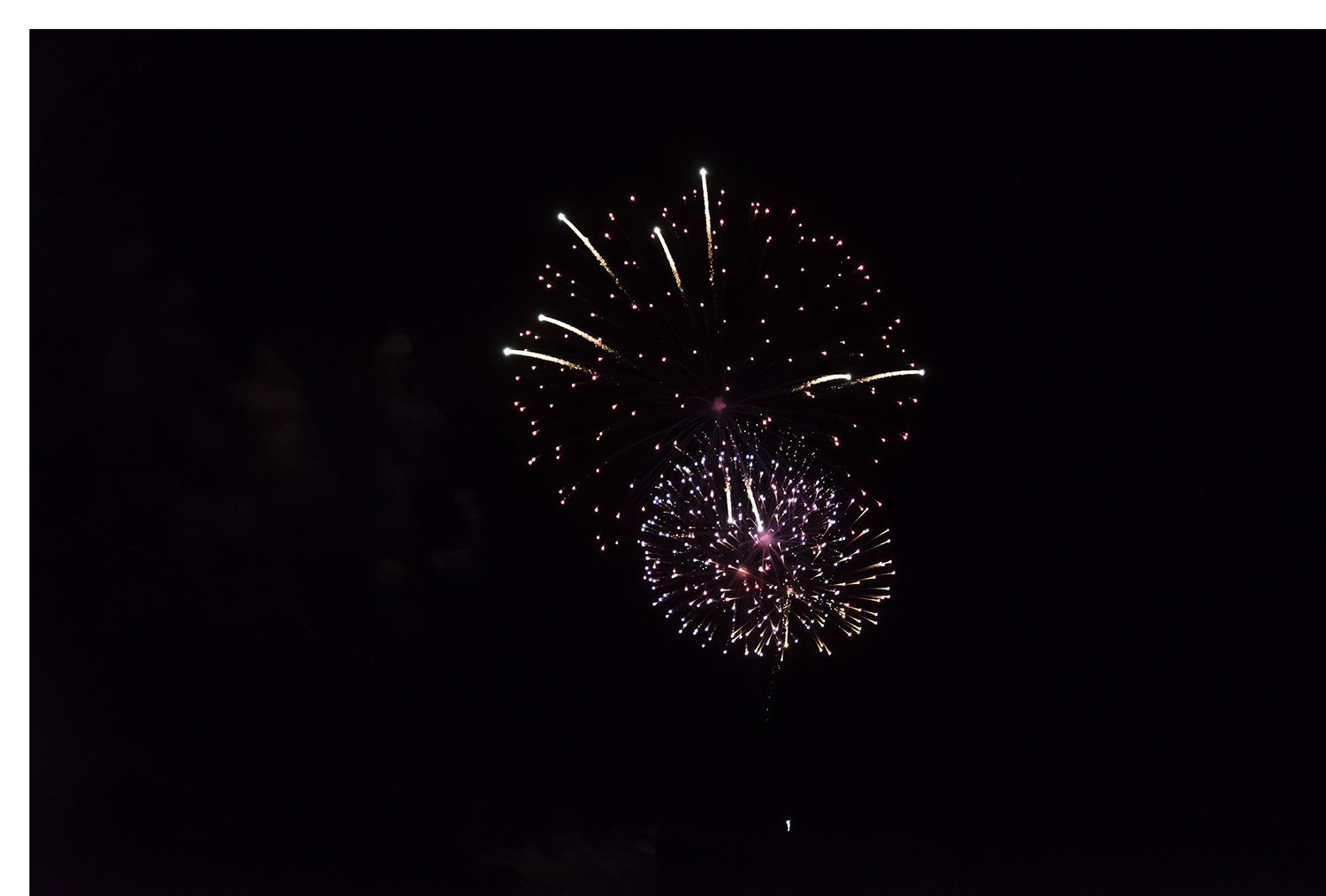
In my last post, I included a composite image of a firework exploding. In today’s post, I’ll explain how I did it. If you’d like to follow along, I’ve included the starting images at the bottom of this post. Simply right-click to download. You can use as few as two images, or all of them, with this method. You will need Adobe Photoshop CC or an extended version of an earlier Photoshop to follow along.

150906-fireworks-0072-edit-1986

The final product! Read below for my methods!

Step 1: Get photographs to composite

To create a composite image, you first need the images to composite! My images are below, and if you prefer to use them, you can skip this section. If you’d like to use your own images, you’ll have to capture them! In this section, I give all the nitty-gritty shooting details; you can also skip ahead if you know how to shoot an exploding firework.

You will need a DSLR, and you will need to know how to change settings like ISO, aperture, speed, exposure bias and your shooting modes. First, fireworks are dim and you will need to make sure your sensor gets all the light it can; I turned up my ISO to 12800 and opened my aperture all the way to f/2.8. (A side note about ISO: your camera may not go up to ISO 12800. My other camera tops out at 3200, and I find the images unpleasantly noisy above ISO 1600. I’ve still taken good fireworks shots with that camera. You may want to turn down exposure bias more than I have, and a tripod is a great asset.) Second, I turned the exposure bias down for several reasons: (1) to avoid blowing the highlights, (2) to allow a faster shutter speed, and (3) because an image of fireworks against a dark sky is a dark image, and a low exposure bias accurately reflects this. I turned the exposure setting down two brightness stops. I shot in aperture priority mode with a fixed ISO and a camera-calibrated speed. You could also fix the speed and allow the ISO to vary. With the settings above, the exposure times were 1/250 sec and 1/400 sec for the nine images. I shot in speed priority continuous shooting mode. I shoot with a Sony Alpha 7s– when shooting in RAW mode (rather than a compressed JPEG mode), it takes 5 frames per second. I took these shots using a monopod. A tripod can allow you more flexibility with your shot settings. I shot these images at a focal length of 72 mm and the Alpha 7s doesn’t have image stabilization, so I wanted my shutter speed to be 1/100 second or faster.

Phew, got all that?

Step 2: Prepare images for composite

Open your images as layers in Photoshop. (Consult this link if you’re uncertain how to open images in layers.) The order of the layers doesn’t matter at all.

The images must be aligned. If you shot using a tripod, you’re probably good. If not, there are two ways to align your images– the easy way and the hard way. If you are using my images, I have already aligned them for you.

The easy way: Auto-Align Layers Select all your layers. Then go to the edit menu and select “Auto-Align Layers”, as in the image below. Select the “Auto” projection in the dialogue box, then click okay. This method will work if there is an object in all the images that Photoshop can recognize and align, say the corner of a building. Sadly, Auto-Align didn’t work for my images. So it was on to the hard method.
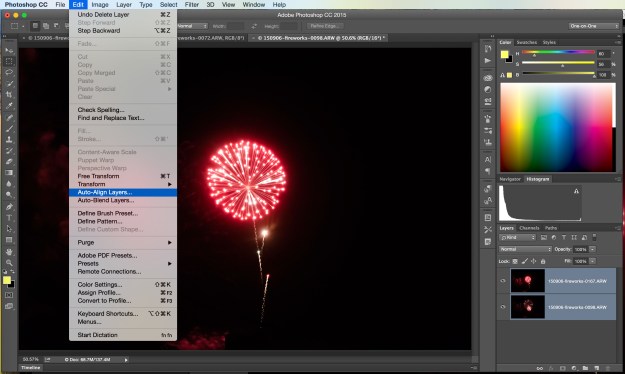
auto-align-layers

The hard way: manually aligning layers This method is more slow than hard. (Still harder than the easy way, though!) Change the opacity of the second layer, and visually align it to the bottom layer using the move tool. You can get the move tool by pressing “v”. I’ve circled it on the tool panel in the image below. On the layer panel, I’ve circled the opacity settings too. I set the blend mode to “Difference”, which makes the differences between the two layers the brightest. Then I visually lined up the center of the explosion, as I show in the first image below. The second image shows the same view before manual alignment.

If you have more than two layers, as I do in the full-sized image, work your way up from the bottom, and use the “Difference” blending mode to align each layer to the bottom layer. Remember to put all your blending modes back to “Normal”!

After manipulation:manual-align

Before manipulation:manual-align-begin

Step 3: Creating the composite

Now that your layers are aligned, it’s time to put them together! Woo! This is a two-step process. First, create a Smart Object from your layers, and then set the Smart Object Stack Mode to “Maximum.”

Creating a Smart Object Select all your layers. Then go to the Layer menu, go down to Smart Objects, and select “Convert to Smart Object.” (See the first image below.) A Smart Object is a kind of envelope Photoshop uses to perform certain tasks. They’re great! You can read more about them here. Here, we need to make a Smart Object so we can use the Smart Object Stack Modes. After you create the Smart Object, you will only see one layer, and it will have the page icon that I’ve circled in red in the second image below. If you ever want to interact with the layers again, say to change the alignment, you just double-click on the Smart Object. We’ll do just that in Step 4 of this tutorial.

Before making the Smart Object:make-smart-object
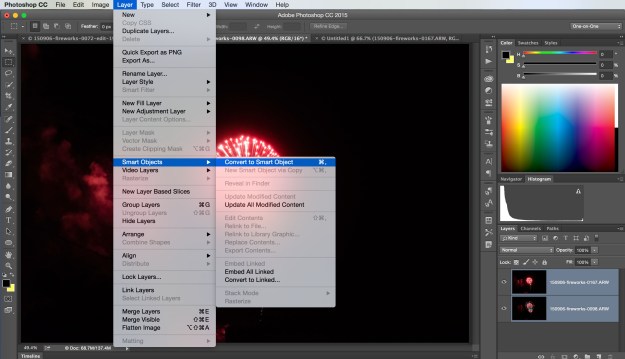
After making the Smart Object:smart-object

Setting the Smart Object Stack Mode Now you have a Smart Object! In Photoshop CC and in the extended versions of previous Photoshops, you have access to a number of Stack Modes. As in the first image below, go to the Layer menu, then Smart Object, the Stack Mode, then Maximum. (Later, you can play with other Stack Modes, but for now, choose Maximum.) The Maximum Stack Mode looks at each pixel of the image and selects the highest luminance value for that pixel amongst all the images in the stack.

stack-mode

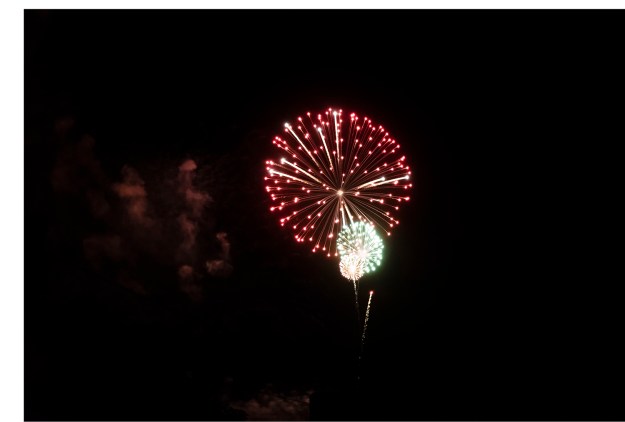
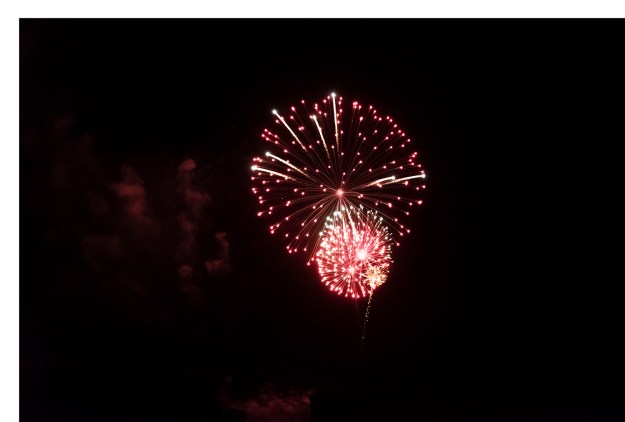
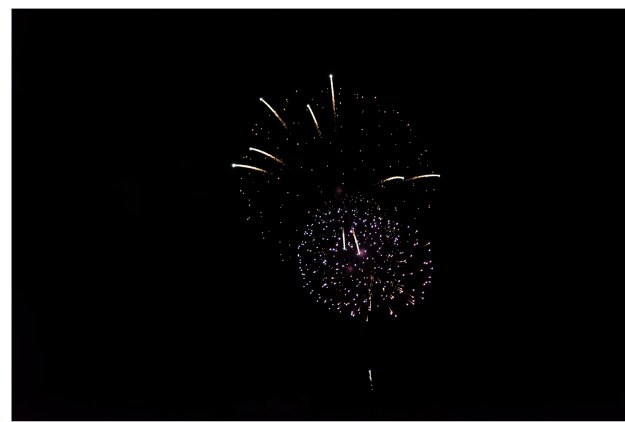
When you use all 9 images that I provide (rather than 2, as above), you’ll get the image below. Which is pretty fun! Because each pixel is the brightest of all the 9 layers, we get a sort of stop motion slo-mo image. And we can make it even better!
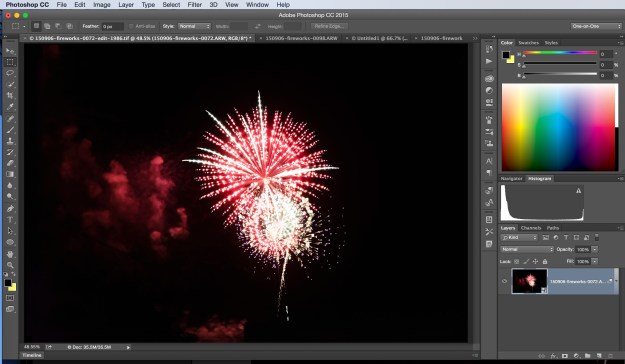
 

stacked

Step 4: Refining the composite

I think the middle of the fireworks is too muddled in the image above. I can’t do anything to alter the Stack Mode logic, but I can change the layers that it makes its choices from. And that’s exactly what I’m going to do!

Double click on the Smart Object image to open the contents of the Smart Object in another tab. You can change the Blending Modes and Opacity (green circle), or you can reduce the opacity of certain parts of each image using Layer Masks. You can create a Layer Mask by clicking the icon in the yellow circle. The Layer Mask for one layer is shown in the red circle on the bottom right. Click it to select it, which allows you to paint into the Layer Mask. Where you paint in darker colors, the image will become more transparent. Learn more about Layer Masks here. You can also perform other layer adjustments, such as Levels or Exposure. I prefer to do such adjustments in Lightroom before I even go to Photoshop, but there are no wrong answers.

If you ever want to see the effects of your changes on the final product, simply save your changes to the content of the Smart Object, and go back to the tab that shows the Smart Object. in-smart-object

Resources

Click here to go to the Flickr folder of full-sized images, or use the smaller images below.

layer1 layer2 layer3 layer4 layer5 layer6 layer7 layer8 layer9

Writing prompt: race your mouse day

Time: 7 minutes. Click here to go to my list of prompts.

“Race your mouse day” (Inspired by this list of silly holidays.)

“Ladies and gentlemen and the rest of us, the mice are being shown on the track now. Place your bets before the bottom of the hour! Look there at Thumbelina, a whole foot taller than last year! They must have discovered another variation for the Am-te-1 gene. And Fivel Goes Sonic is following. Yes, there have been some creative designs this year!” The announcer droned, though few listened.

The stands were full and the elite had their plumage set to “ridiculous.” Holographic dresses made women appear to have 12 inch waists. There were hats 5 feet tall, but didn’t obstruct the views of those seated behind. A man cooed at his pocket-sized St. Bernard. The fabrics were inlaid with microthreads to calculate ever-changing fractals. The men displayed their bare chests, elegantly carved by nanobots into perfectly sculpted forests of bonsais. It was the day of the mouse race. The finest lab specimens from centuries past had been carefully genetically modified. Some were great hulking beasts 12 feet tall. Others where lanky and narrow, but highly optimized in musculature. The mice had to contain at least 99% of the genetics of a Sprague-Dawley lab rat from the year 2000, but some of these beasts would have been difficult for humans from that time to recognize. Some of the humans might have been hard to recognize, but they weren’t modified in any genetic sense. That would be obscene.

Photography prompt: Photographing light

A couple of months ago, I did some photography prompts. Recently, I reviewed these photos and was pleasantly surprised how much I still liked them. I took photos I wouldn’t normally take, and saw new things.

Now that I’m in a new place, paradoxically I am short on photo inspiration. Everything is so interesting that it can be hard to zero in, especially when work, grocery stores, bars, and walking paths are new forms of shiny distractions. So today I’m posting one of my prior photography prompts, and I hope to continue with more in the future.

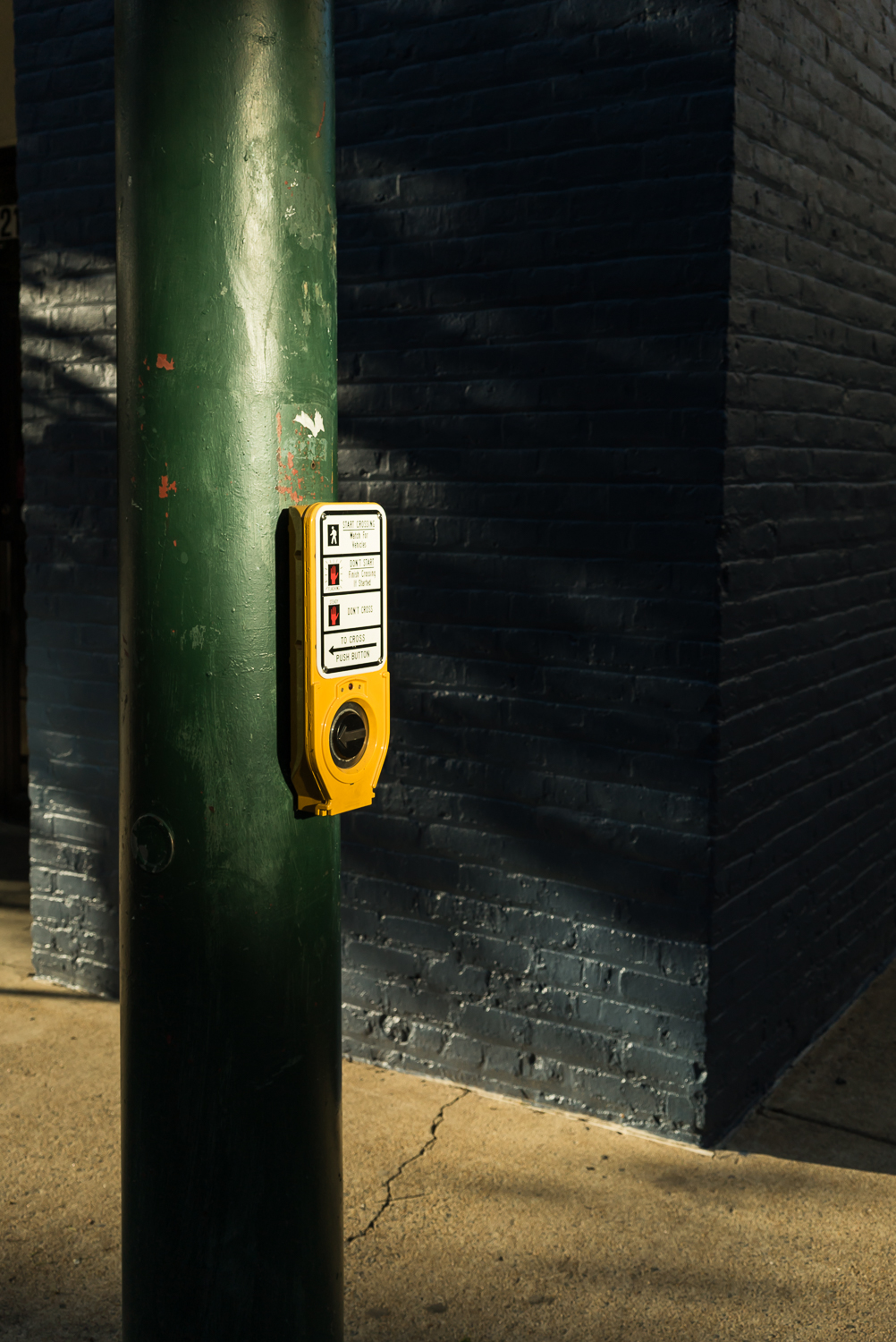
Today’s prompt is “photographing light”. This is not the same as photographing shadows cast by light, it is photographing the light itself. I got this prompt from the Lynda.com photographic composition course by Ben Long. I took these pictures on the Downtown Mall in Charlottesville in the early evening, not quite at golden hour, but late enough in the day that the windows were casting reflections in interesting places.

150423-seelight-0001

In this picture, I liked the way the reflections from different buildings interacted, and how they contrasted with the brick pattern.

150423-seelight-0002

In this photo, the windows from across the street are reflecting light onto shadowed windows. The reflections allow you to see shapes in the windows that you couldn’t see by looking at them directly, plus the contrast simply pleases me.

150423-seelight-0003

A distant window cast light onto this crosswalk aid. I almost ignored it, as one does with crosswalks one does not need, but with this small and brilliant beam of light, the guide suddenly was radiant. I loved the simple colors in this one, turning it b+w would have stripped it of so much.

Writing prompt: cousins day

Time: 7 minutes. Click here to go to my list of prompts.

“Cousins day” (Inspired by this list of silly holidays.)

(author’s note: I am not a biologist, so all the biology in here is just fun and spitballing!)

The Tasmanian Flu wasn’t a type of flu at all. No one knew then, sixty years ago. It was an engineered disease that got lucky enough to absorb a favorable mutation from a wild bacteria. It didn’t develop in Tasmania. We started calling it the Tasmanian Flu after no one would admit to the disease, but it was everywhere. Well gosh, it must’ve come from Tasmania. That’s where devils come from, right?

Either you were susceptible to TF, or you weren’t. A mother would catch the disease, then all her children, but not her husband or her in-laws. Quickly, they isolated the genes responsible for susceptibility. The fear was, if it infected enough people, it would absorb another wild mutation and gain the ability to infect anyone. After Putin died of the illness, conspiracy theorists speculated that it was a targeted assassination of the Russian despot gone awry.

That didn’t to the Cousins.

That’s what they called us. They rounded up those susceptible, the Cousins, and they put us in bio-containment camps away from everyone else. We had good care. They tried to keep the infected isolated from the merely susceptible. But it didn’t work, and TF has a 50% fatality rate even with novel treatment. Then there were the side effects.

I know 200 digits of pi. I didn’t try to remember them, and before TF I had no head for numbers. With minimal training, I found I could make sense of complicated geometries and had inexplicable intuitions as to the solutions of complex systems.

For 60 years, we made up for the loss of our cousins with our gifts. There are fewer of us than there once were. And now, some whisper that perhaps TF could be useful.