Category Archives: Methods

Writing prompt: Stay out of the sun day

Time: 7 minutes. Click here to go to my list of prompts.

“Stay out of the sun day” (Inspired by this list of silly holidays.)

“This will be one your first exercises,” the leader wiggled his antennae sternly. “It might seem like a trivial one, but 15% of recruits fail this test.”

Ix’xin sat nervously in his seat. Everyone knew about this test. They were working to develop genetic tests to identify the trait and lower the loss rate, but until then, the best thing to do was place every recruit in a separate vehicle and only give him the opportunity to take himself out.

“We will be launching you into space shortly. Most of your experience will be exactly like your experiences in the flight simulators. Except one. You will feel drawn to fly into the sun. Most of you will be able to resist, but not all.”

Ix’xin’s wings were strapped to a sensitive interface.The interface detected small muscle movements and translated them into the motion of the ship. It was almost like flying back home.

The sun was bigger and brighter than he could have imagined. In his mind, it felt warm and inviting even though with all the shielding he didn’t feel any difference. Several seconds passed before he realized he was flying straight toward the luminous sphere. With compound eyes, he saw the twinkling of other pods travelling as he did.

He continued toward the sun.
Writing prompt: I forgot day

Time: 7 minutes. Click here to go to my list of prompts.

“I Forgot Day” (Inspired by this list of silly holidays.)

She didn’t know the face in front of her eyes. She reached out and touched the cool glass surface of the mirror. She didn’t know her own face. When had this happened? She realized she couldn’t remember her own name either. In neighboring apartments and out the small bathroom window, she heard screams and wails. She didn’t feel like screaming. She felt numb and confused. She wandered out of the bathroom into the rest of the apartment.

It was comfortable yet alien. Pictures of her unfamiliar face adorned the wall, often accompanied by a young man. The bookcase was full of books; many of them looked interesting. Pleasant music played over the speakers.

“Who are you?” it was the young man from the pictures. He wore pajamas. He looked angry.

She pointed immediately to the pictures. “I don’t know. But we know each other. You can’t remember anything either, can you?”

He looked away, acknowledging. Those screams must have been other people, lost, frightened.

A voice boomed from the sky. “Do not be alarmed! You do not remember anything, but this is for good reason. You must unlearn to relearn.” The words were mechanical, like a voice navigation system or translation. It was the most frightening thing that had happened yet.

“Please exit your domiciles in an orderly fashion in order to begin relearning.”

She exchanged a wild glance with the man. She knew that he didn’t intend to obey the big voice either.

Writing prompt: “I think my house is haunted”

Time: 7 minutes. Click here to go to my list of prompts.

“I think my house is haunted”


I leaned into the corner of the room, huddling over the phone. “I think my house is haunted,” I whispered.

Gale laughed. “Haunted? I’ve seen pictures, it looks like a slice of the southwest straight from the route 66 days.”

“Yea…” I said, not following.

“Well, you know. Haunted houses are like… Victorian houses. Or Cape Cod houses with a dark past. Not adobe houses.” She sighed. “Well, maybe that’s just where I live. Why do you think it’s haunted?”

“There’s a soft spot in the floor. And sometimes it squeaks when I’m not over there.”

“Houses settle.”

“And twice now, Miss Kitty has reared up and hissed at absolutely nothing.”

“Mm hmm,” Gale murmured. She thought Miss Kitty was a psychotic cat already so I could imagine now what she was thinking.

“And…” I inhaled and looked around the room. “The other morning I think I saw the ghost of a Spanish conquistador in the garden hacking at plants.”

“Whoa.”

“After he left, I went and checked the plants and they were damaged where he’d swung his sword.”

“Why’d you lead with the first two?”

“They wouldn’t have sounded like much if I said them after. I tried to call the previous owner. He was very helpful with directions on the irrigation system and how to get the oven to light. But when I mentioned the conquistador he stuttered and hung up.”

“That’s got to be some kind of real estate faux pas,” Gale said.

Writing Prompt: National Tourism Day

Time: 10 minutes. Click here to go to my list of prompts.

“National Tourism Day” (Inspired by this list of silly holidays.)


We met Kosmos at the Spaceport in Richmond. With him (I suppose I really should say it based upon the literature, but it feels rude) travelled a xenobiologist and a diplomat. We were there for local color. I guess we were there to be hillbillies for Kosmos, but everything seemed so different for him I can’t believe he noticed.

When Kosmos came down the jetway, the laughter from his mechanical translator filled the room. The port had been largely emptied, a huge inconvenience, but worth it to host one of the first extraterrestrials. If everyone wasn’t already staring at him, they were now.

“The waves here stand!” he declared to the diplomat, who seemed unfazed. Thomas and I exchanged a glance. I’d once hosted a Tibetan exchange student, and I remembered the culture shocks of her visit. We smiled nervously.

The luxury limo conveyed us west to the mountains. Kosmos had demanded to see mountains.

I had seen Kosmos’ kind on the news often enough, but it was different to experience him in person. The pressure suit hummed softly. Pumps and valves whistled softly at several rhythms. Sometimes, I could see the fluid move through the transparent plates near the top of the suit, where I guessed his face or at least many of his sensory organs must be.

“They tell me you are called Jessica,” Kosmos said, turning his whole body to me in the limo. “And that you are native to this region.”

“Yes,” I replied, feeling a bit out-of-body. “My family has lived in these hills for over ten generations. I’m very proud of it.”

“Hills,” Kosmos breathed in pleasure. “I want to see them all. And caves and cliffs and whatever else you’ve got. This geology of yours fascinates me.”

“I could, uh, show you the fault line down on route 151.”

“Exquisite,” Kosmos said. He turned back to the window.

“His people are aquatic,” the xenobiologist leaned my way. “They live at a depth of 500-1000 meters. He’s very interested in how we live at the boundary of two phases.”

“Of course,” I said. I still wondered what purpose Thomas and I could possibly serve in showing Kosmos around.

World Pinhole Photography Day

Did you know that a pinhole can focus and project light? A pinhole in an opaque material is the world’s simplest camera! Yesterday was World Pinhole Photography Day.

History

The discovery of pinhole optics massively predates photography (the act of chemically recording a projected image). During the Renaissance, painters traced scenes projected onto a canvas by a pinhole on the opposite wall. The use of a pinhole to project images goes back to 5th century BC China.

A camera obscura uses a pinhole to project an image. Renaissance painters could then trace these images. (image source: Wikipedia)

Why Pinholes?

In an age of digital cameras and high-end optics, the pinhole endures, charming and simple.  In honor of World Pinhole Photography Day, I went on a pinhole outing.

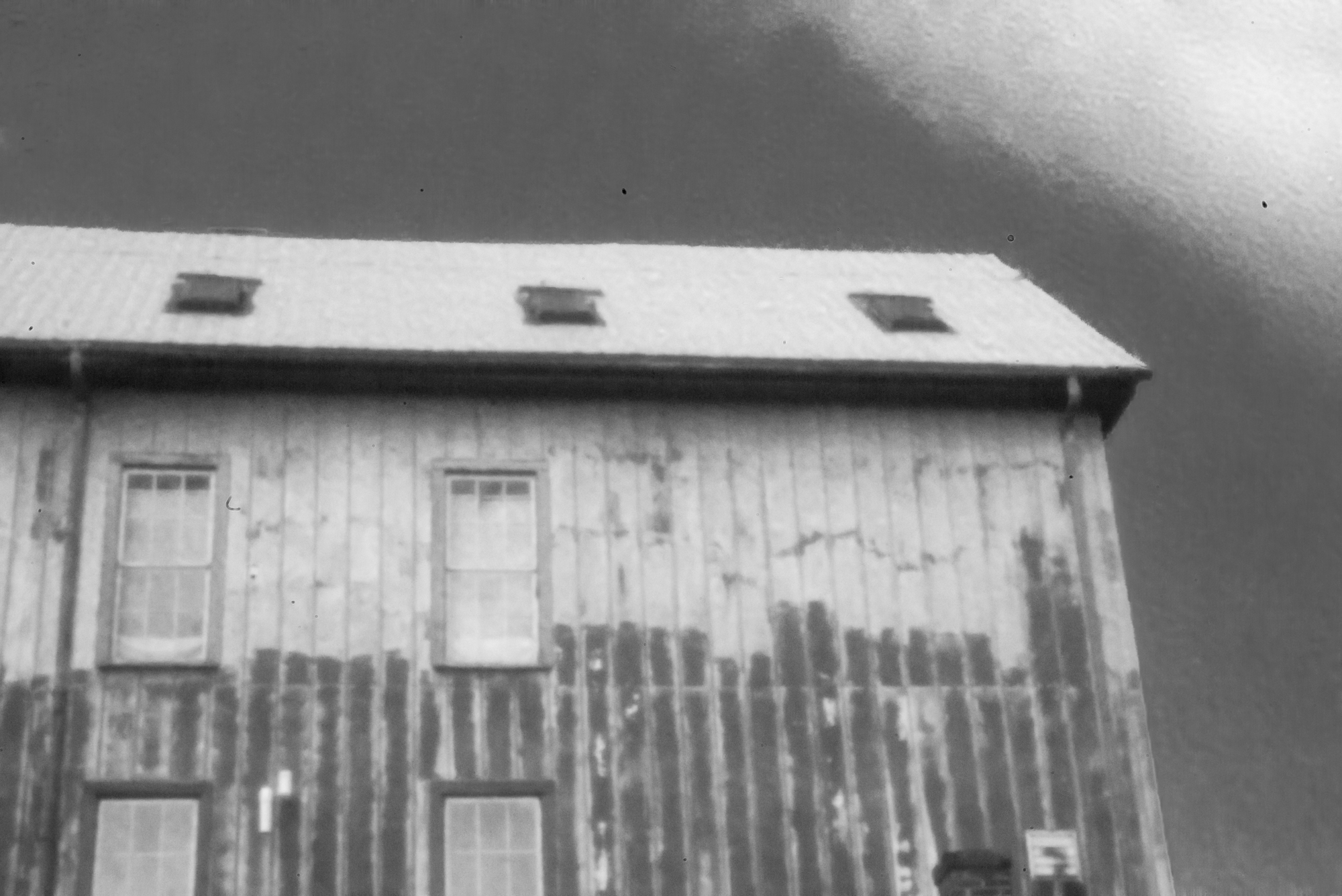
You might ask, what is the point of pinhole photography in this day and age? There are aesthetic and practical reasons. I like knowing exactly how my lens works, for once. Even a prime lens can have upwards of a dozen pieces of glass in it. I have a good science background, and I can’t even touch that level of optics. A hole in black plastic. I get that. Pinholes have interesting properties. True, they don’t focus nearly as sharply as lenses. But because pinholes have such small apertures, they have nearly infinite focal depth.

Brief photography lesson: larger openings (apertures) allow more light and create shallow ranges of focus. This can be desirable in a portrait. Small openings permit less light and increase range of focus. This might be preferable for a landscape. Sufficiently small openings cause softening due to diffraction (physics of light stuff). If you shoot on an SLR, you may have noticed diffraction-caused softening on shots at f/22. The pinhole I use is f/177. This diffraction is what gives pinhole photos their texture.

The upshot: pinhole photos flatten a scene. Something a yard away will look similar to something 100 yards away. This allows a photographer to create interactions between different depths that wouldn’t be possible with a conventional lens. And finally, pinholes can create a really fun old-timey effect.

My setup

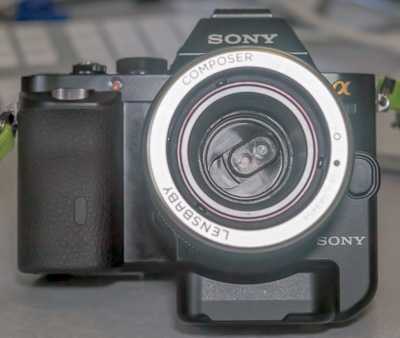
My setup is a bit like sticking a horse-drawn carriage on a rocket ship. I use a Lensbaby composer with the pinhole optics kit. My camera is a Sony Alpha 7s. Pinhole photography, due to the tiny amount of light transmitted, has slow exposure time. Exposures are often measured in multiple seconds. The Sony Alpha 7s is one of the fastest consumer cameras in the industry, with a maximum ISO of 409600. Thus, I was able to take decent handheld pinhole images even in low light by using high ISO.

Lenbaby pinhole on Sony Alpha 7s.

Lensbaby pinhole on Sony Alpha 7s.

The Images!

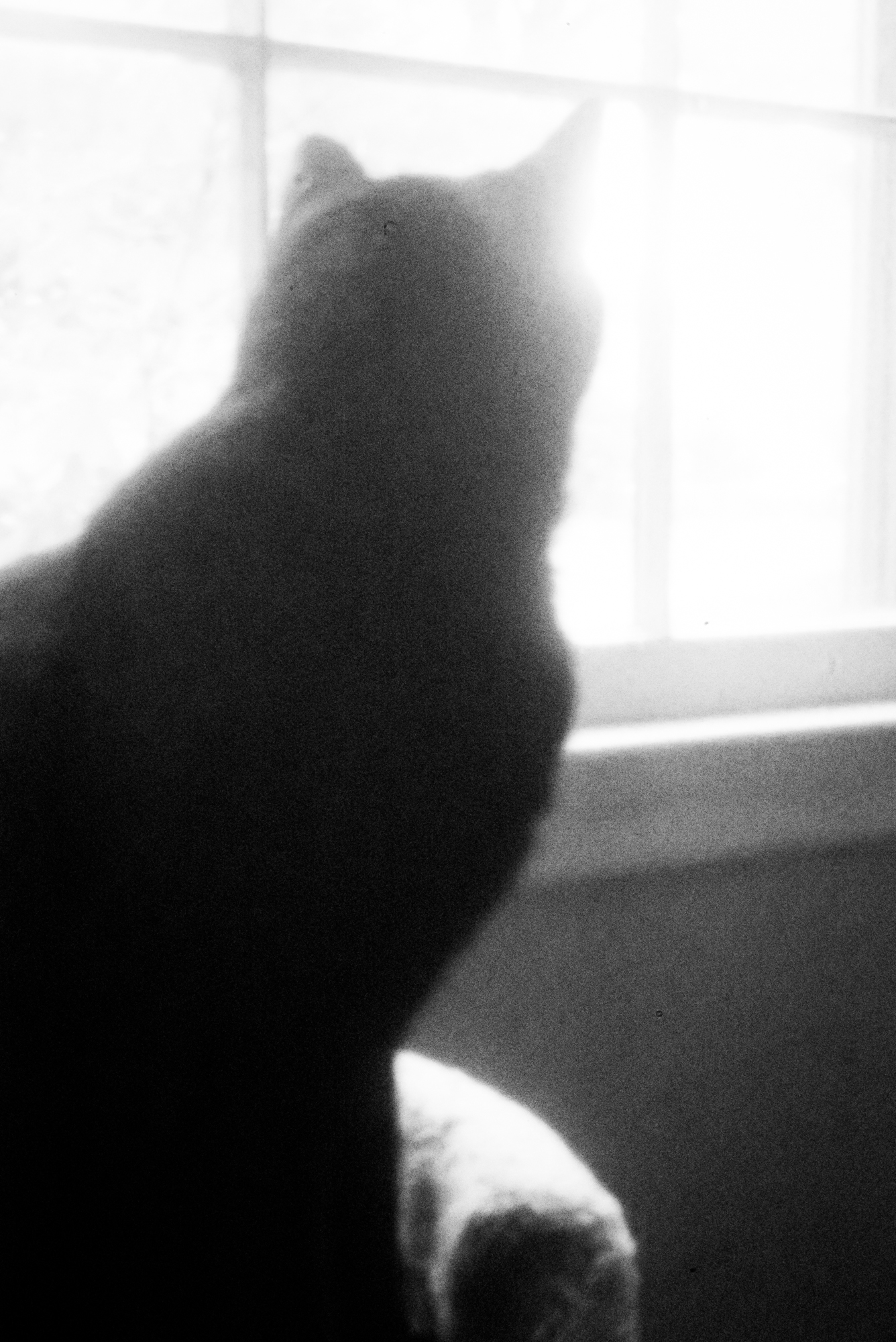
ISO 409,600, 1/6 second exposure. No tripod. Indoor shot on a rainy day.

ISO 409,600, 1/6 second exposure. No tripod. Indoor shot on a rainy day.

ISO 20,000; 1/60 sec.

ISO 20,000; 1/60 sec.

ISO 80,000; 1/60 sec.

ISO 80,000; 1/60 sec.

ISO 12,800; 1/60 sec.

ISO 12,800; 1/60 sec.

ISO 16,000, 1/60 second exposure.

ISO 16,000, 1/60 second exposure.

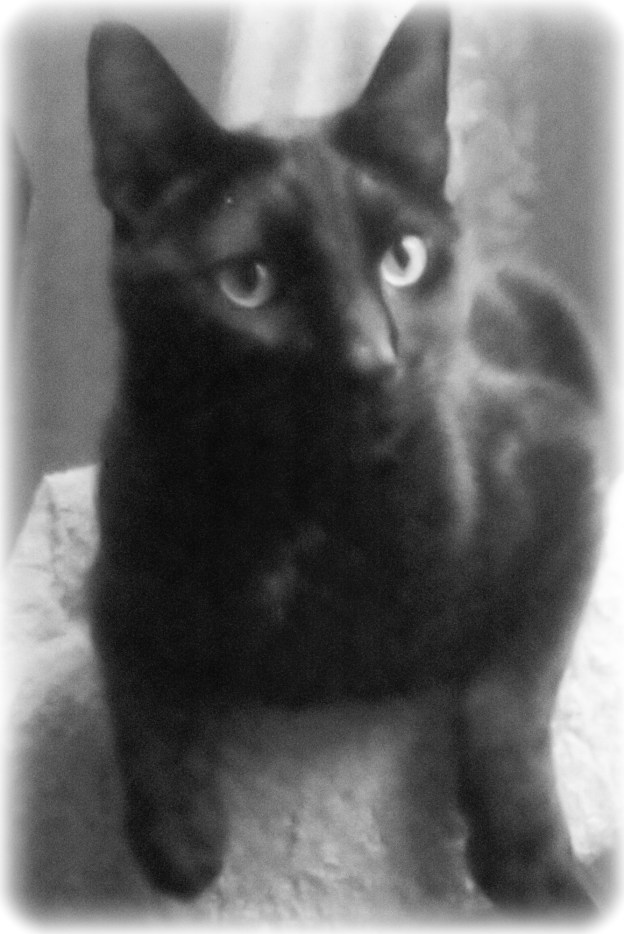
ISO 160,000, 1/10 second exposure. Indoor shot on a rainy day.

ISO 160,000, 1/10 second exposure. Indoor shot on a rainy day. I love how it looks like a 40s cheesecake shot.

Writing prompt: World Laboratory Day

Time: 10 minutes. Click here to go to my list of prompts.

“World Laboratory” (Inspired by this list of silly holidays.)


The capsule docked at the World Laboratory station. Dr. Trinner pushed gingerly from weightlessness into the gentle rotational gravity. The door slipped closed.

“Your laboratory is a ways from the dock. It’s all allotted by need, the labs with heavier shipping duties are near here, the vacuum labs are surface labs, the gravity labs rotate faster, the zero g labs are on the axis.”

“It’s all right, I wouldn’t mind stretching out,” Trinner assured the nervous guide. Her reputation obviously preceded her. But it had been years since the Erlenmeyer Incident…

Strictly speaking, her research didn’t benefit at all from work in space. But as a child, she had dreamt of being an astronaut. Doing science on a space station was damned near the next best thing. The station had jumped at the opportunity to have a Nobel winner onboard.

The light gravity was disorienting, harder on her stomach than zero g somehow.“How many are onboard now?” She braced against the walls of the corridor.

“30%, about,” the guide responded. “Some of the laboratories require special work and will take longer to complete. It will be pretty peaceful for a while here!”

“Other than the construction,” Trinner said.

“Yes, other than that.”

#

Trinner was alone in the lab. Some colleagues would follow in a couple of days. Her quarters were in the cluster near that lab section. It felt like science camp, living and breathing science, away from the cares of the world.

The construction echoed through the bulkheads from time to time. But there were other noises that Trinner couldn’t explain—voices. Voices came from the walls, in languages she didn’t know. She wondered if it were recordings of radio or television, but she couldn’t find a source.

Writing prompt: National Stress Awareness Day

Time: 10 minutes. Click here to go to my list of prompts.

“National Stress Awareness Day” (Inspired by this list of silly holidays.)


Lisa pressed the start button on the tester. The arm slowly pulled harder and harder on the cylindrical sample, and recorded the resistance of the rod. Lisa watched while holding her breath. This was what she had been working toward for the last six years. This either spelled the ticket out of school to a prominent job and good paycheck or back to god-knows-how-much-more grad school with an advisor that would view her as more of a liability than an asset. It had taken three years full of setbacks to build the casting machine. And three more of broken parts and materials choices and whatnot. If she’d known that she would wait six years for a meaningful result, she would never have gone to grad school.

But she had. And she waited. The machine plotted the relationship. The slow grinding sound filled the room. Scritch, scritch, scritch, and another data point.

Crack! A fracture shot through the sample, spider-webbing as it went. It reached from the top to the bottom of the rod. The machine beeped “I’m done!” and stopped pulling on the rod. The chart of the stress-strain filled the air. Lisa’s eyes shot to the stress axis. How far had it gotten?

“Only that far?” Lisa shouted. “That far?” She stood and threw her chair against the ground.

Six years. Six years down the drain. What would she do now? Find a new project? Give up? Her mind buzzed and reeled. The hallway seemed to lurch as she lumbered down it.

“Lisa!” the undergrad accosted her at a time she was least prepared to coddle him. “Lisa, about your test!”

She snarled and moved past him. She needed to be outside. It pulled at her.

“Lisa, you didn’t just do the stress test, did you?” the undergrad pursued.

She looked over her shoulder and kept moving. He seemed to understand.

“Um, which… which sample did you use?”

She stopped.

“It wasn’t in the blue case, was it?”

“It was.” She should be relieved at this line of questioning. She wasn’t. The tension built in her.

“I might have switched the samples. I dropped several of them and had trouble sorting them back out. It might not be the final sample.”

#

Their advisor found the undergrad later, with “stress test” written on his face. He had been bludgeoned with a fractured cylindrical rod.

The professor found Lisa with the stress machine, cradling her printout and another fractured cylindrical rod. She smiled serenely and extended the plot to the advisor.

“This is excellent data,” the advisor said. He nodded, turned around, and left the room in a good mood.

Choosing to write- obstacles and overcoming them

Every day, I work on my writing confidence. One wants to be open to criticism and suggestion but not left raw by it. Like a lot of aspiring writers, I lack a support network, such as I have in the sciences. I don’t have many readers, I lack feedback, I lack editors. These aren’t complaints but a recognition of the challenges I overcome every day I choose to write.

I maintain two continuous goals — to finish projects and to hone my writing skills through reading and exercises. I have four e-books up on Amazon Kindle and Apple iBooks (three posted within the last year) and I’m in a writing class through writers.com. The posts on this website combine both goals.

I get excited about every visit to this webpage, and every download on Kindle or Amazon. I was ecstatic to receive a five-star review on “The Domestic Cat.” My downloads picked up. It was validation on a story I believed in, that made it to the final rounds with several science fiction magazines but was rejected for being conventional. (It is — it’s about a scientifically-enhanced cat. But it’s super fun!) Then I got a three-star review. It wasn’t intensely critical, and said my story felt like the start of a novel. “Doesn’t that mean you felt like reading more?” I said to myself. My downloads sank like a rock. I was pretty bummed.

When I read my friend Stephanie Hunter’s delightful supernatural book, Scary Mary, I decided to look at her negative comments. Two of the one-star comments clearly meant to give five stars. Several others harangued upon grammar and nit-picky details that were not problems. Several said they don’t like supernatural books. Suddenly I felt grateful for my middling three-star review. (But seriously, go check out Scary Mary. The author just got accepted into the Science Fiction Writers of America, and she’s awesome.)

I considered additional stories I could tell with Peppercorn and his captor. The ideas flowed. I love these characters, and I easily see a wide variety of stories. I could practice some of the techniques from my writing class and explore longer works with Peppercorn.

So that’s what I’m doing right now. An ambivalent kindle review and new writing tools have launched me into a new project. One that can satisfy both my goals. I’m proud of making lemonade from lemons. And I’m having a blast writing more about Peppercorn.

Writing prompt: Reconciliation Day

Time: 10 minutes. Click here to go to my list of prompts.

“Reconciliation Day” (Inspired by this list of silly holidays.)

The tone sounded on the radio. It rang out, long and steady and unbroken. The people stood, arrow stiff, looking to the sky. Aina found it all theatrical and disconnected. The city of Vironevaeh’s old hatchet had been buried. It seemed irrelevant. So they were at peace with Naenaiaeh. The ancestors of Vironevaeh and Naenaiaeh had fought. But Naenaiaeh was all the way on another planet. No one could get into orbit, much less to other planets. Even communication between the two worlds was recent. So they’d been at “war”. How much of a war can be held between two civilizations that can’t even talk? What exactly is a war that consists of shaking your fist at the bright star in the sky and writing scathing plays about those bastards in the sky?

The tone stopped at last. Aina’s classmate Yosef wiped a tear from the corner of his eye.

“How can you be moved by this?” she asked him.

“I don’t know… how can I be moved reading stories from Earth? Or fiction? People that I didn’t know that died long ago or never existed.”

Aina snorted.

“Long ago, our peoples were one. And when they were, they were strong. I guess I hope that our unity will bring us back the strength we lost.”

“We weren’t strong because we were one, we were strong because we had technology that’s gone now.”

He shrugged. “Maybe we can regain it together. It would be poetic if our drive to reunite gave of the mechanical means to do so.”

Aina shook her head. She knew why the symbols of meaningless unity bothered her. Declarations of solidarity were just that—declarations. People cut and run when the opportunity presented itself. People told her that she should seek reconciliation too. It was the word on everyone’s tongues these days. But they didn’t know what they were talking about. Isn’t it better to live with one leg than to have a second that might betray you?

Writing Prompt: Make up your own holiday

Time: 10 minutes. Click here to go to my list of prompts.

“Make up your own holiday” (Inspired by this list of silly holidays.)


After the near miss, the year was three days longer. You’d think that not getting hit by a huge asteroid would be the most important outcome of The Scare. At first it was.

Only in the aftermath of something terrible do you see the little ripples and effects. Your birthday wasn’t your birthday. The fourth of July wasn’t The Fourth of July. And it wasn’t just the solar calendar. The asteroid pulled the moon farther out, which changed the lunar calendar. A lot of holidays run on the lunar calendar—Easter, Yom Kippur, Chinese New Year. Each group of people had to decide whether to switch to the new calendar or approximate the old one. Sects were formed, conflicts occurred. The surf was different. Some forms of life live like a clock with the tides, and random species we tend not to think about starting dying in droves. The days were a little longer too.

I was the first one to start it. I looked at the new calendar, I looked at the old calendar, and I said, I don’t care. I’m going to make up my own holiday. It happened roughly once a year, but when I said it would. It didn’t have to answer to anyone but me. I called it Time Dilation Day. We dressed up like Einstein. There were substances that influenced how a person perceives the passage of time. And we didn’t worry. It was a day outside the rigidities of calendars—solar, lunar, or whatever.

That was ten years ago. I’m afraid now that I started a cult. I don’t get to say when Time Dilation Day happens anymore. There’s another asteroid passing near the Earth in a couple of years. It’s not supposed to be close enough. But maybe I can change that. I don’t want it to hit, just another near miss would be swell. Once you control the passage of time, you don’t give it up.