Tag Archives: science fiction

A quick Friday post

Today’s post will be brief. As I mentioned Wednesday, I have dived head-first into a novel-writing effort. Since then I have written 3500 words, which is a pretty rip-roaring pace for me. I work in such fits and starts I have to take the inspiration as it comes. We all work differently; above all else we have to find what works for us.

This weekend I’m taking a science fiction class by Edward Lerner. 7 hours, Saturday and Sunday. I’m looking forward to seeing what he has to say. He worked in the tech industry for many years before becoming a full-time science fiction author.

Next Monday it will be 16 years since I started writing about Vironevaeh. I’ll have to think about something fun to post for that. Happy Friday!

A novel attempt

I finally decided that I will try to write and finish a novel. Of course, I’ve been entertaining such ideas for years, as I suppose a lot of people have. So why do I feel like I can do it now, when I’ve only failed before? You gotta keep trying, but there’s that old Einstein definition for insanity: doing the same thing over and over again and expecting different results. So I am trying again, but I’m doing things differently, and hopefully this will lead to more success.

1. I first wrote the plot arc as a short story. It was originally meant to be a short story but there were so many things I wanted to touch on that I didn’t have time for, even at 7000 words in length. I know how I want the characters to develop, how they feel about each other, and what their motivations are. I know all kinds of societal details that play into the characters actions and motivations.

2. I’m in a writing group now. I know a bunch of people who might have suggestions on how to do better, or what to do if I hit a wall.

3. I’m approaching the writing differently. In the past I said, whelp, 100,000 words, here I go. Around 25k, I got bored, felt like my work was unfocused, and quit. This time I’m thinking of it as a series of short story ish chapters. I have a bunch of little stories to tell in 2-5k words or so. Per point 1, I already have a rough outline of the overall story. As I go, I’m outlining a few chapters forward with further details– what scenes happen in each chapter and where do they happen. So I have a macroscopic outline of everything and a microscopic outline subject to the flow of events. We’ll see how it goes. I’m planning on writing one chapter a week, with weeks off allowed for alternate projects.

I’ll continue to post my progress. It will be interesting to see what works for me and what doesn’t work for me. Any suggestions are welcome too! But basically, it’s time to just write. Chapter 1, here we go…

Sources of Sci-Fi Inspiration: City Culture of Prague

Setting is a critical element to most stories. It frames the actions of the characters and provides a rich and interesting backdrop. Often the environment motivates the character. As most portraits of people would be less interesting on a white backdrop, most stories of people would less interesting without the setting. New Orleans gives Ignatius a good playground in “A Confederacy of Dunces;” “White Fang” would be reduced hugely without the north, and “One Flew Over the Cuckoo’s Nest” would be slightly different without the asylum.

As a writer of science fiction, setting is both a problem and one of my favorite things. How do you draw in the culture and idiosyncrasies of a place that doesn’t exist? They have to be imagined, and imagined plausibly, by the writer. All of my favorite science fiction books have strong settings: In “The Left Hand of Darkness“, we learn about the sexual culture of a differently gendered humanoid species. Through their myths and traditions, we get to learn how they eat, how they like their weather, what is taboo, and what is an insult. In “A Canticle for Leibowitz“, we start at a Catholic abbey in post-apocalyptic New Mexico several centuries in the future. In “The Moon is a Harsh Mistress“, the setting is a lunar colony that feels bullied by earth. We learn about their principles, their marriages, and their aspirations. They can be a little closer to home, too. In “Holy Fire“, the protagonist travels from future San Francisco to future Munich to future Prague. Some sci-fi stays closer yet to home, but I find that I love crazy settings; thus I prefer Vernor Vinge’s “A Fire Upon the Deep” to his “Rainbow’s End“. (For others see my top 20 scifi books post.)

When I write my stories, I don’t want the settings to feel like the Midwestern United States plopped onto Mars or Alpha Centauri. I want them to feel like products of their interstellar, future environments. So I try to understand how settings influence culture currently and historically. I spent a summer in Prague, and in that brief time I tried to learn what I could about the culture. I tried to go where the Czechs go, eat what they ate, and read what they read. My host in town was a retired Czech professor who liked to talk (derisively) about the communist days. I worked half days at a chemistry lab out in suburban Prague. One of my coworkers smoked at her desk only feet from various chemicals and dressed like a 60-year-old teenager. I took frequent walks to Vyšehrad, an ancient fortress in Prague (pictured below).

I most appreciated the Czech sense of humor. As a country often conquered, the country developed a strange sense of absurdism. Under the Petrin Tower in Prague, there is a museum to Jara Cimrman, the best Czech man, who never existed. I can hardly say I understand everything there is to know about Prague and Czech culture, but a few months there certainly showed me a type of people I hadn’t seen before. Hopefully this will aid me in constructing a people we haven’t met before.

Some worthy Czech reading:

Side note: No post this past Friday; I broke my toe and then I had a lot of traveling to do this weekend. Happily, the toe is already much improved, and today it’s 80 F (25 C) out.

Vironevaeh: Hiroshige Influence

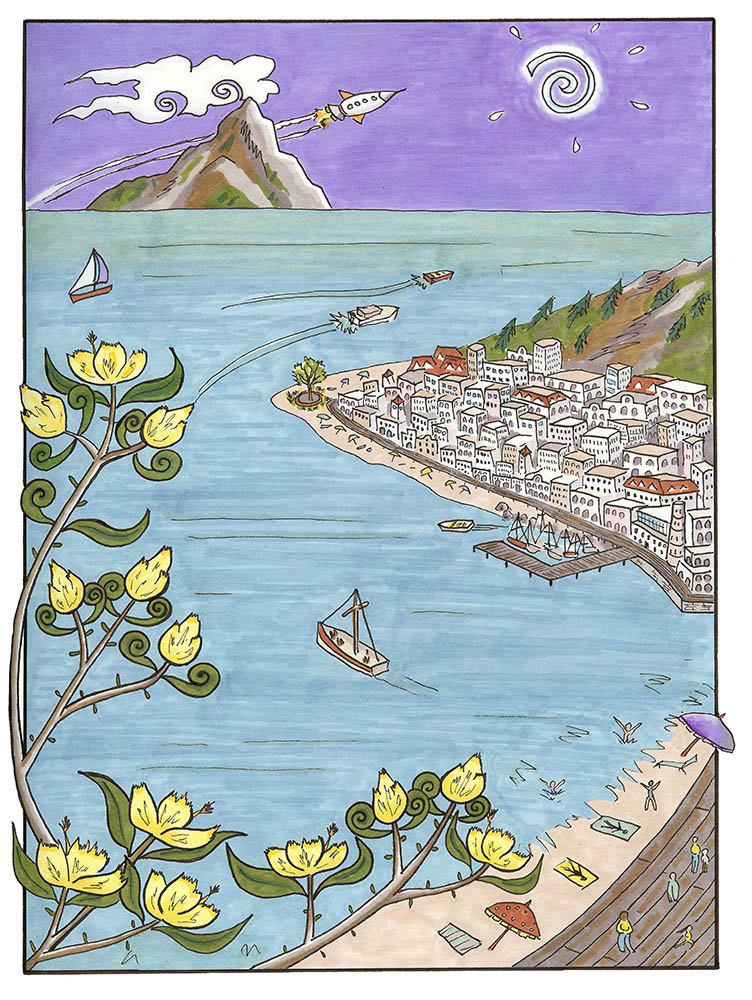
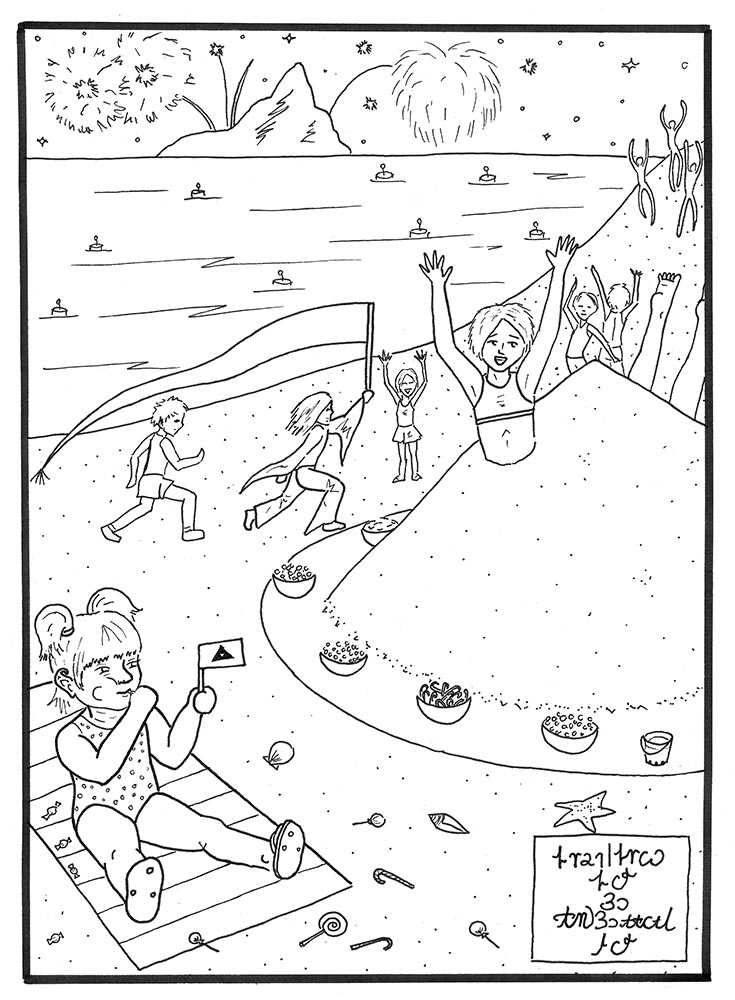
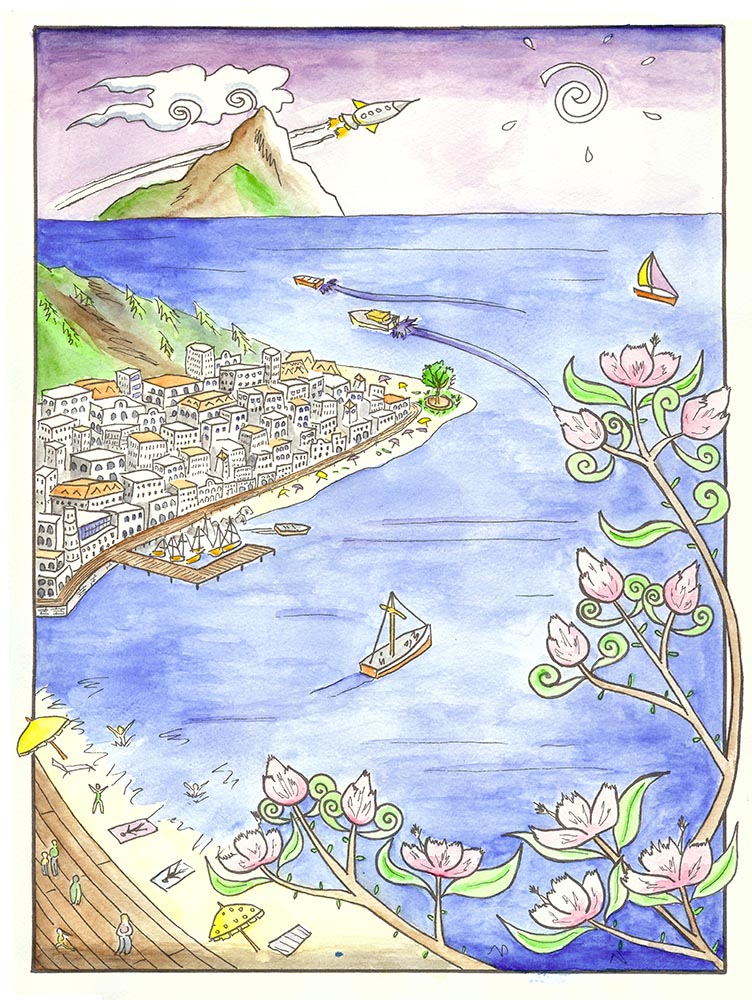
A few weeks ago, I wrote about the paintings of Japanese artist Hiroshige. So I got inspired and tried my hand at something along those lines, something like a science fiction Hiroshige. The drawings are set in the world of Vironevaeh: Science Fiction Fairy Tales (which, btw, is free on iPad =) ).

The first, done in watercolor, shows the city of Vironevaeh on the North Bay with Mt. Viro-Vit in the background. The second is a tweaked version done in markers. The third is the linework for another, depicting a Vironevaehn holiday called Digurtian Day. The Digurtian Day celebration is labeled in Vironevaehn. Many of the Hiroshige paintings are labeled in Japanese, so it felt fun to channel that spirit.

Happy Friday! I’m off to the Virginia Festival of the Book!

viro-city-watercolor-smaller

viro-city-marker-smaller viro-digurtian day-medium

Book Review: Downbelow Station (C.J. Cherryh 1981)

Note: I avoid spoilers in this review. Any plot details I mention occur early in the book.

Rating: 4.5/5 stars

I’ve had Downbelow Station on my shelf for a while. It’s 526 pages, so a little on the long side. I’d seen the book on a few “best of” lists, but no one I know has ever mentioned it. It was the 1982 Hugo award winner. So finally I bucked up and read it, and it was excellent.

Although I see “Downbelow Station” described as a hard science fiction book, the technological aspects of the book do not occupy the foreground. The interactions and desires of the characters do that; in some ways it’s a  high-class space opera. I found the style of the book most similar to Vernor Vinge in books like “A Fire Upon the Deep” with a little more militarism. I wonder how much the post Vietnam era affected the portrayal of militarism; the warring elements do not come off positively in this book. Cherryh does a good job developing culture; we can see the cultural differences between Union, Company, Pell, and the Downers. If you like sweeping science fiction, this is a highly worthy read.

Most of the action takes place on Pell Station, a space station orbiting a habitable planet with natives called “Downers” in the year 2352. Humans have expanded into space, one station after the next. At some point in history, humans developed faster than light “jump” technology, so they can spread further yet, into the “Beyond”. The humans in the Beyond have become disassociated with Earth; likewise Earth is somewhat detached from the stations. Pell finds itself between the forces of the Beyond and the renegade forces of Earth. The first 20 pages or so lay down this background; it’s a lot of exposition and it’s confusing and not totally engaging. The beginning is the weak point of this book. Once the ground work is laid, the story takes off.

We arrive at Pell when the Company ships of Earth force the station to take on a bunch of refugees from another station which has been destroyed in the conflict between the Company and the Union of the Beyond. These unregistered people are housed in quarantine, or Q, which is lawless and places a great deal of strain on the station’s resources. Over the course of the book, we watch people from Q, from Pell station, from Union, and from the Company as they vie for the strategically valuable Pell. The people of Pell station I found especially interesting, and their interactions with the Downers.

There are several other books in Cherryh’s Union-Company universe that I look forward to reading. Check out my Top 20 science fiction novels for more science fiction recommendation.

My Top 20 Best Science Fiction Novels

Following my post last week about my top 5 science fiction novels, I’ve been getting a lot of hits on search engines. I too scour the web for good scifi lists, so I thought I’d add my top 20 science fiction novels to the mix. I weighed a little towards including some less-common mentions, so while I enjoyed both “Hitchhiker’s Guide” and “Hothouse”, two incredibly different books, nobody needs help in hearing about “Hitchhiker’s Guide”. So without further ado, my top 20 science fiction novels in no particular order.

Top Five (see last  week for longer descriptions of each)

The Rest

  • The Moon is a Harsh Mistress (Robert Heinlein 1966)- The inhabitants of the moon attempt to revolt from the oppressive Earth with the help of a supercomputer named Mycroft. Mycroft is an awesome central character. The best of the grown-up Heinlein novels. 1967 Hugo Award winner.
  • The Demolished Man (Alfred Bester 1953)- How does one get away with murder when telepathy is common place? Fast moving and surprisingly modern, the winner of the first Hugo award.
  • The Absolute at Large (Karel Čapek 1922)- See a longer review I did here. The author hypothesizes that when the atom is split (a new concept at the time) that energy is released, as well as a pervasive religious fervor. As the atom-splitter spreads due to its phenomenal energy production, so too does the side effect of religiosity.
  • The Lathe of Heaven (Ursula LeGuin 1971)- When one man dreams, his dreams can become reality. He fears this awesome power; when he enters therapy, his therapist begins to use his gift, imagining he will fix the world.
  • Mathematicians in Love (Rudy Rucker 2006)- Totally awesome and wacky. Mathematics grads students compete to find the equation of everything, and win the affections of a cute girl. And there are enormous sentient venomous conch shells, intergalactic mathematicians, and parallel universes.
  • Worlds (Joe Haldeman 1981)- A woman from a communist orbiting asteroid visits New York City on a scholarship. I love everything by Haldeman, but this is my favorite after “Forever War”. Very heartfelt and emotionally gripping. The rare female protagonist, and done phenomenally. This is the first of a trilogy, but I think it’s the best and stands alone just fine.
  • The Door into Summer (Robert Heinlein 1957)- My favorite of Heinlein’s “children’s” books, which are all very intelligent, but have less of some of Heinlein’s more alarming interests like incest. A man is duped by his business partner, who steals the company and puts him into cold sleep. He awakens after 30 years, and tries to figure out how to get his life back. One of the main characters is the protagonist’s cat, always a plus.
  • Snow Crash (Neal Stephenson 1992)- cyberpunk done properly with a sense of humor. A pizza delivery man, Hiro Protagonist, and a 15-year-old girl start investigate the propagation of a mysterious internet drug, snow crash. The plot line of this one gripped me less than the excellent fun had with a future world.
  • Tau Zero (Poul Anderson 1970)- A crew on a near light speed ship is on a five-year journey to another planet. During the voyage, the deceleration mechanism is damaged. As they continue to go faster and faster, the time dilation grows and they travel farther. The best hard scifi book I’ve read.
  • A Fire Upon the Deep (Vernor Vinge 1992)- The best and most intelligent space opera I’ve read. Different laws of physics exist in different parts of the galaxy. People create a malevolent higher intelligence near the rim of the galaxy and must flee into the galaxy where the laws of physics preclude such an entity. They get stuck on a planet of sentient creatures composed of several animals in constant communication with one another. They are called the Tines, and they are hands-down the best alien I’ve read in scifi. Also read anything by Vernor Vinge. 1993 Hugo Award winner.
  • Stand on Zanzibar (John Brunner 1968)- At first I found this book a bit confusing; the chapters jump around to relatively random people doing random things as part of the world building. But after 50 pages or so you get your bearings. The world is over-populated, and child-limits have been instituted. The plot is complex and rich. The style is grimly funny. Hard to describe, and requires some effort to read, but one of the greats. 1969 Hugo Award winner.
  • Hothouse (Brian W. Aldiss 1962)- Also called “The Long Afternoon of Earth”. In the distant future, the sun is bigger and hotter, and one side of the earth always faces the sun. Plant life, with so much energy available, has evolved in many ways, and all but overruns this half of the earth. There are plant birds, plant predators, and plant just about everything. A small group of humans tries to survive in this near-apocalypse Earth. Chock full of great imaginings. Aldiss doesn’t have the most sparkling characters, but he has engaging concepts, somewhat like Asimov. “Helliconia Spring” is another worthy read by Aldiss, but it is somewhat longer.
  • The Caves of Steel (Isaac Asimov 1954)- My favorite Asimov book, partially because it is self-contained and relatively succinct. People of an overcrowded Earth live under steel domes, and never go outside. The story is set around the investigation of a murder.
  • The Windup Girl (Paolo Bacigalupi 2009)- The 2010 Hugo Award winner. A biopunk story set in Bangkok. After the world has been devastated by engineered illnesses and crop-plagues, society is finally mostly recovered. Carbon emissions are strictly limited, so energy-efficient methods are desirable. The main character is an employee working at a start-up energy company as a front, but for one of the bio-engineering firms that creates genetically modified species actually. A rich world that incorporates biology well.
  • Red Mars (Kim Stanley Robinson 1993)- A group of 100 brilliant hand-picked scientists is selected and sent to Mars to live there and begin terraforming it. These scientists are strong-minded, and don’t always agree how to go about things; political fractures form. The first book follows the political developments of the first 100 martians. “Red Mars” is followed by “Green Mars” and “Blue Mars” which occur over the course of a couple of centuries. Mars itself is the main character of the whole trilogy, and is described in the best scientific detail available at the time. Sometimes a bit long-winded, but very realistic, and an interesting exploration of terraforming.

Happy reading!!

The Best of Science Fiction

I began reading science fiction novels almost by accident. One day I saw an Alfred Bester book on the shelf at a book store. Viewers of Babylon 5 (the best TV show ever) will recall a character by this name. I had read many Star Wars, Star Trek, and Babylon 5 books, and I followed science fiction TV with ardor. So I assumed this book was in the same vein. It was not. The B5 character was named for a writer from the 50s.

Alfred Bester is best known for two novels: The Demolished Man and The Stars My Destination. They’re both amazing, and I recommend them. “The Demolished Man” works on a simple premise: how would someone go about getting away with murder in a society in which telepaths existed? “The Stars My Destination” (loosely based upon the Count of Monte Cristo) explores what would happen if people could transport themselves at will. How would prisons work? How would you prevent theft? “The Demolished Man” won the first Hugo Award in 1953. “The Stars My Destination” has been credited as perhaps the creator of cyberpunk.

After Bester, I was hungry for more. I scoured the web for lists of the best science fiction novels. Here is one good list of the top novels, though it is somewhat weighted towards older books. I also tried to read the winners and nominees of the Hugo and Nebula awards (you can find a list of wins by author here). Wikipedia lists the Hugo Award wins according to year here. I personally strongly prefer the Hugo Award books to the Nebula Award books, but you may find differently.

So after all that hunting, here are my top 5 science fiction novels:

  • The Left Hand of Darkness (Ursula LeGuin, 1969)– A human envoy visits an alien world, hoping to convince them to join an alliance. The aliens have no set gender, but phase in and out of male, female, and neuter. The book explores the culture of this planet, both due to the unusual gender of its people, and the extremely cold climate. For whatever reason, men tend to be unimpressed with this book, but women I’ve recommended it to like it. The book explores gender and cultural topics without getting heavy-handed or obvious. The two main characters are amazingly drawn. The book is filled with little amazing legends and folklore from the culture.
  • A Canticle for Leibowitz (Walter M. Miller, 1960)– A post-apocalyptic story with a very different twist. Broken into three parts at very different times, the first part opens in a Catholic abbey in Nevada several centuries after a devastating nuclear war. The novel has a charming humor and levity despite the settings. It explores religious themes (not very common in scifi).
  • The Forever War (Joe Haldeman 1974)– A story about a man involved in a space war. As the battles are waged, centuries pass, and the man is isolated from his own life by a questionable war. Haldeman was a vietnam vet, and it shows. I have read at least a dozen novels by Haldeman, and I would recommend every single one. He writes science fiction with a focus on heart. “The Forever War” is one of the best science fiction love stories I’ve read.
  • The Stars My Destination (Alfred Bester 1956)– discussed above.
  • Camp Concentration (Thomas Disch 1968)– a dark and twisted “Flowers for Algernon”. A conscientious objector is sentenced to prison. He is then subjected to experiments that greatly increase his intellect, along with a number of other prisoners. This book is very literary to the point of sometimes being maddening. I skipped through some of the literary aspects that I didn’t relate to. But the story and the science fiction and the humor are spot on and excellent.

You may notice the heavy slant to the 50s and 60s. This is no accident. These books are old enough to be reprinted and therefore available, but old enough for the reprints to be available used (used books are so wonderfully inexpensive!). Some more modern very awesome scifi books are “Snow Crash“, “Mathematicians in Love“, “A Fire Upon the Deep“, and “The Windup Girl“.

If you are looking for more reading suggestions, check out my top 20 science fiction novels.

I could talk all day about science fiction, so drop a comment!

Book Review: Holy Fire (Bruce Sterling 1996)

Note: in this review, I spoil nothing past the first 20-30 pages or so. You can see more reviews and an excerpt of the book here.

Rating: 4/5 stars

I really enjoyed “Holy Fire”. Though it is high-tech, low life in the fashion of cyberpunk, I found the characters much more believable than most cyberpunk books. The characters still have ambitions and hopes and don’t just spend their time dwelling on how awful life is (any more than we do now). The book is set about 100 years in the future, in a society where the very elderly call the shots and society is about collectively minimized risk and efficiency. The main character, Mia, is an elderly woman who partakes in a medical procedure to extend her life, and her subsequent adventures. Mia struggles with the effect on the young of a society dominated by the old and her own risk-averse tendencies. Along the way she meets a lot of fun people.

Before I read “Holy Fire”, I was aware of Bruce Sterling and his reputation as a cyberpunk author. I had read the canonical cyberpunk work “Neuromancer” by Gibson, and I was not impressed. Cyberpunk seemed just like rebranding dystopia. But a friend (check out her well-received science fiction work here) loaned me “Holy Fire” by Bruce Sterling, so I read it.

The book is also populated with cool gadgets that are irrelevant but colorful. Sterling doesn’t dwell on any particular one, and the book is peppered with fun droplets of future tech. There is a dog that has been technologically enhanced to be able to talk, but in the fashion that a dog might. There are cities built of edible bio-materials. There are programmable wigs.

Ultimately, I’m not sure if the book hangs together fully in the end for me. I’m not sure if the tales of Mia add up to say something to me. So perhaps it is not a masterpiece. But I enjoyed it thoroughly the entire time I was reading it, which is a rarity. Also a vivid female protagonist is nice (this was actually why my friend recommended the book). To anyone interested, I would definitely recommend a read.

Book Review: The Absolute at Large (Čapek 1922)

The Absolute at Large was written in 1922 by Czech author Karel Čapek (free web translation to English here). It is about the advent of a machine called the Karburator. The Karburator split atoms into two parts: useful work and a mysterious force called the “absolute”. The absolute is a god force which causes intense religiosity in people, and allows them to perform miracles. As the Karburator spreads across the planet, so does the absolute, and the book describes what follows.

I really enjoyed this book, and I would highly recommend it. First, it’s smart science fiction. In 1922, forces such as radiation were pretty recent science. Radium was discovered in 1898. Čapek describes something very like fission well before its invention. Second, this book is subtly very funny. Through the book, Čapek lampoons religion, communism, and nationalism at least. Third, the book is a short and simple read. My copy was about 200 pages with large print and lots of white space. If you enjoy this book, you can try out Čapek’s possibly more famous work, R.U.R., the book in which the word “robot” was created (derived from the Czech word for serf labor). I haven’t gotten around to that one yet myself.

I had a special reaction to The Absolute at Large, which is largely set in Prague. I was lucky enough to spend a summer in Prague, during which time I was able to talk at length with older residents. The Absolute at Large captures a certain essence of the Czech spirit. The Czechs are cynical in a very witty way. They’ve had religion thrust upon them (read about Jan Hus, the Hussites, and the First Defenestration of Prague). They’ve had nationalities thrust upon them (read about the Second Defenestration of Prague). In 1922, Czechoslovakia had been an independent country for only 3 years following the fall of the Austria-Hungarian empire. Unlike the Poles, who seem to resist forcefully, and the Hungarians and their patriotic sorrow, the Czechs have resorted to humor to endure their less-than-dominant place in geopolitical events. A few years ago, the Czechs held a contest to vote for the greatest Czech ever. The Czechs voted for Jara Cimrman, a fictional man who had no official face (the sculpture had become smooth, they couldn’t find him in this photo of a few hundred, etc). However, fictional Cimrman was credited with many wonderful feats: he suggested the Panama Canal, he was briefly an obstetrician, he consulted with Zeppelin, Eiffel, Mendeleev and Curie. If you are ever in Prague, there is a free museum to Cimrman under the Petřín Tower.

The Absolute at Large has a similar sense of humor to Cimrmanology; Čapek lampoons the inevitable powers of the world and their effect on the Czechs. And how appropriate that the Karburator should be invented in Prague… perhaps Cimrman lent a hand.

A little on watercoloring

This week I am spending most of my time painting the line-art from The Galactic Adventures of Zish and Argo. One of the things I really like about watercolors is that they travel well. I’m on the road for the next couple of weeks, but it is just as easy to paint here as it is at home. A major reason for the portability is the type of materials I use. I bought a Windsor-Newton field box set several years ago, pictured below. At $50, you might experience a bit of sticker shock. I’ve only recently had to start replacing pans; it lasts and lasts.

I have used the liquid watercolors as well. I find I enjoy the quick set up of the solid colors. There is no need to dole out paint as you go, and you only use what you need. Plus it’s easier to travel with. The solid paints can still deliver good intensity and brightness. I roll all my brushes up in a bamboo case like this one, and then I’m ready to go anywhere and paint anything. If you have a pigment-ink printer, you can economize on your watercolor paper by selectively choosing what you print. I discuss that more in an old entry, here.

I read a watercolor book a few years ago that I found helpful as well: Watercolor Tricks and Techniques, by Johnson. If you are curious, it is worth a look.

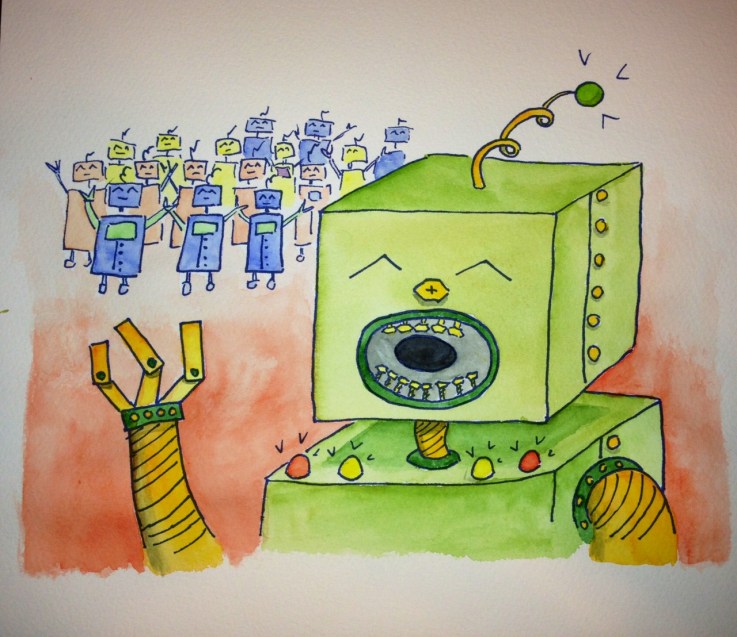
So there are 13 paintings for the core of the Zish and Argo book. I have 7.5 paintings done, so I’m over halfway! The Robotoids say hello!!robot