Tag Archives: science

M.C. Escher: revisiting a familiar name

M.C. Escher and Salvador Dalí are two of the greatest reality-bending artists. So, fittingly, the Salvador Dalí Museum in St. Petersburg, Florida recently hosted a special Escher exhibit. I’ve visited the Dalí collection many times, but I’d never seen Escher in person.

I had many Escher calendars as a kid. When I took crystallography, we studied the symmetries in Escher’s tessellations. I’ve always been interested in design and mathematics, and Escher is the purest intersection of the two. I was ecstatic to see the exhibit.

Before the exhibit, I was most familiar with Escher’s lithographs. Without too much elaboration, lithography is a high-fidelity technique which allows the artist to produce an image that is not directed by the mechanics of printing (I’m sure the method does direct some artistic choices, but as a non-expert, that’s my rough take on it).

The exhibit contained many of Escher’s woodcuts, which were new to me. Woodcuts are make by carving a plate of wood, coating the plate with ink, and pressing the plate to a page. The page will be white where the wood has been cut away and the page will be colored where the wood remained. Woodcuts have a distinctive style–they cannot render colors in between white and ink color. Multiple colors can be achieved with additional pressings, but the technique is inherently color-limited.Additionally, the resolution of the print is limited to the fidelity of the wood. These two aspects give woodcuts a distinctive artistic feeling. If you can’t tell, I’m currently a little in love with woodcuts.

Escher died in 1972, but thanks to Disney, his works remain out of the Creative Commons. However, I am allowed to use low-resolution works for discussion purposes. You’ll have to buy books if you want anything with much detail, though. Below are a few of my favorite Escher images that are available through Wikipedia, as I have linked them under the image.

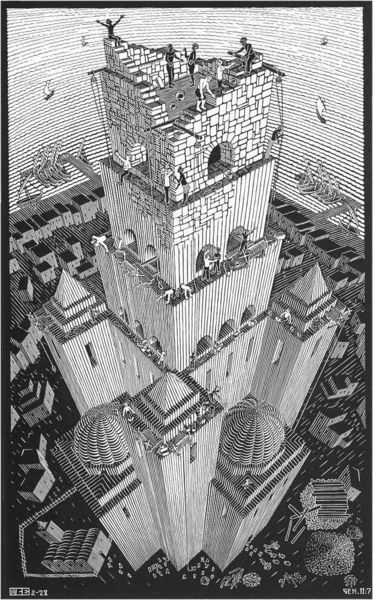
Some of Escher’s early works were illustrations. There was a beautiful cathedral, half underwater. There were evil-looking creatures in forests. It was such a romantic side to an artist most think of as a master of geometry. Below is an example of one of his illustrations. Even though it’s of a conventional subject, the Tower of Babel, the perspective is beautiful. I love the lines; this work just wouldn’t be whole using a method besides woodcut.

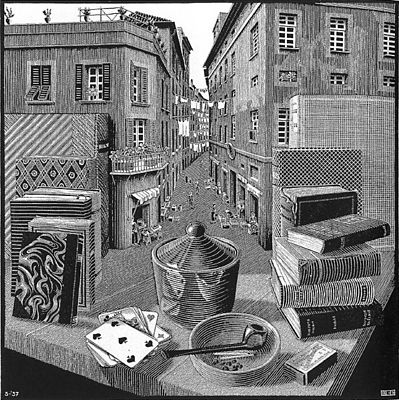
Below was Escher’s first impossible reality. And look, it’s a woodcut! Hooray!

escher2c_still_life_and_street

Still Life and Street: Escher’s first impossible reality

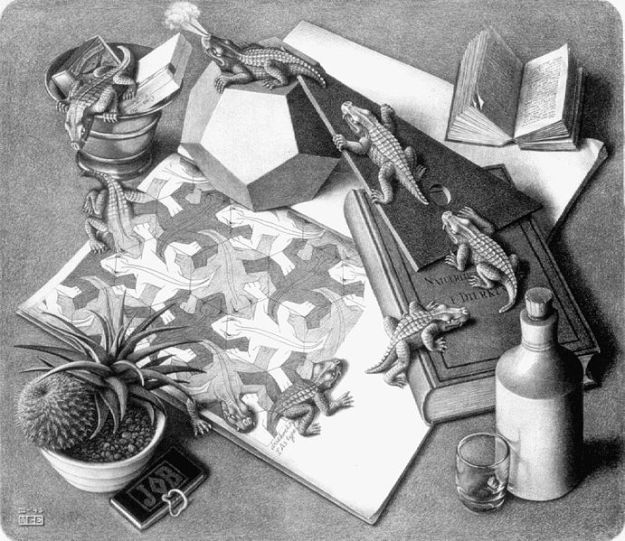
Below is one of Escher’s more famous images. It is a lithograph printing. See how various tones of gray are possible with this technique, as well as high-fidelity. It lends this images a very different tone than the one above. The lizard design is called a tessellation. Tessellations are plane-filling patterns. They occur in nature and area subject of mathematical study. Escher was inspired by the tiling work at the Alhambra in Spain, another example of tessellation.

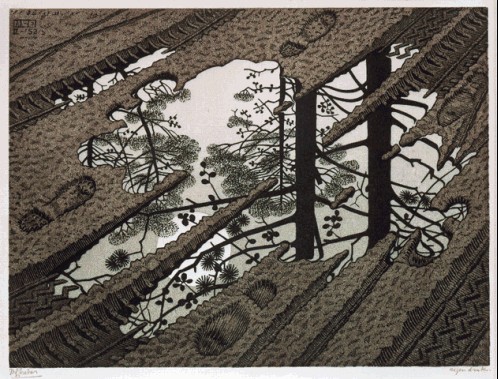
Below is another Escher woodcut, done with several plates to achieve multiple colors. Even when Escher wasn’t exploring impossible realities of geometry puzzles, he chose interesting perspectives.

The FODMAP Diet: An IBS diet based upon peer-reviewed science

I’m extremely lactose intolerant. What this means, biologically, is that I no longer produce enough lactase to process lactose sugar. Because I can’t process lactose in my small intestine, it moves on intact to my large intestine where bacteria eat the sugar. The byproduct of their digestion, gas, causes bloating, pain, cramping and, well, you know the rest.

What is IBS and what causes it?

Irritable Bowel Syndrome (IBS) is an incredibly common malady, affecting 6-46% of the population, depending upon the study. It’s a diagnosis resulting from the lack of a diagnosis; it’s diarrhea, bloating, stomach pain, and cramping that can’t be explained by celiac disease, lactose intolerance, fructose intolerance, or other understood gut disorders.

IBS is thought to be caused by visceral hypersensitivity, or over-sensitivity to pressure on the intestines. Imagine two people eat broccoli and get a bit gassy: the person with IBS would feel pain and discomfort while the other person might be bloated but otherwise fine.

It’s often implied that IBS is psychological as much as physiological. Anxiety and depression are common in people with IBS. In my experience, the perceived psychological component, the lack of simple treatments, and the lack of life-threatening consequences can lead doctors to be blasé about IBS. They recommend fiber, exercise, and routine, and shrug if that does little. Small wonder that people might feel blue. But gut science is improving, and the FODMAP approach is a new and widely successful strategy for reducing the symptoms of IBS.

What is the FODMAP approach, and what is different about it?

The FODMAP diet is based upon known biochemistry and the hypothesis that visceral hypersensitivity causes IBS. There are many molecules that, like my undigested lactose, tend to be digested in the large intestine and produce gas. The FODMAP diet eliminates a wide range of such molecules.

FODMAP, introduced in 2005 by Monash University, is a peer-reviewed diet based upon a concrete biological hypothesis supported and improved by scientific trials. It is not a weight-loss diet. FODMAP stands for Fermentable Oligo- Di- and Mono- Saccharides And Polyols. Catchy, right? But the concept is simple—FODMAPs are short-chain sugars that we know most people digest poorly (meaning bacteria digest them), and you avoid FODMAPs on the FODMAP diet. (For the biochemists, that means avoiding fructans (oligosaccharide), lactose (disaccharide), fructose (monosaccharide), and all sugar alcohols such sorbitol (polyols).)

Many other diets have questionable scientific bases and are profit driven. The Atkins Diet was published by a cardiologist who never published any peer-reviewed work, but several books. The Paleo Diet was published by an “exercise scientist untrained in paleobiology”. This is not to say that these diets cannot be beneficial in any way. But they have not been tested and refined in the way the FODMAP diet has been, and their fundamental science is hazier. Putting the cart before the horse, they have been developed first for profit, and then researched afterwards, often with mixed results. To be fair, the scientific process is slow and contentious and doesn’t always lend itself well to studies as broad and complex as diet. But FODMAP was developed, tested, and improved using the scientific process. If you’re skeptical of diets, as I am, you can read up and convince yourself that this diet has a reasonable basis and good results.

What’s a FODMAP diet like?

If you are considering a FODMAP diet, you will have to do some research, and be able to prepare food often from scratch. The internet is a phenomenal tool, and there are even some dieticians you can consult online. FODMAP sensitivity is not the same thing as an allergy. You don’t have to absolutely eliminate FODMAP foods, you simply must aim to minimize them for a period of time.

To follow the FODMAP diet, you avoid FODMAP-laden foods for two weeks to two months (different sources vary in their recommendations, and provide rationales). After this time, you re-introduce foods in a controlled manner to identify trigger foods. Most IBS-sufferers are not sensitive to all FODMAPs. Many people report benefits within a few days of starting the diet, and 70% of IBS patients in peer-reviewed studies reported improvements following the diet. I personally had much less bloating within a few days. Following a FODMAP diet revealed that some of my symptoms are due to gastritis, which I’m now treating. I see now that I’ve had gastritis symptoms for a while, but I was unable to separate various gastrointestinal symptoms before this diet. I remain on the full FODMAP diet after three months, but I have eliminated one side issue.

What foods are and aren’t allowed?

Following the most basic level of the FODMAP diet, one avoids all garlic, onion, and gluten-containing foods. It is not a gluten-free diet, but grains containing gluten overlap almost perfectly with grains containing the FODMAP fructan. Beer happily is the major exception; it is FODMAP-free due to the fermentation process.

I consider the FODMAP approach an alternative way of categorizing foods. There is a common perception that vegetables and fruit are healthful, and grains and meat are less healthful. At least from the perspective of IBS, that is not a useful framework. On the FODMAP diet, meats are okay. Roughly half of grains, dairy, vegetables and fruit contain FODMAPs, and these are avoided on the diet. Specifically, greens and squash are okay, but broccoli, leeks, and  brussels sprouts aren’t. Citrus and melon are okay, but peaches, cherries, and figs aren’t. Lactose-free milk and hard cheeses are okay, and ice cream, fresh cheeses, and sour cream aren’t.

For those considering the diet, this is my favorite exhaustive list of allowed and disallowed foods.

TL;DR

In short, the FODMAP diet requires research and it’s a pain to follow, but it offers real promise to the numerous people suffering from IBS. If you’re considering the diet yourself, good luck. I hope this provided a better explanation of the topic than the sources I encountered when trying to understand this diet. To others, maybe this will help explain why your friend has such a fiddly diet, and why you should support them.

Book now with the Exoplanet Travel Bureau

(You may have a wait while the technology for your flight is developed.)

A lot of my first reading as a child was astronomy books and magazines. When I was little, my brother told me there was a black hole under his bed (to keep me from snooping—nerd children fight dirty), and after that, I had to know more about the enigmatic and alarming properties of the universe.

One of the things I remember was the hunt for the first exoplanet, that is, the first confirmed planet outside of the solar system. Scientists were quite sure they should exist (why wouldn’t they?), but the equipment and techniques thus far hadn’t shown them. I remember reading about some of the first exoplanets in the hazy early 90s. They were massive, close to their stars, and had outrageous properties that inspired wild imaginings.

Now confirmed exoplanets number in the thousands. And poking around the internet on an unrelated chore the other night, I found this gem: the Exoplanet Travel Bureau. NASA’s Jet Propulsion Laboratory (the extremely prestigious and awesome JPL) made travel posters for four exoplanets in the style of retro travel posters. Each of them features characteristics of their planet. I promptly printed out three and hung them in my guest room. I’m still ecstatic about them; these are the kinds of visions and dreams I had so long ago as a kid, and that I love to chase in my own art. These are awesome, and I love them, and you can download them at full size. Tell all your friends, and print your own! Here they are!

Click on the image for more image sizes. Images by the NASA Jet Propulsion Laboratory.

Click on the image for more image sizes. Images by the NASA Jet Propulsion Laboratory.

Click on the image for more image sizes. Images by the NASA Jet Propulsion Laboratory.

Click on the image for more image sizes. Images by the NASA Jet Propulsion Laboratory.

Book Review: Pandemonium (Daryl Gregory 2008)

Note: in this review, I avoid specific spoilers beyond the first few chapters or back cover blurb. I discuss my reaction to the ending, but none of the specific events.

Rating: 3.5/5 stars

I don’t read a lot of fantasy. I chose to read Pandemonium because it was the book club selection for a book club meeting I failed to attend (sigh, moving). I devoured this book in less than 48 hours and I really enjoyed the process of reading it. For two reasons, this book forced me to contemplate the nature of science fiction versus fantasy: 1) because the book explicitly calls out the artificiality of the separation and 2) because I myself strongly tilt towards science fiction.

Pandemonium is set in a world where demonic possessions happen. They come in many flavors; there’s the Captain, who possesses soldiers and performs acts of bravery and there’s the Little Angel, who possesses little girls and releases old people from the pain of the world. Del Pierce was possessed as a child, and now as an adult he suspects that the demon never entirely left him.

Science wants to understand these possessions as much as it wants to understand cancer in our own world. Del wants to be freed of his demon, by science or otherwise. He’s damaged by what he’s endured. He talks to scientists and to their less-scientific groupies. Del’s condition isn’t considered possible by science, and he’s exasperated by the limitations of science. The characters criticize the way the scientific community regards the demonic possessions. It felt like the tired criticisms of our scientific process. Perhaps, as a scientist, I’m over-sensitive to such things.

People separate fantasy and scifi in different ways, and here’s my separation: fantasy is about exceptions to the rules and scifi is about inevitable outcomes of the rules. Harry Potter is an exceptional member of an exceptional class of people. Piers Anthony’s Xanth stories are about the people with the best magical powers. Ann Leckie’s Ancillary Justice is about one of many sentient programs that through a unique set of circumstances becomes something more. Nancy Kress’s Beggars in Spain is about the first products of genetic engineering. Both genres often focus on exceptional characters, but in scifi the character is exceptional due to circumstances and in fantasy the character is inherently exceptional in some way that cannot be explained.

In arguing a lack of separation between science fiction and fantasy, Pandemonium has the trappings of fantasy but makes several explicit science fiction references. Early in the book, a character (named Valis) quotes Philip K. Dick and asserts that “you cannot separate science fiction from fantasy.” There are references to AE van Vogt and Theodore Sturgeon. I made a mental footnote to expect something genre-defying at the end.

After the book argued for the lack of distinction between the genres, the ending didn’t challenge my definition of fantasy. For me, this was a book about demons and possession and the human psyche. Which is fine. But like Chekov’s gun, after a lot of discussion about the blurred lines between two genres, you expect to partake in a book with blurred lines. I didn’t dislike the ending, but I didn’t feel affected by it either. I flew through the book, finished it, and shrugged.

Pandemonium is a lovely read. As a mild scifi snob, I am out of its core audience, and I can’t say how those with different genre sensibilities might feel about it. For me it just felt insubstantial, like a book that will fade from my memory.

What is an engineering PhD?

Sorry I have fallen way off of schedule. Since my last posting, my husband defended and graduated with his PhD, and we visited out new city and bought our first house. So it’s been extremely exciting and hectic.

But I promised to write about what a PhD is, and so I shall. During  our seven years of graduate study, I’ve encountered a lot of confusion about what a PhD in science and engineering is. Getting a PhD is really really different from other forms of graduate education, such as law, business, and medical school. A PhD in fields like English can vary some from the science experience I describe here, but pursuing a PhD in English is more similar to pursuing a PhD in Physics than it is to law school.

Why you never ask a PhD student when they will graduate

Law school takes 3 years. Med school takes 4 years. A PhD takes ???? years. In science and engineering, it takes about 4-7 years, depending upon whether you go in with a masters, how hard you work, who your advisor is, and luck. Very little of the timing is directly within your control.

When you start with your bachelor’s degree, the first year focuses mostly on classes, the second year is a balance between classes and research, and most of the time after the second year is totally devoted to research. (A student starting with a master’s degree gets to skip most of the classwork.) In science and engineering, you might TA (teaching assist) for a semester or two. In other fields like Spanish and English, you might teach every semester. For them, this is often a good thing since teaching comprises a lot of their post-graduate opportunities. Teaching also pays the bills.

There are three big hurdles in grad school: qualifying exams, proposing your dissertation, and finishing your dissertation. Qualifying exams vary by school and department. If you fail your qualifiers, you won’t get your PhD. Many people who fail their qualifiers leave with a masters. Some departments have terribly difficult qualifiers, others don’t.

Your dissertation tells the story of your research. It describes experimental and mathematical techniques, the state of the field, shows results, and talks about future research possibilities. A dissertation is typically 100-300 pages, depending upon your field. You and your advisor work together to develop a central narrative to your dissertation. A PhD student must propose this avenue of exploration to their proposal committee, a panel of five professors, in a formal presentation. The professors give their feedback and criticisms on the proposed work. They may reject the proposal.

A PhD student graduates when they successfully defend their dissertation. But typically it’s writing the dissertation that is the hardest part after a successful proposal. It takes a long time to write 200 pages, and your advisor will expect a lot of things out of the document. You may also be expected to publish peer-reviewed papers. You can incorporate these papers into your dissertation, but the papers alone don’t count toward the dissertation directly. Papers are even harder to write than dissertation chapters. Papers may involve collaborations with researchers on other continents with other native languages and time zones.

All of the above is why a PhD student’s graduation date is hazy. So don’t ask a PhD student when they will graduate—they are wondering the same thing!

PhD students get paid

Unlike other types of grad school, you get paid to study towards a PhD. The teaching and research you do pay your tuition and salary. Your salary is never a lot, but unlike other post-graduate educations, you earn rather than pay. Depending upon the school and your area of study, a grad student earns between $15k-30k a year. You sometimes get benefits like health insurance as well (this might be universal now).

Your advisor: the master of your grad school experience

Every graduate student has an advisor. An advisor is the professor that funds you and your research project. Your advisor is the most important person in your grad school experience. Your advisor pays your salary and tuition, determines the area of your research topic, and influences your connections within your field.

An advisor can make your life miserable. If they run out of funding, you might have to teach more. They can slow your graduation. They are more than just a boss; they control your access to your doctoral degree. If you are five years into your PhD, you can’t do much if your advisor jerks you around short of quitting sans degree. And you may have noticed that professors are sometimes difficult people. Most grad students can name the difficult professors in their department.

Research

This simple cartoon explains the significance of your research in grad school. Your research is why you get paid to go to grad school. Your research could address industrial issues or basic science. Your advisor gets money based upon the kind of research he promises to do. In grad school, you produce research output, but more importantly, you learn how to do research. You learn how to solve problems and learn to identify interesting questions.

I would argue that you also learn patience. As an undergraduate student, few tasks take more than a week. The longest tasks take is a semester. You can get help from other students or professors in many cases. If you phone it in, perhaps you’ll get a lower grade, but the task goes away. Your research in grad school is a multi-year problem solving exercise. No one in the world may know the answer to your problem. Few people in the world may even understand the significance of your problem. You can try to go in a different direction, but at some point, you will bang your head against a problem for months. You learn an appreciation for what advancing human knowledge entails. And you advance human knowledge. This may damage your ability to speak English with everyone else.

Why get a PhD?

Because you are curious. Because the type of work described above appeals to you. Don’t start a PhD because you don’t know what to do next, or because you want to make more money. A PhD in science and engineering will get you a decent paying job, but you will deal with a ton of frustration and low-income years. Law school or business school are way faster, and engineers with these skills are valuable.

I started my PhD because it seemed like an interesting thing to do next. Like a lot of students, I found the middle of the process very discouraging. School seemed like it would never end, and I didn’t know what I would do after school. But I still liked my research. I still woke up thinking of ideas of things I could do. I felt more capable as a person with the skills I was developing in grad school. Grad school will feel aimless at some point for most; it’s your innate passion that helps bridge the gap and get you to the end.

The fun stuff

Grad school can also be a lot of fun. Other members of your research group help you learn and help you cope with setbacks. Your fellow prisoners well understand your challenges. Many schools have vibrant grad student communities apart from the undergraduate communities, in which you will meet grad students studying crazy and amazing things. Almost any eccentric nerding that you enjoy will be enjoyed by some other grad student. You’re all old enough to drink at bars, and most college towns will have some fun ones. Grad students get into their beer and drinks and most long-standing grad students can tell you a lot about them. Many grad students learn to be great cooks. The resources available for the undergraduates, such as gyms, sporting events, and social clubs, are still available to you as a grad student. While you’re pulling your hair our trying to get your degree, you will be in the middle of a community with some fun distractions when you need them and some really fun peers.

Hopefully that’s a useful summary of the PhD school experience, and not rendered too incoherent by my own state of disorganization. I’m happy to provide further info to those with questions as well!

Writing prompt: World Laboratory Day

Time: 10 minutes. Click here to go to my list of prompts.

“World Laboratory” (Inspired by this list of silly holidays.)


The capsule docked at the World Laboratory station. Dr. Trinner pushed gingerly from weightlessness into the gentle rotational gravity. The door slipped closed.

“Your laboratory is a ways from the dock. It’s all allotted by need, the labs with heavier shipping duties are near here, the vacuum labs are surface labs, the gravity labs rotate faster, the zero g labs are on the axis.”

“It’s all right, I wouldn’t mind stretching out,” Trinner assured the nervous guide. Her reputation obviously preceded her. But it had been years since the Erlenmeyer Incident…

Strictly speaking, her research didn’t benefit at all from work in space. But as a child, she had dreamt of being an astronaut. Doing science on a space station was damned near the next best thing. The station had jumped at the opportunity to have a Nobel winner onboard.

The light gravity was disorienting, harder on her stomach than zero g somehow.“How many are onboard now?” She braced against the walls of the corridor.

“30%, about,” the guide responded. “Some of the laboratories require special work and will take longer to complete. It will be pretty peaceful for a while here!”

“Other than the construction,” Trinner said.

“Yes, other than that.”

#

Trinner was alone in the lab. Some colleagues would follow in a couple of days. Her quarters were in the cluster near that lab section. It felt like science camp, living and breathing science, away from the cares of the world.

The construction echoed through the bulkheads from time to time. But there were other noises that Trinner couldn’t explain—voices. Voices came from the walls, in languages she didn’t know. She wondered if it were recordings of radio or television, but she couldn’t find a source.

Book review: What If the Moon Didn’t Exist? (Neil F. Comins 1993)

What If the Moon Didn’t Exist? is a book that asks just that– what would Earth be like if the ancient collision that led to our present-day moon never happened and the Earth had no moon? Comins, a professor of astronomy and physics at the University of Maine, also asks what if the moon was closer, what if the Earth was smaller, what if the Earth was tilted like Uranus, among other questions.

This book is a must-have for science fiction writers interested in writing about other planets. Comins follows through on his initial questions in a way that science fiction enthusiasts will appreciate. If the moon didn’t exist, the moon’s tidal pull wouldn’t exist. Due to the lack of that tidal pull, Earth’s day would be 8 hours long, not 24. Which would cause much stronger winds and storms. And the tides would be lower. Which would impede the transition of  life from water to land. And that life would have to adapt to the windy, stormy short days. Would that life develop hearing, with all that wind? Would plants opt for low-surface-area needles instead of broad leaves? Assuming humans developed, how would early man tell time without a lunar cycle? Would this influence man’s scientific development? Comins asks and suggests answers to all of these questions. It’s exciting food for thought, and it made me want to go dream up worlds of my own.

What If the Moon Didn’t Exist? is over twenty years old now. I expect some of the science in it may be outdated (none that I actually noticed, but given the advances in planetary science since 1993, it seems likely). However, the logic the book employs is sound, and I still found it very stimulating. And in researching this post, I discovered two more recent books my Comins: What If the Earth Had Two Moons? written in 2011 and The Hazards of Space Travel: A Tourist’s Guide written in 2007. They seem similar in tenor and I expect to like them too.

Fun Science: Two metals in contact do fun stuff

Have you ever made lasagna, and later discovered black spots or holes on the tin foil you used to cover it? Those spots are due to bimetallic or galvanic corrosion. Galvanic corrosion is an electrochemical process that occurs when two different metals contact through an electrolyte. Any two metals or alloys can experience galvanic corrosion, but pairs with dissimilar potentials will experience more. The potential of a metal is an inherent property of that metal, like density or hardness. Galvanic corrosion can be a very destructive force, or it can be exploited to make electrical current in a battery. In the case of the lasagna, the lasagna functions as the electrolyte, the pan as one metal, and the tin foil as the second metal.

How to make a simple battery at home

The first battery was invented in 1800 by Alessandro Volta. It was called the voltaic pile, and it was composed of a stack of zinc and copper disks.

A voltaic pile, the earliest kind of battery. Voltaic piles were used to discover many elements and to study electricity (credit: wikimedia commons)

If you have coins, you can make a battery. US pennies are zinc coated with pure copper and US nickels are 75% copper.

Battery 1 (weak, but easy): You can make a weak battery by stacking pennies alternated with nickels. Just separate the coins with paper towels soaked in vinegar, which will serve as the electrolyte. Here’s a great summary of some experiments you can do with this system. If you have a multimeter, you can measure the voltage of your system; the more alternating sets of coins, the higher the voltage. This battery won’t be powerful enough to light an LED, but if you keep it wet for a few days, you will be able to see the effects of the corrosion on the coins.

Battery 2 (strong, but more work): If you’re more ambitious, you can sand the copper off one side of the pennies, and create a battery from just pennies. A few pennies like this can easily light LEDs.The video below shows how to make battery 2.

Battery 2 is much more powerful because the metals in battery 2 (the zinc of the penny’s core and the copper of the penny’s surface) have a higher difference in potential than those in battery 1 (the 75% copper of the 5 cent coin and the pure copper of the penny surface). The farther apart two substances are on the galvanic series, the more voltage there will be.

Galvanic corrosion and the Statue of Liberty

The Statue of Liberty has an iron skeleton covered by a thin layer of copper. It was built with insulators between the copper and iron to prevent corrosion, but these insulators broke down. The Statue of Liberty was extensively renovated in the 1980s to repair damage from this corrosion.

Galvanic corrosion occurs in a lot of systems. If you use washers that are a different kind of metal than your screw, galvanic corrosion will occur. Galvanic corrosion can get even trickier: alloys that contain more than one kind of metal are composed of crystal grains that may vary slightly in composition. Galvanic corrosion can occur in an alloy between grain boundaries!

The bolts are a different kind of stainless steel, which has led to corrosion (credit: wikimedia commons)

Fortunately, we have methods for combatting corrosion. Corrosion only eats away at the lower potential metal. So engineers often design less critical pieces out of lower potential metals, so that they are sacrificial. Galvanic and other kinds of corrosion are major topics of research, relevant to boat construction, bridges, high temperature processing, and more. And thanks to galvanic corrosion, you can power a light with just pennies.

Book review: The Electric Life of Michael Faraday (Alan Hirshfeld 2006)

Rating: 5/5

Michael Faraday is the man who showed that light, electricity, and magnetism were interconnected forces. The farad is named after him; you know a scientist is important when they’ve got their own unit. He had no formal math training or university education. He made his discoveries through dogged experimentation, humility, and curiosity. And because he was the son of a blacksmith, he almost didn’t even get the chance.

The Electric Life of Michael Faraday is an excellent professional biography of Faraday*. Hirshfeld, a physicist, details Faraday’s motivations in addition to his discoveries. We learn about the books, people and thoughts that motivated Faraday. We see how Faraday coped with the endless failures that precede an experimental success. We also see how Faraday fought for his ideas against the incorrect prevailing notions of the day. We get all this in a compact and readable 200 pages. (The Cosmos episode “The Electric Boy”, covers many of the facts of Faraday’s life, though less of the motivation, and is and excellent companion to this book. And it’s free to stream on Netflix!)

The way we are taught science as children is so different from the way science comes into being. For example, the power of the electron was harnessed well before it was discovered in 1897. Volta invented the battery in 1800; the dynamo, which converted mechanical energy into electricity, was built in 1832. Scientists like Humphry Davy isolated and named elements decades and centuries before we had any idea what made elements different. When a scientist does science today, they also have incomplete information. We learn science as a set of facts and rules, rather than the procedures for learning those facts and rules. The Electric Life excellently illustrates the difference. This book, accompanied with some simple experiments and videos, could make a rich and beautiful teaching example.

Hirshfeld also touches on a social issue that’s as relevant today as it was in Faraday’s time: scientific literacy. Speaking about the Victorian pseudoscience of table-moving, Faraday said

I do not object to table-moving itself… though a very unpromising subject for experiment; but I am opposed to the unwillingness of its advocates to investigate; their boldness to assert; the credulity of the lookers-on; their desire that the reserved and cautious objector should be in error; and I wish, by calling attention to these things, to make the general want of mental discipline and education manifest.

In Faraday’s day, there was no science education. Today, I would argue that while we teach scientific fact, we still don’t teach enough scientific reasoning. The above statement could apply to vaccines, global warming, GMOs, evolution, among others.

I would have liked to learn more about Faraday’s personal life. We learn almost nothing about Faraday’s wife Sarah, or anyone else in his family, or whether he even had children (he didn’t). But again, the book is short, and does such a good job with its chosen issues that this is more of an observation than a criticism.

I whole heartedly recommend this book to anyone, scientist or not. You’ll learn about an interesting man of history. You’ll learn how science happens now and two centuries ago. And I think you’ll simply enjoy it.

* I should note that my copy was an advance reading copy from a used book store, so it may vary from the final book in small details.

Writing prompt: Puzzle day

Time: 10 minutes. Click here to go to my list of prompts.

“National Puzzle Day” (This list is an awesome source of completely silly prompts.)

Cyn reached the front door at 12:03. She keyed in her entry code. Instead of turning blue, the key pad turned red and displayed a string of text. Who had the lowest average with over one hundred home runs?

“Damn,” Cyn spat. She hadn’t meant to get home after midnight. Some of the puzzles were solvable, but some, like this one, were ancient nonsense. She looked around the street. A few other bewildered people stood at their doors. It was a dangerous night to be on the street. Thousands of other people like her would wander the street. Police cars would challenge their operators too.

Every member of the city dreaded puzzle day. That’s what they called it. Exactly every 400th day, everything that worked smoothly the other 399 days would torture its users.

“Why does this happen?” the inevitable lament would arise. They lived in an ancient city of wonders. Most of the time, they took the functionality for granted. But not on puzzle day.

Cyn started toward Elbie’s house. Public transportation was out of the question. All of their questions were antique unit conversions. It was still quiet this time of night. She’d never been out on puzzle day, but like everyone else, she’d read enough.