Tag Archives: scifi

Writing prompt: Expand a detail from an existing story

Time: 7 minutes. Click here to go to my list of prompts.

“Write in about a small detail from another story as its own story” (In this case, another story mentions the excitement caused by a two-headed snake.)

People from the next three hollows over agreed that the two-headed snake was the most amazing thing they’d ever seen. Only old Alvin Teek, always crazy but growing more combative as he aged, was unimpressed. But then he thought there were buildings made of glass taller than any tree and invisible light that could cook food. Whatever hollow he originally came from must have died out for lack of practicality. The man couldn’t even catch his own food.

After the bomb, it was common to see animals with growths or legions. They were usually pretty sick. The most interesting ones were always dead. Teek said it was the radiation, some relative of his magic cooking light. But the two-headed snake was alive, and mad as hell that we’d caught it. It bit one of the honored blue men, and the other blue men were jealous that he’d grown closer to the hills until his wound grew infected and he lost the hand. One only wanted to be so close to the hills.

Lately we’ve been seeing things in the sky. Teek says they’re planes, full of people. They look like slow-moving shooting stars. They’re not full of people, but they do seem full of meaning. First lights in the sky, now a two-headed snake. They’re omens for sure. Times are going to be changing. The land we live on is older than the world, but we aren’t. The elders say the land is preparing to shed us once more.
Writing prompt: An elderly diatribe

Time: 7 minutes. Click here to go to my list of prompts.

“An elderly diatribe”

“The children are not ready to inherit this planet. By their age, I had my second doctorate and a dozen papers. It isn’t their fault that no universities exist on this compromise of a planet, and yet none do. They are experienced at excavating and earth works and weatherproofing, but so was my general contractor in Seattle. I would not choose to leave the fate of a civilization in her hands.

“The young will say, who, then? Us. It still has to be us. The masters of physics and chemistry and psychology and metallurgy and meteorology. These aren’t fields where hunches suffice.”

I paused. I rubbed my aching, weary hands. My grandmother hadn’t looked this bad at 110, and I was only 80. So many from my generation had already died. We didn’t have real universities, and we didn’t have real hospitals. These things hadn’t occurred to us when we left Earth, full of vigor and zeal. Now what I wouldn’t give for an anti-inflammation treatment at an Appalachian spa.

We would have to hand over the reins at some point. But everything seemed so perilous still. Food supplies were a constant concern, weather still dominated every day, and the foggs were still deadly in the east. As my generation died, the next struggled to replace their skills. They were failing.

Writing prompt: Farming the Death Valley

Time: 7 minutes. Click here to go to my list of prompts.

“Farming the death valley”


Dad said I was a hero. Mom wouldn’t speak to me. I was going to go farm in the Death Valley, so neither of their reactions were really at the top of my mind. I went to the City Works, excited and nervous.

“These are the seeds you’ll take. I see you’ve done work in the local farms, so you probably know what you need to. Still, we have a training course for you. The conditions in the valley are a little different. Wetter. You’ll have to watch for rot more, but things grow there.” The representative spoke in slightly awed tones. Everyone seemed to.

“Different conditions… and different critters,” I remarked.

“Yes, different critters. That’s part of the course. I… didn’t want to be grim. You know most of the farmers survive, come back very profitable. The valley is supposed to be beautiful, like a paradise.”

“Most. So… more than 50%? How much more than 50%?”

She looked away. I snorted softly.

“It’s a good thing to do,” she said, with softness that spoke of conviction rather than the propaganda associated with her office. My sister went.” She paused, and I felt like she didn’t return. “The yields they can get in the valley… people like you keep children from starving.”

“That’s not why I’m doing it,” I said.

“Well, that’s not up to me,” she replied. “But we try to prepare you for the valley as best we can.”

“It’s mist. It comes in under the doors and takes you in the night. Is there a preparation for that?”

She looked away again.

The slow and steady

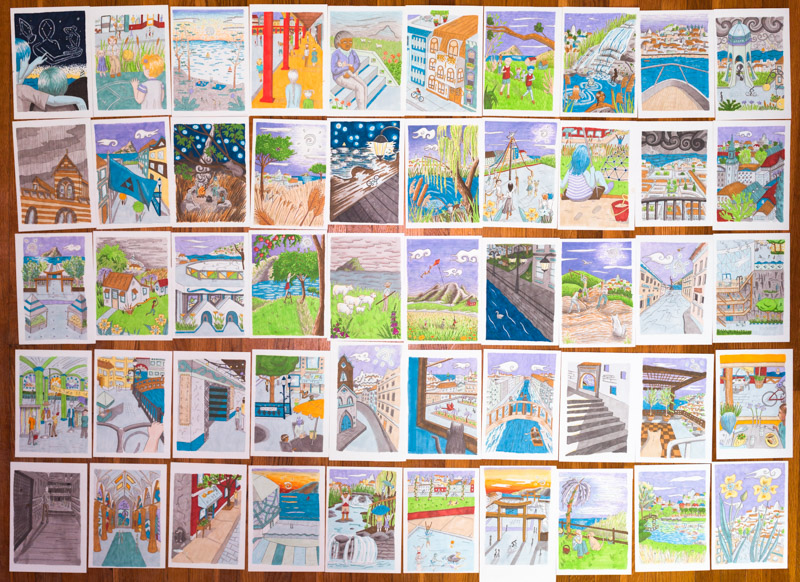
Over six months ago, I challenged myself to do 100 illustrations of my city of Vironevaeh, the fictitious city that is the unspellable namesake of this website. I would build my world in myriad ways, practice art, and create some beautiful scenes. On Thursday, I finished the fiftieth color image. I have images of city streets, markets, pets, agriculture, constellations, architecture, pastimes, clothing, family, and weather.

50-74


Eventually, I will have descriptions for each of them, and a place on the map. Eventually there will be at least 50 more. It’s a lot of work to do for something that probably won’t mean much to anyone besides me. But Vironevaeh is a city at my side for over 17 years, and it will mean a lot to me. I am so pleased with my progress. Here are a couple of my favorites:

006-small

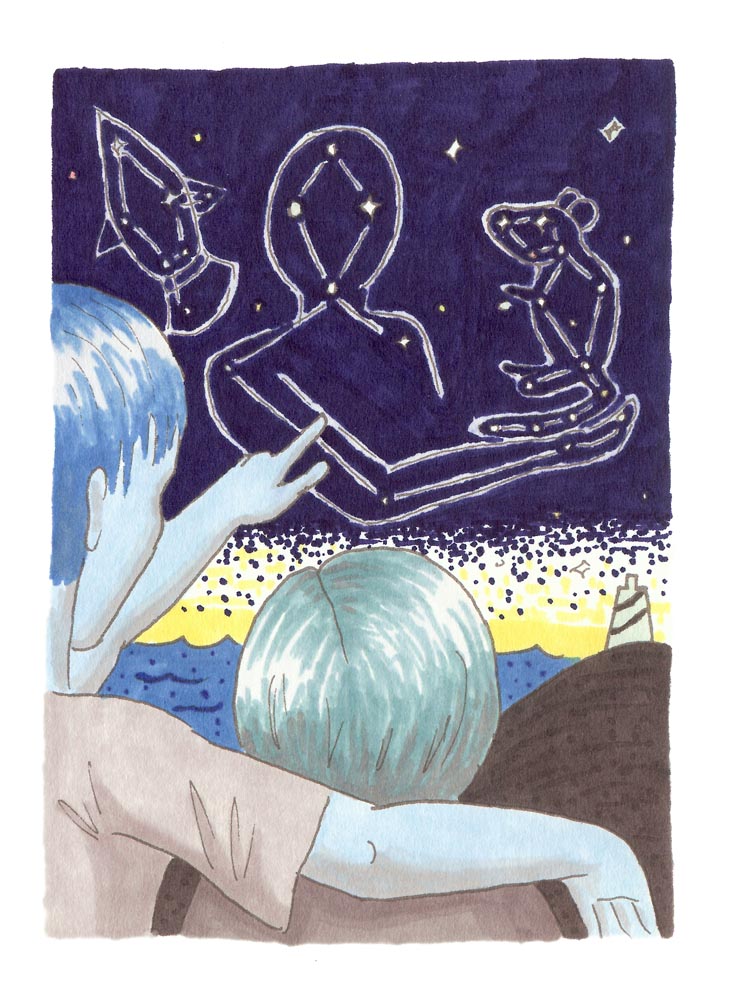
A man showing a child constellations in the sky. These constellations are of Abenn the hermit and Peep the mouse, who hid away on Neva the spaceship. These legendary figures are the subject of my recent and free fairy tale The Lonely Man on the Ship. Sharp eyes may note that the people here are blue and green.

008-small


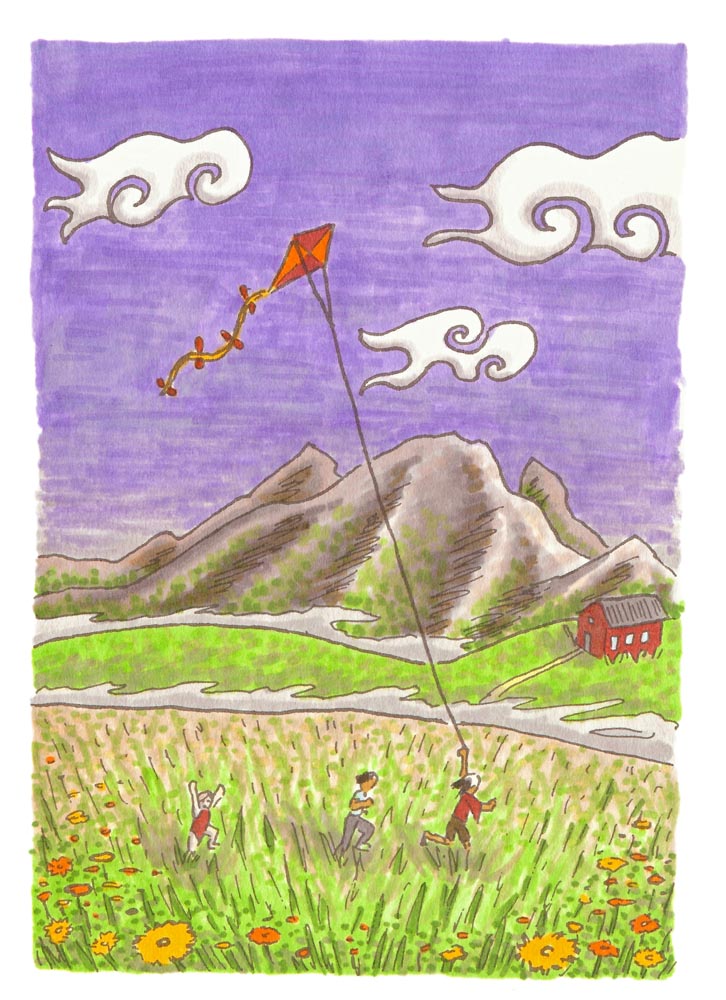
Children running with a kite in the countryside. A pretty typical scene even here on Earth, except for the lovely purple Vironevaehn sky. Also the fact the fog in the valleys behind them could be brain-eating. All in normal day!

Soon I’ll bind up a little fun book of my favorite ten illustrations, but for now, I’m basking. Onto the next milestone!

Writing prompt: Turning 200

Time: 7 minutes. Click here to go to my list of prompts.

(A quick aside: travel this month has damaged the regularity of my posting, but I am back now, with a Monday post and a Thursday writing prompt.)

“turning 200” (this prompt inspired by my grandmother-in-law’s recent 90th birthday.)

Heather surveyed the room of happy faces, here for her birthday party. She wasn’t the first person to turn 200, but she was the first she knew. She had lived a healthy life, reaching 95 before the longevity treatments became available. Since then it had been smoothing sailing. She didn’t feel a day over 65. Physically.

Several of her great-great-great-great grandchildren played across the room. She mostly didn’t know their names or the names of their parents. That was odd to realize. When she had an expiration date, the young had seemed like the greatest investment she could make, the only real way to some kind of reach beyond the grave. Now that she was still around… well even the 100 year olds had so much to learn. Apparently the country agreed with the average age in the senate at 120.

The guests sang happy birthday, and Heather sat politely through it. She could bear anything with equanimity. She had time. After cake, she checked the news, something to do.

Third bicentennial dies under unknown circumstances, one headline read. She pushed the article up. The authorities couldn’t tell what had killed the man. A scientist sourced noted how little was known about the physiology of the extremely aged, due to small sample size. The three cases would be researched extensively, no doubt.

Heather had faced death before. But now she quaked in her chair. If the treatments had limits, she would surely face them before they were solved. She wasn’t prepared. She had been before, resolved to her fate for decades. She walked out of the celebration. There were things to do.

Writing prompt: Pop-up People

Time: 7 minutes. Click here to go to my list of prompts.

“Pop-up people”

Light speed was a drag—it left the far colonies as alien to us as Victorians from Flappers. So when GE broke the barrier, a cheer went up. There was more celebration than when Lindbergh crossed the Atlantic. But the scientists soon realized the limitations to their ©SuperWarp Field. No space more than a cubic millimeter could exceed light speed. We had communication, but no transportation.

Every attempt to spread the field beyond a cubic millimeter failed, often disastrously. Finally another idea arose—if the field couldn’t grow larger, maybe the object could grow smaller. The nucleus is compact enough, but around it, electrons swim in a luxuriant, and frankly wasteful, vacuum.

Using the repulsive nature of dark matter, Sandia devised a way to compress matter as in a neutron star. Suddenly, a cubic millimeter was a damned fine amount of space. We sent little grains of rice to the colonies, full of a thousand people and a multitude of machinery in compression stasis.

The pop-up people went to the stars.

Writing prompt: I’ve never seen one, but how hard could it be?”

Time: 7 minutes. Click here to go to my list of prompts.

“I’ve never seen one, but how hard could it be?” (This prompt inspired by the Erie Canal, built by four men who hadn’t even seen a canal when they set out to build one.)


“I’ve never seen one before, but how hard could it be?” Emmaye Cevluss said. “They built them practically in medieval times, it’s just a ditch full of water.”

*

Three months later and how she regretted those words. Without construction equipment, how did she remove the dirt? Without drafting software, how did she visualize the project? How would she calculate stress loads? On this new world, where would she find the materials for good concrete? For good steel?

How hard could it be? A canal connecting the bay to the western part of the peninsula with the quarries and mines. It might as well be a space elevator. Since they had arrived on this world, every day was a day spent learning to adjust to all the things it didn’t have.

Their ship, the Neva, was supposed to help with many of these things. Instead it sat broken, useless, to the west. All the energy it held was devoted to cold storage, to keep biological samples like seeds and useful fungi and bacteria until they could be properly used. And now the cold storage was having issues.

And it was starting to rain a lot. Especially a lot for a supposed desert region.

It was going to be a while before there was a canal.

Writing prompt: foraging

Time: 7 minutes. Click here to go to my list of prompts.

“Foraging” (This prompt inspired by the well-known Danish foraging restaurant, top-rated Noma.)


“Announcing the release of the Forage 1000! For the low price of $1000, you can virtually eliminate grocery costs!”

Sylvia showed Tanisha the ad. Tanisha couldn’t share Sylvia’s enthusiasm. For one thing, she didn’t have nearly the shares in the product. But for another thing, Tanisha always felt a little sad when scientific breakthroughs went toward such short-sighted uses. And there was that third thing…

“So what about when everyone has one?” Tanisha asked. She had helped write the software that finally allowed machines to approximate an animal sense of taste. “Then these foragers won’t find much of the cheap grasses and fungi and bugs you’re promoting it for.”

Sylvia shrugged. “I think that’s a pretty good problem to have. Then we up the price. Or make a new one that finds things the old one didn’t.”

Tanisha sighed. She had to say it, she knew it. But it was hard giving bad news to funders. “You can’t.”

Sylvia crossed her arms. “Spit it out.”

“We still have this little problem,” Tanisha said. “It’s not perfect about identifying poisons.”

Sylvia sat.

“The body is complex. Something can taste good but have trace amounts of toxin or parasites or bacteria. Or just be bad for you like antifreeze. We didn’t know until a few weeks ago when we started to use a larger sampling range. Two dead mice.”

“We can fix that, right?” Sylvia said hopefully. “You’re going to fix this.”

Tanisha nodded, and Sylvia left, already on the phone. She turned to the ad. “How am I going to fix this?”

Another Fairy Tale at last


When I released my collection of science fiction fairy tales, it was the start of a push to creatively engage with the world. I finally finished a project and put it out there, doubtless non-perfect like everything. Since then, I’ve submitted my short works nearly 90 times (with 3 acceptances). I’ve joined a writing group and participated in critiquing groups to work on my writing. I’ve studied Adobe’s Photoshop and illustrator, and recently painting, to improve my artistic skills. I’ve studied Indesign and book layout. I started posting regularly on this site, as I have for nearly two years now. The first set of fairy tales started all of this self-improvement.

I always intended to do another collection of fairy tales. I recently finished the first story, “The Lonely Man on the Ship”, about a man trapped alone for years on a spaceship during  terrible storms. I did the art with Prismacolor color pencils (which I intend to use for the rest of the eventual collection).

Now I’m coding the fairy tale for the kindle. Once I do, “The Lonely Man on the Ship” will be available free on the kindle and on the iPad. Much of the last two years’ studies has gone into this work. I used Indesign and illustrator for layout work. I used Photoshop to make sure my scanned art work was as attractive as possible. I think the writing is stronger than in the first fairy tales. As the first fairy tales inspired new studies, to release this work properly I’m learning CSS and HTML coding.

So until I finish this last step, enjoy a couple of illustrations!

abenn_ghost-small letterhead-small

Writing prompt: Driftless

Time: 7 minutes. Click here to go to my list of prompts.

“Driftless” (If anyone’s curious, the driftless region is in Southwest Wisconsin. It is indeed full of valley and caves and unwashed hippies. And Holsteins.)

They call this region the Driftless region, a region around which the glaciers split so they didn’t drift the soil. It’s rough and wild, unlike everything else around. As a kid, I always assumed driftless refered to the quality of the region. It didn’t drift. Nothing changed. You came to the region and didn’t leave, and the less washed you were, the more likely you were to arrive.

But the geological reason made sense, too. Still, I wondered, how do glaciers just go about splitting? It seems like you’d need some force to split glaciers. We don’t have high mountains or great volcanos.

We also have a ton of caves around here. I started to wonder, between massive glaciers splitting and rendings in the Earth, well, was there something below? So I read what I could on Wikipedia and packed for a journey under the Driftless region.

I’m stuck down here now. I’m writing down why I came here, as if I don’t make it, hopefully these records do. Small bipedal creatures are running up to me and stealing food from my bag. At least, I think that’s what’s happening. I have no light, and they glow, and either this is a hallucination or I’m onto something really exciting. Either way, I’m not sure about the odds of my survival.