Category Archives: artists and books

Book Review: The Absolute at Large (Čapek 1922)

The Absolute at Large was written in 1922 by Czech author Karel Čapek (free web translation to English here). It is about the advent of a machine called the Karburator. The Karburator split atoms into two parts: useful work and a mysterious force called the “absolute”. The absolute is a god force which causes intense religiosity in people, and allows them to perform miracles. As the Karburator spreads across the planet, so does the absolute, and the book describes what follows.

I really enjoyed this book, and I would highly recommend it. First, it’s smart science fiction. In 1922, forces such as radiation were pretty recent science. Radium was discovered in 1898. Čapek describes something very like fission well before its invention. Second, this book is subtly very funny. Through the book, Čapek lampoons religion, communism, and nationalism at least. Third, the book is a short and simple read. My copy was about 200 pages with large print and lots of white space. If you enjoy this book, you can try out Čapek’s possibly more famous work, R.U.R., the book in which the word “robot” was created (derived from the Czech word for serf labor). I haven’t gotten around to that one yet myself.

I had a special reaction to The Absolute at Large, which is largely set in Prague. I was lucky enough to spend a summer in Prague, during which time I was able to talk at length with older residents. The Absolute at Large captures a certain essence of the Czech spirit. The Czechs are cynical in a very witty way. They’ve had religion thrust upon them (read about Jan Hus, the Hussites, and the First Defenestration of Prague). They’ve had nationalities thrust upon them (read about the Second Defenestration of Prague). In 1922, Czechoslovakia had been an independent country for only 3 years following the fall of the Austria-Hungarian empire. Unlike the Poles, who seem to resist forcefully, and the Hungarians and their patriotic sorrow, the Czechs have resorted to humor to endure their less-than-dominant place in geopolitical events. A few years ago, the Czechs held a contest to vote for the greatest Czech ever. The Czechs voted for Jara Cimrman, a fictional man who had no official face (the sculpture had become smooth, they couldn’t find him in this photo of a few hundred, etc). However, fictional Cimrman was credited with many wonderful feats: he suggested the Panama Canal, he was briefly an obstetrician, he consulted with Zeppelin, Eiffel, Mendeleev and Curie. If you are ever in Prague, there is a free museum to Cimrman under the Petřín Tower.

The Absolute at Large has a similar sense of humor to Cimrmanology; Čapek lampoons the inevitable powers of the world and their effect on the Czechs. And how appropriate that the Karburator should be invented in Prague… perhaps Cimrman lent a hand.

Artists: Walter Crane

I love to go to art museums to new style ideas. On a recent trip to the Virginia Museum of Fine Arts (VMFA), I visited the art nouveau section and saw a piece by English artist Walter Crane:

Walter Crane plate at VMFA.

The plate mentioned that Walter Crane did children’s books.

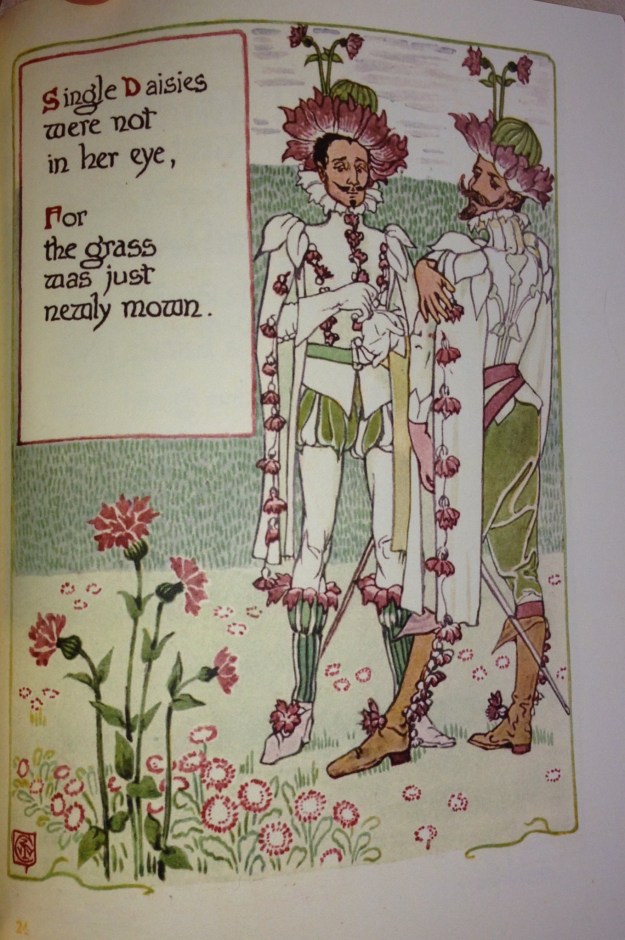
So I went home and ordered a couple of his books. A Floral Fantasy in an Old English Garden anthropomorphizes the flowers of the gardens in beautiful art nouveau fashion. Below is a photo of one of the pages. This page depicts bachelor’s buttons. All the little details, down to their boots, are done to match the characteristics of the plant. Another panel shows a battle between a thistle knight and a snapdragon. Walter Crane has several children’s books besides this one. Since Walter Crane died in 1915, his works have entered the creative commons, and they can be had very cheap, especially digitally.

photo

Walter Crane also did more adult works. Neptune’s Horses reminds me of the scene in Lord of the Rings where the elf summons up the waters to fend off the nazgul, but it was painted over a century before.

Paper engineering (AKA: pop ups!)

Everybody love a pop-up book. The well-executed ones are a thing of joy. I got a pop-up book as a kid about dinosaurs, which I didn’t care that much about, in French, which I didn’t read. I read that thing to its grave.

Recently, I see more pop-up books in stores, aimed at more than just children. These books are made by not artists, but paper engineers. As an engineer, I approve of this shift in language. Perhaps I should strive to be a word and paint engineer, rather than writer and illustrator. A few years ago, I bought Moby Dick, as done by paper engineer Sam Ita. Amazon lists a few of his books here. He even has a pop-up Xmas tree, if you’re still looking. His Moby Dick is wonderful, with whirling whirlpools and ships complete with rigging and a looking-glass.

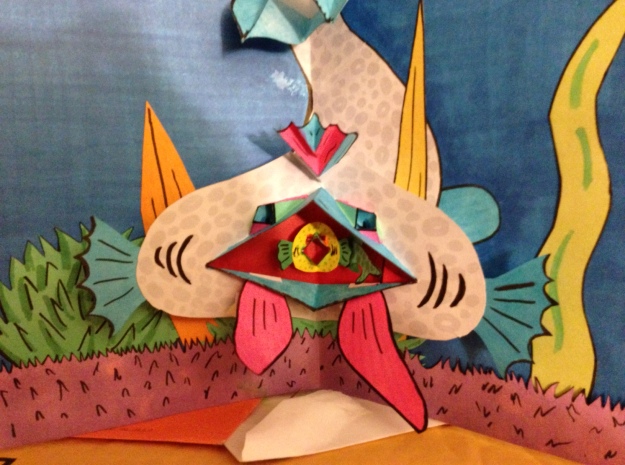
I have started my own attempts at pop-up (shown below). A fun project, but one on hold for now because I’m not sure how to put them together with any kind of efficiency. If you’re interested in learning about pop-ups, I have used a few books to guide my exploration:

popupHappy paper engineering!


Artists: Thomas Hart Benton

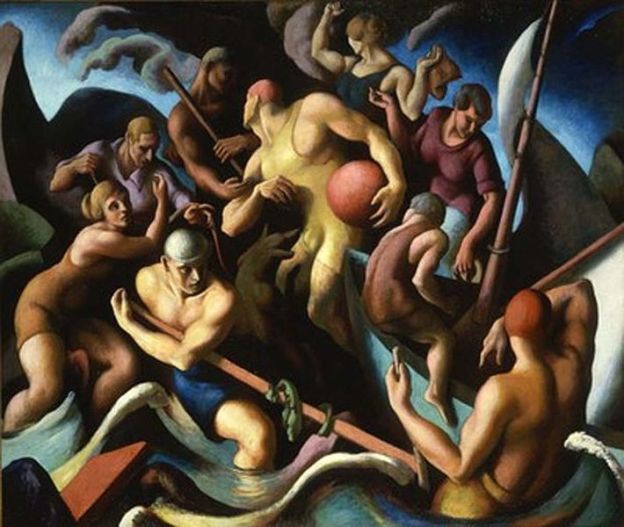
Previously I have talked about depression era posters and Soviet propaganda posters. Thomas Hart Benton was a depression era painter and muralist from southwest Missouri. Growing up in St. Louis, I was exposed to his art from a young age. His shading brings the people in his paintings to life. He often depicts scenes of work, as suits the depression. (Both of the images in this entry can be found on Wikipedia.)

Cut the Line (Wikipedia)

If you for some reason find yourself in Jefferson City, Missouri (unlikely), the capitol building has many of his murals. Then stop by Central Dairy, where you can get a pile of amazing ice cream for very little $. Then you have seen all there is to see in the illustrious capitol.