Tag Archives: methods

Writing prompt: “The whirlpool sucked them downwards”

Time: 7 minutes. Click here to go to my list of prompts.

“The whirlpool sucked them downwards”

Aeli floated through the air. The parachute held her aloft, descending unnaturally slowly. Around her, the storm spun, and below her the sea roiled. Angry caps of gray water shot up. They came closer and closer, and she had the distinct feeling that they were reaching for her. Far off, she saw the ship descend in flaming glory into the sea. She would never know what had gone wrong. Blue and green lightning flashed all around.

She floated into the ocean, and the chute came down over her, trapping her against the water. She gasped, trying to pull air and the sea boiled around her. The water began to spin, with a strong clockwise motion. The whirlpool sucked her downwards. She contemplated if she did believe in an afterlife. Her sight began to grow dim, and she felt the burning, salty water enter her nose.

Something wrapped tightly around her ankle—something strong and something living. She imagined it like the tentacle of Ursula from that old Disney movie. The purple tentacle wrapped around her ankle, suction-cup strong, and pulled her down. She imagined she heard the fat villain laughing and peering at her ugly hench fish. Then the world didn’t exist anymore.

#

Aeli woke, coughing sea water, in a cave of crystal. Soft light filtered in from all around her. She was naked, and she was cold.


Science is Creative!

In the US, science is regarded as valuable, but dry and a bit stiff. As a student, it’s easy to get this impression, studying rigid facts first explored centuries ago. The math, chemistry, physics, and biology we learn in high school and college are about recreating long-known answers by well-established methods. But the process of making new science and math is inherently creative, and new ideas require letting the mind run wild a little. In this post, I’ll talk about how I develop my ideas.

I work with populations of oscillators. The idea of this research is that the complexity of the whole (the population) exceeds the complexity of each element (the oscillator). The human brain is a good example of such a system–each neuron is fairly simple and well-understood, but overall brain behavior arising from the interactions of many neurons is not understood. My research tends to work by observation–I notice something I find interesting and I explore that further. Other researchers work on what they suspect they will find, based upon other work. All research works within the context of its field. There are many interesting behaviors I have noted in my experiments, but I explore the ones I might explain. Really random observations are cool, but hard to frame in a way which is meaningful to the community.

The above may not sound particularly creative. But the key to experiments like I do is imagining what might happen when one explores slightly beyond what is known. It requires extrapolating from the areas we know, in the context of the rules we know, to the areas we don’t know. Some of the rules we know are pretty absolute, like thermodynamics, but others may be flexible. (As a note on this point, the stable chemical oscillations I study were once considered thermodynamically impossible. Someone had to bend the established understanding of thermodynamics to explain these oscillations. Einstein had to bend Newton’s Laws for relativity, and he arrived at that conclusion by logic rather than by observation.) In an experimental apparatus like mine, thousands of experiments are possible. It is up to the experimentalist to pick from the possibilities, in the context of what might work in his imagination, to demonstrate something hitherto unknown.

In some ways, the process is similar to writing. There are rules that must be obeyed, and the process of finding something new or interesting is very indirect. With science and writing, I develop some of my best ideas drinking a beer or taking a walk. Sitting at a desk focusing is required at times, but so too is active contemplation. The rules of science are broader and more rigid and take longer to learn, but there are similarities.

A lot of historical scientists were fascinating people, akin to historical artists. Van Gogh got his ear cut off in a fight. Astronomer Tycho Brahe lost his nose in a duel. Salvador Dali shellacked his hair. Electrical engineer Nikola Tesla fell in love with a pigeon. Mathematician Paul Erdos lived itinerantly for decades. In one visit to a colleague, he couldn’t figure out how to open a carton of juice, so he instead stabbed it open (among many, many other oddities). Physicist Richard Feynman used to work on his physics at strip clubs. Artists may share their eccentricities more in their works, but I would argue that scientists have every bit as much oddness.

I hope this post illustrates a little what it is like to be a research scientist, and how science at the cutting edge works. For more science posts, check out my fun science list.

Writing prompt: “What if a disease that causes schitzophrenia became common?”

Time: 7 minutes. Click here to go to my list of prompts.

“What if a disease that causes schitzophrenia became common?”

The man on the far corner screamed at the sky. Little Alicia pointed at him and laughed. “Daddy, that man is funny.” I pull her back from the curb harder than I intend to and she starts to cry. Somebody else will call this one in, probably. I pull Alicia and Tania behind me, against their protests. When they’re older, they’ll understand. I hope, I really hope, that when they’re older, this will just be another terrible chapter in history like the yellow fever of Memphis or the swine flu.

The schitz strikes men more often than women. The latest statistics suggest 5% of adult men have been stricken, and 2.5% of adult women. Nobody really knows why. Only about 10% ever recover. Unlike many more ignorable maladies, the schitz first struck in the wealthier classes. Scientists think it first became widespread through air travel. They say that the sickness doesn’t actually have a gender preference, but that businessmen are more common and thus were more stricken. I’m skeptical. The old disease, schitzophrenia, which this one so strongly resembles, selected for men. I’ve seen many of my old classmates go down to the illness.

I tighten my mask. Alicia’s has slipped down and she is fingering her nose. I swat her hand and pull her mask back up. The kids don’t see it, which is frightening and heartening. Maybe they will make it through these times not much worse for the wear. We walk, rather than take the tram, which is empty, back to the flat on the edge of town.

Writing prompts: “The child yelled at the monkey” Aug/29

Sometimes I want to write, but I don’t have a great idea or I’m not in the mood to write something grand and perfect. I just want to write something. When I was working on my novel draft, I was writing 1500 words a day, and afterwards, I felt like a better writer than before. I learned to be in the habit of just sitting down and getting to it and worrying later.

I felt like I could do the same thing with writing prompts. I scoured the web, and a lot of what I found felt more like writing exercises than prompts– I wanted something to run with and retreat into a brief, if perhaps hastily formed, fictional realm.

So I decided I can make up my own writing prompts.

On different days, I can focus on different aspects of writing–beautiful language, or character development, or world-building, or economy of words, or plain weirdness. And I end up with a couple hundred words I can take and mold into something better, or that I can chuck. I do them on a timer, so far of 5-7 minutes, so I can fit them into any day, no matter how hectic.

Unlike fiction I intend to publish, I can share this with others through the blog. I’d love to see what others do with the prompts too. Just link me so I can enjoy it too.


Today’s 7 minute prompt is “The Child yelled at the monkey”. I’ve posted mine below, for your pleasure. I will post these at noon on Thursdays. (Edited only to remove several horrific typos!)

The child yelled at the monkey, and waved his doughy arms about. I looked around for this tiny miscreant’s guardian. About twenty feet away stood a man, thoroughly absorbed by his hand held electronic device. I watched smugly from my bench, safely out of the radius of any potential mayhem, eating a frozen lemon sorbet. The child’s taunts increased, and so too did the monkey’s rage. This culminated finally in the flinging of certain odoriferous weapons. The many-creased child shrieked and fled. The wayward father scolded him. I smiled slightly. Then the monkey looked me sternly in the eye. I didn’t think it could throw this far, but perhaps I ought to go elsewhere.

I wandered on, and again observed the husky child, his bright yellow shirt now tarnished with certain unpleasant organics. This time he leaned over the tiger pit. He waved, like he had at the monkey. The tigers roared and the air seemed to quaver. Maybe the child had a talent for enraging beasts. Again, the father didn’t seem to notice. He was certainly inattentive, but perhaps the rage of animals around his child simply wasn’t abnormal. Curious, I decided to stalk them a little. Every animal seemed incensed by the existence of this child; the polar bears, the penguins, the giraffes, even the turtles. I had read papers proposing ESP, a sort of ability to read emotions and probabilities. Maybe this kid had a sort of Extrasensory Irritation Factor. I had to admit, upon examination, that watching the kid made my blood boil slightly, and watching the animals hate him was exciting. Perhaps his father could only bear his presence by so dedicatedly ignoring him.

Sources of Sci-Fi Inspiration: City Culture of Prague

Setting is a critical element to most stories. It frames the actions of the characters and provides a rich and interesting backdrop. Often the environment motivates the character. As most portraits of people would be less interesting on a white backdrop, most stories of people would less interesting without the setting. New Orleans gives Ignatius a good playground in “A Confederacy of Dunces;” “White Fang” would be reduced hugely without the north, and “One Flew Over the Cuckoo’s Nest” would be slightly different without the asylum.

As a writer of science fiction, setting is both a problem and one of my favorite things. How do you draw in the culture and idiosyncrasies of a place that doesn’t exist? They have to be imagined, and imagined plausibly, by the writer. All of my favorite science fiction books have strong settings: In “The Left Hand of Darkness“, we learn about the sexual culture of a differently gendered humanoid species. Through their myths and traditions, we get to learn how they eat, how they like their weather, what is taboo, and what is an insult. In “A Canticle for Leibowitz“, we start at a Catholic abbey in post-apocalyptic New Mexico several centuries in the future. In “The Moon is a Harsh Mistress“, the setting is a lunar colony that feels bullied by earth. We learn about their principles, their marriages, and their aspirations. They can be a little closer to home, too. In “Holy Fire“, the protagonist travels from future San Francisco to future Munich to future Prague. Some sci-fi stays closer yet to home, but I find that I love crazy settings; thus I prefer Vernor Vinge’s “A Fire Upon the Deep” to his “Rainbow’s End“. (For others see my top 20 scifi books post.)

When I write my stories, I don’t want the settings to feel like the Midwestern United States plopped onto Mars or Alpha Centauri. I want them to feel like products of their interstellar, future environments. So I try to understand how settings influence culture currently and historically. I spent a summer in Prague, and in that brief time I tried to learn what I could about the culture. I tried to go where the Czechs go, eat what they ate, and read what they read. My host in town was a retired Czech professor who liked to talk (derisively) about the communist days. I worked half days at a chemistry lab out in suburban Prague. One of my coworkers smoked at her desk only feet from various chemicals and dressed like a 60-year-old teenager. I took frequent walks to Vyšehrad, an ancient fortress in Prague (pictured below).

I most appreciated the Czech sense of humor. As a country often conquered, the country developed a strange sense of absurdism. Under the Petrin Tower in Prague, there is a museum to Jara Cimrman, the best Czech man, who never existed. I can hardly say I understand everything there is to know about Prague and Czech culture, but a few months there certainly showed me a type of people I hadn’t seen before. Hopefully this will aid me in constructing a people we haven’t met before.

Some worthy Czech reading:

Side note: No post this past Friday; I broke my toe and then I had a lot of traveling to do this weekend. Happily, the toe is already much improved, and today it’s 80 F (25 C) out.

Getting creative with a printer

Last year I got a medium format pigment printer (epson r2000). With research, you can get a decent deal on these kinds of printers. I purchased mine for $300 (with rebate) while it now lists for $550 (but remember, the ink is always a swindle). If you know how to use color profiles and tune your screen’s color, these printers can be a ton of fun. Printing photos was the main motivation for my purchase, but the other less expected uses have been equally exciting.

Watercolor painting and pigment printing

Pigment inks are waterproof after they dry. Long ago I learned the hard way that normal ink jets are not waterproof. This feature of pigment inks has helped my watercolor process immensely. Now I can do line art on low quality paper. Then I scan the line art in and I can digitally fix it. This can mean a number of things: I can remove a badly placed stroke, or I can rearranged items in space. For the Zish and Argo stories, I did preliminary line art, and moved things to satisfy the needs of the page layout.

Once the line art is optimized, then I can print to the expensive watercolor paper. I probably only use half of my preliminary line art, which is an awful waste of premium watercolor paper. But now I can be efficient. Printing line art is additionally attractive because it uses little ink. Additionally, I can print several copies, and have several chances to get my work just right. I did the featured image art using this procedure.

Printing on fun materials

The printer can also print to some fun surfaces. It can print to basically anything you feed through it, like poster board, wood, foam board, canvas, or other sufficiently heavy fabric. Obviously, it can also print to any sturdy paper as well (I print frequently to drawing and watercolor paper).

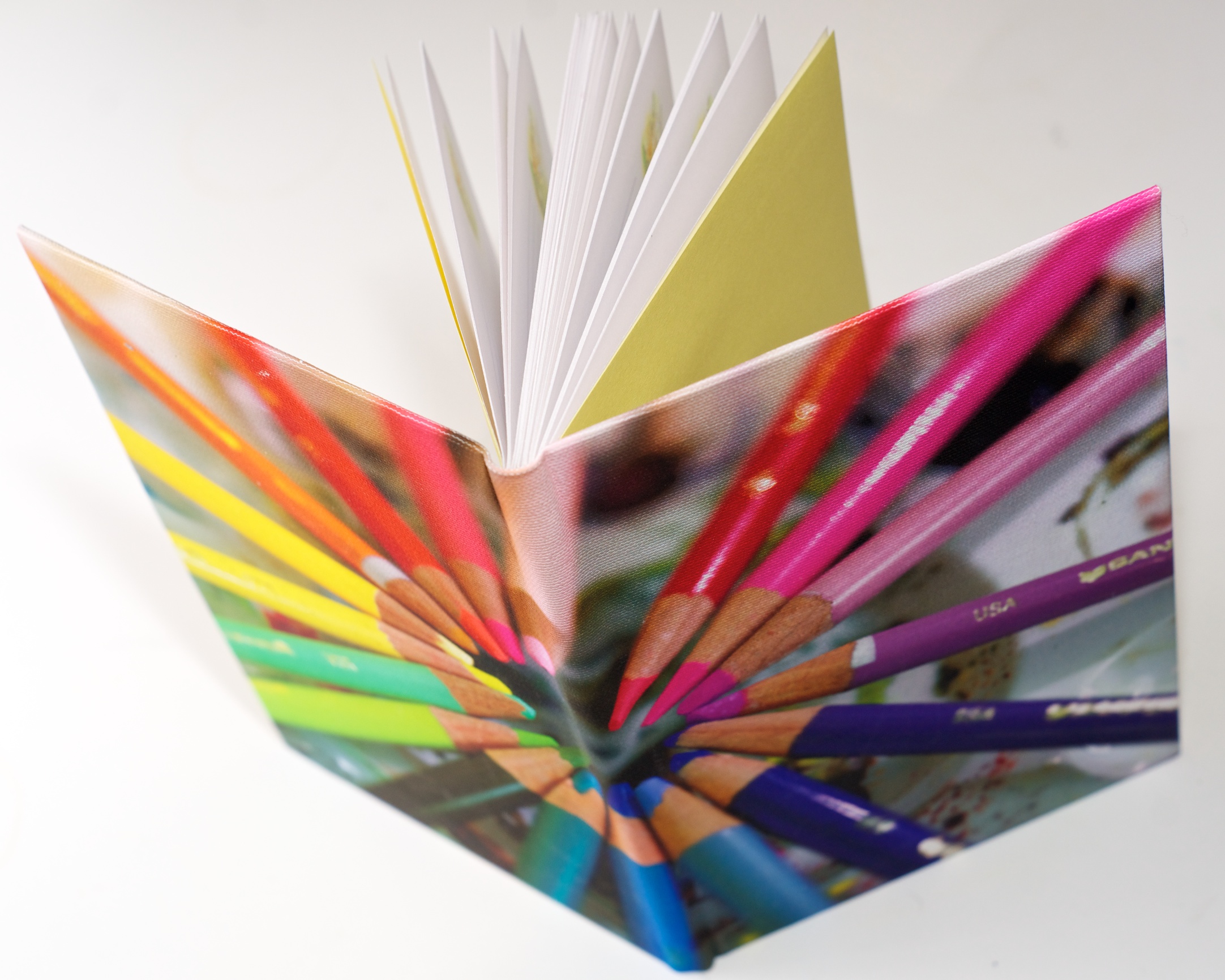
I recently did my first project printing to canvas. I then used this canvas to cover a book, shown below. This canvas is also designed to stretch over a frame like any canvas.

Any additional ideas on creative printing? There’s nothing better than using a tool on hand in a different way.