Tag Archives: sci fi

Book Review: Player of Games (Iain M. Banks 1988)

In this review, I avoid spoilers, but since nothing really happens in this book for about 100 pages, that means some of the things I mention do happen a good percentage into the book.

Rating: 2.5/5 stars

Iain M. Banks Culture series is renowned for its great far future space operas and artificial intelligences. I like space operas and I like artificial intelligences, so I picked Player of Games as one of Iain Banks well-rated books on amazon.

I almost didn’t make it through this book. The main character, Gurgeh, is a professional game player who lives in a wonderful castle on a wonderful world with other people who like games and parties. They live in the Culture, the future civilization of humans (and presumably others) that is mostly controlled by artificial intelligences.

We don’t start the book with the Culture, we start it with Gurgeh. Gurgeh (whose name kept reminding me of Gurgi from The Black Cauldron) is famous across the Culture for the fact he can play basically any game and almost always win. The entire first 75 pages are consumed by Gurgeh’s ennui and partying. I hated these 75 pages.

Then the book picks up. We get to see more of the Culture, and eventually a different civilization called the Azad. The Azad are a barbaric people whose society rotates around a game called Azad. The Culture sends Gurgeh to go play Azad against the Azad.

This isn’t a book for character development or sparkling prose, it’s a book with neat ideas. Azad is neat, the Culture is neat, and the interactions between the two lifestyles was neat. The drones are interesting. I liked the Azad planet Echronedal, which is always on fire.

I really enjoyed the last 200 pages of the book; it was full of fun and interesting things. I want to read more Culture books in the future. But I don’t want to read this one again and I would recommend it only with the caveats above. I didn’t find the posturing and sparring in games that I didn’t know and didn’t mean anything to the protagonist either. But obviously a lot of people loved this book and probably enjoyed the early game play.

The people who recommended Banks to me compared him to Vernor Vinge, whom I love. I can see why people would compare the two, but Player of Games didn’t stack against my favorite Vinge books. We’ll see what I think about future Culture books.
Book Review: Ancillary Justice (Ann Leckie 2013)

Note: in this review, I spoil nothing beyond the first few chapters or back cover blurb.

Rating: 4/5 stars

Ancillary Justice by Ann Leckie grabbed me quickly, with tight writing and careful and intriguing word choice. The winner of both the 2014 Hugo and the 2014 Nebula Awards, the most prestigious in sci-fi, it clearly had this effect on others. Only on page 3, we get the wonderful phrase “She was probably male”. The novel reminded me a lot of C. J. Cherryh’s Cyteen, with high space opera and sophisticated scheming. The protagonist, Breq, is a semi-human fragment of an artificial intelligence. I found Breq interesting in expression and nature, and she was easy to root for.

You will notice gender in this book. Breq is from the Radch Empire, where gender is not determinable from appearance nor is it important to try, and thus everyone, male or female, is referred to as “she”. Surprisingly, this totally achieved gender anonymity for me. In Ursula LeGuin’s The Left Hand of Darkness, all pronouns are male, which left me picturing every character as male even though some of them are physically ungendered. Perhaps because female doesn’t seem like the default pronoun, using “she” didn’t feel the same. We know that Breq is a female human and her companion Seivarden is a male human, but we don’t know the gender of most of the characters.

Unlike Left Hand, Ancillary Justice doesn’t dwell on gender. The Radch convention is what the characters use, unless they are speaking in another language, and that is that. We never find out why the Radch in particular ignore gender in a way that must have been a determined effort at that level. Have their sexual proclivities evolved with their language too? I wondered. In a way, not knowing answers to questions that had inspired such curiosity in me bothered me. But in a way, it was in keeping with the Radch Culture– gender wasn’t important there and it wasn’t important in the book, and it was my hang-up only that kept it there. Why did anyone’s gender matter to the story?

I suppose it’s strange to devote such a chunk of my review to something that the book doesn’t dwell on. But still, in the contexts of our language, it was a major choice on the part of Leckie. It makes my brain itch in such a delightful way.

The novel has several other nifty science fiction ideas. Breq’s current sentience versus her life as an AI is wonderful. Leckie uses music to characterize Breq in a way I really enjoyed. The Radch Empire is also pretty interesting, though it sounds obnoxious. They run around and brutally conquer and are filled with narcissistic oligarchs like Seivarden. The empire is run by several thousand clones of the same person, Anaander, who for some reason I kept on picturing as Edna Mode from The Incredibles, but that weird detail is almost certainly on me as a reader.

I ended up giving the book a 4/5, though I still debate myself over the rating. A book that I read in a day and a half because I was so enthralled, a book that still has me thinking a week later should be a 5/5. But I felt like the book didn’t quite come together for me at the end, like it was all sweetness and no substance. I didn’t ever feel uncomfortable or uncertain as to the outcome. That said, I would read it again, and recommend it to others. Read it yourself and see what you think.

The slow and steady

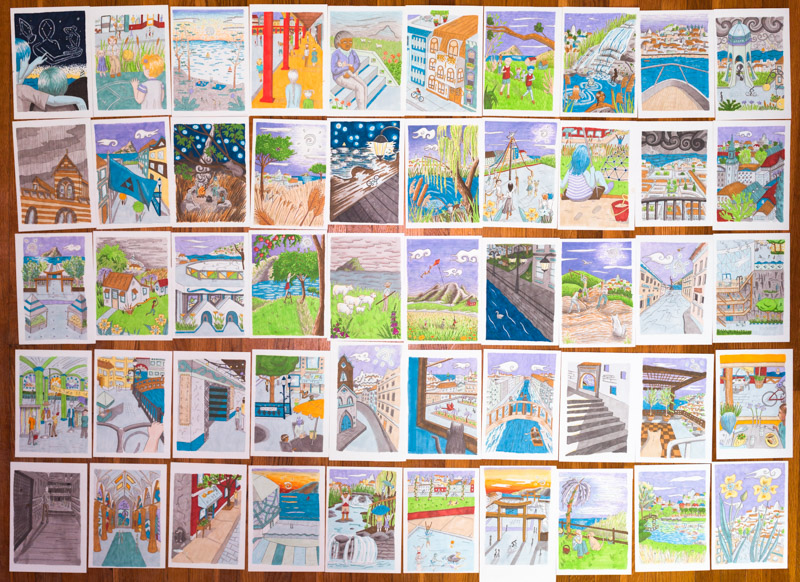
Over six months ago, I challenged myself to do 100 illustrations of my city of Vironevaeh, the fictitious city that is the unspellable namesake of this website. I would build my world in myriad ways, practice art, and create some beautiful scenes. On Thursday, I finished the fiftieth color image. I have images of city streets, markets, pets, agriculture, constellations, architecture, pastimes, clothing, family, and weather.

50-74


Eventually, I will have descriptions for each of them, and a place on the map. Eventually there will be at least 50 more. It’s a lot of work to do for something that probably won’t mean much to anyone besides me. But Vironevaeh is a city at my side for over 17 years, and it will mean a lot to me. I am so pleased with my progress. Here are a couple of my favorites:

006-small

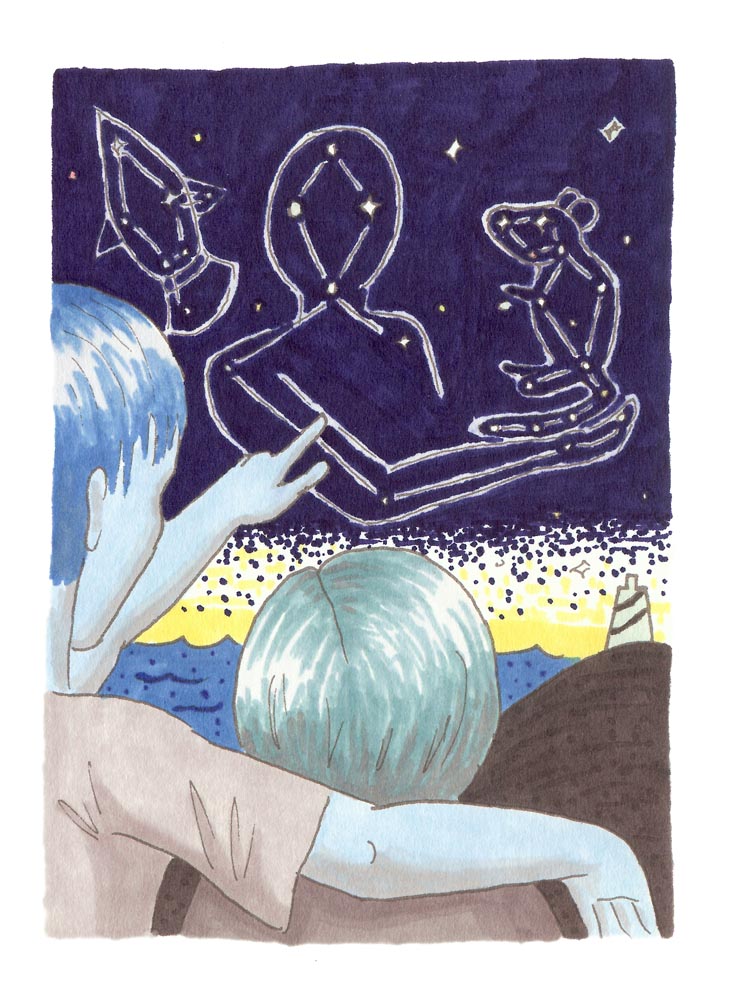
A man showing a child constellations in the sky. These constellations are of Abenn the hermit and Peep the mouse, who hid away on Neva the spaceship. These legendary figures are the subject of my recent and free fairy tale The Lonely Man on the Ship. Sharp eyes may note that the people here are blue and green.

008-small


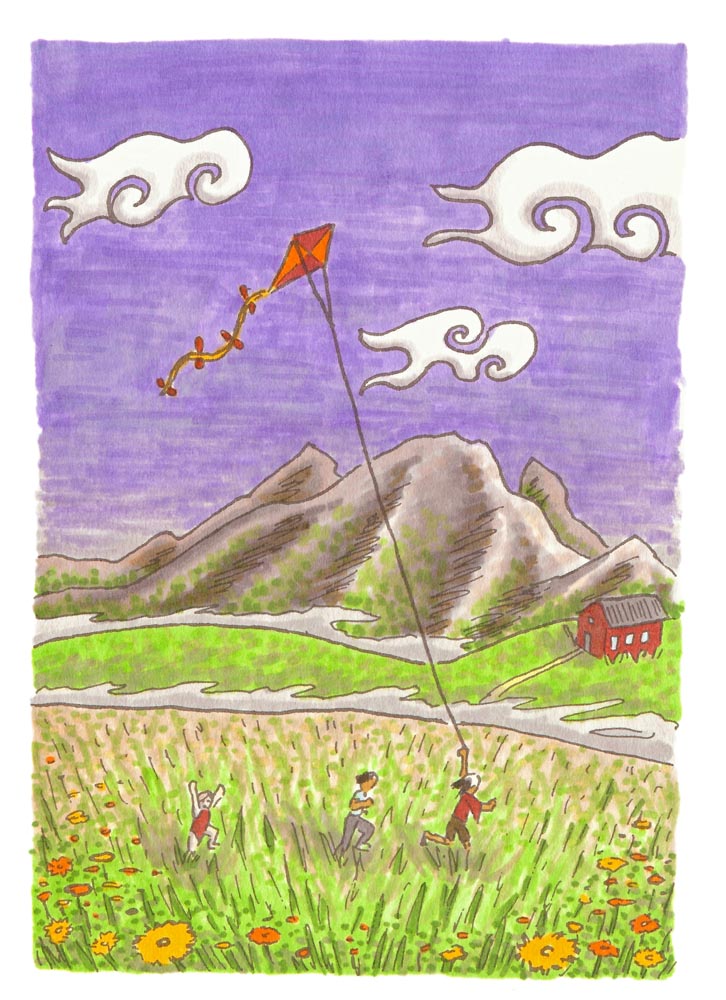
Children running with a kite in the countryside. A pretty typical scene even here on Earth, except for the lovely purple Vironevaehn sky. Also the fact the fog in the valleys behind them could be brain-eating. All in normal day!

Soon I’ll bind up a little fun book of my favorite ten illustrations, but for now, I’m basking. Onto the next milestone!

Another Fairy Tale at last


When I released my collection of science fiction fairy tales, it was the start of a push to creatively engage with the world. I finally finished a project and put it out there, doubtless non-perfect like everything. Since then, I’ve submitted my short works nearly 90 times (with 3 acceptances). I’ve joined a writing group and participated in critiquing groups to work on my writing. I’ve studied Adobe’s Photoshop and illustrator, and recently painting, to improve my artistic skills. I’ve studied Indesign and book layout. I started posting regularly on this site, as I have for nearly two years now. The first set of fairy tales started all of this self-improvement.

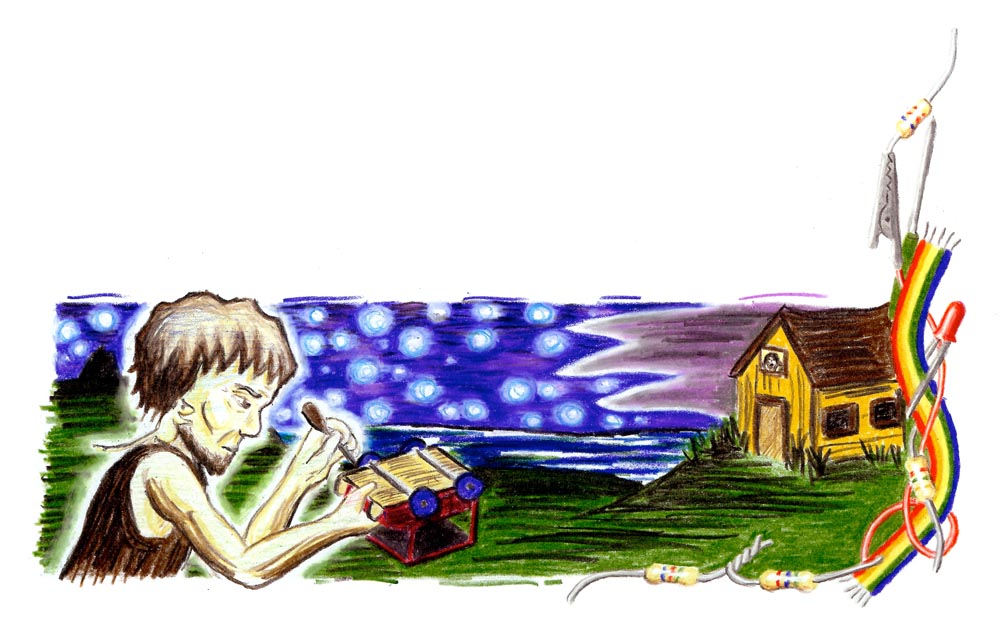
I always intended to do another collection of fairy tales. I recently finished the first story, “The Lonely Man on the Ship”, about a man trapped alone for years on a spaceship during  terrible storms. I did the art with Prismacolor color pencils (which I intend to use for the rest of the eventual collection).

Now I’m coding the fairy tale for the kindle. Once I do, “The Lonely Man on the Ship” will be available free on the kindle and on the iPad. Much of the last two years’ studies has gone into this work. I used Indesign and illustrator for layout work. I used Photoshop to make sure my scanned art work was as attractive as possible. I think the writing is stronger than in the first fairy tales. As the first fairy tales inspired new studies, to release this work properly I’m learning CSS and HTML coding.

So until I finish this last step, enjoy a couple of illustrations!

abenn_ghost-small letterhead-small

Writing prompt: add a cat to an existing universe

Time: 7 minutes. Click here to go to my list of prompts.

“Add a cat to an existing universe”

When the Founders left Earth, they brought a variety of animals, kept in suspended animation, for the founding of their eventual colony. Sheep, cows, horses, pigs, all the big animals that civilization used to get started, along with some smaller ones like chickens and dogs. The only animal out of suspension was Andine Kenda’s black cat Nyx. It prowled the hallways of the Neva, and it was clear that it owned that ship more than anyone.

The cat lived with Andine after Founding—in the city at first, and in Mt. Vit during the rains. After Andine was killed, she was taken back to the Neva, which then went to Naenia. Nyx refused to get off the ship on Naenia, and lived out her remaining 5 years as the terrifying spook of the ship. Stories recount engineers repairing parts of the ship encountering the black beast, and with the scratches to prove it.

Eventually all creatures slow, though. Her body was found, curled up as though sleeping, outside the room that was once Andine’s. In Vironeaveh, black cats are creatures of wonder and energy. On Naenia, they’re little demons that bring you bad luck.

(Just got back from vacation and with a cold, so this one was a struggle. But if I write now, I can always write, and that’s important!)

Writing prompt: invasive species

Time: 7 minutes. Click here to go to my list of prompts.

“Invasive species”

Years ago, I watched time-lapse photography of plants growing. Plants move and respond to stimuli and avoid pain like animals, the narrator said. They just do it on a different time scale. That documentary made me wonder what the world seems like to a plant.

Reading the news the other day, that documentary came to mind. The tenta plant has been making its way up from Mexico. Here in the Shenandoah we knew we’d be safe; we have winters here after all. Plants adapt over time, but winter is a mighty thing.

Somehow, the tenta adapts faster. Scientists are fascinated by it the way they always are by hazardous things, like a kitten with a grenade. Some have compared it to reverse transcription viruses like HIV, somehow it has some ability to incorporate genetic attributes of other plants. Surrounded by winter-hardy plants, ten thousand of these plants could try ten thousand combinations.

There are indications of new traits to the plant, as it grows further into more densely settled regions. It was never an irritant like poison ivy, but now it is. Some have nettles.

I remember watching those vines frantically reach toward the light, in some way we can’t understand knowing and feeling what they wanted. Or the ficus tree, slowly growing the life out of its host. I couldn’t help but wonder if the tenta plant had such an awareness to accompany its novel new ability, and what that might hold for the future.

Writing prompt: world build for an in-progress work

Time: 7 minutes. Click here to go to my list of prompts. This prompt is related to the prompt “a door that goes anywhere“.

“World-build for an in-progress work, specifically for a magic system”

The main character’s parents have a door that goes anywhere. Through his childhood, the character didn’t know about this door, and he only found out about it by accident when he did. His parents are unhappy about him finding out. They didn’t want him to know because they didn’t want him to follow their footsteps and do what they did.

The door can go anywhere. The parents use this to gather scarce and special materials from all corners of the planet for special paintings that have magical properties. A portrait of a person with the right ingredients can improve their health or maybe their fertility. A different portrait can sabotage their health, or make the stressed or unlucky. Without the door, obtaining the right materials in the right purities would be nearly impossible, but it’s still quite hard as you must have been to the location before. The parents apprenticed to learn these locations and materials.

Naturally enough, there are people who use the paintings to control and harm people, and people who use the paintings to help and enrich people, and these two groups don’t like each other. The character’s parents are the nice group, but each group works hard to maintain the secrecy of their identity, since then the opposition could paint a portrait of them.

The paintings need not be only portraits. A painting of a volcano with the right ingredients might increase the likelihood of an eruption or a painting of a plane with the right ingredients might increase the likelihood of a smooth flight. A painting of locusts could either increase or decrease the likelihood of destruction by them.

The parents don’t want the character participating because the good side has been losing, and their own health has been sabotaged. The bad side has a sense of honor, and doesn’t generally attack unaffiliated people, but if the character were to become involved, his health and safety would be vulnerable.

Writing prompt: Lie detector

Time: 7 minutes. Click here to go to my list of prompts.

“Lie detector”

Blood flows in the face indicate certain emotions. Rage is one pattern, confusion another, fear (perhaps of getting caught in a lie) yet another. Some cameras could detect subtle changes in face color from the blood flow, but better yet were cameras that reached into the infrared, to see the heat of that blood flow.

Trish first loved the science of this technology, but after she was denied tenure for lacking funding, she found a new purpose to it. Business.

With google glasses so common as they were, it wasn’t much of a trick to fit hers out with the additional infrared range camera and write the code to show the blood flows overlaid upon their face. She became a human lie detector, able to fox out the lies and bluffs of all but the sociopathic (who incidentally had their own telltale patterns). Perhaps the preponderance of the sociopathic shouldn’t have come as a surprise, but it did.

Still, the funding came in now, and she started up a company. Not with her own special technology, of course. It was her ticket to a bright future. Some other good but less phenomenal idea.

That was, until the meeting with Ms. Teller, who seemed oddly apt at dissecting Trish’s own lies and sidesteps. Reading up on her, Trish discovered Teller’s background in pattern processing and optics. Suddenly, the marketplace had grown just a little more crowded.

To Trish, the solution was obvious—she had to destroy Teller or join with her.

Writing prompt: A door that goes anywhere

Time: 10 minutes. Click here to go to my list of prompts.

“You discover a door in your house/apartment that will lead to any door in the world that you want it to.” (I found this writing prompt through the Reddit Writing Prompts sub forum. Check it out for hundred of writing prompts on all kinds of topics, including this one.)

It was strange coming back to my childhood home after so many years, but probably not so strange as living with my parents after I’d gone forth into the world, expecting my obvious greatness to be recognized. Instead, I was 30, in debt, and back with the folks in rural Missouri. It was humiliating. What I wouldn’t give to be back in Belgium at the chocolate shop or in New York in central park. But most of all, I thought, I’d like to be away from people—Moab. But I didn’t have money, so these thoughts stayed dreams.

In the five years since I’d returned home, mom had redone the kitchen and redecorated my bedroom into a hobby room and dad had given away a good portion of my toys to cousins kids. I don’t think they were thrilled to have me back either. The heavy bookcases of the living room were gone, and I realized I’d never seen that wall. The old wallpaper behind where they had stood was brighter, showing their outline.

Hold on, I thought to myself, noticing another line in the wallpaper. I went closer. It was a seam in the paper, about 7 feet high and 3 feet wide. A door? There was a dent at about the right place for a handle. I pushed, tentatively at first, but when I felt give, I pushed harder.

The door popped open. Moab’s grand orange arch stood in front of me, the blazing hot and dry summer air pouring through the door. I stood and gawked, and several dozen tourists turned and snapped my picture, looking delighted. I pulled the door shut with a slam. Why was there a door to Moab in my childhood home?

The whole front of my body still seared. I could feel the beads of sweat form, half from apprehension I think. I pushed the door open again, bracing myself for the heat. Instead, a rocky coast full of fog and mist stretched before me. Canon Beach in Oregon. The air was refreshingly cool, and then it occurred to me that the door was taking me where I wanted to go. I closed the door.

“Prague, Wenceslas Square,” I said, and opened it again. The square stretched before me, with tinges of twilight falling over it and the National Museum and the Jan Palach memorial. I shut the door again.

“Gabriel, what are you doing in there?” My mother rushed in. “Get away from that wall!”

Happy 17th Anniversary, Vironevaeh!

Tomorrow is April 15th, 17 years since I did a project about a city named Vironevaeh, chock full of V’s and vowels, because why not? Somehow it never went away, and seventeen years later, it’s hard to imagine life without it. When people ask me what color the sky is in my world, I say purple; it used to be turquoise, but I thought that a white sun was more likely to diffract into the purple frequency range. That’s… usually where those conversations end.

Since the 16th anniversary, I’ve earned my PhD. I’ve started another Vironevaehn history project, and I’ve published my first story set in the Vironevaehn universe. I’ve written drafts for two different novels set in the universe.

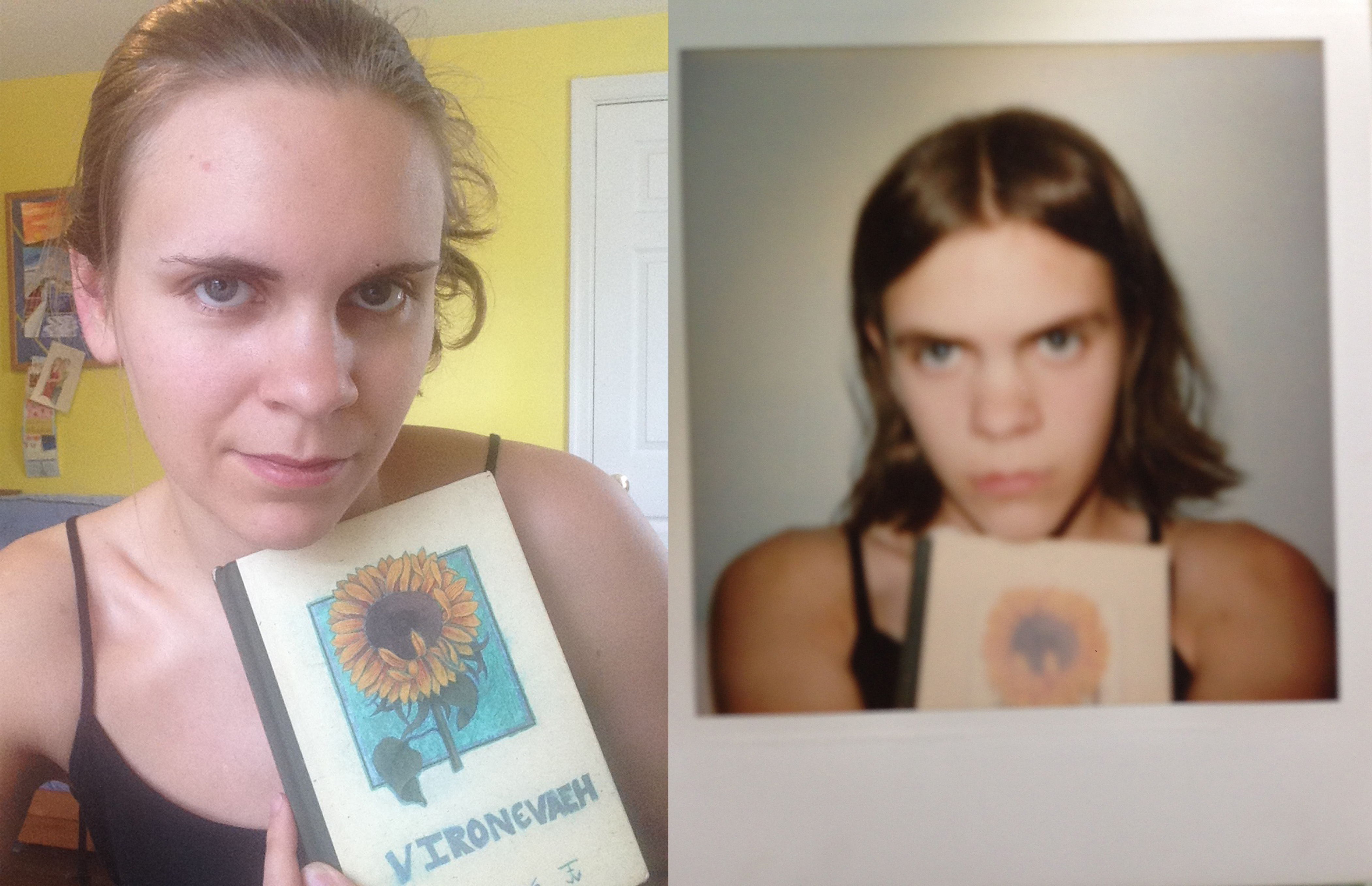
But today, I thought I’d post a blast from years farther past. In 8th grade, I wrote my first Vironevaehn book. It was just by hand, and without much planning or forethought, half of it scribbled down during orchestra while my friends patiently ignored my rantings. But I filled a whole notebook with it. 14 years later, that book is one of my most valued possessions. Here I am with it today, and there I was with it 14 years ago, in a Polaroid taken as just another offhand idea.

comparison


Create something today, even if it’s silly. The only folly is not trying.