Tag Archives: science

Science and Cooking

I love to cook. As one might gather from this blog, I like to keep my hands busy, and cooking saves money and provides deliciousness. (Many other hobbies have more of a knack for consuming money.) I also happen to be very lactose-intolerant, so cooking for myself also greatly benefits my digestive health.

When I was younger, I was absolutely apathetic to cooking, as I suspect many kids are, feeling that it’s house-wifely and unimportant. Then I got out on my own, and, astonishingly, good food was expensive and I had little currency.  I wanted to improve my cooking, but I really didn’t know the rules. But I knew the next best thing: science. Many recently published books explore the relationship between science and cooking. For those of us that can’t remember the baking soda without knowing its chemical purpose, this is a great thing.

Some recommended books:

  • What Einstein Told his Cook by Robert Wolke. The content is good, especially for those less versed in chemistry. The author wrote a newspaper column about cooking, and this book is mostly the compilation of answers to various questions such as “What is the difference between cane sugar and beet sugar?” It contains several recipes illustrating various points of the book. A major emphasis of the book is clarifying common misunderstandings of food science. As someone who knows a lot of science, I sometimes find the answers too basic, but I definitely learned things reading this book.
  • Molecular Gastronomy: Exploring the Science of Flavor by Herve This. Of the three books I discuss, this is the one I have had the least time to scrutinize. However, I really like what I have read. Wolke’s book covers more conceptual topics, like the differences between various kinds of salts. This’s book covers more specific topics, like why we marinade roasts in red wine rather than white, or how different kinds of truffles are related. This one is probably most strictly for those interested in cooking, with fewer “gee whiz” moments and more “that would be useful” moments.
  • Cooking for Geeks: Real science, great hacks, and good food by Jeff Potter. This one is definitely the most fun of the three! This book is from the publisher O’Reilly, which does a lot of technical textbooks. This book shares its layout with those kinds of book, but its soul is lighter. Its layout is more varied, as textbooks are. Plus, this book has a fun section about hardware like evaporators and sous vide water baths. Sous vide is involves cooking foods in circulating water baths. It is similar to slow-cooking, but the food is kept in a plastic bag and thus not diluted. Foods can safely and extra-deliciously be cooked at much lower temperatures by this method. Low temperatures denature specific proteins, prevent drying, and, when held for a bit, kill bacteria. This book does a great job explaining why and how sous vide works. I just got a sous vide system myself, and this book has given me some confidence about something I knew very little about. Plus it’s very fun to read, and covers tons of other topics in geek-friendly ways.

Science is Creative!

In the US, science is regarded as valuable, but dry and a bit stiff. As a student, it’s easy to get this impression, studying rigid facts first explored centuries ago. The math, chemistry, physics, and biology we learn in high school and college are about recreating long-known answers by well-established methods. But the process of making new science and math is inherently creative, and new ideas require letting the mind run wild a little. In this post, I’ll talk about how I develop my ideas.

I work with populations of oscillators. The idea of this research is that the complexity of the whole (the population) exceeds the complexity of each element (the oscillator). The human brain is a good example of such a system–each neuron is fairly simple and well-understood, but overall brain behavior arising from the interactions of many neurons is not understood. My research tends to work by observation–I notice something I find interesting and I explore that further. Other researchers work on what they suspect they will find, based upon other work. All research works within the context of its field. There are many interesting behaviors I have noted in my experiments, but I explore the ones I might explain. Really random observations are cool, but hard to frame in a way which is meaningful to the community.

The above may not sound particularly creative. But the key to experiments like I do is imagining what might happen when one explores slightly beyond what is known. It requires extrapolating from the areas we know, in the context of the rules we know, to the areas we don’t know. Some of the rules we know are pretty absolute, like thermodynamics, but others may be flexible. (As a note on this point, the stable chemical oscillations I study were once considered thermodynamically impossible. Someone had to bend the established understanding of thermodynamics to explain these oscillations. Einstein had to bend Newton’s Laws for relativity, and he arrived at that conclusion by logic rather than by observation.) In an experimental apparatus like mine, thousands of experiments are possible. It is up to the experimentalist to pick from the possibilities, in the context of what might work in his imagination, to demonstrate something hitherto unknown.

In some ways, the process is similar to writing. There are rules that must be obeyed, and the process of finding something new or interesting is very indirect. With science and writing, I develop some of my best ideas drinking a beer or taking a walk. Sitting at a desk focusing is required at times, but so too is active contemplation. The rules of science are broader and more rigid and take longer to learn, but there are similarities.

A lot of historical scientists were fascinating people, akin to historical artists. Van Gogh got his ear cut off in a fight. Astronomer Tycho Brahe lost his nose in a duel. Salvador Dali shellacked his hair. Electrical engineer Nikola Tesla fell in love with a pigeon. Mathematician Paul Erdos lived itinerantly for decades. In one visit to a colleague, he couldn’t figure out how to open a carton of juice, so he instead stabbed it open (among many, many other oddities). Physicist Richard Feynman used to work on his physics at strip clubs. Artists may share their eccentricities more in their works, but I would argue that scientists have every bit as much oddness.

I hope this post illustrates a little what it is like to be a research scientist, and how science at the cutting edge works. For more science posts, check out my fun science list.

Book Review: The Invention of Everything Else (Samantha Hunt 2008)

There are no spoilers in this review beyond what you’d find in the first few chapters or the cover blurb.

Rating: 5/5

I absolutely adored “The Invention of Everything Else”. I’ve always meant to read more histories and biographies than I do, but sometimes they can be dry. This book, in many ways, is a fictional biography of Tesla, a famously eccentric inventor who first pioneered AC electricity and radio. To learn more about Tesla, check out this awesome Oatmeal cartoon, which has a lot more detail than I’ll include here. The book also has rich and lovely descriptions about historic New York City. And most of all, this book is a romance of eccentric people, whom I feel get far less respect than they deserve. The characters are pigeon-enthusiasts and hoarders and dreamers and inventors.

The book opens with Tesla as a very old man, broke and largely forgotten. He was a brilliant inventor, but not a businessman like Edison. He lives in a dreamlike state, remembering past glories and failures, and seeking his beloved white pigeon (see the Oatmeal cartoon). The other main character of the story is Louisa, a young vibrant woman who works at Tesla’s hotel. She likes to listen to radio dramas and to study people, so she is naturally fascinated by Tesla. Over the book, we learn a lot about Tesla and Louisa as they orbit one another.

The language of this book is wonderful. The descriptive passages evoked touchable images in my head although the descriptions were fairly brief. I could imagine being in bygone New York, and the distractions and wonders of the characters in that setting. The dirtiness of it, and the perpetual motion of it. Here is a quote from the first chapter that captures some of the loveliness of the language:

“Drawer #42. It sticks and creaks with the weather. This is the drawer where I once thought I’d keep all my best ideas. It contains only some cracked peanut shells. It is too dangerous to write my best ideas down. ‘Whoops. Wrong drawer. Whoops.’ I repeat the word. It’s one of my favorites. If it were possible I’d store ‘Whoops’ in the safe by my bed, along with ‘OK’ and ‘Sure thing’ and the documents that prove that I am officially an American citizen.”

If you are a lover of hard science fiction, this one might not be for you. The genre of this book is subtle, with the fantasy element of dreaming maybe most prominent. It seemed like every character in this book took a jump off of something, imagining they could fly. But if you love characters and setting and eccentricity, then you should like it. I loved it, and I really recommend it.

Fun Science: Gravitational waves

Gravitational waves were first predicted in 1916 by Einstein’s general theory of relativity; today we are trying to directly observe them. A gravitational wave is a tiny oscillation in the fabric of space-time that travels at the speed of light; all other findings from general relativity predict its existence. Many objects will create minuscule gravitational waves, and even the largest objects create ones we just barely hope to see (such as binary stars and black holes). From the LIGO wikipedia page “gravitational waves that originate tens of millions of light years from Earth are expected to distort the 4 kilometer mirror spacing by about 10−18 m, less than one-thousandth the charge diameter of a proton.”

What would we gain from this? Astronomers believe that gravitational waves could eventually become another mode of imaging by which to analyze the universe, like gamma ray, x-ray, and infrared imaging.

Example of gravitational wave distortions (from wikipedia)

The LIGO (Laser interferometer gravitational-wave observatory) ran from 2002 to 2010; it was unsuccessful in its hunt for gravitational waves. It is being recalibrated to restart in 2014. The two observatories in Louisiana and Richland, Washington record the same events and compare the time at which they arrive. Below is a schematic of this set-up. LISA, the laser interferometer space array, has been discussed for years as an orbiting detector with greater length scales (and therefore greater accuracy) than LIGO; a proof-of-concept is due for launch in 2014.

Laser interferometer set-up (wikipedia)

If you want to learn more, Einstein Online, which is run by the Max Planck Institute, is a great resource (the Max Planck Institute is involved in great cutting edge research, perhaps comparable to NASA). The above link is for info on gravitational waves, but there is also great info on other concepts related to relativity if you are interested.

Fun Science: Enzymes

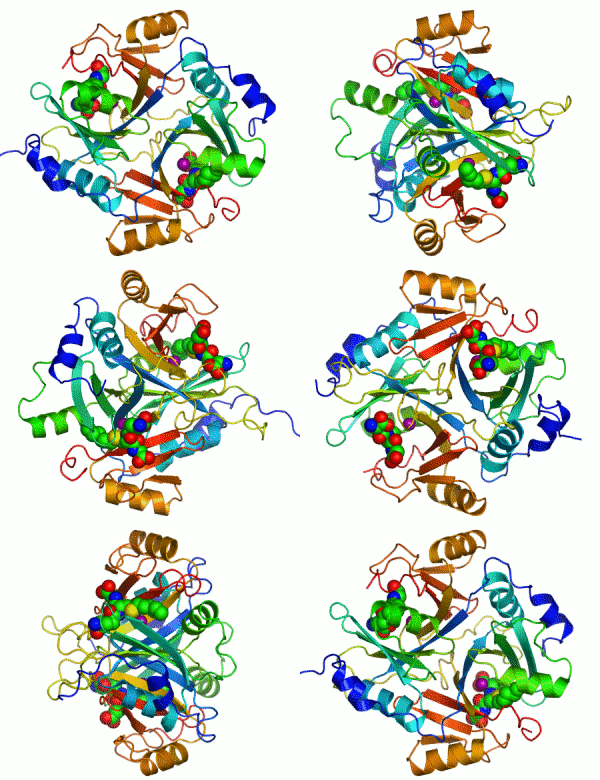
An enzyme. Spirals and sheets and strands indicate different kinds of structures. (from Wikipedia)

Enzymes are the catalysts of the body, helping to facilitate chemical reactions that would be very slow or unfavorable in their absence. In a previous post, I discussed how platinum lowers the activation energy barrier for desirable chemical reactions in a car engine, among other places. Enzymes do the same thing, but they are much more selective. Platinum can act on millions of molecules. Enzymes are shaped so specifically that they act only on one molecule. Because of this, enzyme catalysis is often compared to a lock and key–only one chemical is so perfectly shaped as to fit into the active site of the enzyme.

Enzymes are mostly proteins, which are made of hundreds of amino acids with several layers of structure. Our DNA is coded so that enzymes can be assembled from the instructions. The “primary structure” is the sequence of amino acids strung together. The shape of local groups of amino acids gives the “secondary structure”; some combinations tend to coil, others tend to be flat (see the picture at the top of this post). This is due to interactions between the amino acid groups; for example, ionic groups might attract or repel each other. The “tertiary structure” is the structure of the overall molecule, also called the “folding”. We can reproduce the primary and secondary structures in the lab; the folding is harder, because for most sequences of amino acids, there are several possible structures. In the body, the protein is assembled in such a way that it conforms properly. We are mostly still unable to synthesize proteins and enzymes. We usually use bacteria and fungi to make them, when possible.

Enzymes are essential to life. They aid in digestion. Many diseases are caused by the lack of a single enzyme. People with lactose intolerance lack lactase; the deadly Tay-Sachs disease is caused by the lack of hexosaminidase A. In Tay-Sachs, a waste product of cellular metabolism builds up in the brain. Without the enzyme to accelerate its break-down, the waste product builds up to intolerable levels. We can obtain hexosaminidase A, but we can’t therapeutically deliver it to where it is needed in the brain.

You probably already knew that the human body is a remarkable machine. But I hope this brief overview of enzymes gives an appreciation for this one small aspect. Happy digesting.

Fun Science: The Element Lithium

Lithium is the third element on the periodic table, after hydrogen and helium. It is the lightest metal, and you probably use it every day. The batteries in your phones and laptops and most rechargeable batteries you use are lithium ion batteries.

Lithium is used in batteries because it has the highest electrochemical potential of any element. It is so high that it will split water into hydrogen and oxygen (and violently!). This means there is a lot of energy available to exploit. This is also why laptop batteries can sometimes explode; the batteries are sealed very tightly, but if the seal is broken, air and water vapor will come in contact with the lithium and this is unsafe. 10-15 years ago, there weren’t as many lithium batteries in use, but now they are everywhere. Science has made great strides in improving the configurations of the batteries to give more energy, such as increasing the surface area of the lithium portion. Each time you cycle your battery, the lithium undergoes an electrochemical reaction on the draining and again on the charging of the battery. This is also why batteries become shorter lived over time; the high surface areas of new batteries aren’t thermodynamically favorable, and the lithium will become lower surface area with time. Less available surface area means less available energy.

Lithium ion (Li+) has another, very different use. It is used as a mood stabilizer. It is particularly useful at combatting mania. The linked wikipedia page contains its fascinating medical history. It was first used in the 1870’s as a mood stabilizer. Eventually LiCl was marketed as an alternative to table salt (NaCl), to avoid high blood pressure, and its mood properties were forgotten. Early versions of 7 Up contained lithium. Excessive lithium use was found to be deadly, and it was banned as an additive in the 1940s. Then in Australia, it was again discovered to have mood-stabilizing properties. Its therapeutic dose is quite close to its toxic dose, which is maybe why it took a while to gain approval in the US. Studies suggest that water supplies containing lithium may promote longevity and reduce the occurrence of suicide.

Lithium salts also have another really nifty use: cleansing the air in spaceships and submarines.  Not only does human breathing consume oxygen; it also produces carbon dioxide, which is toxic when present in high amounts. Several lithium salts can remove carbon dioxide from the air. One even adds oxygen to the air when it removes carbon dioxide.

Elemental lithium is highly reactive, and is a member of the alkali metal group (all of whom react very impressively with water). Below is a video of lithium reacting with water. It bursts into bright red flame:

Another video shows more lithium action:

The people who made the second video have a great youtube channel with videos about all the elements done in a university laboratory environment. Most of them have good footage of reactions as well. I just spent an hour watching their videos, they are very entertaining for people with little knowledge, or a lot. If you have a little time to kill, the videos of sodium and potassium are also good, flammable fun.

Interesting facts: 50-75

Today I post interesting facts 51-75. These last weeks have been incredibly intense, and it’s been tough meeting my 100 fact challenge celebrating reaching 100 posts. I will follow with the last 25 later this week or next Monday. The blog has had to take a backseat to work and to my book writing efforts; I will hit 70,000 words tomorrow and I am closing in on the finish. And without further ado, more facts!


51. Earth’s magnetic poles switch every few hundred thousand years, as a result of natural movements in iron in the crust. I wondered how this might affect migratory species using magnetic senses, but there isn’t enough evidence from the last switch 41,000 years ago to tell.

52. The creator of Kellogg’s cornflakes was at war with sexuality. The cornflakes were a part of this, as an unstimulating food. He was a strong advocate against masturbation– advocating circumcision and application of acid to the genitals.

53. Left-handed people are at a higher risk for numerous ailments, including schizophrenia, ADHD, and depression. I am what they call mixed-handed– I do some tasks with my right hand (writing), and some with the other (sports).

54. Eta Carinae is sometimes one of the brightest stars in the sky, and sometimes not. It is a system including a luminous blue variable, which grows a coat of obscuring gas, and then periodically blasts it off. In 1843, it was the second brightest object in the sky. It currently cannot be seen with the naked eye.

55. George Washington did not have wooden teeth. His dentures were made of gold, hippopotamus ivory, lead, and human and animal teeth (including horse and donkey teeth).

56. Goldfish actually have memories of about three months. As anyone who ever owned a goldfish should know.

57. Alfred Tennyson was troubled and interested by the science of his time. Themes about evolution and references to the contemporary phrase “ontogeny recapitulates phylogeny” (a since debunked scientific concept which claims an organism develops in vitro according to its phylum order) can be found in his poetry, specially In Memoriam.

58. Water-induced wrinkles are not caused by the skin absorbing water and swelling. They are caused by the autonomic nervous system, which triggers localized vasoconstriction in response to wet skin, yielding a wrinkled appearance. This may have evolved because it gives ancestral primates a better grip in slippery, wet environments.

59. Eating nuts, popcorn, or seeds does not increase the risk of diverticulitis.These foods may actually have a protective effect.

60. The Coriolis effect does not determine the direction that water rotates in a bathtub drain or a flushing toilet. The Coriolis effect induced by the Earth’s daily rotation is too small to affect the direction of water in a typical bathtub drain. The effect becomes significant and noticeable only at large scales, such as in weather systems or oceanic currents. Other forces dominate the dynamics of water in drains.

61. Abner Doubleday did not invent baseball.

62. Nikola Tesla was a badass scientist. Thomas Edison isn’t as great as you thought. Tesla pioneered AC current distribution and the lightbulb. Edison stole ideas from Tesla and attempted to undermine him to increase his own profits.

63. Paul Erdös wrote over 1500 math papers. If you’ve heard of six degrees of Kevin Bacon, this was originally known as the Erdös number, the number of degrees of separation from publishing a paper with Erdös. He was very eccentric. For years, he lived out of his suitcase, traveling across the world and collaborating on papers. He didn’t know how to open juice containers and used amphetamines to give him energy. His epitaph was “I’ve finally stopped getting dumber.”

64. Catherine the Great was the longest-ruling female monarch in Russian history. She was actually prussian, and married Peter the Great’s grandson. She probably conspired in his assassination, and took the throne. Her son changed Peter the Great’s succession laws to exclude women from rule.

65. Marie Curie was the first woman to win a nobel prize, and the only person to win in multiple sciences. She discovered polonium and radium and x-rays. She used x-rays to help diagnose injuries in WW1. She eventually died due to radiation-related illness.

66. Ramanujan was an indian-born mathematical genius. With little formal instruction, he devised many theorems that are still being incorporated into mathematical theory. He died at 32.

67. Michael Faraday was a pioneering scientist in electromagnetism, although he also received little formal education. He discovered benzene, and discovered the relationship between light and magnetism. He knew little math beyond trigonometry. The unit of capacitance, Farad, is named after him, as well as numerous constants and devices.

68. the symbol pi, π, originally referred to the perimeter of a circle. only in 1706 was it used to mean the ratio of perimeter to diameter.

69. James Tiptree Jr., a prominent science fiction writer, was actually a woman. She wrote under the pseudonym for two decades until she killed her husband and then herself.

70. In the early years of the Soviet Union, a type of genetics besides Mendelian genetics became accepted as correct, known as Lysenkoism. In Lysenkoism, the way you raised a crop determined its outcome, not the type of seed. Widespread starvation occurred in the Soviet five-year plans, partially due to Lysenkoism.

71. There are over 20,000 species of orchids, or four times the number of mammalian species. Many of them are epiphytes, meaning they grow above the ground in tree-borne habitats.

72. East germans could only buy Trabant cars. Used Trabants were more expensive than new ones, because the waiting line was shorter.

73. A girl in Sweden survived her body temperature dropping to 55 F (13 C) in 2010.

74. Hypothermia is highly correlated to age. Older people suffer hypothermia at a much higher rate.

75. The Cape Hatteras lighthouse is the tallest base to tip lighthouse in the United States. Due to shore encroachment, it was moved in 1999. Its light can be seen 20 miles out to sea.

100 posts, 100 fun facts

This list making business is slow stuff, and too interesting, so I decided to split it into two 50-fact posts. Happy memorial day, and happy 100 posts to me! Here are your first 50 factoids!

1. People from different cultures differ in what colors they perceive. As a simple example, english speakers deem pink as a different color than red. Russian speakers don’t, but they have a fundamentally different word for dark and light blue. In chinese, red and pink are red and pastel red, and likewise with blue.

2. Corrosion occurs preferentially where you can’t see it, such as under the head of a bolt or a foot or two under sea water. This is due to small concentration differences which cause a charge differential, which leads to corrosion. This is one reason trying to detect corrosion is very hard.

3. The biggest silicon wafers made are 45 cm or 17.7″, though they aren’t yet in production. The silicon is 99.9999999% pure, and monocrystaline.

4. Glass doesn’t have a set crystal structure; this is why it can cut so badly, because shards can be arbitrarily sharp. Auto glass is laminated with plastic to help hold it in place.

5. Many of the scenes in engineering in “Star Trek” and “Star Trek: Into Darkness” are filmed at the Anheuser-Busch brewery in Los Angeles. Look for the green labels reading “VF##”– these are vertical fermenters. In another part of the movie, Chekhov slides past some really shiny tanks on a red floor– these are horizontal fermenters. I used to work at an AB brewery, so I got really excited when I first noticed this.

6. A neutron star is so-called because all the electrons and protons are forced by immense gravitational pressure to combine. The whole star is nearly as dense as a nucleus, or 5.9×10^14 times denser than water. This is equivalent to the weight of a 747 in the space of a grain of sand.

7. Have you ever tried dividing by zero on a calculator? A black hole is remarkably similar to dividing by zero in space.

8. Near a black hole, forces called “tidal forces” (which are felt everywhere, but are crazy strong near a black hole) can be very strong over short distances, ripping anything apart. This is called “spaghettification” (no joke).

9.  After the death of Ivan the Terrible in Russia, three men claimed to be his lost son, Dimitri. They are collectively referred to as the false Dimitris. The first successfully became Czar for ten months, after which his was killed and cremated. His ashes were loaded into a cannon and shot towards Poland, as he was believed to be a Polish spy.

10. The word “defenestration” means “the act of being thrown from a window”. The need for such a word was precipitated by two such events in Prague.

11. The 1904 World’s Fair and Olympics were held in St. Louis. In the marathon, the man who finished first hitched a ride in a car, one favorite made himself sick eating apples, and another favorite was run off course by an angry dog.

12. Toasted ravioli, or breaded deep-fried ravioli, are a culinary delight in St. Louis. Also popular is provel, a cheese used almost exclusively in St. Louis (giving a hilarious Wikipedia by someone who seems unimpressed).

13. The Cahokia mounds are a set of artificial hills in Southern Illinois. They may look unimpressive, but they are about a thousand years old, built by a native culture which later abandoned them. An old nickname of nearby St. Louis is “mound city”, because similar mounds used to be found in the city.

14. Peter the Great of Russia was 6′ 7″. In his early adulthood, he traveled to Europe to learn about shipbuilding, a passion of his. He tried to pass off as a member of the company, but his great height continuously gave him away. The little shack where he lived in Holland still stands near Amsterdam.

15. Over 100,000 serfs died building St. Petersburg, Russia. Peter the Great commissioned the city because the only Russian port at the time, Archangel, was occluded by ice 6 months of the year.

16. 5 people died building the Empire State Building.

17.  The first electric light bulb and dynamo west of the Mississippi was on the campus of the University of Missouri at Academic Hall. The building caught fire and burned to the ground, leaving only the front columns of the building. They remain standing today.

18. Thomas Jefferson has two tombstones: one at his home of Monticello, and one at the University of Missouri. The University of the Missouri is the first land-grant university in the Louisiana Purchase, and many aspects of the university were modeled after Jefferson’s University of Virginia.

19. Cape Hatteras on the Outer Banks has had over 600 recorded shipwrecks. The most recent occurred during Hurricane Sandy in 2012.

20. In November 1956, the USSR invaded Hungary. The Hungarian water polo team fled the country after watching the invasion from nearby mountains. On December 4, the Russian and Hungarian teams met in the gold medal qualifying game of the 1956 Olympics. The game is called the “Blood in the Water” game, due to its violence. The story is told in a documentary called “Freedom’s Fury.”

21. The shortest player in the history of baseball was Eddie Gaedel, who batted for the St. Louis Browns on August 19, 1951. He stood 3’7″ tall, and wore the number”1/8″. Because he had such a small strike zone, he was walked. His contract was voided by baseball the next day.

22. Mercury is a toxic metal that used to be used in thermometers due to its consistent thermal expansion. The mad hatter concept owes to mercury poisoning in old hat makers. A researcher at Duke died in 1997 after a few drops of methyl mercury fell on her glove; organic mercury is incredibly toxic.

23. Humans now have 46 chromosomes in 23 pairs, but at some point in history, they had 48 chromosomes, the same as chimpanzees. Scientists theorize that the number changed when the human population dwindled at one point in history.

24. Splenda is chemically identical to sugar, but it is the mirror image “left-handed” sugar. The left-handed sugar tastes the same as sugar, but it can’t be digested, because the human body only handles right-handed molecules. However, brain scans of people eating sugar or splenda show that the brain registers more reward sensation with sugar. The body can be clever! (I tried to find this study; unfortunately, searching about splenda turns up a lot of nonsense to wade through.)

25. Cuttlefish can change the color of their skin for communication or for camouflage. They can make complex, varying patterns, or they can match a stationary one. Check out this video of a cuttlefish matching a chessboard.

26. Women generally have a better sense of smell than men. in particular, they are better at smelling something they’ve smelled before, where men show less improvement.

27. The Marianas Trench, the deepest ocean trench, is 6.8 miles deep at its deepest point. We still know very little about our deep oceans.

28. Giant squids have been written about since ancient times, but we took our first picture of one in 2004.

29. Only two elements are liquid at standard room temperature: mercury and bromine.

30. The world’s deepest hand dug well in is Greensburg, Kansas. Greensburg was decimated by an EF5 tornado in 2007. It has since started rebuilding, and aims to be the first LEEDS certified green city in the US.

31. Hurricane Camille came over land in Louisiana in 1969 as a category 5 hurricane. Of the 259 deaths caused, 123 were in the mountains of Virginia, in Nelson County (over 1% of the population). The storm dropped 27 inches of rain in a few hours. 133 bridges were washed out, and birds drowned in the trees.

32. Many of Thomas Jefferson’s inventions still reside at Monticello in Charlottesville, VA. There is a clock that tells the day of the week, a dumb-waiter, and a device for writing on two pieces of paper at once.

33. Blue eyes are caused by the presence of less pigment in the eye, resulting in a different light scattering pattern. Blue-eyed baseball players sometimes have much lower daytime hitting averages, because blue eyes filter out less glare.

34. Albinism is principally defined by eye defects caused by the lack of pigment during the formation of the eye. Without pigment in the iris, the eye doesn’t properly focus light, leading to numerous vision problems. It is possible to be albino while still having normally pigmented skin.

35. Catgut is prepared from animal intestine, and was used historically to make strings for instruments. Its name is probably a shortening from cattle gut, for those of us who like kitties.

36. Paper didn’t make its way to Europe until after the year 1000. It was made from old fabric and clothes. Old paper doesn’t yellow and age the same way as 1900’s paperbacks because it tended to be acid-free. Books can last centuries if the paper and ink are acid free.

37. Organisms around deep sea vents metabolize hydrogen sulfide from the vents to survive. 300 new species have been discovered around such vents; because exploration there is so hard, there are likely many more.

38. Hydrogen Fluoride is considered a weak acid, because hydrogen and fluoride bond strongly as resist dissociation. However, HF will go after just about anything including glass. HF is very dangerous to work with, because it does not hurt immediately. It seeps through the skin and begins to dissolve the bone.

39. Phosgene was used in chemical warfare in World War 1. The Japanese also used it extensively in World War 2. It smells like freshly cut grass.

40. The kite buggy was invented in China in the 1300s. It is a cart drawn by wind power. It seems hard.

41. Capillary action in trees helps fluid rise in trees. This is how tree several hundred feet tall supply water to the leaves.

42. The Negro Leagues baseball museum is in Kansas City, Missouri. Many of the negro leagues teams were fairly successful, and drew enthusiastic crowds. The exclusion of blacks from baseball was shameful, but they made something great in spite of it. You can learn about Satchel Paige or Buck O’Neal, as well as the various negro leagues teams.

43. The Eads bridge in St. Louis was the longest of its kind when it was built, over a mile wide. The supports are some of the deepest ever sunk, and 15 workers died due to decompression sickness.

44. The Anheuser-Busch brewery in St. Louis is the biggest brewery in the world. It outputs 25 million barrels per year. You can visit for free and get some complimentary beer.

45. The international rose test garden in is Portland, Oregon. It is free to visit and they have over 550 varieties.

47. The male paradise whydah grows out a foot-long feather during mating time to impress the female paradise whydah. The paradise whydah is a parasitic species that uses the nest of the melba finch.The male whydah imitates the melba finches song. In captivity, the whydah cannot reproduce without the melba finch also present.

48. The carrion flower is an enormous bloom that stinks of rotting flesh. It can be up to nine feet tall.

49. Blue is a rare color for organic molecules. This may be because the color is associated with alkaline conditions, which are relatively rare in organisms.

50. Monarch butterflies can sense the earth’s magnetic field. They use it to complete their 2000 mile migration.

Come back Thursday for 50 more interesting factoids! Happy 100 posts!

Fun Science: Helium

Helium: filler of floating balloons, maker of high-pitched voices. But there are a lot of other interesting things about helium too!

First, helium makes our voices high because it is less dense than air, and thus the vocal chords vibrate more quickly. (Also fun: higher density gases, like sulfur hexafluoride, will correspondingly make the voice become very low. In this case, the practitioner must be upside-down, because right-side-up the gas will settle in the lungs, potentially causing asphyxiation.)

Helium is the second most common elements in the universe, but it’s pretty rare on earth. We get pretty much all of our helium during natural gas extraction, when it is trapped underground. Because it has such a low density, it basically escapes the atmosphere once it gets into the air. Helium is very common in the universe because it is formed by the fusion of hydrogen. Our sun and other stars are hydrogen to helium engines, pumping out tons os helium per second, though it doesn’t come to Earth. Most helium on earth comes from the radioactive decay of uranium, which emits helium.

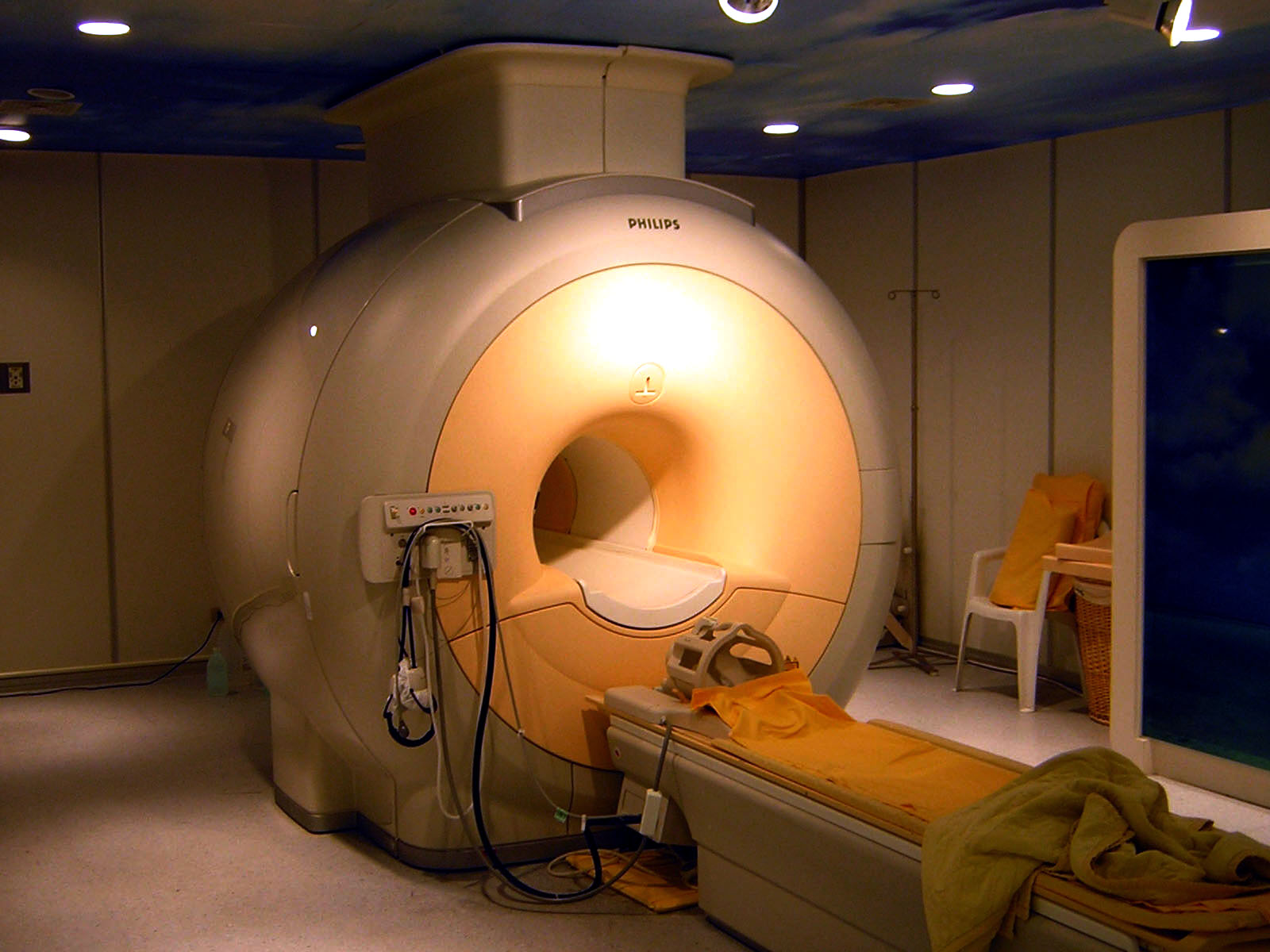
Helium is a noble gas. This means that it naturally has the number of electrons to be stable without interactions with other atoms. Helium has the lowest boiling and melting points of any element, at 4K and 1K respectively. This is due to its stability. Liquids and solids are formed when atoms energetically interact with one another; helium has very little tendency toward this. Because of its stability, helium is used as a cryogenic gas. Helium is an essential part of an MRI machine, shown below. The helium is required to supercool the magnets, which increases the magnetic field and thus the resolution.

MRI for medical imaging.

The US is the largest supplier of hydrogen in the world. This is partially because congress signed an act to bleed down our helium reserve by 2015. However, some scientists have pointed out that helium is hard to come by, and we should conserve our helium. One source estimates that helium balloons should cost $100 dollars each, based upon the scarcity of helium. Another says they should be illegal.

So the next time you look at a blimp or a balloon, marvel at the substance that fills it. It’s really star stuff, and rare to boot!

Happy 50th Anniversary, Chaos

This month, the American Physics Society magazine, Physics Today, published an article about the 50th anniversary of the Lorenz model. At the link, you can read the entire article. In it, experts describe the history of chaos, Lorenz’s discovery of it, and some of the state of the field today, but with a great deal less technical jargon.

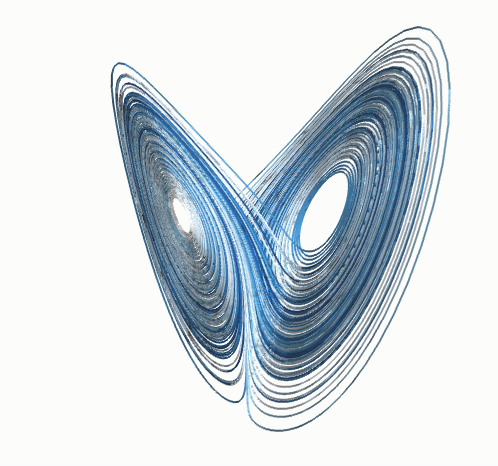
50 years ago, Edward Lorenz first captured the mathematical phenomena we now know as chaos, known popularly as the “butterfly effect“. Below is a picture from the Lorenz model exhibiting chaos. The idea of chaos boils down to highly structured behavior that cannot be predicted. No matter how precisely we measure, after some time we cannot know the state of the system. We can say that the system will stay in a certain region of weather; in the picture below, there are definitely places the trajectory does not visit. We observe this with weather models– the forecast is good for a couple of days, so-so for a couple of days after that, and completely inaccurate for any time farther in the future. Analogously, we can say that it will not be -100 C tomorrow. Appropriately, Lorenz’s discovery of chaos came about as he tried to develop a model for the weather. Chaos is all around us and can be observed in a number of systems.

the Lorenz system, which turned 50 this year

At this link, you can play with a fun Lorenz model java applet. The trick with the applet is choosing the right parameters. Try setting the “spread” to 0.1, the “variation” to 20, the “number of series” to 2, and the “refresh period” to 100. Then push the button “reset the parameters” and “restart”. This will start 2 trajectories in the Lorenz model that differ by only 0.1. You will quickly see the two paths diverge and become completely unrelated. If you reduce the “spread” to 0.01, the same thing will happen, though it will take longer. As long as the spread is more than 0, the two paths will eventually diverge.

This is why we cannot predict the state of a chaotic system, because our ability to measure the state of the system is inevitably flawed. If we could measure the state of the weather to 99.99999% accuracy, that 0.00001% inaccuracy would eventually lead to divergence. And you can imagine that getting 99.99999% accuracy is much harder and more expensive than 99.9% accuracy.

Did you know that Pluto’s orbit is chaotic? Or a double pendulum? Or the logistic model for population dynamics? So check out the Lorenz model, and happy chaos-ing.