
Tag Archives: sff

Writing prompt: An impending storm

Time: 7 minutes. Click here to go to my list of prompts.

“An impending storm”

Enka jabbed at the thin soil with her trowel. If the flimsy little sprouts took to this thin soil, it would be a miracle. She knew that this work was essential, but understanding its importance didn’t make it any more enjoyable. Sometimes Sasha sang when she worked, low and slow, like a dirge. That matched more with how Enka felt about the work.

Around her, people paused in the work. “The tower,” they said. Enka looked up, and indeed, there was a light in the tower. She and the others watched the light, eager to know how severe the coming storm would be. The sky was clear and purple now, but Enka knew not to trust it. She’d heard stories of how confusing the sudden weather was to the Founders. People who lived with radars and satellites and never had to rely on their instincts. Not that instincts did much in the sudden and violent weather on this planet.

Two long blinks. A bad storm was coming. She helped the others pull tarps over the delicate seedlings. Then they would have to find shelter. Sometimes she wondered what the storms must be like for the towerkeepers, so high in the air during such violence, unable to run. A few months ago, one to the north collapsed, taking its keeper and several homes with it. Enka was glad that her own home was not in the shadow of the tower.

A little part of her longed to be up in the tower. Every time the storms came, she hid, and she saw the beautiful violence afterwards. It must be enthralling to stand within. The others had already fled home. Did she really have to be in the tower to stay and watch the storm?

Writing prompt: the woods burst into flame

Time: 10 minutes. Click here to go to my list of prompts.

“The woods burst into flame”


The sky seemed to darken in an instant. Heavy clouds swirled, and lightning flashed. Only a moment ago, it had been a perfect summer day. Around Nadya and Vanya, the woods burst into flames.

“How?” Vanya cried.

Nadya grabbed Vanya’s hand and ran. Vanya had such a habit wanting to know the why of things, and as the flames licked around the great trees, the why was not currently important. Nadya saved her curiosity for the relevant time.

Flames seemed to repel them on all sides. Above, dark clouds still swirled. Flocks of bird and animals also fled the uncanny fire too, and so the air and trees were full of frightened motion. Nadya and Vanya were encircled by flames. There was nowhere to run.

Vanya sat on the ground and began to cry. “It’s so hot, I just want to go home.” He was only six, and even in her frustration with her brother, her heart ached for him. As the big sister, it was her job to provide safety, but she too was tempted to collapse onto the ground and give in. It seemed inevitable at this point.

“Vanya, come with me,” Nadya said, a sudden idea in her mind. It might not save them, but it was something. “Climb this tree with me.”

“But—” Vanya tears paused as confusion took over, “Papa says we must never climb those trees. That children who do are never seen again, or fall to their death.”

“Vanya, look around,” Nadya said, suddenly manic with the idea, “we could use a miraculous disappearance. I don’t know where we’d go, but it couldn’t be worse than here.”

Nadya and her brother climbed the tree. The texture was odd under hand, untreelike. When they neared the top, she heard a sound. It was the piercing cry of an enormous bird. Nadya was so startled she almost fell as the six-foot bird emerged from the storm clouds. One bird grabbed Nadya, and the other grabbed Vanya. The two birds flew high into the sky, and the children looked down onto the burning forest. Nadya hoped that the birds were kindly disposed to children.

Writing prompt: using an illustration as inspiration

Time: 7 minutes. Click here to go to my list of prompts.

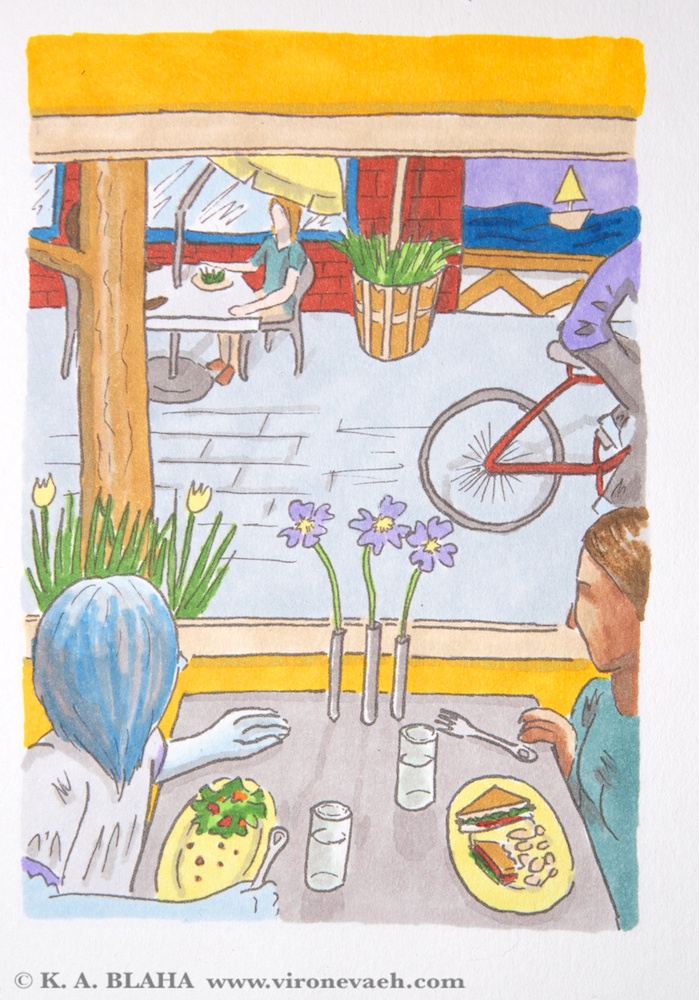
I wrote this prompt while looking at the image below, which I made for my worldbuilding exercises, discussed here.

SONY DSC

Enh and Della sat at the table, staring out the window rather than at each other. Enh hadn’t seen Della in fifteen years, not since that terrible night. And now they sat in a beautiful café, staring out at the sea rather than talking. Out of the blue, Della had contacted her two days before. She still hadn’t explained why, and Enh was growing uncomfortable. In the distance, a sailboat skating gracefully by. Enh wished she were there. Anywhere but here.

“It’s good to see you again, Enh,” Della mumbled again. Enh just nodded this time. Della’s voice, so distinctive, was unchanged, and she mumbled just like she had so many years ago. She paused for a long time. “Don’t you have anything to say to me?”

Enh sighed. “You contacted me. And you still haven’t told me why yet. I didn’t come here to reminisce. I came here because to asked me to, and I’d prefer you get to the point.”

Della’s eye’s narrowed. When she was young, she might have cried, but evidently she was past that. “You always make everything hard. Fine, I’ll just say it. I found out that Intira might be alive.”

Enh dropped her fork. Visions of that night came unbidden. The night they found the bike on the beach, but not Intira. Intira’s angry note, condemning all their undermining, how they had never really been friends. A man who’d seen her running into the ocean. Her clothes, found a month later on the coast.

(As it happens, the end of this prompt became inspired by another illustration, see below.)

SONY DSC

Writing prompt: The Little Viking

Time: 7 minutes. Click here to go to my list of prompts.

“The Little Viking”  (this prompt inspired by a little Viking figurine in my office, as pictured.)

It wasn’t easy for Olie to be the littlest Viking in his boat. Big Thorvald stood two heads taller than him, and most of the others stood at least one head taller. Olie even had a special sword made to be lighter and shorter for him. The others were mostly polite to his face, respecting his moniker of “mad herring”, but they laughed when they thought he couldn’t hear. He heard.

There were advantages to his stature. He knew that, he just wished he could convince the others of it. Once in battle, his enemy, a great hulking man with braided red hair, took a mighty swipe with his sword. Fortunately, Olie was so low the blow only took one horn from his helmet. And then he stabbed the red-haired man and danced on his corpse. But did his boat-mates remember that? No, they laughed at his one-horned helmet.

Then one voyage, Olie spotted a tiny Viking on another boat. Here was a man who could understand him, perhaps teach him battle techniques. At the very least, here was a man who he could drink a lot of mead with. When the boats landed in the trading town, Olie immediately rushed to the other ship, neglecting his duties, but not caring.

The other tiny Viking turned around—it was a lady. Olie’s village used to have women on the boats, but when there were enough men, they opted not to. Here, finally, was a Viking he stood over. He smiled broadly at her.

“Don’t get any ideas,” the woman said, smiling back. “I might be as little as you, but you know as well as I do how hard we fight to make up the difference.”

Her eyes glinted, and Olie saw that she probably would punch him as easily and effectively as any of his boatmates. “This is true. Let’s drink now and save the fighting for later.”

Science Fiction Worldbuilding

One thing I love about science fiction is worldbuilding. When you go to a new place, you take in the architecture, the language, the food, the weather, how someone enters a house, how someone insults another person… These things exist in any culture, but they vary, sometimes radically. In science fiction, the creator tries to imagine these things in a logical and consistent manner for a time that hasn’t happened yet, for planets unknown, with the very constants of life such as gravity and oxygen subject to change. And yet the end product, when successful, is similar to travel–we visit a place that is deeply familiar in the fundamental ways and yet different in ways that provoke thought.

(Some people think that there is too much worldbuilding–I don’t agree. I think the author can tell too much of their own personal worldbuilding process and not consider the reader enough. However, I speak from a place of no authority, so take my opinion for what it is worth.)

In the last few weeks, I’ve been working on illustrations of street life in my city inspired by Hiroshige’s 100 views of Edo. Even after 17 years working on this world, I see many new things this way.

SONY DSC

On the hill in the background is the outline of an old storm tower, shaped a bit like a lighthouse. The old fortifications stood high on the hills with thick walls to withstand the storms.SONY DSC

The view west from a storm tower, to give early warning of storms. In the early days of the city, storms caused flash flooding and devastation.SONY DSCGleaming cities often have unsavory hidden parts, sometimes literally lurking around the corner.

So far I’ve done about 20 illustrations. I’d like to do at least 100. In each one I feel more comfortable with previous details. I’ve looked up references of European and Moroccan and Japanese architecture (mostly the European showing in these three samples). Now I’ve started incorporating old sketches over a decade old. The city feels all the more real to me (it’s great inspiration for story ideas and details), and the work is great fun.


Book Review: Cyteen (C. J. Cherryh 1988)

There are no spoilers in this review beyond what you’d find in the first few chapters or the cover blurb.

Rating: 4/5

Cyteen was the winner of the 1989 Hugo Award. It is about neither cyborgs nor teenagers nor cyborg teenagers, despite the name; Cyteen in the name of a planet. Cyteen takes place in the same universe as Downbelow Station (which I reviewed here) in a different culture and time. Like Downbelow Station, this is a book that requires patience up front, but offers great rewards. Cyteen is 750 pages of intricate scheming and counter-scheming, supported by interesting and conflicted characters.

Cyteen is the capital planet of the Union, one of a few major political entities in a future where humans have drifted amongst numerous stars with faster-than-light travel. The economy of Union is largely supported by the production of a cloned working force called “azis”, who are psychologically trained to serve in various capacities. All azis are produced in a research lab/city called Roseune. The book opens with power struggles between the forces of Roseune, the military, and another faction. A murder follows this initial conflict, which weakens the status of Roseune and fundamentally alters the lives of the characters. The continuing power struggles are described through the individuals trying to survive them at Roseune.

My biggest complaint: the book takes too long to develop. The first 20 pages are textbook-style background. Even after that, my progress was slow. It took a while to figure out a lot of the politics, and I didn’t understand what azi were for at least a hundred pages. Additionally, it read slowly, constantly packed with intricacy and detail on each large page of text. I very much enjoyed this book, but it is not light reading. Read this one when you have a solid block of time to set aside.

I would recommend Downbelow Station over Cyteen, although I prefer the characters in Cyteen. Despite a shared universe, the styles of the two books differ substantially. Downbelow Station is a smart space opera, threaded with politics. Cyteen is a personal drama, saturated with politics. If you enjoy hard science fiction and you are patient, you will probably enjoy both of them.

Book Review: Lilith’s Brood (Octavia Butler 2000)

There are no spoilers in this review beyond what you’d find in the first few chapters or the cover blurb.

 Rating: 4.5/5

Lilith’s Brood is a collection of three novels by Octavia Butler published from 1987 to 1989, gathered together in 2000. The set of three books, also called the Xenogenesis trilogy, is about 750 pages long. They were published as three novels, but I would highly recommend reading them back to back as I did. The world that Butler builds over the three novels is complex. I would have had trouble trying to read the second or third novels after a long gap.

Lilith’s Brood was my first book by Octavia Butler. The writing is incredibly readable; I easily covered 50 pages an hour.  Some science fiction novels dump world-building at the beginning;  it can be something the reader has to fight through. Butler does not do this; she develops the main character first and then the environment from the eyes of the main character. The world she eventually develops is intricate and explained in detail, but by the time she got to it, I was engaged.

The trilogy opens with Lilith, a woman who survived World War III on a now ravaged Earth. She is held alone by aliens called the Oankali. Without going into spoiling detail, the Oankali are extremely alien. All three books develop the Oankali, and they are as much of the world Butler builds as anything. The Oakali want something from Lilith, though she is unsure what. Lilith finds them physically frightening, and is uncertain about her future.

Butler approaches situations from the character’s emotional response, rather than from a technical aspect. The book explores themes of gender, sex, humanity, and community–some pretty hefty topics that sci-fi sometimes skirts, especially at the time of its writing. I rate the book as a 4.5/5 partially because of this novelty and distinctiveness. In many stories, I enjoy rooting for a protagonist or a certain course of events. In this story, I didn’t know what I wanted, which was odd, but not bad. My only real criticism of the story is that, while certain aspects of the world were highly developed, it was hard to imagine living in this world. While I enjoyed reading about this world, I think I would find it profoundly dull. Still, I highly recommend reading this, especially if you haven’t read Butler before.

Book Review: Marooned in Realtime (Vernor Vinge 1986)

There are no spoilers in this review beyond what you’d find in the first few chapters or the cover blurb.

Rating: 4/5

Marooned in Realtime by Vernor Vinge is the far future sequel to The Peace War, set on Earth 50 million years in the future. The Peace War introduced the concept of “bobbling”, a scientific discovery where a spherical bobble, impervious to the laws of physics, can be created. Anything inside the bobble doesn’t experience what happens outside of it; a year can pass outside the bobble, but no time passes inside it. The time length for which a bobble exists can be tuned. This was used to great effect in The Peace War as a mechanism for sequestering weapons. In Marooned in Realtime, the people who were bobbled through various circumstances come together and try to reestablish humanity after it was somehow lost.

If you like other Vinge stuff, you’ll probably like this, and it’s a lot shorter than some of his things. I recommend reading The Peace War first, although I think I like this book slightly better. There are some references back to the characters in the first book and a novella written between the two, which got a little annoying eventually. Also, I am not sure if the ubiquitous bobbles and their governing rules would be totally obvious reading this as a stand alone. It has been several years since I read The Peace War, and though I remembered the basics, I found myself wishing I could remember more clearly.

Overall it was  a solid Vinge book, with good hard scifi and far-flung and fun extrapolations. Vinge is a computer scientist, and he makes the most of this background. Don’t expect to read Vinge for the emotions. His forte is playful futurism and making everything go wrong at once. I read Marooned in Realtime easily in three days, and I’m not the fastest reader. It was easy to get into, and the first book I’ve read off my holiday reading list.

Which is the fictional critter?

Because nature is weird, and I like science fiction, which is the real creature, and which is the fictional critter?

Critter #1 is 1 mm long critter that:

  • Can survive in space and at the bottom of the Mariana Trench
  • Contains a set number of cells in its body
  • Can be rehydrated after over a century
  • Can survive thousands of times more radiation than a cockroach

Critter #2 is a bird that:

  • The males deliberately sets fires as a mating ritual
  • The males perform this ritual in pairs, in case one catches fire
  • After the fire spreads, the fires leave masses of cooked meat. The birds scrape off their meals with their distinctive, blade-like beaks

So… which critter is real, and which is not? For bonus points, in what book did the fictional critter appear?

Read the Answer

My Reading List for the Holidays

Between preparing my dissertation and doing NaNoWriMo, I haven’t read much lately. My eventual goal is to write excellent science fiction. I feel that reading in the field is essential to writing better in the field. So I try to make sure that I keep up on science fiction reading. Below is the reading list, in no particular order. We’ll see how I do!

Marooned in Realtime by Vernor Vinge– Vinge is one of my favorite authors, and this book is the sequel to The Peace War, which I enjoyed.

Camouflage by Joe Haldeman– Haldeman is another favorite of mine. This novel won the nebula award.

Gateway by Frederick Pohl– I read this over a decade ago. I enjoyed it, but I remember nothing of it, so a re-read is in order. The novel often appears on “best-of” scifi lists.

Starship by Brian W. Aldiss– I enjoy Aldiss, and novelist Ed Lerner recommended it to me at a science fiction seminar. So I definitely should read it.

Cyteen by C. J. Cherryh– Set in the same universe as Downbelow Station, which I loved (see my review here). It’s the size of a bible, but I have high hopes.

The Good Soldier Švejk by Jaroslav Hašek– A classic humorous novel of Czech literature, set during World War I. I keep hearing good things about it and it’s been on the shelf for 5 years. I’ve even been to one of the bars described in the book. Time to read it.

The Innocents Abroad by Mark Twain–  Twain writing about travel. Yes.

Lilith’s Brood by Octavia Butler– I haven’t read anything by Butler yet. People rave about her, so I would be remiss not to try her out.