Or you know, whatever winter holiday. Enjoy the lights and the songs, and may it be a restful day.





Or you know, whatever winter holiday. Enjoy the lights and the songs, and may it be a restful day.

Every year, I trek south to Florida for the holidays. The sun and warmth are great, but I especially like the feeling of going to a different world. The land is flat and riddled with little inlets and brackish creeks. Here in southwest Florida, there is a feeling that man does not control the wilderness. Things grow at an insane rate and they fight for space. The landscape takes on that wild, violent look. I like the greenery and the beaches and the boats and the sunsets all. And I like to drag my camera along for documentation.
Happy Friday!


This week I am spending most of my time painting the line-art from The Galactic Adventures of Zish and Argo. One of the things I really like about watercolors is that they travel well. I’m on the road for the next couple of weeks, but it is just as easy to paint here as it is at home. A major reason for the portability is the type of materials I use. I bought a Windsor-Newton field box set several years ago, pictured below. At $50, you might experience a bit of sticker shock. I’ve only recently had to start replacing pans; it lasts and lasts.

I have used the liquid watercolors as well. I find I enjoy the quick set up of the solid colors. There is no need to dole out paint as you go, and you only use what you need. Plus it’s easier to travel with. The solid paints can still deliver good intensity and brightness. I roll all my brushes up in a bamboo case like this one, and then I’m ready to go anywhere and paint anything. If you have a pigment-ink printer, you can economize on your watercolor paper by selectively choosing what you print. I discuss that more in an old entry, here.
I read a watercolor book a few years ago that I found helpful as well: Watercolor Tricks and Techniques, by Johnson. If you are curious, it is worth a look.
So there are 13 paintings for the core of the Zish and Argo book. I have 7.5 paintings done, so I’m over halfway! The Robotoids say hello!!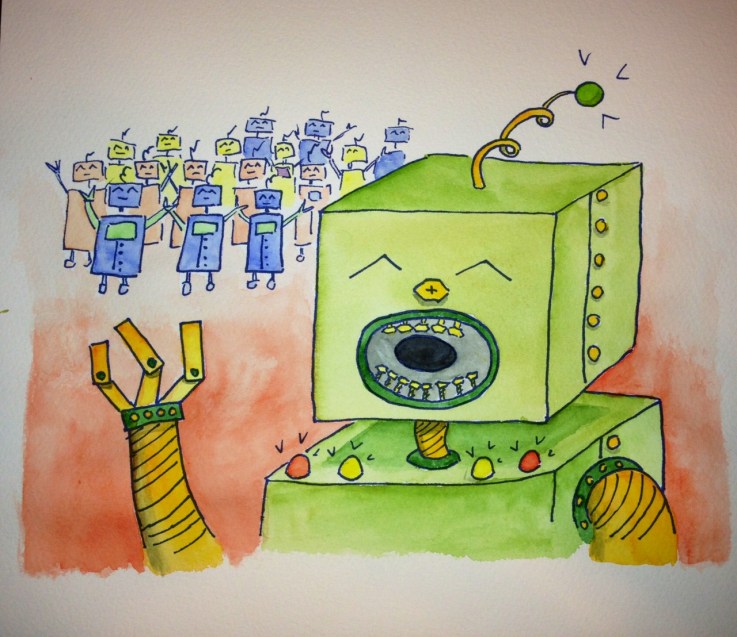
Everybody love a pop-up book. The well-executed ones are a thing of joy. I got a pop-up book as a kid about dinosaurs, which I didn’t care that much about, in French, which I didn’t read. I read that thing to its grave.
Recently, I see more pop-up books in stores, aimed at more than just children. These books are made by not artists, but paper engineers. As an engineer, I approve of this shift in language. Perhaps I should strive to be a word and paint engineer, rather than writer and illustrator. A few years ago, I bought Moby Dick, as done by paper engineer Sam Ita. Amazon lists a few of his books here. He even has a pop-up Xmas tree, if you’re still looking. His Moby Dick is wonderful, with whirling whirlpools and ships complete with rigging and a looking-glass.
I have started my own attempts at pop-up (shown below). A fun project, but one on hold for now because I’m not sure how to put them together with any kind of efficiency. If you’re interested in learning about pop-ups, I have used a few books to guide my exploration:
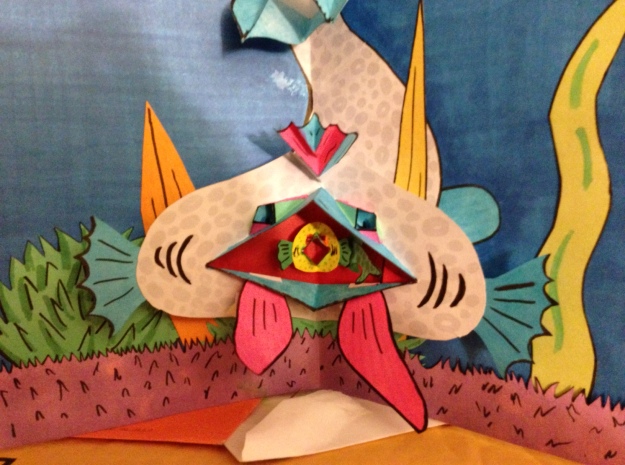 Happy paper engineering!
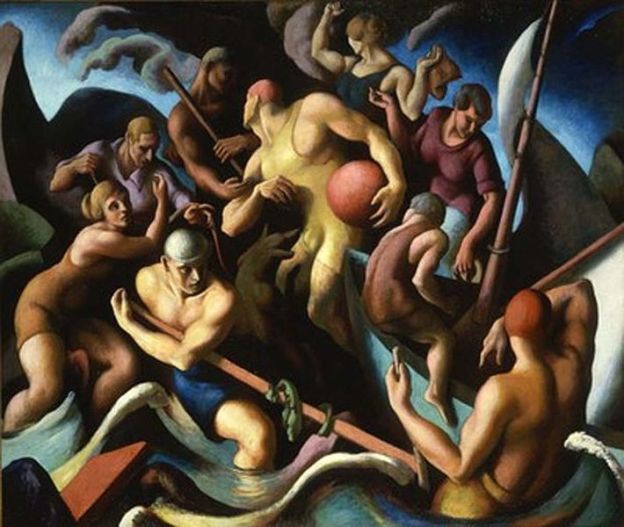
Previously I have talked about depression era posters and Soviet propaganda posters. Thomas Hart Benton was a depression era painter and muralist from southwest Missouri. Growing up in St. Louis, I was exposed to his art from a young age. His shading brings the people in his paintings to life. He often depicts scenes of work, as suits the depression. (Both of the images in this entry can be found on Wikipedia.)

Cut the Line (Wikipedia)
If you for some reason find yourself in Jefferson City, Missouri (unlikely), the capitol building has many of his murals. Then stop by Central Dairy, where you can get a pile of amazing ice cream for very little $. Then you have seen all there is to see in the illustrious capitol.
Fractals are a branch of math that better describes nature. Before fractals, there was Euclidean geometry, the geometry of lines, planes, and spaces. Euclidean geometry cannot give the length of a rough coastline; neither can it give the surface area of shaggy tree bark. The answer you arrive at in Euclidean geometry depends upon the scale at which you examine an object– intuitively the distance an ant travels over rough terrain is different from the distance we cover walking. The ant interacts with the terrain at a different length scale than we do. Fractal geometry is designed to handle objects with multiple meaningful length scales.
Fractal objects are sometimes called “scale-free“. This means that the object looks roughly the same even if examined at very different zooms. Many natural objects look similar at multiple zooms. Below, I include a few. The craters on the moon are scale-free. If you keep zooming in, you could not tell the scale of the image.
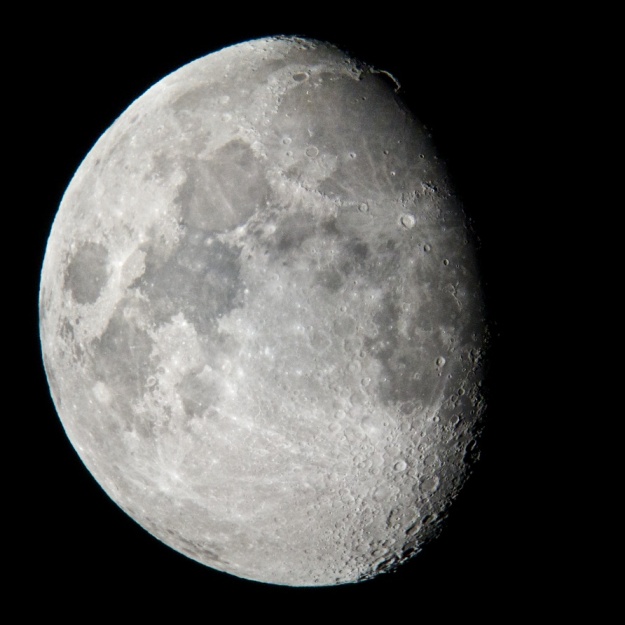
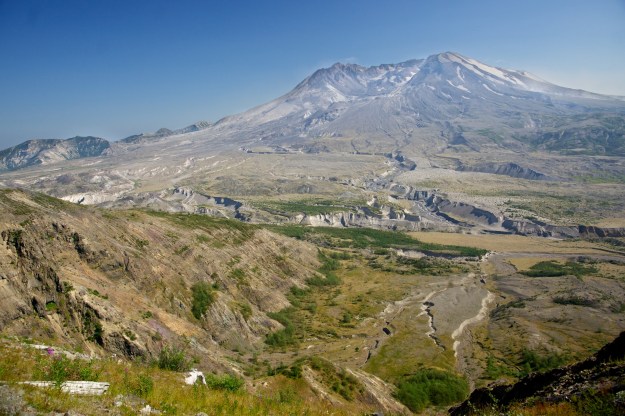
Terrain is often scale-free in appearance– a few years ago there was a joke photo with a penny for scale. The owners of the photo subsequently revealed that the “penny” was actually 3 feet across. I couldn’t find the photo, but you cannot tell the difference. The reveal was startling. Below is a picture of Mount St Helens. The top of this mountain is five miles (3.2ish km) away. Streams carry silt away from the mountain, as you can see more towards the foreground. They look like tiny streams. These are full-sized rivers. Mount St. Helens lacks much of the vegetation and features we would usually use to determine scale. The result is amazingly disorienting, and demonstrates scale invariance.
Plants are often scale free too. Small branches are very similar in appearance to large branches. Ferns look very fractal. Below is a picture of Huperzia phlegmaria. Each time this plant branches, there are exactly two branches. Along its length, it branches many times. It is a physical realization of a binary tree.

For more about fractals, read my posts about fractal measurement and the mandelbrot set.
I began printing and painting the line work for The Galactic Adventures of Zish & Argo. Now that painting has begun, I hope to have the first book pulled together in a month or two. In the meantime, this project has been a source of great joy.
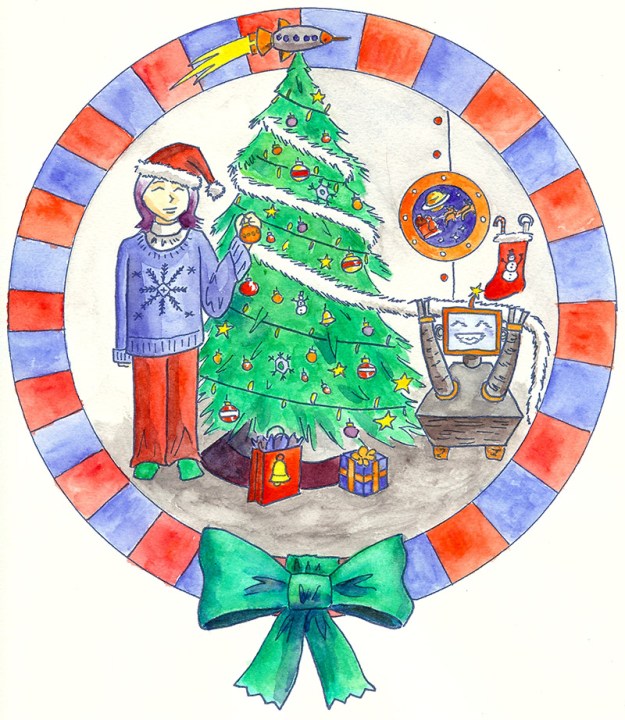
I have become fond of the characters, so I find myself doodling the pair engaging in a variety of activities. Happy holidays from Zish and Argo!
The common concept of chaos as the disordered unknown is a concept thousands of years old. Chaos as a branch of mathematics refers to an extremely ordered but complex behavior. In some lights, mathematical chaos might seem utterly random; different inspections reveal order. The first model of chaos emerged in the 1950s to model the movement of air in the atmosphere– the Lorenz model.
First, let’s discuss what chaos is in a mathematical sense (chaos on scholarpedia). In daily language, we would assume that something chaotic is not at all predictable. Chaos is deterministic, which means that if we know the position or value of a chaotic element exactly, then we know every value that it will ever have for all times. Many non chaotic systems are deterministic also; if we measure the position and velocity of a pendulum and its frictional loss, we can predict its path for all time.
If we are measuring some value, there is a limit to our possible accuracy. If you measure your weight, you are measuring your weight plus or minus some error associated with the instrument. We know some scales are more accurate, and some are less accurate. When we measure the position and velocity of the pendulum, there is some error, but the behavior at position x plus a little bit (or x+ε) is essentially identical to the behavior at position x. In a chaotic system, the paths following positions x+ε and x will be entirely different after some window of time. The paths will be similar for some window of time; the length of this window is determined by how chaotic the system is. This behavior is known as sensitive dependence upon initial conditions (or more famously, the butterfly effect).
The lower half of the image below shows the difference between two paths starting at x+ε and x in the Lorenz attractor. The paths are nearly the same, until they quickly become very different. You can look at the Lorenz attractor in more detail and play with it here. The link goes to a Java applet hosted by Caltech where you can change the parameters and see what happens in a time series and in a different representation called the state space.

The above image also shows the third of the three most common criteria for chaos: periodicity. This means that the system oscillates in some kind of way. The top half the picture above shows the time series of z variable (see link above for the full model if you are interested). If we plot the data in a different way, we get the image below. This image is called the Lorenz attractor. We see it loops around, but that it is bounded in space. That is, there are places we can say the path will not go. Intriguingly, the Lorenz attractor has a fractal dimension of 2.06. For more on fractals, you can read my posts on fractals and fractal dimensions.

Many pretty simple systems can exhibit chaos. The easiest example is the double pendulum, which is just a pendulum whose bottom is the top for a second pendulum. The video below shows the complexity of behavior achieved by the double pendulum. Chaos has also been demonstrated in electrical circuits, biological systems, electrochemical reactions and planetary orbits. In another post, I will write about the amazingly universality of chaos, which shows how all of the diverse systems I listed are in fact very similar.
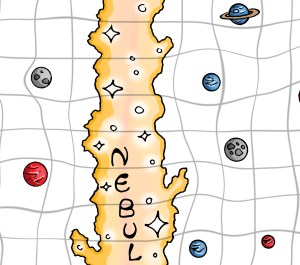
I am designing a board game. This is kind of new territory for me, so we’ll see how it goes. Right now I have a beta edition of the board (a little piece below) and a portion of the rules written. I have a vague idea of the rest, but I will need to get it onto paper. Yesterday, I printed the first copy of the board onto 13″ x 19″ paper. After I finish the rules and the cards, I will test it. It is a space-based game, but in the image below you can see the background is still white. I assume some of the details will need to move, so no need to fill in the background just yet. I’ve been throwing this idea around for a little bit, so it’s exciting to share the progress. It still has no name, but it is a game about space travel, perhaps loosely related to my Zish and Argo stories.
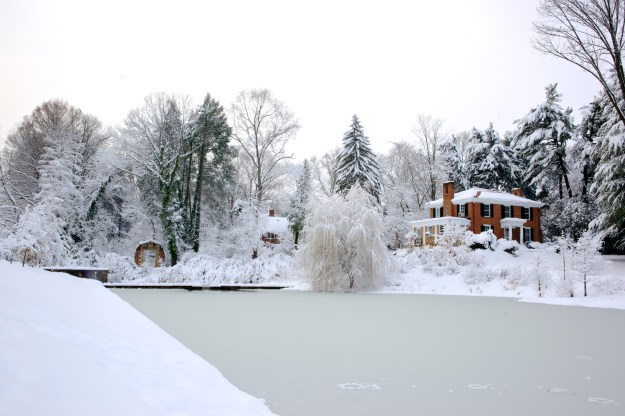
Happy December! If it gets this cold, may it look this nice.
 Vironevaeh