Category Archives: Illustration

Drawing Books: Andrew Loomis

I always find a good drawing book to be very motivating. When I draw, I do best when I have a good visual aid, especially when posing people. Alas, I have no models living in my attic to call upon for posing when the need arises. So a good book of poses is the best substitute I have.

Andrew Loomis was as illustrator in the middle part of the 20th century. He wrote several drawing instruction books as well. These books were very well-regarded and popular, but they went many years without being reprinted. Old copies of the books would sell for over $100 on eBay.

Happily, his books started being reprinted a couple of years ago. They are lovely hard-cover reproductions, available for about $25 each on Amazon.com. I believe four have been released:

  • Figure Drawing for All It’s Worth– A book about drawing the figure. I’ve found in the past many figure books are more men than women (which I always thought was strange). If anything, this book has more female figures, but men are covered as well, as well as various proportions, and the proportions of children.
  • Drawing the Head and Hands– About drawing the head and hands. As you’d expect, this covers the head and hands from all kinds of angles, for different ages and backgrounds.
  • Successful Drawing– I don’t have this one. I find its title vague. I like to imagine I can already draw. But if anyone has read it, I’d be curious to hear.
  • Creative Illustration– I just got this one, but I haven’t had a chance to go through it in much detail. This is the one I’ve been anticipating most, based upon the title. I have observed many heads and hands and figures, but illustration is a way of interpreting the scene to make it more engaging.

Zish and Argo Artwork

My biggest goal over the holidays was to complete painting for the Zish and Argo book. Last night I finished the last painting! Hooray! Champagne! Zish and Argo has 13+ full size color illustrations, painted in water colors. The picture below shows the ones I finished during the holidays. For reference, they are about 8 inches tall. In the next couple of weeks, I will pull together the art and put up book details. The featured image shows the tentative cover that I just finished as well.

Tomorrow I head back north to new projects and adventures.

SONY DSC


Artists: Walter Crane

I love to go to art museums to new style ideas. On a recent trip to the Virginia Museum of Fine Arts (VMFA), I visited the art nouveau section and saw a piece by English artist Walter Crane:

Walter Crane plate at VMFA.

The plate mentioned that Walter Crane did children’s books.

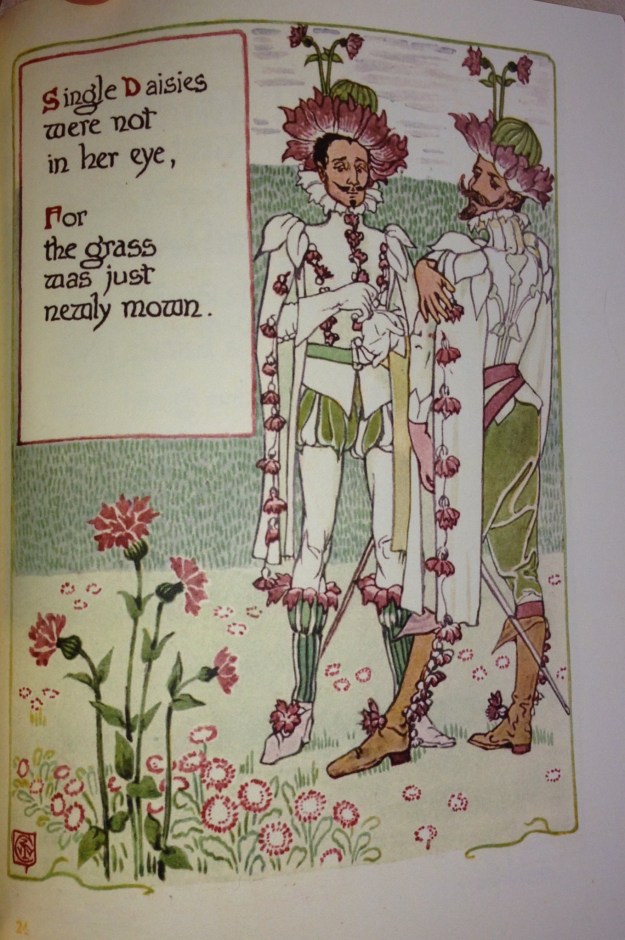
So I went home and ordered a couple of his books. A Floral Fantasy in an Old English Garden anthropomorphizes the flowers of the gardens in beautiful art nouveau fashion. Below is a photo of one of the pages. This page depicts bachelor’s buttons. All the little details, down to their boots, are done to match the characteristics of the plant. Another panel shows a battle between a thistle knight and a snapdragon. Walter Crane has several children’s books besides this one. Since Walter Crane died in 1915, his works have entered the creative commons, and they can be had very cheap, especially digitally.

photo

Walter Crane also did more adult works. Neptune’s Horses reminds me of the scene in Lord of the Rings where the elf summons up the waters to fend off the nazgul, but it was painted over a century before.

Soviet Holiday Cards

Boingboing had a cool post yesterday about Soviet “Christmas” cards. Actually most of the cards say “s novum godom”– “to the new year”. I love all the science and rocketry themes. I also find it interesting how many things we associate with Christmas have been co-opted for a holiday the soviets found safer: New Year’s. You can find the original website for the cards here. Below are a few of my favorites, which can all be found at www.mazaika.com/postcard01.htm.


A little on watercoloring

This week I am spending most of my time painting the line-art from The Galactic Adventures of Zish and Argo. One of the things I really like about watercolors is that they travel well. I’m on the road for the next couple of weeks, but it is just as easy to paint here as it is at home. A major reason for the portability is the type of materials I use. I bought a Windsor-Newton field box set several years ago, pictured below. At $50, you might experience a bit of sticker shock. I’ve only recently had to start replacing pans; it lasts and lasts.

I have used the liquid watercolors as well. I find I enjoy the quick set up of the solid colors. There is no need to dole out paint as you go, and you only use what you need. Plus it’s easier to travel with. The solid paints can still deliver good intensity and brightness. I roll all my brushes up in a bamboo case like this one, and then I’m ready to go anywhere and paint anything. If you have a pigment-ink printer, you can economize on your watercolor paper by selectively choosing what you print. I discuss that more in an old entry, here.

I read a watercolor book a few years ago that I found helpful as well: Watercolor Tricks and Techniques, by Johnson. If you are curious, it is worth a look.

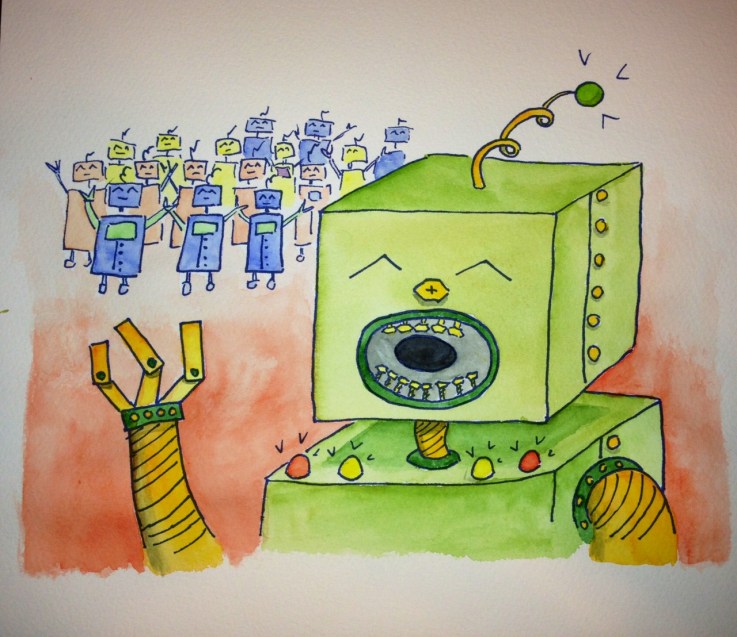
So there are 13 paintings for the core of the Zish and Argo book. I have 7.5 paintings done, so I’m over halfway! The Robotoids say hello!!robot

Artists: Thomas Hart Benton

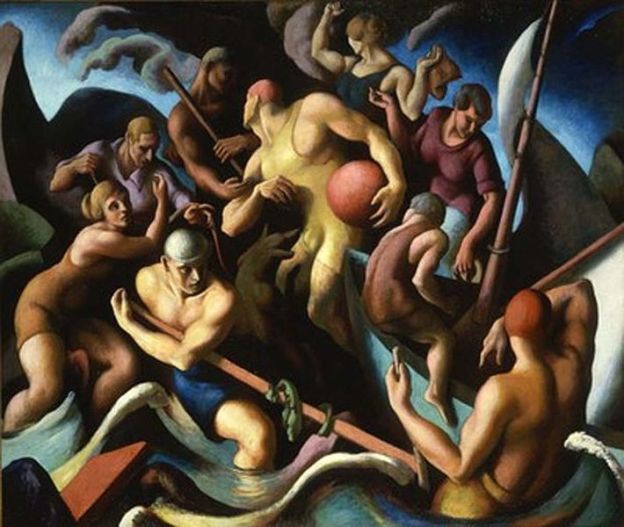
Previously I have talked about depression era posters and Soviet propaganda posters. Thomas Hart Benton was a depression era painter and muralist from southwest Missouri. Growing up in St. Louis, I was exposed to his art from a young age. His shading brings the people in his paintings to life. He often depicts scenes of work, as suits the depression. (Both of the images in this entry can be found on Wikipedia.)

Cut the Line (Wikipedia)

If you for some reason find yourself in Jefferson City, Missouri (unlikely), the capitol building has many of his murals. Then stop by Central Dairy, where you can get a pile of amazing ice cream for very little $. Then you have seen all there is to see in the illustrious capitol.

Xmas from Zish and Argo

I began printing and painting the line work for The Galactic Adventures of Zish & Argo. Now that painting has begun, I hope to have the first book pulled together in a month or two. In the meantime, this project has been a source of great joy.

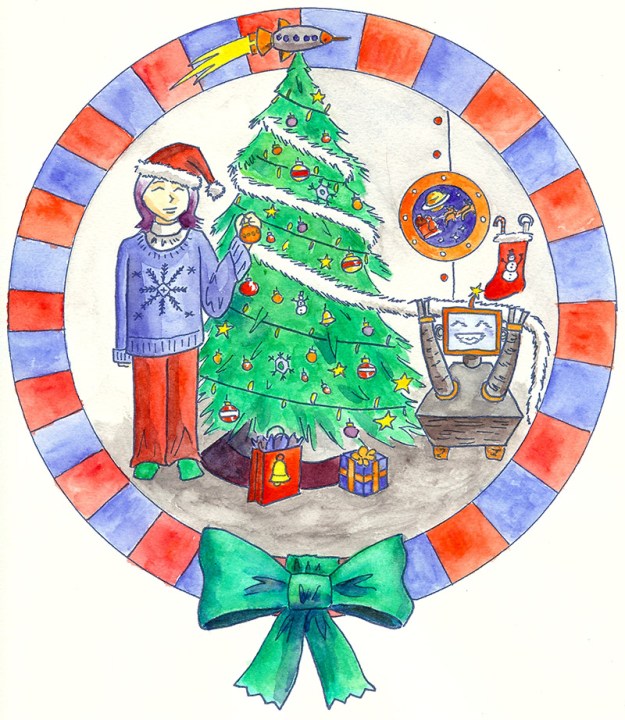
I have become fond of the characters, so I find myself doodling the pair engaging in a variety of activities. Happy holidays from Zish and Argo!

xmas-color-smaller

Board game in progress

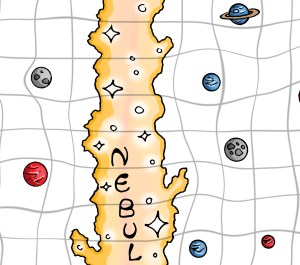
I am designing a board game. This is kind of new territory for me, so we’ll see how it goes. Right now I have a beta edition of the board (a little piece below) and a portion of the rules written. I have a vague idea of the rest, but I will need to get it onto paper. Yesterday, I printed the first copy of the board onto 13″ x 19″ paper. After I finish the rules and the cards, I will test it. It is a space-based game, but in the image below you can see the background is still white. I assume some of the details will need to move, so no need to fill in the background just yet. I’ve been throwing this idea around for a little bit, so it’s exciting to share the progress. It still has no name, but it is a game about space travel, perhaps loosely related to my Zish and Argo stories.

boardgame zoom

Style: Soviet Propaganda Posters

The 20-40s really seem like it was a golden age for illustration. Color photos were not as vibrant as they are today, yet mass printing existed. Thus, beautiful and stylized portraits of life were used in advertising and propaganda (Alphonse Mucha did lovely art nouveau illustrations for advertisers since the late 1800s, I wrote about him here). Many of us have seen the posters created for the Great Depression and WW2 by artists such as Thomas Hart Benton.

When I visited the Czech Republic, Budapest and East Berlin, I was struck by their propaganda posters from the same period. There was such a contrast between the lovely illustrations and the content that we would likely find oppressive. It can be a window into history to understand how people chose (or were forced into) their path. For good collections of Czech or CSSR Propaganda, check out the Communist Musuem in Prague and Checkpoint Charlie in Berlin. The featured image for this post is the poster for the Communist Museum; one of my souvenirs from Prague are some nesting dolls with this design.

To have more we must produce more (Wikipedia)

The Czech, Hungarian, and German posters seem hard to find, and I only know the languages a little (if anyone knows good sources, let me know!) I find the role of small countries in the early 20th century especially interesting since they are underrepresented. The countries of central Europe endured many of the worst hardships during the 20th century. There are many sources for Russian propaganda posters:


10 years since the revolution


Getting creative with a printer

Last year I got a medium format pigment printer (epson r2000). With research, you can get a decent deal on these kinds of printers. I purchased mine for $300 (with rebate) while it now lists for $550 (but remember, the ink is always a swindle). If you know how to use color profiles and tune your screen’s color, these printers can be a ton of fun. Printing photos was the main motivation for my purchase, but the other less expected uses have been equally exciting.

Watercolor painting and pigment printing

Pigment inks are waterproof after they dry. Long ago I learned the hard way that normal ink jets are not waterproof. This feature of pigment inks has helped my watercolor process immensely. Now I can do line art on low quality paper. Then I scan the line art in and I can digitally fix it. This can mean a number of things: I can remove a badly placed stroke, or I can rearranged items in space. For the Zish and Argo stories, I did preliminary line art, and moved things to satisfy the needs of the page layout.

Once the line art is optimized, then I can print to the expensive watercolor paper. I probably only use half of my preliminary line art, which is an awful waste of premium watercolor paper. But now I can be efficient. Printing line art is additionally attractive because it uses little ink. Additionally, I can print several copies, and have several chances to get my work just right. I did the featured image art using this procedure.

Printing on fun materials

The printer can also print to some fun surfaces. It can print to basically anything you feed through it, like poster board, wood, foam board, canvas, or other sufficiently heavy fabric. Obviously, it can also print to any sturdy paper as well (I print frequently to drawing and watercolor paper).

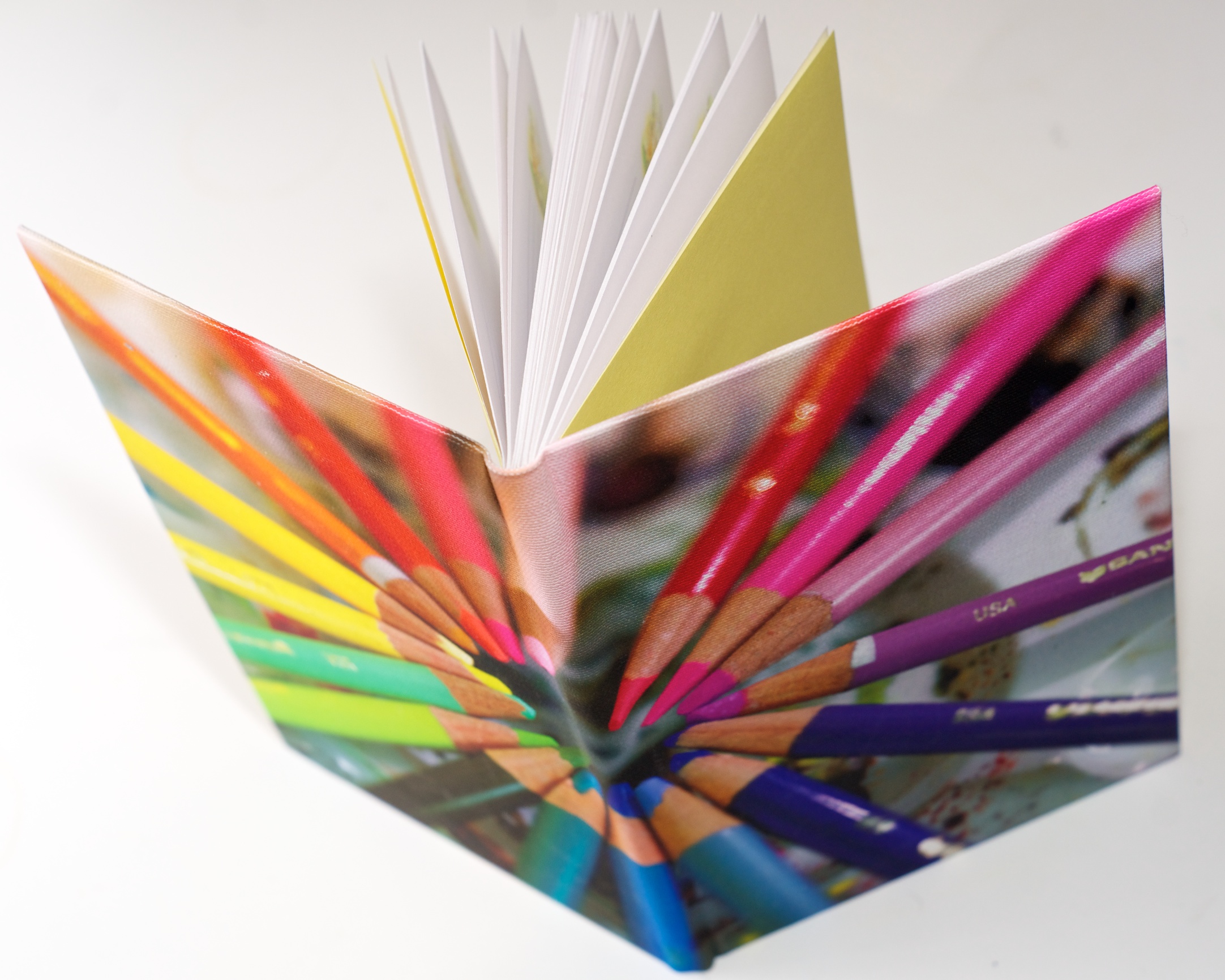
I recently did my first project printing to canvas. I then used this canvas to cover a book, shown below. This canvas is also designed to stretch over a frame like any canvas.

Any additional ideas on creative printing? There’s nothing better than using a tool on hand in a different way.