Category Archives: Science

Book now with the Exoplanet Travel Bureau

(You may have a wait while the technology for your flight is developed.)

A lot of my first reading as a child was astronomy books and magazines. When I was little, my brother told me there was a black hole under his bed (to keep me from snooping—nerd children fight dirty), and after that, I had to know more about the enigmatic and alarming properties of the universe.

One of the things I remember was the hunt for the first exoplanet, that is, the first confirmed planet outside of the solar system. Scientists were quite sure they should exist (why wouldn’t they?), but the equipment and techniques thus far hadn’t shown them. I remember reading about some of the first exoplanets in the hazy early 90s. They were massive, close to their stars, and had outrageous properties that inspired wild imaginings.

Now confirmed exoplanets number in the thousands. And poking around the internet on an unrelated chore the other night, I found this gem: the Exoplanet Travel Bureau. NASA’s Jet Propulsion Laboratory (the extremely prestigious and awesome JPL) made travel posters for four exoplanets in the style of retro travel posters. Each of them features characteristics of their planet. I promptly printed out three and hung them in my guest room. I’m still ecstatic about them; these are the kinds of visions and dreams I had so long ago as a kid, and that I love to chase in my own art. These are awesome, and I love them, and you can download them at full size. Tell all your friends, and print your own! Here they are!

Click on the image for more image sizes. Images by the NASA Jet Propulsion Laboratory.

Click on the image for more image sizes. Images by the NASA Jet Propulsion Laboratory.

Click on the image for more image sizes. Images by the NASA Jet Propulsion Laboratory.

Click on the image for more image sizes. Images by the NASA Jet Propulsion Laboratory.

What is an engineering PhD?

Sorry I have fallen way off of schedule. Since my last posting, my husband defended and graduated with his PhD, and we visited out new city and bought our first house. So it’s been extremely exciting and hectic.

But I promised to write about what a PhD is, and so I shall. During  our seven years of graduate study, I’ve encountered a lot of confusion about what a PhD in science and engineering is. Getting a PhD is really really different from other forms of graduate education, such as law, business, and medical school. A PhD in fields like English can vary some from the science experience I describe here, but pursuing a PhD in English is more similar to pursuing a PhD in Physics than it is to law school.

Why you never ask a PhD student when they will graduate

Law school takes 3 years. Med school takes 4 years. A PhD takes ???? years. In science and engineering, it takes about 4-7 years, depending upon whether you go in with a masters, how hard you work, who your advisor is, and luck. Very little of the timing is directly within your control.

When you start with your bachelor’s degree, the first year focuses mostly on classes, the second year is a balance between classes and research, and most of the time after the second year is totally devoted to research. (A student starting with a master’s degree gets to skip most of the classwork.) In science and engineering, you might TA (teaching assist) for a semester or two. In other fields like Spanish and English, you might teach every semester. For them, this is often a good thing since teaching comprises a lot of their post-graduate opportunities. Teaching also pays the bills.

There are three big hurdles in grad school: qualifying exams, proposing your dissertation, and finishing your dissertation. Qualifying exams vary by school and department. If you fail your qualifiers, you won’t get your PhD. Many people who fail their qualifiers leave with a masters. Some departments have terribly difficult qualifiers, others don’t.

Your dissertation tells the story of your research. It describes experimental and mathematical techniques, the state of the field, shows results, and talks about future research possibilities. A dissertation is typically 100-300 pages, depending upon your field. You and your advisor work together to develop a central narrative to your dissertation. A PhD student must propose this avenue of exploration to their proposal committee, a panel of five professors, in a formal presentation. The professors give their feedback and criticisms on the proposed work. They may reject the proposal.

A PhD student graduates when they successfully defend their dissertation. But typically it’s writing the dissertation that is the hardest part after a successful proposal. It takes a long time to write 200 pages, and your advisor will expect a lot of things out of the document. You may also be expected to publish peer-reviewed papers. You can incorporate these papers into your dissertation, but the papers alone don’t count toward the dissertation directly. Papers are even harder to write than dissertation chapters. Papers may involve collaborations with researchers on other continents with other native languages and time zones.

All of the above is why a PhD student’s graduation date is hazy. So don’t ask a PhD student when they will graduate—they are wondering the same thing!

PhD students get paid

Unlike other types of grad school, you get paid to study towards a PhD. The teaching and research you do pay your tuition and salary. Your salary is never a lot, but unlike other post-graduate educations, you earn rather than pay. Depending upon the school and your area of study, a grad student earns between $15k-30k a year. You sometimes get benefits like health insurance as well (this might be universal now).

Your advisor: the master of your grad school experience

Every graduate student has an advisor. An advisor is the professor that funds you and your research project. Your advisor is the most important person in your grad school experience. Your advisor pays your salary and tuition, determines the area of your research topic, and influences your connections within your field.

An advisor can make your life miserable. If they run out of funding, you might have to teach more. They can slow your graduation. They are more than just a boss; they control your access to your doctoral degree. If you are five years into your PhD, you can’t do much if your advisor jerks you around short of quitting sans degree. And you may have noticed that professors are sometimes difficult people. Most grad students can name the difficult professors in their department.

Research

This simple cartoon explains the significance of your research in grad school. Your research is why you get paid to go to grad school. Your research could address industrial issues or basic science. Your advisor gets money based upon the kind of research he promises to do. In grad school, you produce research output, but more importantly, you learn how to do research. You learn how to solve problems and learn to identify interesting questions.

I would argue that you also learn patience. As an undergraduate student, few tasks take more than a week. The longest tasks take is a semester. You can get help from other students or professors in many cases. If you phone it in, perhaps you’ll get a lower grade, but the task goes away. Your research in grad school is a multi-year problem solving exercise. No one in the world may know the answer to your problem. Few people in the world may even understand the significance of your problem. You can try to go in a different direction, but at some point, you will bang your head against a problem for months. You learn an appreciation for what advancing human knowledge entails. And you advance human knowledge. This may damage your ability to speak English with everyone else.

Why get a PhD?

Because you are curious. Because the type of work described above appeals to you. Don’t start a PhD because you don’t know what to do next, or because you want to make more money. A PhD in science and engineering will get you a decent paying job, but you will deal with a ton of frustration and low-income years. Law school or business school are way faster, and engineers with these skills are valuable.

I started my PhD because it seemed like an interesting thing to do next. Like a lot of students, I found the middle of the process very discouraging. School seemed like it would never end, and I didn’t know what I would do after school. But I still liked my research. I still woke up thinking of ideas of things I could do. I felt more capable as a person with the skills I was developing in grad school. Grad school will feel aimless at some point for most; it’s your innate passion that helps bridge the gap and get you to the end.

The fun stuff

Grad school can also be a lot of fun. Other members of your research group help you learn and help you cope with setbacks. Your fellow prisoners well understand your challenges. Many schools have vibrant grad student communities apart from the undergraduate communities, in which you will meet grad students studying crazy and amazing things. Almost any eccentric nerding that you enjoy will be enjoyed by some other grad student. You’re all old enough to drink at bars, and most college towns will have some fun ones. Grad students get into their beer and drinks and most long-standing grad students can tell you a lot about them. Many grad students learn to be great cooks. The resources available for the undergraduates, such as gyms, sporting events, and social clubs, are still available to you as a grad student. While you’re pulling your hair our trying to get your degree, you will be in the middle of a community with some fun distractions when you need them and some really fun peers.

Hopefully that’s a useful summary of the PhD school experience, and not rendered too incoherent by my own state of disorganization. I’m happy to provide further info to those with questions as well!

Book review: What If the Moon Didn’t Exist? (Neil F. Comins 1993)

What If the Moon Didn’t Exist? is a book that asks just that– what would Earth be like if the ancient collision that led to our present-day moon never happened and the Earth had no moon? Comins, a professor of astronomy and physics at the University of Maine, also asks what if the moon was closer, what if the Earth was smaller, what if the Earth was tilted like Uranus, among other questions.

This book is a must-have for science fiction writers interested in writing about other planets. Comins follows through on his initial questions in a way that science fiction enthusiasts will appreciate. If the moon didn’t exist, the moon’s tidal pull wouldn’t exist. Due to the lack of that tidal pull, Earth’s day would be 8 hours long, not 24. Which would cause much stronger winds and storms. And the tides would be lower. Which would impede the transition of  life from water to land. And that life would have to adapt to the windy, stormy short days. Would that life develop hearing, with all that wind? Would plants opt for low-surface-area needles instead of broad leaves? Assuming humans developed, how would early man tell time without a lunar cycle? Would this influence man’s scientific development? Comins asks and suggests answers to all of these questions. It’s exciting food for thought, and it made me want to go dream up worlds of my own.

What If the Moon Didn’t Exist? is over twenty years old now. I expect some of the science in it may be outdated (none that I actually noticed, but given the advances in planetary science since 1993, it seems likely). However, the logic the book employs is sound, and I still found it very stimulating. And in researching this post, I discovered two more recent books my Comins: What If the Earth Had Two Moons? written in 2011 and The Hazards of Space Travel: A Tourist’s Guide written in 2007. They seem similar in tenor and I expect to like them too.

Fun Science: Two metals in contact do fun stuff

Have you ever made lasagna, and later discovered black spots or holes on the tin foil you used to cover it? Those spots are due to bimetallic or galvanic corrosion. Galvanic corrosion is an electrochemical process that occurs when two different metals contact through an electrolyte. Any two metals or alloys can experience galvanic corrosion, but pairs with dissimilar potentials will experience more. The potential of a metal is an inherent property of that metal, like density or hardness. Galvanic corrosion can be a very destructive force, or it can be exploited to make electrical current in a battery. In the case of the lasagna, the lasagna functions as the electrolyte, the pan as one metal, and the tin foil as the second metal.

How to make a simple battery at home

The first battery was invented in 1800 by Alessandro Volta. It was called the voltaic pile, and it was composed of a stack of zinc and copper disks.

A voltaic pile, the earliest kind of battery. Voltaic piles were used to discover many elements and to study electricity (credit: wikimedia commons)

If you have coins, you can make a battery. US pennies are zinc coated with pure copper and US nickels are 75% copper.

Battery 1 (weak, but easy): You can make a weak battery by stacking pennies alternated with nickels. Just separate the coins with paper towels soaked in vinegar, which will serve as the electrolyte. Here’s a great summary of some experiments you can do with this system. If you have a multimeter, you can measure the voltage of your system; the more alternating sets of coins, the higher the voltage. This battery won’t be powerful enough to light an LED, but if you keep it wet for a few days, you will be able to see the effects of the corrosion on the coins.

Battery 2 (strong, but more work): If you’re more ambitious, you can sand the copper off one side of the pennies, and create a battery from just pennies. A few pennies like this can easily light LEDs.The video below shows how to make battery 2.

Battery 2 is much more powerful because the metals in battery 2 (the zinc of the penny’s core and the copper of the penny’s surface) have a higher difference in potential than those in battery 1 (the 75% copper of the 5 cent coin and the pure copper of the penny surface). The farther apart two substances are on the galvanic series, the more voltage there will be.

Galvanic corrosion and the Statue of Liberty

The Statue of Liberty has an iron skeleton covered by a thin layer of copper. It was built with insulators between the copper and iron to prevent corrosion, but these insulators broke down. The Statue of Liberty was extensively renovated in the 1980s to repair damage from this corrosion.

Galvanic corrosion occurs in a lot of systems. If you use washers that are a different kind of metal than your screw, galvanic corrosion will occur. Galvanic corrosion can get even trickier: alloys that contain more than one kind of metal are composed of crystal grains that may vary slightly in composition. Galvanic corrosion can occur in an alloy between grain boundaries!

The bolts are a different kind of stainless steel, which has led to corrosion (credit: wikimedia commons)

Fortunately, we have methods for combatting corrosion. Corrosion only eats away at the lower potential metal. So engineers often design less critical pieces out of lower potential metals, so that they are sacrificial. Galvanic and other kinds of corrosion are major topics of research, relevant to boat construction, bridges, high temperature processing, and more. And thanks to galvanic corrosion, you can power a light with just pennies.

Book review: The Electric Life of Michael Faraday (Alan Hirshfeld 2006)

Rating: 5/5

Michael Faraday is the man who showed that light, electricity, and magnetism were interconnected forces. The farad is named after him; you know a scientist is important when they’ve got their own unit. He had no formal math training or university education. He made his discoveries through dogged experimentation, humility, and curiosity. And because he was the son of a blacksmith, he almost didn’t even get the chance.

The Electric Life of Michael Faraday is an excellent professional biography of Faraday*. Hirshfeld, a physicist, details Faraday’s motivations in addition to his discoveries. We learn about the books, people and thoughts that motivated Faraday. We see how Faraday coped with the endless failures that precede an experimental success. We also see how Faraday fought for his ideas against the incorrect prevailing notions of the day. We get all this in a compact and readable 200 pages. (The Cosmos episode “The Electric Boy”, covers many of the facts of Faraday’s life, though less of the motivation, and is and excellent companion to this book. And it’s free to stream on Netflix!)

The way we are taught science as children is so different from the way science comes into being. For example, the power of the electron was harnessed well before it was discovered in 1897. Volta invented the battery in 1800; the dynamo, which converted mechanical energy into electricity, was built in 1832. Scientists like Humphry Davy isolated and named elements decades and centuries before we had any idea what made elements different. When a scientist does science today, they also have incomplete information. We learn science as a set of facts and rules, rather than the procedures for learning those facts and rules. The Electric Life excellently illustrates the difference. This book, accompanied with some simple experiments and videos, could make a rich and beautiful teaching example.

Hirshfeld also touches on a social issue that’s as relevant today as it was in Faraday’s time: scientific literacy. Speaking about the Victorian pseudoscience of table-moving, Faraday said

I do not object to table-moving itself… though a very unpromising subject for experiment; but I am opposed to the unwillingness of its advocates to investigate; their boldness to assert; the credulity of the lookers-on; their desire that the reserved and cautious objector should be in error; and I wish, by calling attention to these things, to make the general want of mental discipline and education manifest.

In Faraday’s day, there was no science education. Today, I would argue that while we teach scientific fact, we still don’t teach enough scientific reasoning. The above statement could apply to vaccines, global warming, GMOs, evolution, among others.

I would have liked to learn more about Faraday’s personal life. We learn almost nothing about Faraday’s wife Sarah, or anyone else in his family, or whether he even had children (he didn’t). But again, the book is short, and does such a good job with its chosen issues that this is more of an observation than a criticism.

I whole heartedly recommend this book to anyone, scientist or not. You’ll learn about an interesting man of history. You’ll learn how science happens now and two centuries ago. And I think you’ll simply enjoy it.

* I should note that my copy was an advance reading copy from a used book store, so it may vary from the final book in small details.

Mechanical computers blow my mind

Before the digital era, there were still computers. These mechanical computers performed their tasks using clever set-ups instead of operations on ones and zeros.

The video embedded below is an analog Fourier transform calculator. All of us use Fourier transforms every day; they are used to compress data, as in jpegs and mp3s. Fourier transforms can represent an oscillatory signal by its frequency components, and they can re-create the signal again from those frequency components.

To me, this computer is what steam punks dreams to be. Its gears, levers, springs, and cranks work in mesmerizing motion, but even better, they do something, something that by hand takes a long time to do. Asimov books talk about gears and cranks and such in spaceships, and it’s these kinds of machines that I imagine fill his worlds.

Check out the video, as well as the videos that explain how signals are both synthesized and analyzed with this machine. These videos fill me with awe on this otherwise bogged-down Monday morning.

Art and Math: Poemotion (Takahiro Kurashima)

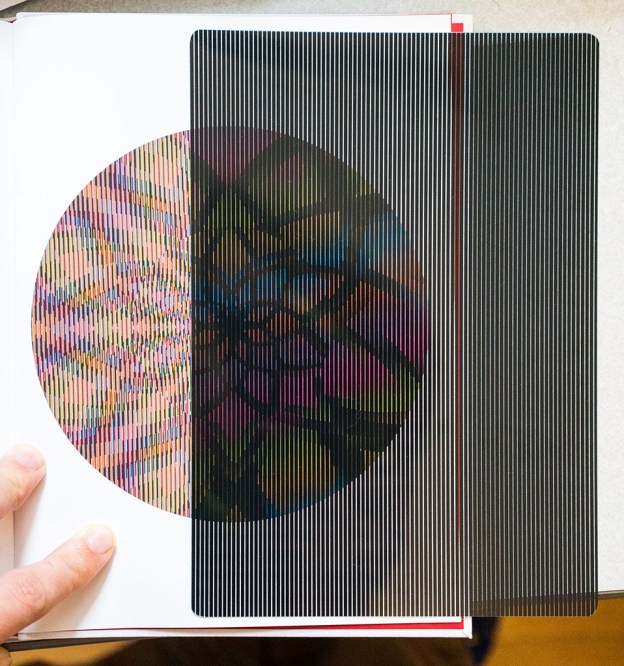
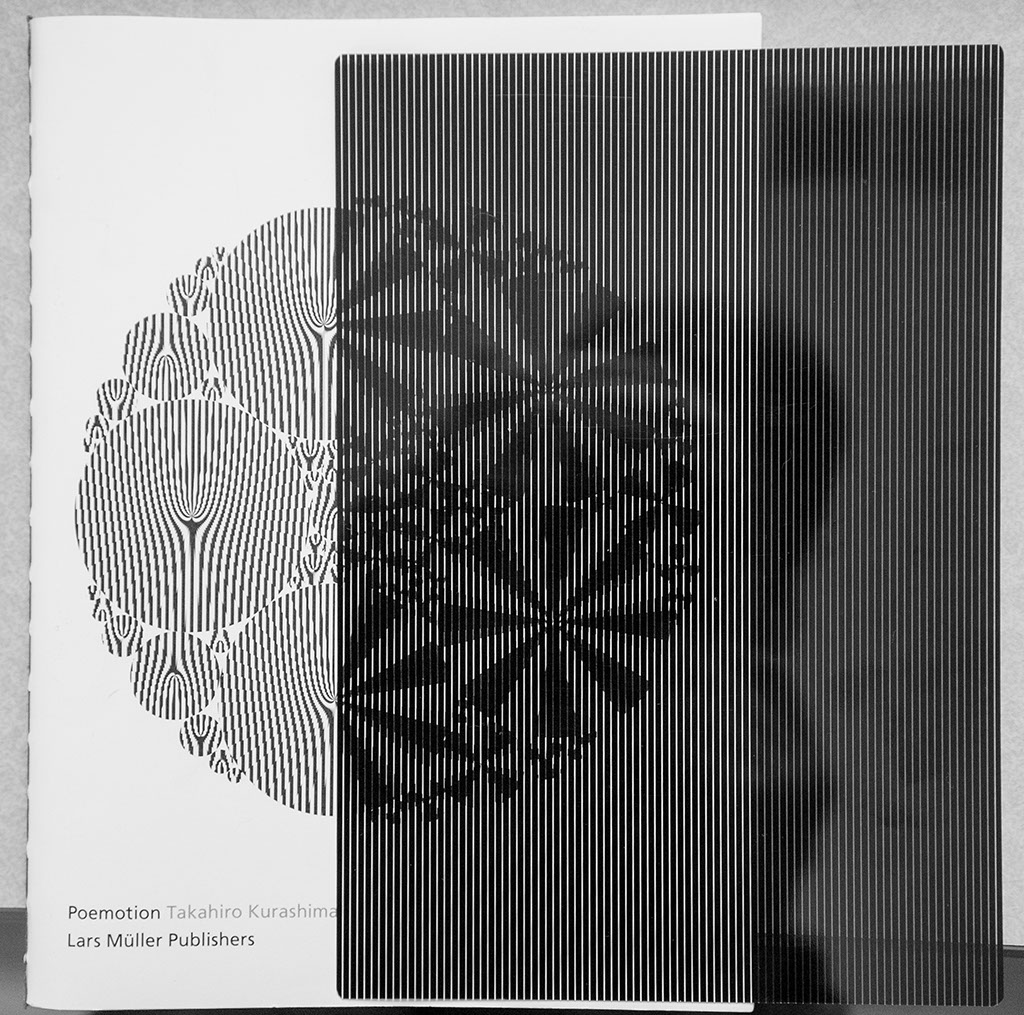
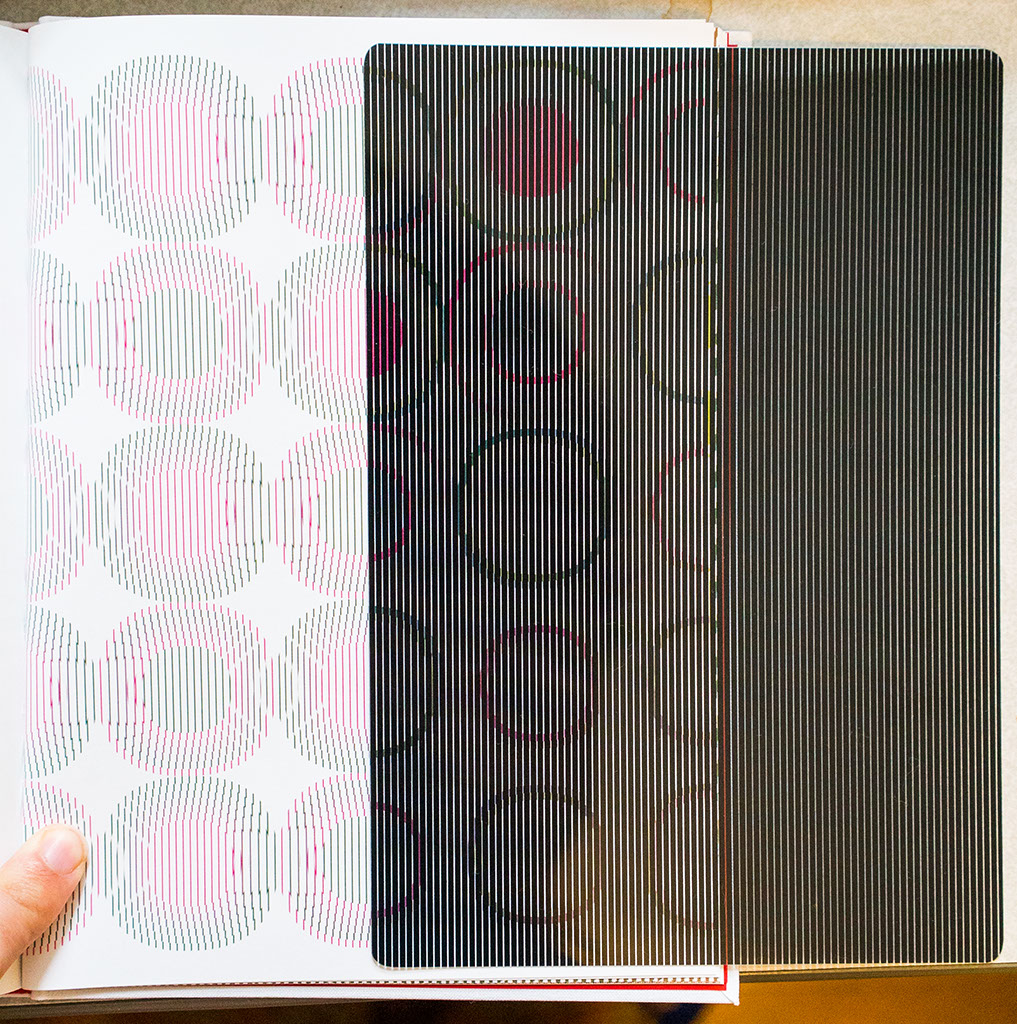
Poemotion and Poemotion 2 books of astonishingly beautiful patterns. They are beautiful because they are so simple and yet I struggle to describe them here. The book comes with a lined overlay, and when the images of the book combine with the overlay, they dance and amaze.

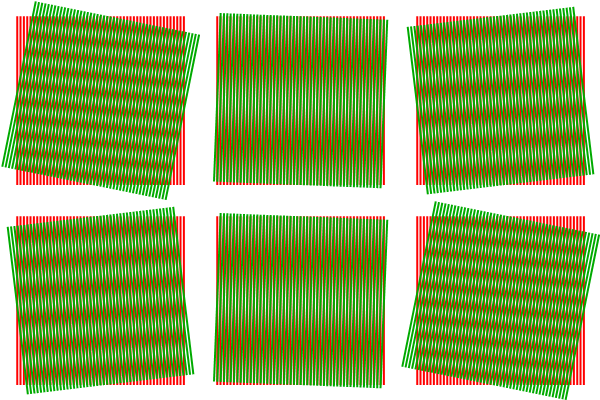
These dancing patterns arise from something called a Moiré pattern, a creature of math and physics. These kinds of patterns naturally arise when two patterns are overlaid.

Moire pattern (wikipedia)


You’ve probably seen Moiré patterns when people wear busy patterns on tv:

We usually associate Moiré patterns with annoying visual artifacts, but science has found several ways to exploit them. Moiré patterns can be used to measure strain in materials. They can also be exploited to take microscope images at high magnification. The little lines on US dollars are designed to create Moiré lines when scanned, as a mechanism for defeating counterfeiters.

Kurashima’s Poemotion (just in black) and Poemotion 2 (in color), contain dozens of Moiré patterns. Every time I look at them, I feel such simple joy. The patterns are so deeply familiar and yet I had never consciously noticed them before. These books made me look at the world differently.

DSC00928 DSC00933 DSC00935

Fun science: An easy fractal to make at home

DSC00224

Viscous fingering is a fractal pattern that occurs when a less viscous (or thick) fluid spreads through a more viscous (or thick) fluid. Such systems are present in oil extraction, when we pump one fluid underground to push another one out. Fractals are common in nature even though they’re new to our mathematics, and they are beautiful.

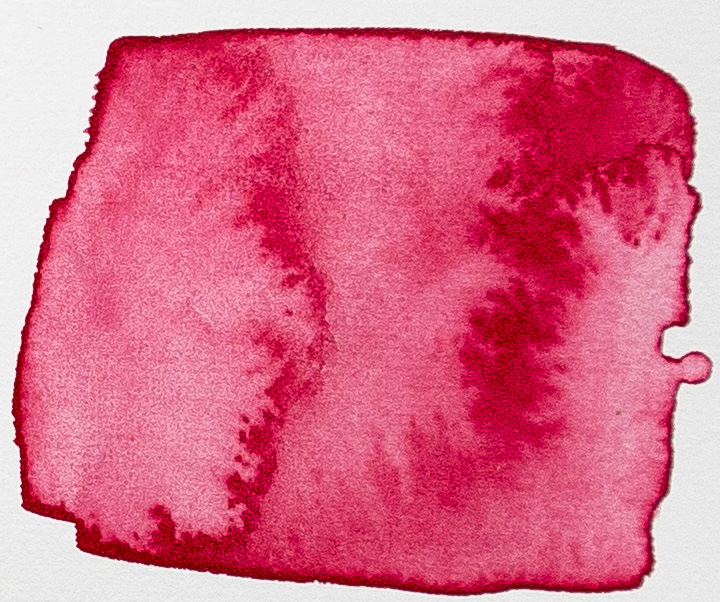
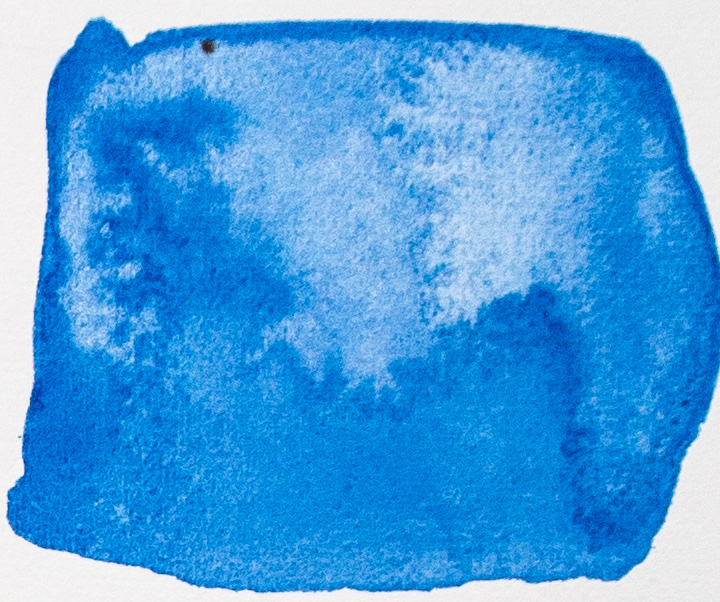
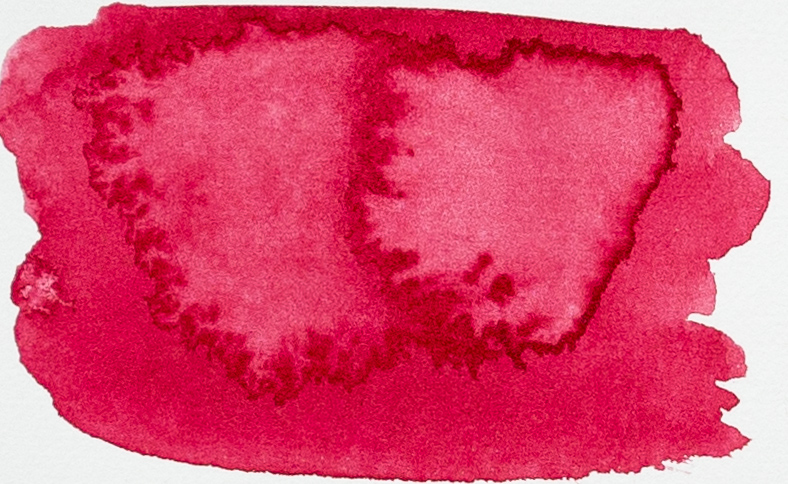
The pictures in this post were created with basic watercolor paints using one simple principle: water containing paint is more viscous than regular water. It’s easy to try at home!

For the top picture, I laid down red paint. Before the paint dried, I added salt, then let the square dry. Water from the still-damp paper rushed to the salt (because of entropy, systems tend towards uniform distributions of things if they can help it– in this case, the lowest energy state is to have a uniform distribution of salt). But because paint molecules are larger than water molecules, they don’t move as well. The water that accumulates around the salt has less paint than the water in the rest of the paper, and thus we have a less viscous fluid spreading into a more viscous one. Try it at home! If the paint is too wet or too dry when you add the salt, the results won’t be as dramatic, so play around a bit. Larger salt crystals can be especially fun.

For the three pictures below, I simply placed a drop of water into a damp square of paint. The patterns vary depending upon the size of my drop, the wetness of the paint, and the paint color (the chemistry of which influences the viscosity of the paint).

DSC00225-2 DSC00225-3 DSC00225


Below are a couple of examples from the University of Alberta of viscous fingering with pentane into oil and water into oil. This particular research aims to improve the flow rate of oil during extraction. And it looks pretty similar to some humble watercolors.

Left: pentane displacing mineral oil. Right: Water displacing mineral oil (University of Alberta).

Color

Color runs through our lives in many ways– it’s how we pick out the ripest strawberries and cherries, it’s how we put together an outfit, it sets a mood and conveys symbolism. Red is passion and blood, white is purity, blue is serenity or even depression.

Colors are human. We see only a tiny range of electromagnetic waves, and the colors we see depend upon the frequency of that light. The colors of the world are there because our brains and eyes interpret them into the tints we see. Our brains give us that beauty.

Human history is full of color. Painters strive for vibrant shades that withstand the degradation of time. We use colors in food, makeup and clothes. Often, though, we don’t consider the origins of color, and how we obtained these colors throughout history. Many were toxic, such as lead white and red cinnabar (a combination of mercury and sulfur). They chemicals were so valuable and prized that people used them even for makeup. Today, we still use eyeshadow and cherry sodas with crushed bugs, which while slightly icky, is vastly safer.

Although we have many more synthetic compounds and colors, these old colors are still sometimes the best. The titanium white we use today is more opaque and less lustrous than lead white, and some suggest it may not hold up as well over time. Red cinnabar used in Roman art retains its color 20 centuries later. In the last two centuries, we have discovered a whole new range of color compounds with the advent of chemistry and globalization. But our goals are always the same, to stimulate the part of our brain that sees color in wiggles of light.

Colors!

Food and science: Our international food

The food we eat today may have been grown on the farm next door or in Chile or in Ethiopia. But thousands of years ago, their ancestors grew wild somewhere. The plants we eat originate from around the world.

Before recently reading Jared Diamond’s Guns, Germs, and Steel, I never appreciated the difficulty of the domestication of plants. Only a handful of plants comprise the majority of our crop production and calorie consumption. Even in thousands of years, many plants have never been domesticated. A domestic plant is a precious thing; without domestic plants, civilization would probably not have arisen.

Scientists can determine the likely wild origins of crop foods by the location of genetically similar wild plants. Tomatoes, potatoes, corn, chocolate, and chile peppers all come from the Americas. Sugar cane comes from India and New Guinea. Rice and soybeans are from China. Onions are from present-day Iran. Cashews are from Brazil.

Pecans are from the Mississippi valley, but they were not grown commercially until the 1880s! Macadamia nuts were the sole domesticated food from Australia, and they were not grown commercially until the 1880s either.

Although these plants come from around the world, you wouldn’t know it from our cuisines and cultures today. Italian food and tomato sauce, the Irish Potato famine, cashews and pineapples and chiles in Thai fried-rice, Belgian chocolate… Although humans have trouble domesticating plants, we are good at adopting them. In antiquity, similar adoptions happened with wheat and rice and millet. For discussion of how various plants influenced history, I recommend the book Fifty Plants that Changed the Course of History by Bill Laws.

It piques my curiosity– 200 years ago, pecans and macadamia nuts were wild. 500 years ago, most of the world didn’t know chocolate or potatoes or tomatoes. With modern science, what will be a dietary staple in 100 years?