Category Archives: writing

Happy 17th Anniversary, Vironevaeh!

Tomorrow is April 15th, 17 years since I did a project about a city named Vironevaeh, chock full of V’s and vowels, because why not? Somehow it never went away, and seventeen years later, it’s hard to imagine life without it. When people ask me what color the sky is in my world, I say purple; it used to be turquoise, but I thought that a white sun was more likely to diffract into the purple frequency range. That’s… usually where those conversations end.

Since the 16th anniversary, I’ve earned my PhD. I’ve started another Vironevaehn history project, and I’ve published my first story set in the Vironevaehn universe. I’ve written drafts for two different novels set in the universe.

But today, I thought I’d post a blast from years farther past. In 8th grade, I wrote my first Vironevaehn book. It was just by hand, and without much planning or forethought, half of it scribbled down during orchestra while my friends patiently ignored my rantings. But I filled a whole notebook with it. 14 years later, that book is one of my most valued possessions. Here I am with it today, and there I was with it 14 years ago, in a Polaroid taken as just another offhand idea.
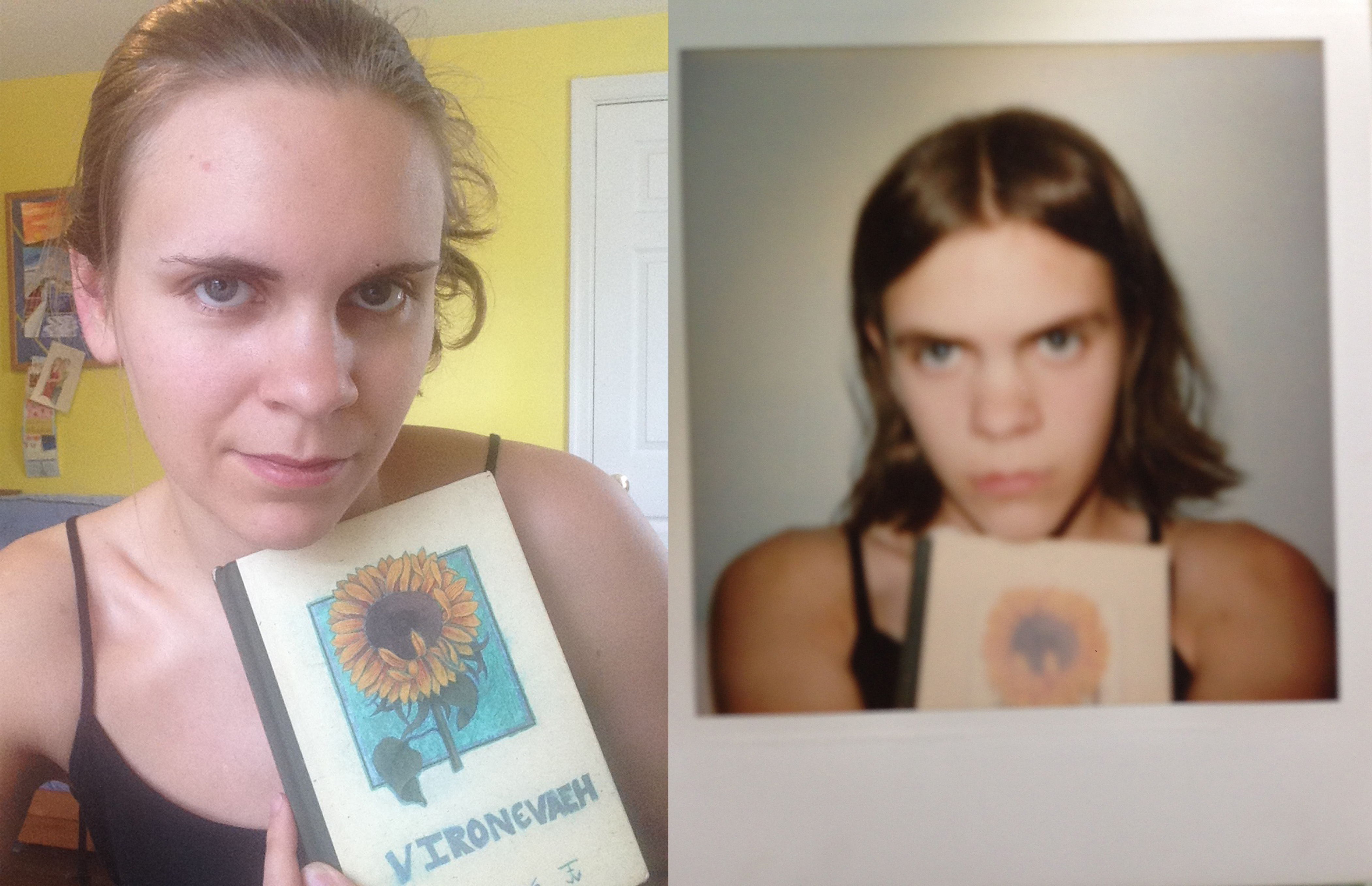
comparison


Create something today, even if it’s silly. The only folly is not trying.
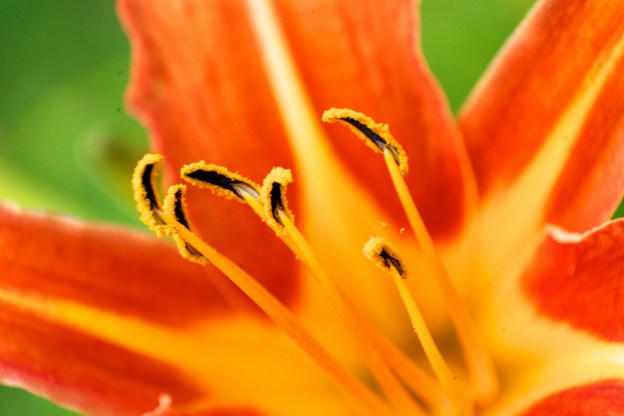
Writing prompt: Modified pollen

Time: 7 minutes. Click here to go to my list of prompts.

“Modified pollen” (quote at bottom by Alfred Tennyson, in ‘The Lotos Eaters’)

The hazard flower came to our county five years ago. Another invasive species, blown in on winds from the south and trucks. No one knows how exactly it came to exist, going on twenty years ago now. Terrorism? Science gone bad? A chance cross-pollination?

Pollen season started yesterday, so often course we are all indoors, with the windows closed and the filtration systems on. The count is still well below two inside, so all is well. It looks so beautiful out, and I am trapped inside with canned air. The season only lasts about a week.

In the last year or two, I’ve wondered… what would it be like? The ‘Lotos Eaters,’ as they call those exposed, seem serene and at peace. Damage to the emotional center of the brain, the doctors say, not so different from a lobotomy. But they seem at peace, and right now, I do not feel at peace. I watch the yellow dust drift, and know that until the hazard crews come and hose it all off, I will remain inside. Once an injured cat lay in my yard during pollen season, and I simply watched, unable to help, but unable not to care.

It’s 75 out, a beautiful day. A lovely day to take a walk.

“Thro’ every hollow cave and alley lone
Round and round the spicy downs the yellow Lotos-dust is blown.”

Writing prompt: An impending storm

Time: 7 minutes. Click here to go to my list of prompts.

“An impending storm”

Enka jabbed at the thin soil with her trowel. If the flimsy little sprouts took to this thin soil, it would be a miracle. She knew that this work was essential, but understanding its importance didn’t make it any more enjoyable. Sometimes Sasha sang when she worked, low and slow, like a dirge. That matched more with how Enka felt about the work.

Around her, people paused in the work. “The tower,” they said. Enka looked up, and indeed, there was a light in the tower. She and the others watched the light, eager to know how severe the coming storm would be. The sky was clear and purple now, but Enka knew not to trust it. She’d heard stories of how confusing the sudden weather was to the Founders. People who lived with radars and satellites and never had to rely on their instincts. Not that instincts did much in the sudden and violent weather on this planet.

Two long blinks. A bad storm was coming. She helped the others pull tarps over the delicate seedlings. Then they would have to find shelter. Sometimes she wondered what the storms must be like for the towerkeepers, so high in the air during such violence, unable to run. A few months ago, one to the north collapsed, taking its keeper and several homes with it. Enka was glad that her own home was not in the shadow of the tower.

A little part of her longed to be up in the tower. Every time the storms came, she hid, and she saw the beautiful violence afterwards. It must be enthralling to stand within. The others had already fled home. Did she really have to be in the tower to stay and watch the storm?

Writing prompt: the woods burst into flame

Time: 10 minutes. Click here to go to my list of prompts.

“The woods burst into flame”


The sky seemed to darken in an instant. Heavy clouds swirled, and lightning flashed. Only a moment ago, it had been a perfect summer day. Around Nadya and Vanya, the woods burst into flames.

“How?” Vanya cried.

Nadya grabbed Vanya’s hand and ran. Vanya had such a habit wanting to know the why of things, and as the flames licked around the great trees, the why was not currently important. Nadya saved her curiosity for the relevant time.

Flames seemed to repel them on all sides. Above, dark clouds still swirled. Flocks of bird and animals also fled the uncanny fire too, and so the air and trees were full of frightened motion. Nadya and Vanya were encircled by flames. There was nowhere to run.

Vanya sat on the ground and began to cry. “It’s so hot, I just want to go home.” He was only six, and even in her frustration with her brother, her heart ached for him. As the big sister, it was her job to provide safety, but she too was tempted to collapse onto the ground and give in. It seemed inevitable at this point.

“Vanya, come with me,” Nadya said, a sudden idea in her mind. It might not save them, but it was something. “Climb this tree with me.”

“But—” Vanya tears paused as confusion took over, “Papa says we must never climb those trees. That children who do are never seen again, or fall to their death.”

“Vanya, look around,” Nadya said, suddenly manic with the idea, “we could use a miraculous disappearance. I don’t know where we’d go, but it couldn’t be worse than here.”

Nadya and her brother climbed the tree. The texture was odd under hand, untreelike. When they neared the top, she heard a sound. It was the piercing cry of an enormous bird. Nadya was so startled she almost fell as the six-foot bird emerged from the storm clouds. One bird grabbed Nadya, and the other grabbed Vanya. The two birds flew high into the sky, and the children looked down onto the burning forest. Nadya hoped that the birds were kindly disposed to children.

Science communication

Science communication is hard, but it’s something scientists should always be striving to improve.

Specifically, we often see the difficulty in communication between scientists and the general public. The concepts discussed are often complex and not fully settled. Scientists often use jargon or scientific methods of communication that don’t translate to the public well. The final result is that scientists and the public don’t understand one another as well as they might, which is a loss for all of us.

On Friday I went to a science communication workshop run by The American Association for the Advancement of Science (or AAAS) to learn about science communication. The AAAS tries to help scientists communicate in all ways–such as with policy makers, with other scientists, and with members of the public. They outlined three points of emphasis to improve communication. We then practiced talking about our research following these guidelines (perhaps I’ll post my spiel in some future post).

  • Communication structure: Scientific papers first provide the background material before stating the outcomes or results of a paper. Popular writing starts with the results and then provides the supporting arguments. In discourse with the public, scientists must follow the conventions the public uses.
  • Audience: A scientist must understand the communication’s audience. Jargon may work within the field, but even scientists from nearby disciplines probably won’t know it. The general public or children definitely won’t.
  • Message: A brief talk or article cannot communicate an entire field. It must communicate two or three salient points. It can be tempting to explain everything to an interested member of the public, but it simply isn’t possible.

In particular, I think the public might be surprised to learn of the difficulties different scientists have in communication. I recently earned my PhD in chemical engineering. When I was writing my final dissertation, I asked my father for help with editing. He has a PhD in chemical engineering as well, and works on advanced data management. It might seem strange, but he struggles to understand my work, and I struggle to understand his. With effort, I made the more general parts of my dissertation accessible to him, but the truly technical parts would have taken him much longer to understand. This graphic of what a PhD is partially illustrates the nature of this problem.

The difficulty two people with the same kind of PhD face in communication highlights the need for us to discuss science communication. As I initially said, science communication is hard. But many important problems today have a scientific aspect or could be examined in a scientific way. As scientists learn to articulate their concerns and findings better, that paves the way for better discourse with the public.

Writing prompt: using an illustration as inspiration

Time: 7 minutes. Click here to go to my list of prompts.

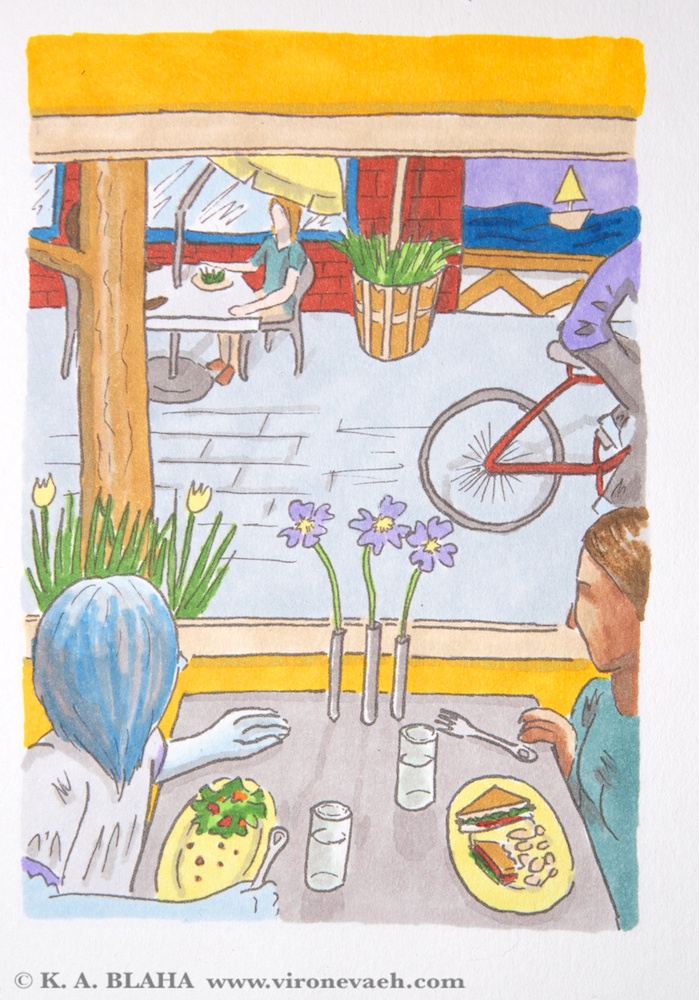
I wrote this prompt while looking at the image below, which I made for my worldbuilding exercises, discussed here.

SONY DSC

Enh and Della sat at the table, staring out the window rather than at each other. Enh hadn’t seen Della in fifteen years, not since that terrible night. And now they sat in a beautiful café, staring out at the sea rather than talking. Out of the blue, Della had contacted her two days before. She still hadn’t explained why, and Enh was growing uncomfortable. In the distance, a sailboat skating gracefully by. Enh wished she were there. Anywhere but here.

“It’s good to see you again, Enh,” Della mumbled again. Enh just nodded this time. Della’s voice, so distinctive, was unchanged, and she mumbled just like she had so many years ago. She paused for a long time. “Don’t you have anything to say to me?”

Enh sighed. “You contacted me. And you still haven’t told me why yet. I didn’t come here to reminisce. I came here because to asked me to, and I’d prefer you get to the point.”

Della’s eye’s narrowed. When she was young, she might have cried, but evidently she was past that. “You always make everything hard. Fine, I’ll just say it. I found out that Intira might be alive.”

Enh dropped her fork. Visions of that night came unbidden. The night they found the bike on the beach, but not Intira. Intira’s angry note, condemning all their undermining, how they had never really been friends. A man who’d seen her running into the ocean. Her clothes, found a month later on the coast.

(As it happens, the end of this prompt became inspired by another illustration, see below.)

SONY DSC

Writing prompt: The Little Viking

Time: 7 minutes. Click here to go to my list of prompts.

“The Little Viking”  (this prompt inspired by a little Viking figurine in my office, as pictured.)

It wasn’t easy for Olie to be the littlest Viking in his boat. Big Thorvald stood two heads taller than him, and most of the others stood at least one head taller. Olie even had a special sword made to be lighter and shorter for him. The others were mostly polite to his face, respecting his moniker of “mad herring”, but they laughed when they thought he couldn’t hear. He heard.

There were advantages to his stature. He knew that, he just wished he could convince the others of it. Once in battle, his enemy, a great hulking man with braided red hair, took a mighty swipe with his sword. Fortunately, Olie was so low the blow only took one horn from his helmet. And then he stabbed the red-haired man and danced on his corpse. But did his boat-mates remember that? No, they laughed at his one-horned helmet.

Then one voyage, Olie spotted a tiny Viking on another boat. Here was a man who could understand him, perhaps teach him battle techniques. At the very least, here was a man who he could drink a lot of mead with. When the boats landed in the trading town, Olie immediately rushed to the other ship, neglecting his duties, but not caring.

The other tiny Viking turned around—it was a lady. Olie’s village used to have women on the boats, but when there were enough men, they opted not to. Here, finally, was a Viking he stood over. He smiled broadly at her.

“Don’t get any ideas,” the woman said, smiling back. “I might be as little as you, but you know as well as I do how hard we fight to make up the difference.”

Her eyes glinted, and Olie saw that she probably would punch him as easily and effectively as any of his boatmates. “This is true. Let’s drink now and save the fighting for later.”

Science Fiction Worldbuilding

One thing I love about science fiction is worldbuilding. When you go to a new place, you take in the architecture, the language, the food, the weather, how someone enters a house, how someone insults another person… These things exist in any culture, but they vary, sometimes radically. In science fiction, the creator tries to imagine these things in a logical and consistent manner for a time that hasn’t happened yet, for planets unknown, with the very constants of life such as gravity and oxygen subject to change. And yet the end product, when successful, is similar to travel–we visit a place that is deeply familiar in the fundamental ways and yet different in ways that provoke thought.

(Some people think that there is too much worldbuilding–I don’t agree. I think the author can tell too much of their own personal worldbuilding process and not consider the reader enough. However, I speak from a place of no authority, so take my opinion for what it is worth.)

In the last few weeks, I’ve been working on illustrations of street life in my city inspired by Hiroshige’s 100 views of Edo. Even after 17 years working on this world, I see many new things this way.

SONY DSC

On the hill in the background is the outline of an old storm tower, shaped a bit like a lighthouse. The old fortifications stood high on the hills with thick walls to withstand the storms.SONY DSC

The view west from a storm tower, to give early warning of storms. In the early days of the city, storms caused flash flooding and devastation.SONY DSCGleaming cities often have unsavory hidden parts, sometimes literally lurking around the corner.

So far I’ve done about 20 illustrations. I’d like to do at least 100. In each one I feel more comfortable with previous details. I’ve looked up references of European and Moroccan and Japanese architecture (mostly the European showing in these three samples). Now I’ve started incorporating old sketches over a decade old. The city feels all the more real to me (it’s great inspiration for story ideas and details), and the work is great fun.


Writing prompt: The Melt

Time: 7 minutes. Click here to go to my list of prompts.

“The Melt”

Elijah strapped the packages and foodstuffs to the sleigh. When they were secured, he went and fed the dogs. It would be a long day for them tomorrow. It was the hard time of year. It was time for the Melt. Each year their small community packed onto sleds to escape the floods of the spring melt. One who left too early faced oppressive cold and winds in the high country. One who left too late faced mud and run off and risked the sudden floods. This winter’s weather had been tumultuous, and Elijah felt uneasily that they might both be too early and too late. This year, perhaps nothing would be right.

#

In the morning, Elijah and his neighbors left their communal home. It would not be there when they returned. Ahead of them stood miles of whiteness, the great fertile flood plain. The world was silent but for the creaking of the ice under the sun. All day long, the dogs pulled the sleds. Elijah and the stronger men and women skied alongside the sleighs. The children and the elderly rode the sleighs.

Late in the afternoon, the party came to a river.

“This ice is no good,” Elijah’s sister Elta said. “Look, cracks run deep into it, and the color is not right.”

“I said we left too late,” someone said.

“We’ll have to go around,” Elijah said, trying to force an air confidence he did not feel. “This has happened before.” It had happened before, but never without death and suffering. The fickle sun shone down, weakening the river further.

Writing prompt: giant sheep

Time: 7 minutes. Click here to go to my list of prompts.

“Giant sheep” (This prompt is loosely inspired by Norstrilia by Cordwainer Smith, which involves ranching gigantic sheep that produce an immortality serum. If you are looking for weird sci-fi, give in it a try)

John’s sheep Dolly stood with effort. She had eaten everything on this patch of the ranch, and regrettably had to drag herself to another patch. This part always worried John. Although Dolly’s bones were engineered to include carbon nanofibers, her tremendous weight still caused fractures sometimes. A few generations ago, the sheep were only 50 feet tall. Now they were 100 feet tall, and maybe that was just too tall.

Dolly sensed the danger, too, and she walked gently, testing each patch of ground before placing her weight more firmly. John stayed well back from her path. She had lost her balance before. Other ranchers had died in this way.

Dolly set another foot down. John heard a cracking sound. “Oh no, oh no, oh no!” He shouted. He ran from Dolly. She gurgled in surprise as a sinkhole opened under her hoof. She tumbled to the ground. Her eyes were wide and she bleated deafeningly. The fall must have injured her.

John sighed. Ohio simply wasn’t Norstrilia, and this stupid form of husbandry should have stayed on that god forsaken rock. He ought to switch to giant chickens.