Writing prompt: dress up your pet day

Time: 10 minutes. Click here to go to my list of prompts.

“Dress up your pet day” (Inspired by this list of silly holidays.)


My alarm sounds. I hear the pitter-patter of soft feet racing to the bed, and feel those feet step on the softest parts of my torso and groin.

“Good morning, kitty,” I croak. I reach over and slap the alarm. I open my phone. Euler purrs like a bulldozer and nearly nuzzles my phone out of my hand.

“Oh kitty, did you not want me to see today’s notifications?” I coo. I scroll through the day’s appointments and reminders. “Today is Dress Up Your Pet Day.” Euler head butts my hand. In his opinion, I should be using that hand to make him happy. I scratch his butt. He flops over and kneads the air.

“You’re happy now,” I say to him, “but we’ll see about later.”


On the way back from work, I swing by WalMart and go to the baby clothes aisle. My mom would love a picture of Euler dressed as a sailor.

Before I even open the door, Euler is crying to see me. I feel bad that he spends so much time alone, but hey, he’s a cat and I work to put food in his bowl. My guilt is not remarkably deep.

I open the door, and Euler jumps on my shoulders. “Kitty!” I shout, dismayed. It’s really my fault, I haven’t trimmed his claws lately.

Whelp, I’ve bled on this shirt now, I think. I take it off, put stain remover on the spots, and switch shirts. Euler purrs and slithers on the bed.

“Dress your pet day,” I say. “And it’s you who’ve made me change outfits. I’m your pet, aren’t I?”

Euler straightens. I’m sure it’s just my imagination, but there is a glint in his eye. A knowing glint. A cold shiver rushes up my spine.

Euler leaps at from from the bed, pushing me into the closet. The last thing I see before I black out is cats holding garments.

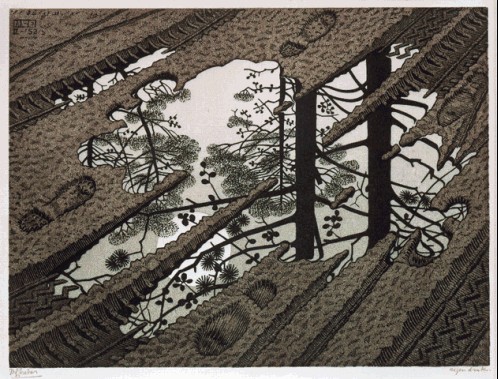
M.C. Escher: revisiting a familiar name

M.C. Escher and Salvador Dalí are two of the greatest reality-bending artists. So, fittingly, the Salvador Dalí Museum in St. Petersburg, Florida recently hosted a special Escher exhibit. I’ve visited the Dalí collection many times, but I’d never seen Escher in person.

I had many Escher calendars as a kid. When I took crystallography, we studied the symmetries in Escher’s tessellations. I’ve always been interested in design and mathematics, and Escher is the purest intersection of the two. I was ecstatic to see the exhibit.

Before the exhibit, I was most familiar with Escher’s lithographs. Without too much elaboration, lithography is a high-fidelity technique which allows the artist to produce an image that is not directed by the mechanics of printing (I’m sure the method does direct some artistic choices, but as a non-expert, that’s my rough take on it).

The exhibit contained many of Escher’s woodcuts, which were new to me. Woodcuts are make by carving a plate of wood, coating the plate with ink, and pressing the plate to a page. The page will be white where the wood has been cut away and the page will be colored where the wood remained. Woodcuts have a distinctive style–they cannot render colors in between white and ink color. Multiple colors can be achieved with additional pressings, but the technique is inherently color-limited.Additionally, the resolution of the print is limited to the fidelity of the wood. These two aspects give woodcuts a distinctive artistic feeling. If you can’t tell, I’m currently a little in love with woodcuts.

Escher died in 1972, but thanks to Disney, his works remain out of the Creative Commons. However, I am allowed to use low-resolution works for discussion purposes. You’ll have to buy books if you want anything with much detail, though. Below are a few of my favorite Escher images that are available through Wikipedia, as I have linked them under the image.

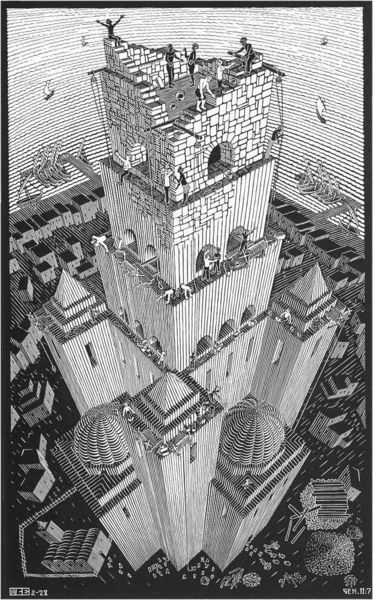
Some of Escher’s early works were illustrations. There was a beautiful cathedral, half underwater. There were evil-looking creatures in forests. It was such a romantic side to an artist most think of as a master of geometry. Below is an example of one of his illustrations. Even though it’s of a conventional subject, the Tower of Babel, the perspective is beautiful. I love the lines; this work just wouldn’t be whole using a method besides woodcut.

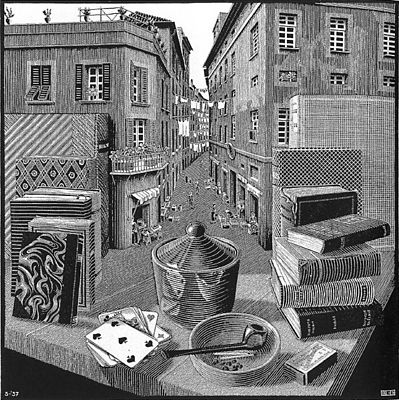
Below was Escher’s first impossible reality. And look, it’s a woodcut! Hooray!

escher2c_still_life_and_street

Still Life and Street: Escher’s first impossible reality

Below is one of Escher’s more famous images. It is a lithograph printing. See how various tones of gray are possible with this technique, as well as high-fidelity. It lends this images a very different tone than the one above. The lizard design is called a tessellation. Tessellations are plane-filling patterns. They occur in nature and area subject of mathematical study. Escher was inspired by the tiling work at the Alhambra in Spain, another example of tessellation.

Below is another Escher woodcut, done with several plates to achieve multiple colors. Even when Escher wasn’t exploring impossible realities of geometry puzzles, he chose interesting perspectives.

Writing prompt: Old rock day

(It’s the new year and I going to restart my weekly prompts! Hooray! I slacked a bit this fall, which means I’m chock full of inspiration, right?)

Time: 10 minutes plus a 5 minute edit. Click here to go to my list of prompts.

“Old rock day” (Inspired by this list of silly holidays.)

After I went to an exhibit on Mars rocks, I was determined to find my own chunk of Mars. I dropped $1500 on a Pocket Geology GC™ Field Testing Kit. The Pocket GC could vaporize a small chunk of rock and run it through a tiny analyzer. Based upon the composition and structure, it could access an online database and tell you how the rock formed, where it was from, and how old it was. Crowd sourcing meant better data every day. If you really needed to be sure, you could send it off for authentic geological testing by certified scientists… for a price.

Only a handful of Mars rocks have ever been found because most rocks just look like rocks. Peering into their history isn’t something human eyes were made for. But since the Pocket GC hit market, the number of samples had grown by 50%.

I drove throughout the southwest. I studied the circumstances of other rock finds. I kept looking. I kept failing, but I was keeping busy, which is important, right?

I found it, appropriately enough, in City of Rocks State Park in New Mexico. It wasn’t a Mars rock; it was something else. I only went there for the scenery; the rocks there are way too young to find a Mars rock. But, so accustomed to fiddling with my hands, I tested an unassuming chunk of rock.

“Origins: Unknown, age: unknown,” my phone displayed, followed by a mess of chemical data. The Pocket GC didn’t return “unknown” too often these days. Sometimes scientists in the lab with new substances stumped it, but after 5 years of crowd supplied data, it had seen almost everything. So I had found something wonderful: a puzzle. I knew I should send it in for the extra testing. But I decided to keep it intact for a few days as a trophy. It was almost a compulsion, I couldn’t stand to hurt it more than I already had for the testing.

I set the rock on the bedside table as I went to bed that night. In the morning, I woke tired. The dreams crept up on me slowly over the next few nights.

My Florida Bird captures

I’m wrapping up three weeks birding south Florida, testing my new 70-200mm lens. I was inspired by a recent photography class through my local Albuquerque photography club, the Enchanted Lens. The instructor showed many beautiful images of birds using 600- and 700mm lenses. I can’t afford 600mm lenses. I wanted to see what I could accomplish with my new (and already very dear) 70-200mm. I’ve had a 70-300mm lens for 8 years now, but it is optically weak. It takes gray, lifeless images. It has a resale value of $12. With my new, colorful, sharp lens,  I’m falling in love with the 70-200mm zoom range all over again.

Below are my captures on this trip. I always learn more when I bring my camera; I get to study for an hour that which I saw for a moment. I see that macaws can have multiple colors on one feather. I find out what macaws are. I see which parts of the color were skin and which parts are feathers.

Some of the images below I shot in the wild. Others I shot at the Peace River Wildlife Center in Punta Gorda, Florida and at the Sarasota Jungle Gardens in Sarasota. I uploaded many more pictures at full res at my Flickr site, and my birds album.

151221-bird-and-sunset-0351-edit-151221

A wild great egret

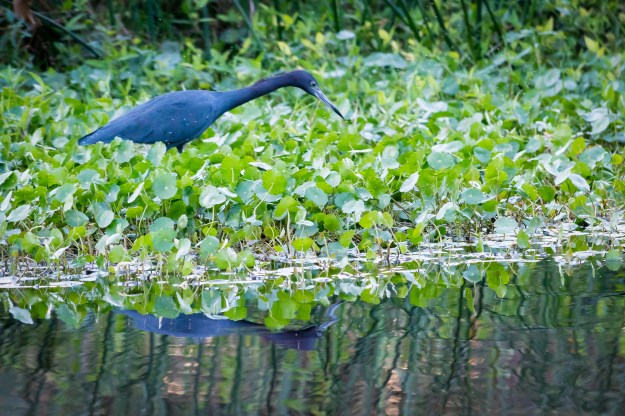
151221-bird-and-sunset-0476

I couldn’t figure out what this guy was! He resembles a double-breasted cormorant, but all the example images I found of them had orange beaks. I found this fellow hunting in the wild.

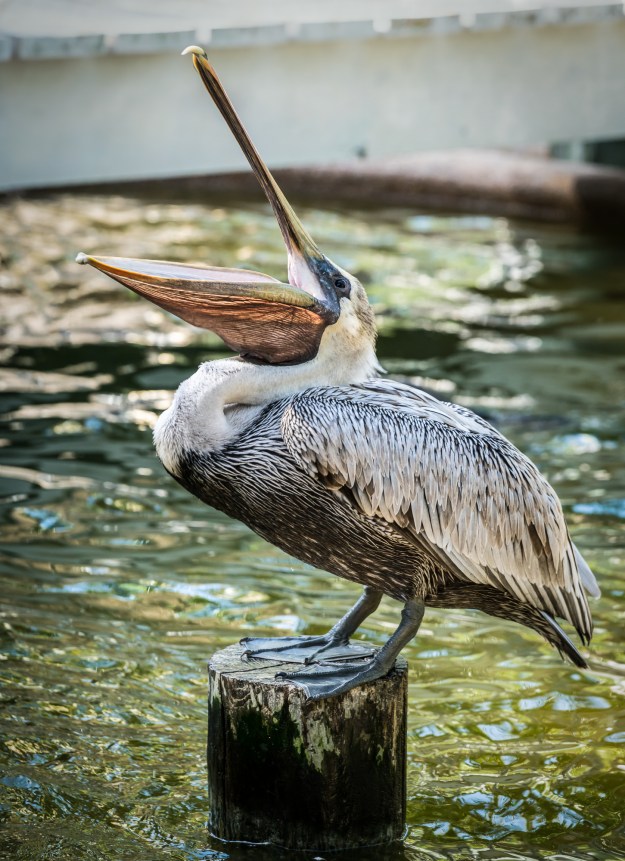
151229-peace-river-wildlife-1102-edit-151229

A brown pelican at the Peace River Wildlife Center in Punta Gorda, Florida.

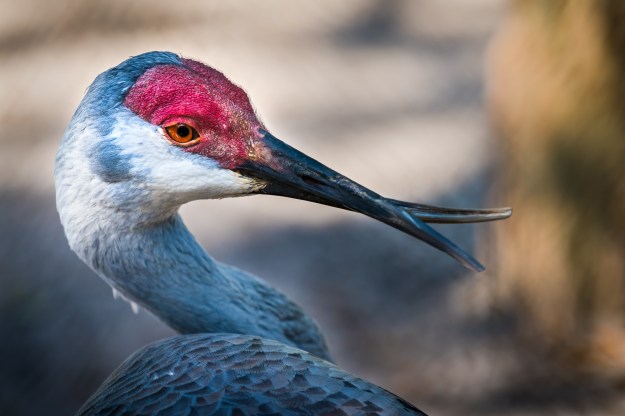
151229-peace-river-wildlife-1124

A rescued sandhill crane at the Peace River Wildlife Center in Punta Gorda, Florida.

151229-peace-river-wildlife-1063

A great blue heron at the Peace River Wildlife Center in Punta Gorda, Florida.

151229-peace-river-wildlife-1192

A yellow-crowned night heron at the Peace River Wildlife Center in Punta Gorda, Florida.

151222-sarasota-jungle-gardens-0814

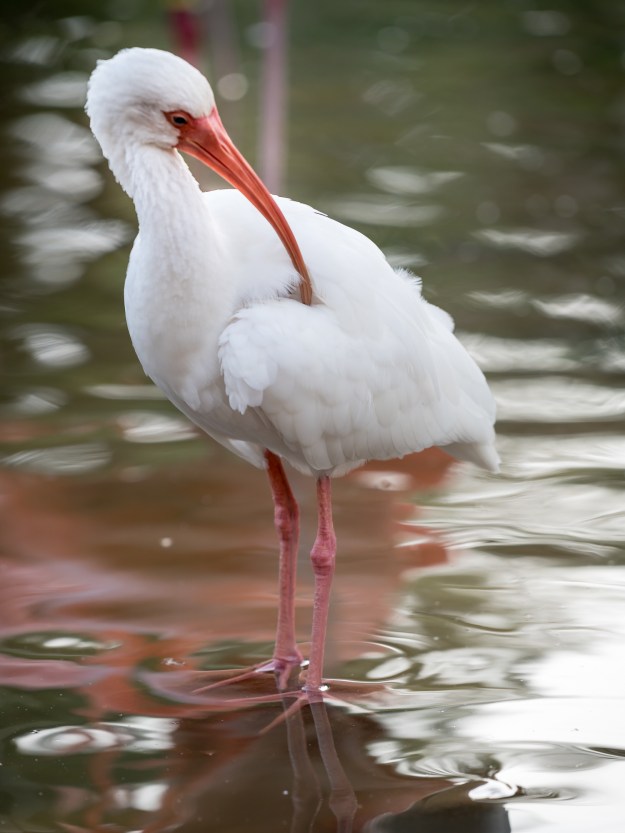
A white ibis at Sarasota Jungle Gardens in Sarasota, Florida.

151222-sarasota-jungle-gardens-0828-edit-151222

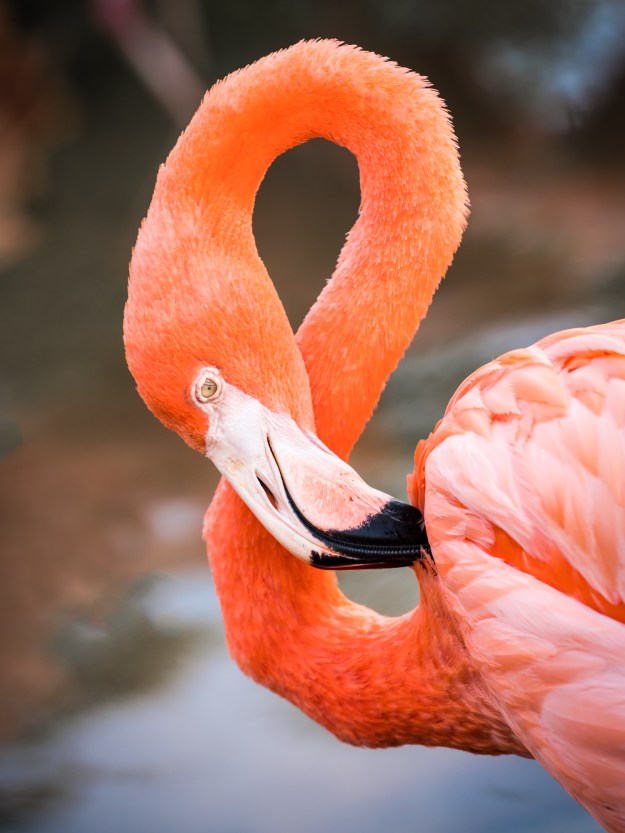
A flamingo at Sarasota Jungle Gardens in Sarasota, Florida.

151222-sarasota-jungle-gardens-0583

An indian ringneck parakeet and a sun conure parrot at Sarasota Jungle Gardens in Sarasota, Florida.

151222-sarasota-jungle-gardens-0617-edit-151222

A hyacinth macaw at Sarasota Jungle Gardens in Sarasota, Florida.

151222-sarasota-jungle-gardens-0550-edit-151222

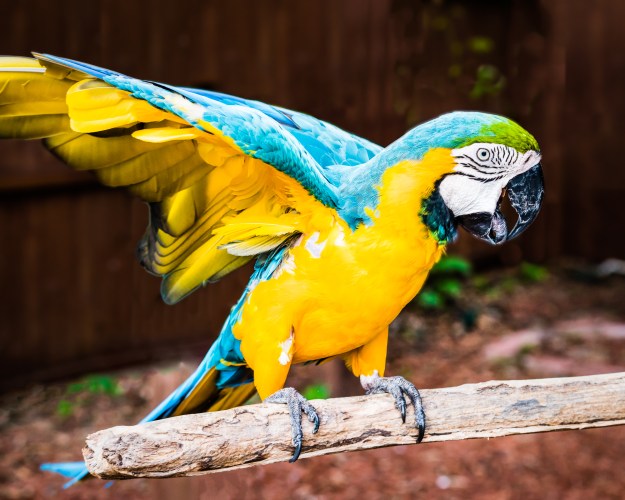
A blue and gold macaw at Sarasota Jungle Gardens in Sarasota, Florida.

151222-sarasota-jungle-gardens-0606

A military macaw at Sarasota Jungle Gardens in Sarasota, Florida.

151222-sarasota-jungle-gardens-0974-edit-151222

A female eclectus parrot at Sarasota Jungle Gardens in Sarasota, Florida.

10 photos for 2015

How strange that this is the last Monday of 2015. I’ve done a lot in 2015. I moved 2000 miles and started a new life. There’s nothing like new digs to inspire photography and boy have I been inspired. Even after the standard culling, I have over 17,000 pictures from this year.

I’ve tried hard to improve my photography, revisiting basic lessons like composition and exposure and flash. I’ve taken photos that I wouldn’t have taken before–and I love them. I’ve committed to learning more about Photoshop, editing, and making the most of my images. I guess the best sign of all is that I’m eager for more in 2016 after all the hours I’ve spent behind the lens and in front of the computer this year.

So, without further ado, ten photos for 2015. They don’t cover everything from the year, but all ten represent different things. It’s great to look back over 17000 photos, you tend to forget some of them!

1

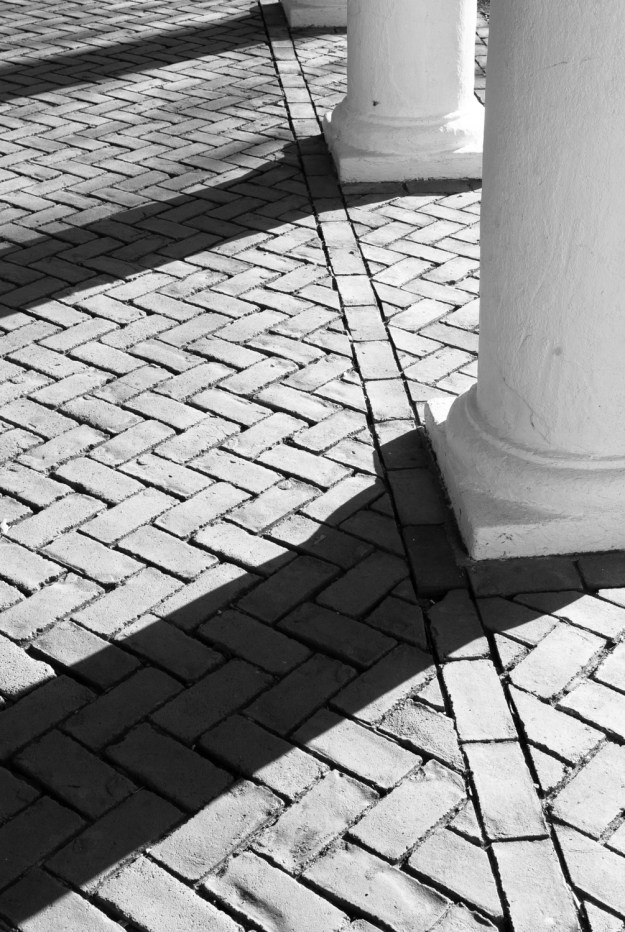
The famous columns and herringbone brickwork of University of Virginia’s Academical Village. And for me, revisiting the basics of composition, contrast, and lines.

2

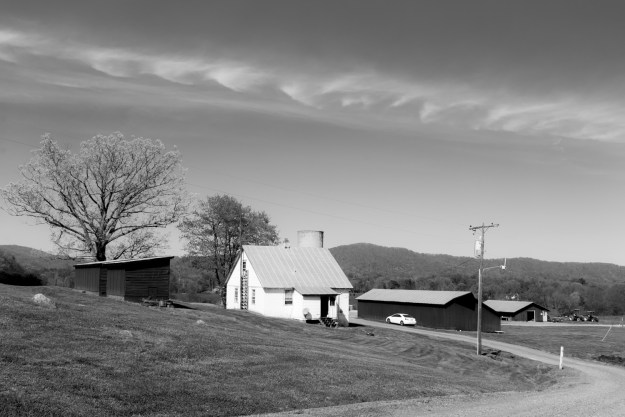
A band of clouds (maybe some variant on Kelvin-Helmholtz clouds?) over a farm in rural Virginia. And a study in black and white.

3

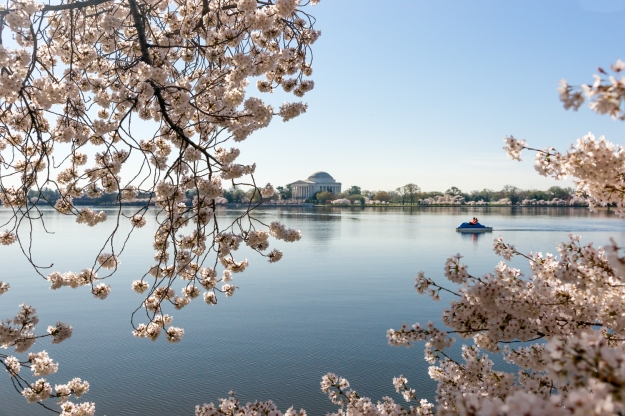
The Cherry Blossom festival in Washington, DC. Perfect blooms, perfect weather. And a composite of two focal depths so I would have my cake and eat it too, photographically.

4

A pinhole of a pinhead. My lovely Chat Noir posing on National Pinhole Photography Day. Pinhole photography is more fun than ever with modern ISO capabilities.

7

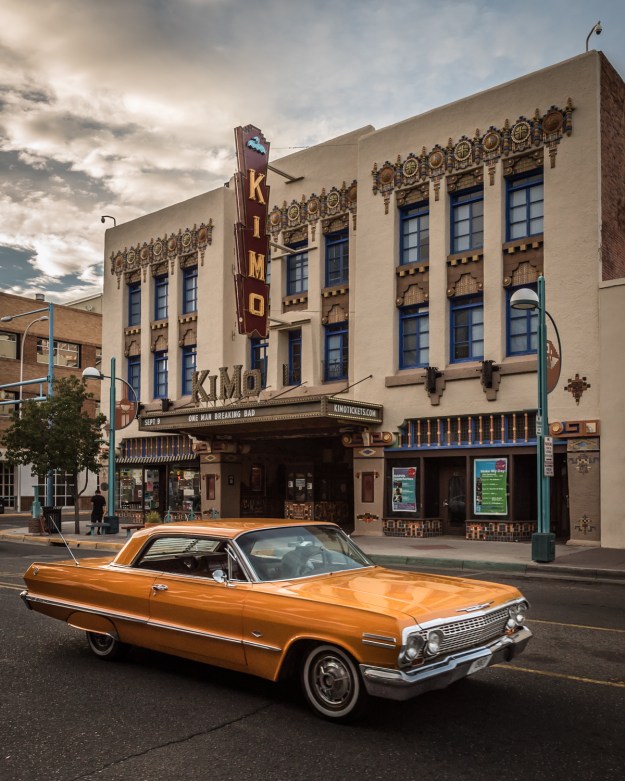
Iconic imagery in a new land. Pueblo deco architecture and classic cars on Route 66 in Albuquerque.

5

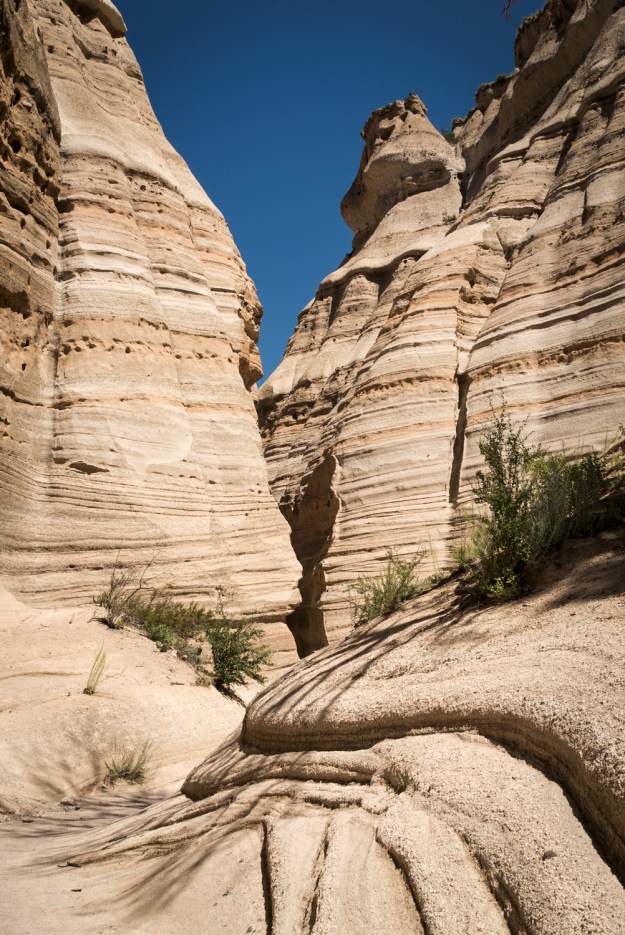
Western landscapes. A slot canyon at Tent Rocks National Monument.

6

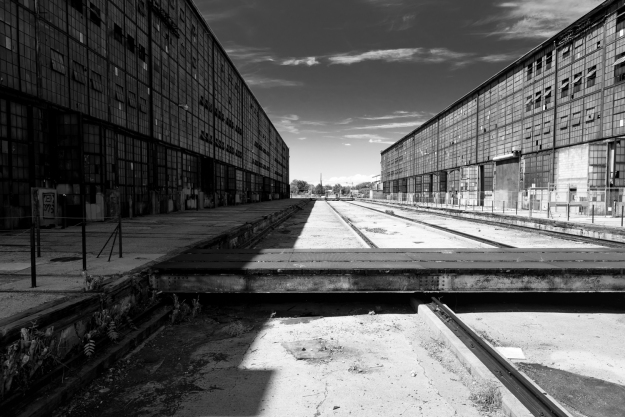
Industrial decay at the Albuquerque Railyards, once the largest employer in the city, now a weekly farmer’s market. And a lot of neat, disused buildings.

9

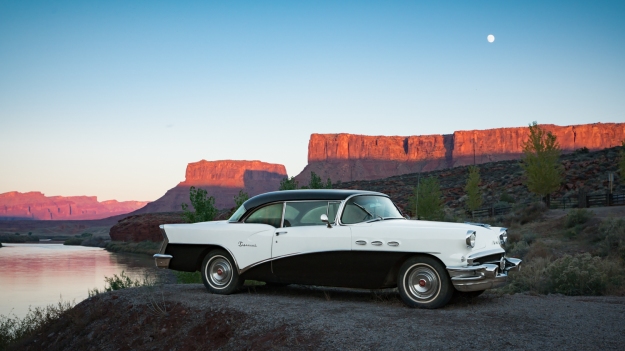
Classic car and red rocks on our October national parks trip. So many of my previous posts are stuffed with images from those journeys that I decided not to include more than just this one. Ten is quite the limit!

8

The day before the Albuquerque International Balloon Festival, balloonists visit local elementary schools and teach kids about aviation.

10

Bird love in Florida. Color, contrast, and life to end the year on a strong note.

Luminarias in New Mexico

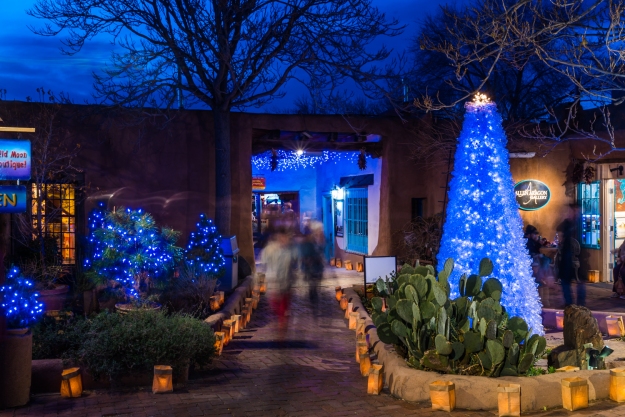
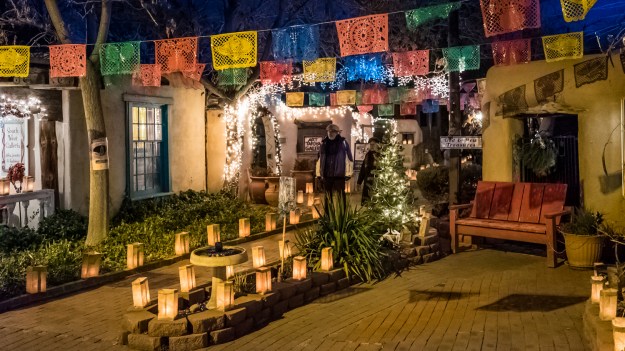
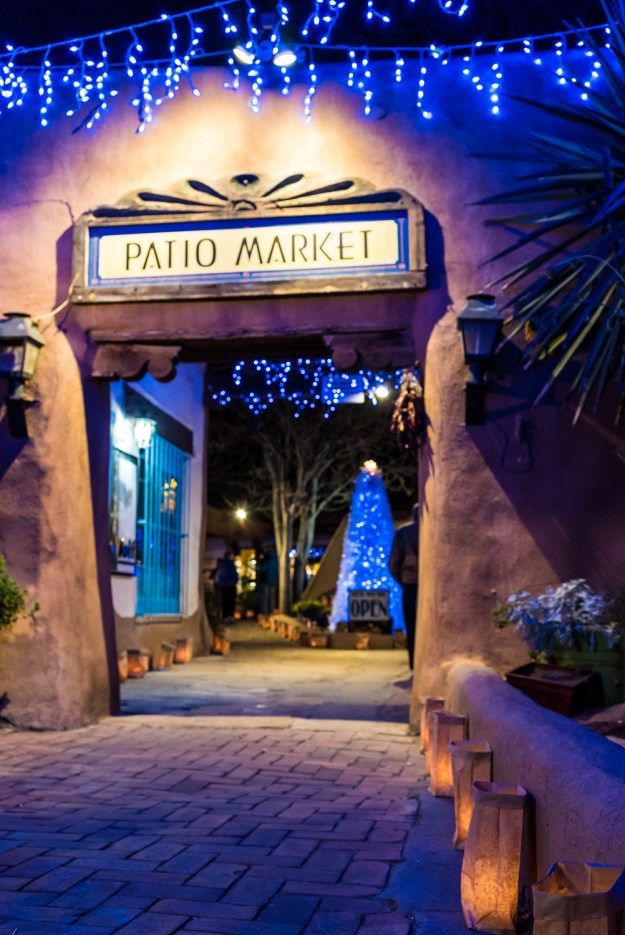
It’s Christmastime, and in New Mexico that means the night is full of glowing paper bags. The streets of Old Town are lit with luminarias, candles in bags that are somehow transformative.

New Mexico is my fourth state in a decade. I’ve lived in Missouri, midwestern and self-conscious; northern New Jersey, its traffic snarled under the spires of the country’s greatest city; and central Virginia,pastoral and historic and preening. New Mexico stands apart. Maybe it feels different because it belonged to a different country until just before the Civil War. Maybe a place that actually gets mistaken for Mars (and is used to study Mars) inevitably feels different. But throughout my short six months in this state, I’ve enjoyed feeling like a stranger in a strange land that is still familiar enough to feel like home.

It’s luminaria season in New Mexico. When New Mexico was New Spain, Spanish merchants brought the tradition of paper lanterns from China . Something as simple as votive candles in brown sacks dates back centuries. And it’s as beautiful as ever to behold.

151204-old-town-lighting-09164

Luminarias in an Old Town courtyard

151204-old-town-lighting-09167

Old Town Holiday Stroll

151204-old-town-lighting-09200

Christmas in New Mexico


A four day weekend goes a ways out west

You can do a lot in a four day weekend in the west. We visited White Sands National Monument, Chiricahua National Monument, the Arizona Sonoran Desert Museum, Saguaro National Park, and Petrified Forest National Park.

The pictures can say more than me. And I’m already a day late on this post! When I updated my operating system, my entire photo preview collection got eaten. Poor computer has been slaving around the clock since I discovered that yesterday. No data lost, but lots of work for compy and about 300 gigs of disc space that’s in limbo. Remember to back up your libraries!

Black and White: Not just for faux artistry

I used to dislike black and white photography. It seemed pretentious and useless; it was for portraits of very wrinkly old people, or still lifes of food. It seemed like an attempt to introduce drama or emotion that I never felt. Unless you were Ansel Adams shooting on silver nitrate, what was the point?

But since that time, I’ve found love for black and white. I found it in photo editing. And understanding the reasons a photographer might choose black and white helped me to appreciate the images. I guess I got there backwards, but regardless, I’m happy to appreciate a new category of photography at last. And if there are any others out there that just don’t get black and white, here are a few reasons that swayed me.

Adding drama that would look artificial in color

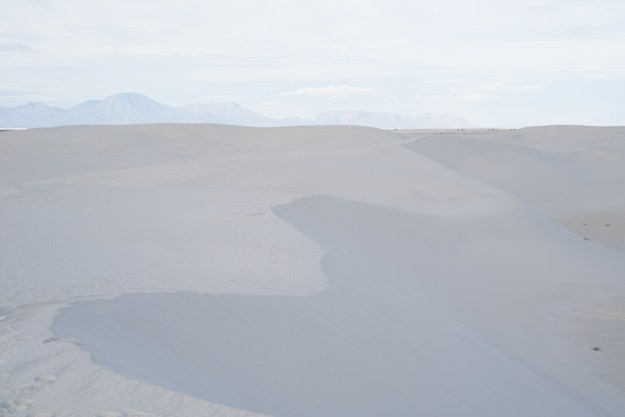
I encountered this situation just last weekend shooting at White Sands National Monument in Southern New Mexico. It was cloudy. White Sands is, as it sounds, a region covered with white sand dunes. Without a light source, it is monochromatic and flat. The mountains in the distance were hazy. The first image below is what the camera captured. I love the composition, but this is not a good image as-captured. It is gray and washed out.

So, I went to work in my editor. I knew this image would be flat when I took it, but I had faith that I could add life in post-processing. I pulled down the blacks, increased the contrast, and pushed the tone curve around. I added a gradient filter bringing up the exposure and contrast on the sand so it would look brighter, but so that I wouldn’t have to over-expose the sky. The second image is what I got. I hated it. The sand looked dingy, rather than the dazzling white it was in person and in the first image. The color balance for the sky and the sand would have to be different. That’s doable, but that means fiddling with masks in photoshop on a photo-by-photo basis, and then having tifs that aren’t as flexible as the RAW format I shoot in. I set my White Sands photos aside to tend to other pictures from the trip, hoping for a revelation at a later date.

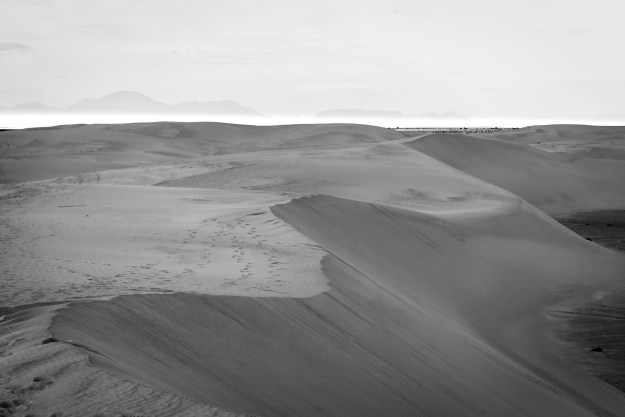
And I had that revelation a few days later: black and white. I took that second picture, added a warm light black and white filter, and had to tinker only slightly to get image #3. I love image #3. The sand is still dark, but I find it plausible without the saturation of image #2.

Black and white isn’t just black and white. As a photographer, you have a choice how to map between color and b+w. You could just use brightness for that conversion, but why be restricted? Maybe you want a nice dark sky, and thus you want blue to map to a dark black and white value. Film photographers used colored glass filters to influence which colors were light or dark in the black and white rendering of the image. They had to make this choice at shooting time because the image captured in black and white. Nowadays with digital, we capture in color and can make choices in the comfort of an office chair. A warm light filter brightens the warm colors of the image and darkens the cool colors of the image.

Image #4 shows what image #3 would look like with a cool light filter (with bright cool colors and dark warm colors). In my opinion, image #3 is the obvious winner. But you can see what a difference the bw/color mapping makes. Other than the bw filter settings and an exposure adjustment to avoid overexposure, images #3 and #4 are the same. They don’t feel the same at all.

San Andres Mountains behind White Sands

Image #1: Without any edits

San Andres Mountains behind White Sands

San Andres Mountains behind White Sands

Image #3: Black and white #1, using a warm light filter.

San Andres Mountains behind White Sands

Image #4: Black and white #2, using a cool light filter.

Directing the viewer’s eye

Sometimes I like to use black and white to clarify an image. In this case, the image isn’t a disaster to edit in color, it just doesn’t need its color info.   At best, the color is irrelevant, and at worst, it can be distracting.

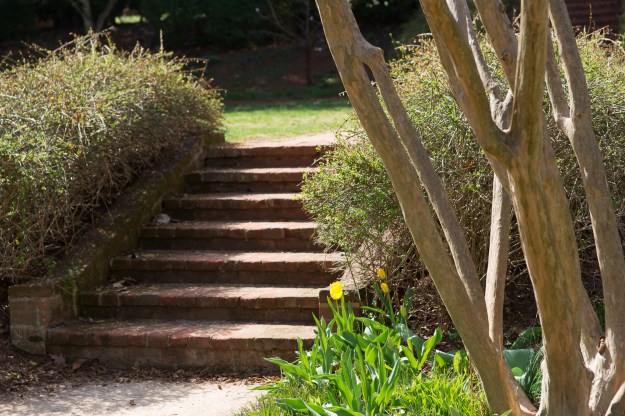
In the first pair of images below, I liked the different linear elements, some horizontal, some vertical; some organic, some artificial. The browns and reds and greens of this image aren’t terribly impressive, and they don’t contribute to this narrative I wanted to convey. I felt that leaving the color would convey nature as the subject rather than the abstraction I wanted to convey. So I changed image #1 to image #2. I did this edit 8 months ago. Now I look at the black and white and want to push the contrast harder on the tree; perhaps if I did this edit again I would brush some contrast in.

SONY DSC

Image #1

SONY DSC

Image #2

In this pair of images, again I was interested in an abstraction. I took this photo as part of a photography prompt: photographing light. The windows of a building across the street were reflecting light onto these windows. The window-vs-window aspect intrigued me. But other than the window reflection, the image was of a drab building wall in shadow and a slightly washed out sky. Not very exciting. By removing the color information, I thought the image more truly captured the “photographing light” prompt that I wished for it to convey.

Windows and reflections of windows

Image #3

Windows and reflections of windows

Image #4

Of course there are other reasons to edit to black and white. Sometimes it is to convey mood or to fit a theme. But the examples above are reasons that didn’t occur to me when I first started shooting. And they offer a lot of creative options that I didn’t realize either. Black and white can be dynamic and fun!

The Mineral Maketh the Monument

I spent my holiday weekend exploring New Mexico and Arizona. I visited four national park service sites. I played in the sand, hiked amongst stone columns, walked through fields of trees turned to sparkling stones, and looked from a volcanic plateau over a desert of color. I visited White Sands National Monument, Chiricahua National Monument, Saguaro National Park, and Petrified Forest National Park, and with the exception of Saguaro, I was struck by how little flukes of crystallography and geology birthed the places of beauty I admired.

White Sands National Monument

White Sands National Monument is located in southeast New Mexico, not too far from Roswell. The national monument is surrounded by White Sands Missile Range, which contains the Trinity Site (which by the way, looks rather dull from the road, just a plaque. There were a lot of cattle grazing nearby, amusingly). Occasionally, the monument closes because of tests on the missile range. The morning of the day we visited, an F-16 crashed in the missile range (the pilot was okay).

White Sands National Monument is made up of gypsum sand. That sand is actually why it’s a missile range. It’s brilliantly white, and thus makes a great target. Check it out on google earth, it really sticks out.

Gypsum is water soluble, so gypsum dunes are pretty rare. The White Sands dunes exist because the Tularosa Basin in which it sits has no drain. The dunes are basically a dried lake bed–a small lake does exist at the southern end of the park. In my humble opinion, gypsum kicks silica’s (normal sand) butt. The grains are very fine. They sell sleds in the gift shop, and families went sledding on the dunes. The sand doesn’t capture heat like silica sand does. And when you get sand in your mouth, as you will when sledding or when you drop your water bottle in  the sand like I did, it dissolves. Truly, the gypsum sand dunes are the closest thing I’ve ever seen to warm snow.

(Gypsum is generally just a cool mineral. Selenite is composed of gypsum. If you’re in a rock shop, find a piece to look at. Selenite has what is known as birefringence–if you set it on text and look through it, you’ll see that text twice. Gypsum also is what desert roses are made of. Selenite crystals have been found up to meters long in caves in Mexico. Gypsum is also what makes drywall. And gypsum is just calcium bonded to sulfate. Chemistry is wonderful stuff.)

The White Sands National Monument is spectacular, more spectacular than many national parks I’ve seen. The nearby Organ Mountains are beautiful too. I suspect this would be a national park, if not for the air force wanting to bomb it from time to time. It is absolutely worth a visit– but it is in southern New Mexico, so perhaps at a cooler time of day or year. On November 25th, it was a high of 75, and it was great.
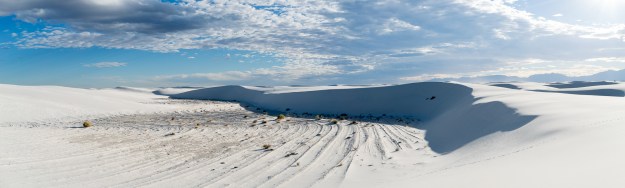
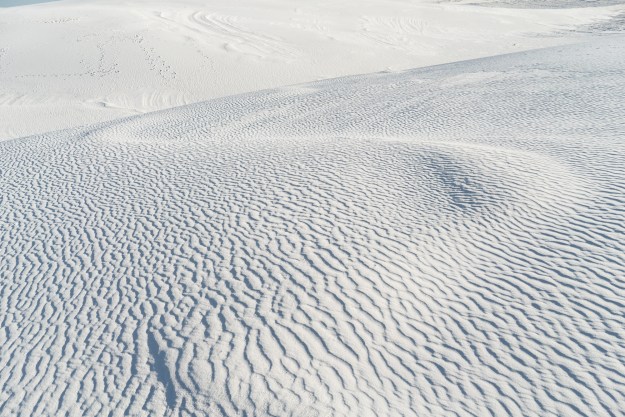
151125-white-sands-06624-Pano151125-white-sands-06654151125-white-sands-06022

Chiricahua National Monument

Chiricahua National Monument is the 14th least-visited national monument of the 114 national monuments in the country. I thought it was paradise. There aren’t many places this beautiful that you can enjoy in relative privacy. Unlike many of the little-visited national monuments in New Mexico, Chiricahua has quality paved roads all the way to and into the park. It’s only a 40 minute drive from I-10 in southeastern Arizona. If you happen to find yourself in that part of the country, Chiricahua is worth it.

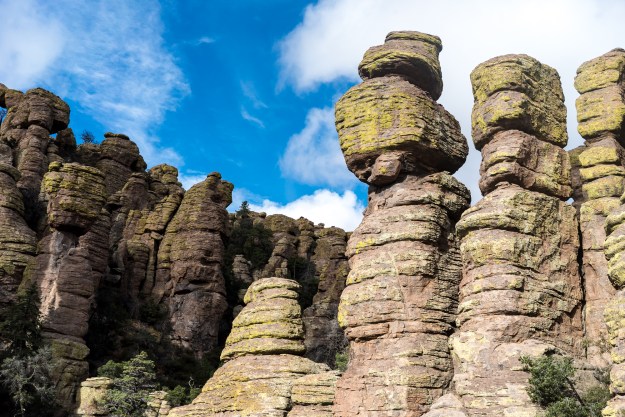
The magic mineral in Chiricahua is volcanic rhyolite. Rhyolite is chemically similar to granite, but it forms differently. It cools faster at the time of formation, and therefore has smaller crystals. The rhyolite at Chiricahua formed with tension in the rock, leading to cracks called joints. Over millions of years, wind, water and plant life have worked at those cracks and led to the thousands of rhyolite pillars that fill the park. Much of the work was done in the CCC era… walking around I marveled at what hard work that much have been in this park, and yet 80 years later the park is still relatively unknown.

Chiricahua has been one of my favorite hikes yet. We did the Echo Canyon loop trail, which is chock full of great sights. You see columns up close and at a distance, with relatively little pain for a 3.3 mile trail. Several other longer trails looked like fun, and I intend to be back to check them out.
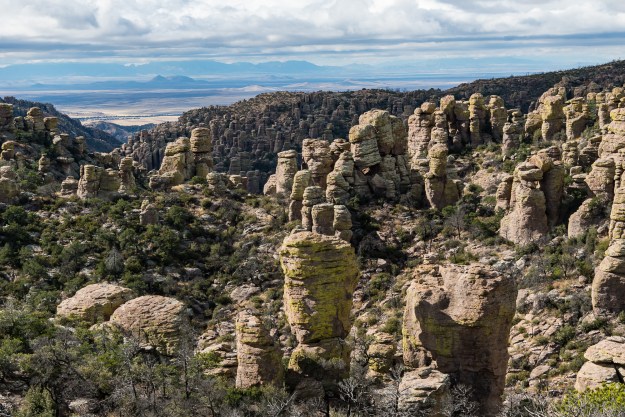
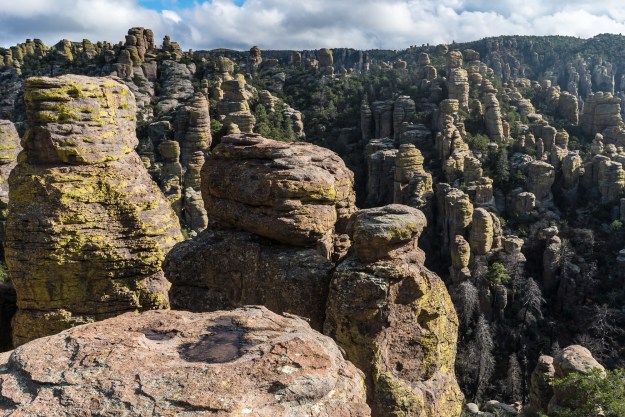
151126-chiricahua-07025151126-chiricahua-07153151126-chiricahua-07206

Petrified Forest National Park

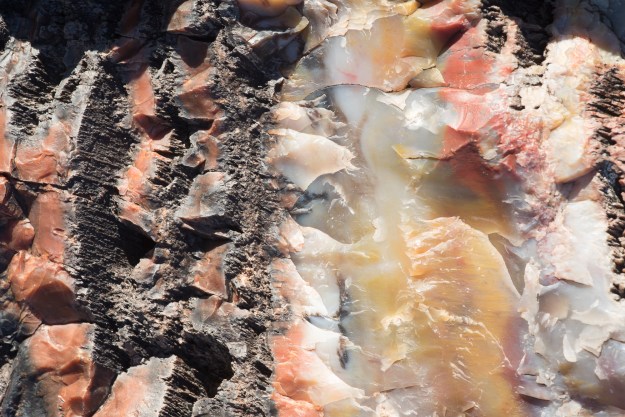
Although this was the most famous of my destinations, the miner0logy for this one was the toughest to research! Petrified Forest National Park contains its eponymous petrified wood, but it’s also famous for the colorful sands of the painted desert. I found lots of information on petrified wood; it is formed by felled trees that, because they get buried for some reason, are not subject to the normal decay processes. The wood turns to agate (like those agate slices from geodes that I used to collect as a kid) and the result is beautiful colors and stone. Some of the wood is imperfectly agatized, and still contains ancient DNA, which is also cool. It’s pretty cool to think that the grassland desert of Petrified Forest was once an equatorial forest full of enormous trees. What a difference 200 million years makes!

The painted desert was harder to research. The different colors are due to different layers of rock from different eras. But I wanted to know why some were blue or red or purple or yellow! What chemicals? The internet is built by geeks of the bit variety and less the atom variety, so my struggle turned up little in the initial investigation. So, I take it as a great challenge for a future post!

Petrified Forest was a bit cold this time of year! The low overnight when we were there was 22. So I must recommend it with a tad more warmth. But the hiking was great. We did a backwoods trail by the Jasper Forest and walked along the dirt road that once brought stage coaches from the railroad station. If such a landscape feels alien to us, with TV and internet bringing us HD video of any place at a click, one thinks what a landscape felt like in 1906 when the park was designated as a national monument. Even today, it’s an open, austere place, full of ruins 200 million years old.
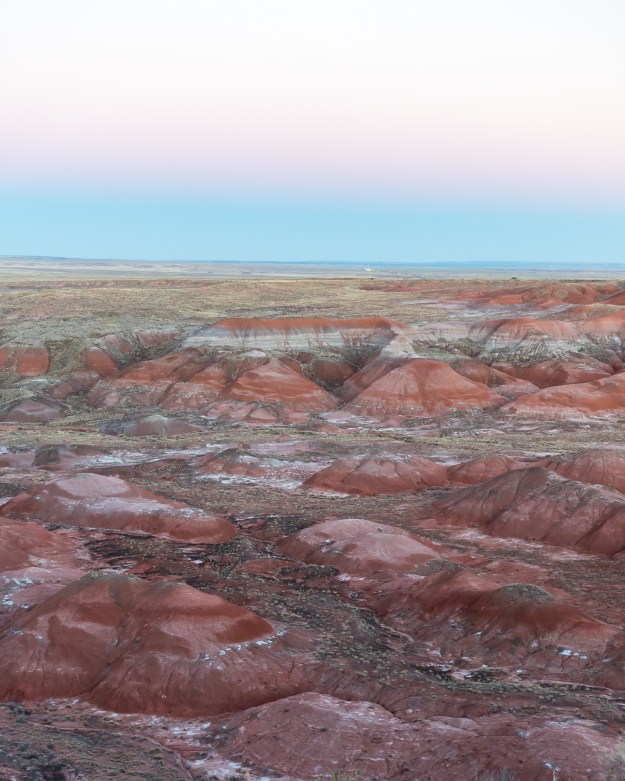
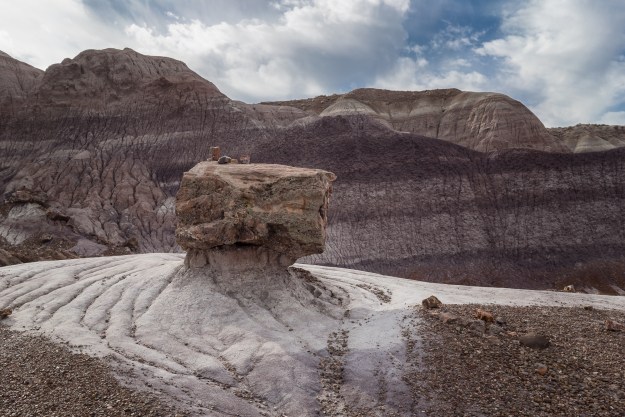
151128-petrified-forest-08657151129-petrified-forest-08839151128-petrified-forest-08492

A Thousand (non-paper) Cranes

Every year, sandhill cranes migrate south for the winter. They winter in Florida and the gulf coast and California. You might be surprised to hear that they winter in New Mexico. And they do, by the thousands. And one of the places they winter is the Bosque del Apache National Wildlife Refuge, about 90 miles south of Albuquerque.

This past week, Bosque del Apache hosted its annual Festival of the Cranes, a wildlife and photography event focused upon the large wintering population of cranes. The festival hosts classes, workshops, and lots of bird-obsessed topics. We visited the festival on Friday. And we saw a ton of cranes. But we also saw thousands of snow geese, several deer, at least a hundred turkeys, a western screech owl, and several raptors.

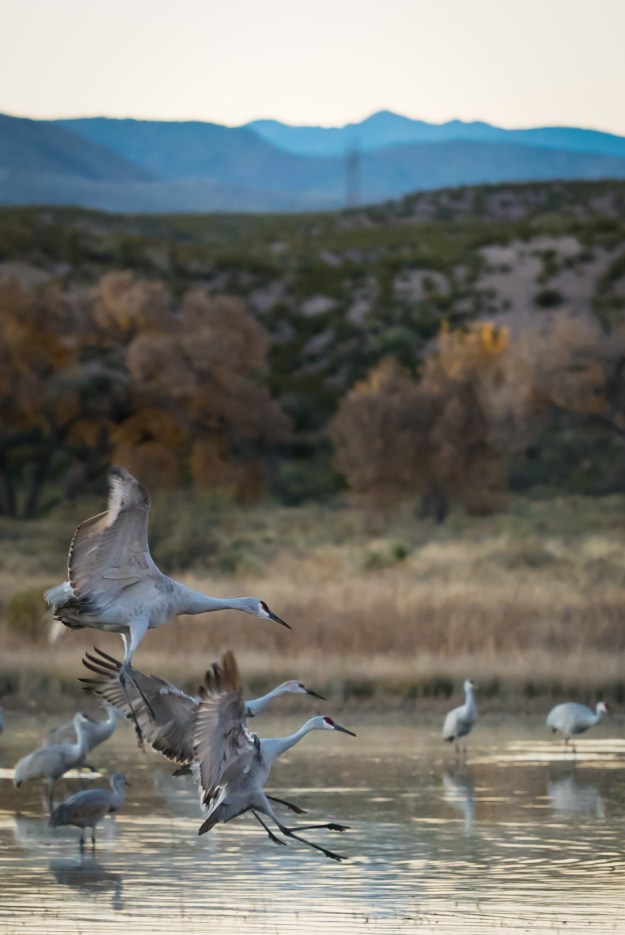
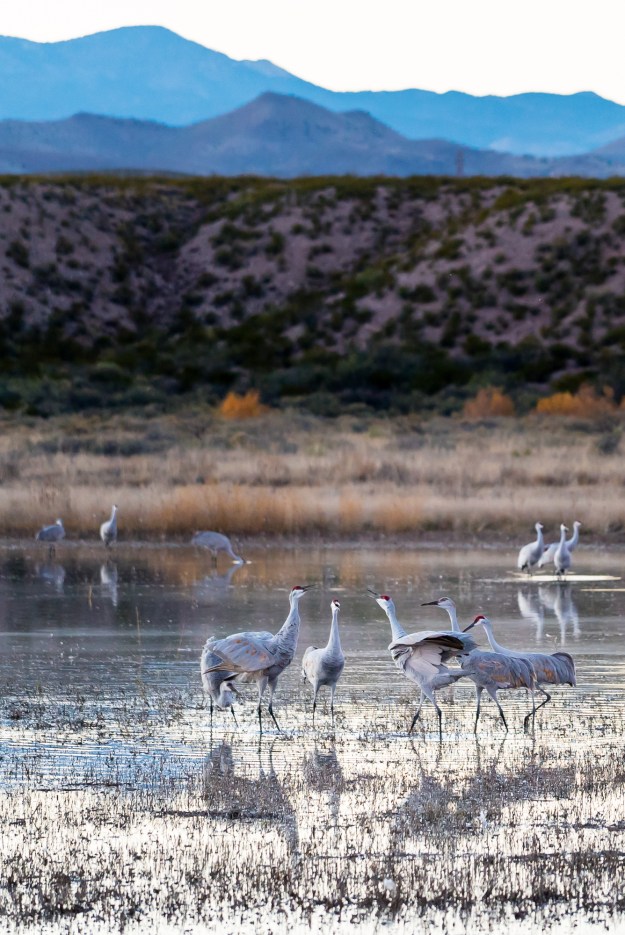
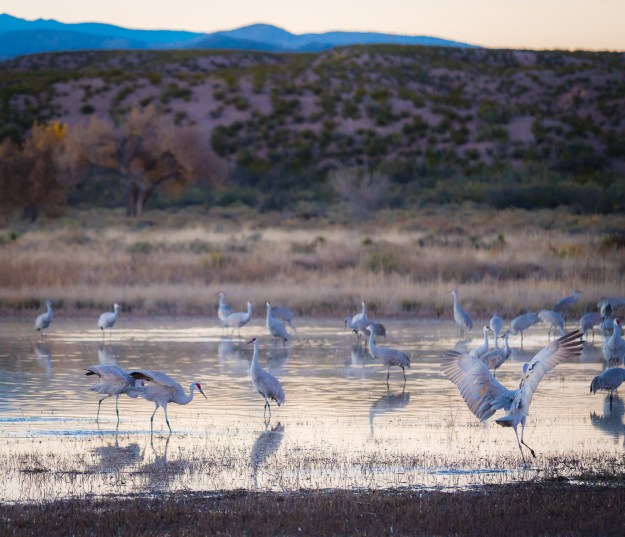
Our guides told us that the refuge was established in 1939. Canals and ponds were constructed with CCC labor. In the first year that records are available, 1941, the refuge hosted 19 cranes. Nowadays, the estimates run closer to 20,000. It is not something I expected to find in New Mexico. At sunset, we watched hundreds of them glide in to land, and we watched the somewhat-territorial birds squawk at each other and vie for space. It’s truly a wildlife experience that can be had with little expertise and little hiking. The cranes are around until February this winter and every winter. I know I’ll be back.

151120-festival-of-cranes-05727

Cranes landing at sunset in Bosque del Apache National Wildlife Refuge in New Mexico.

151120-festival-of-cranes-05652

151120-festival-of-cranes-05791

Territorial negotiations amongst cranes. The ones with red crests are adults, and those without are juveniles. Amongst the six cranes in front, the bent over leftmost crane and the second-from-right are the two juveniles. Cranes have very strong family units; two interact here.

151120-festival-of-cranes-05735

151120-festival-of-cranes-04760

Cranes in a field of corn.

151120-festival-of-cranes-04642