Tag Archives: books

Making Lovely Books

As my blog might reflect, I have a tendency to lurch from one area of interest to the next. Last week, my interests moved again to bookbinding. The pile of lovely paper and fabric sitting in my office called out. (hollanders.com has some lovely stuff.) So I tried a few new things.

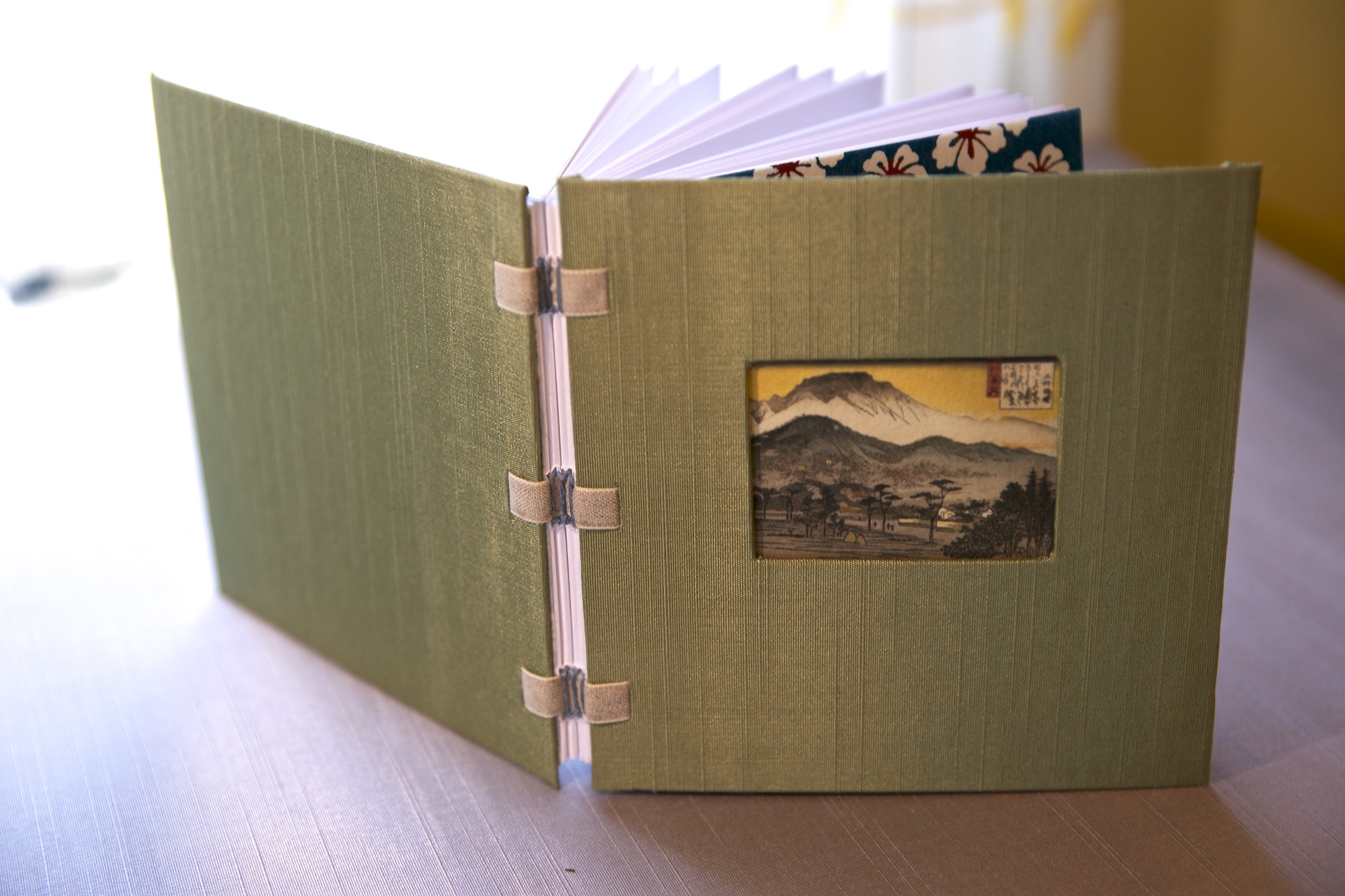
The book below is covered with Japanese linen. I used an exposed stitch on the spine, and exposed linen tape. This is the first time I’ve cut a hole in the cover. Appropriately (see last week), I found a Hiroshige painting in the creative commons to use in the hole.

SONY DSC

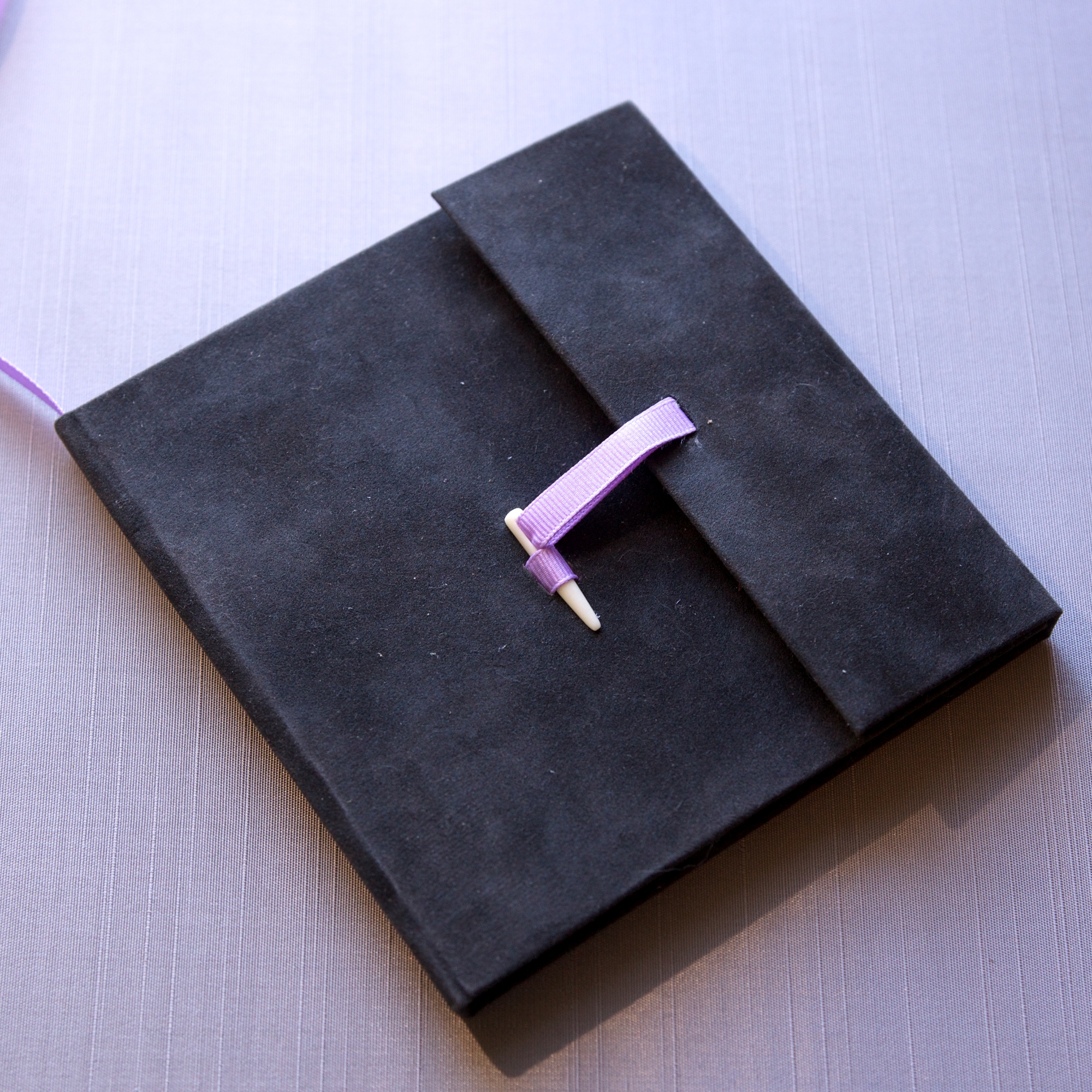
Next I made a book that closes in the front with a bone clasp. The cover is black imitation suede.

SONY DSC

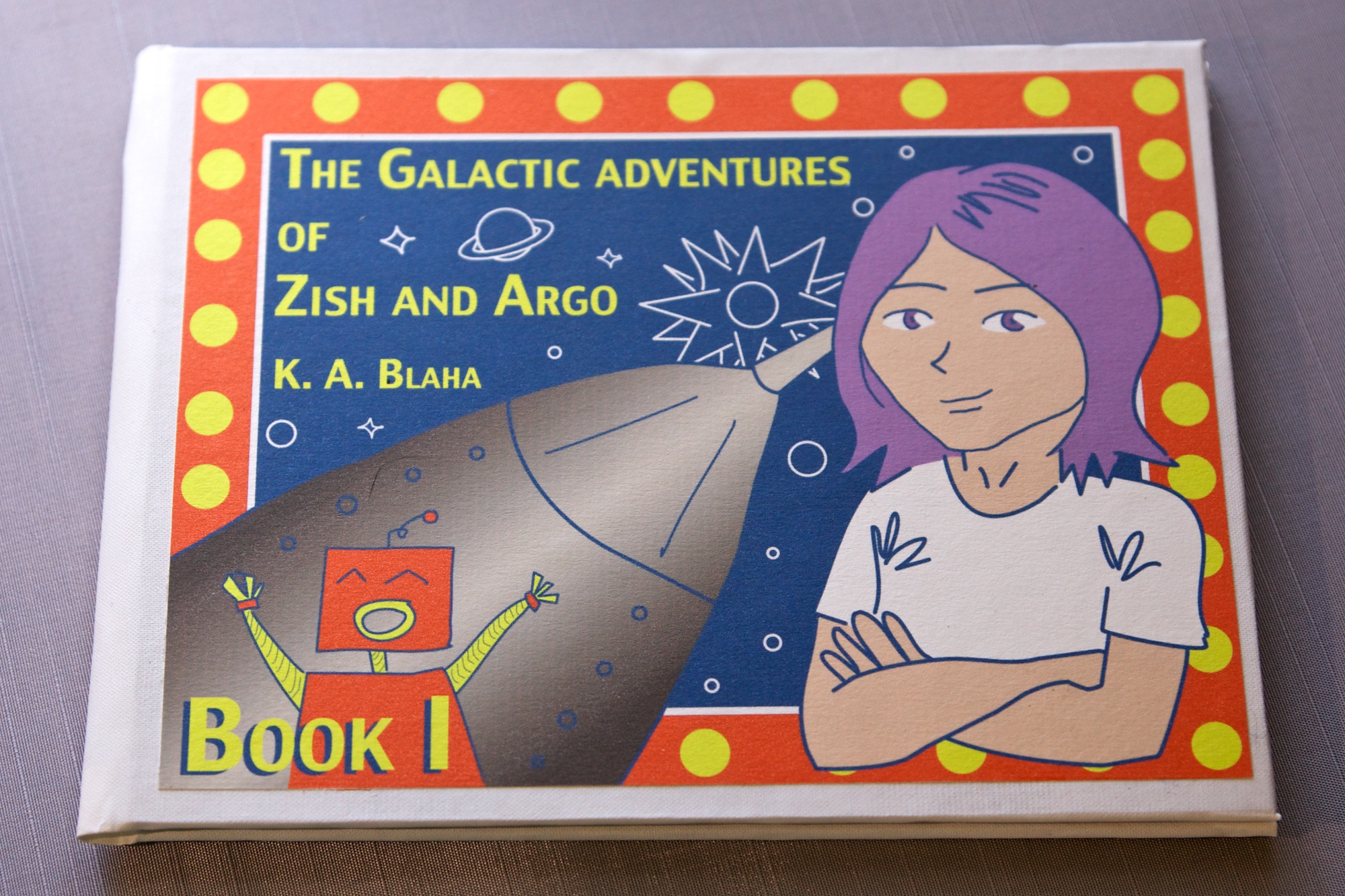
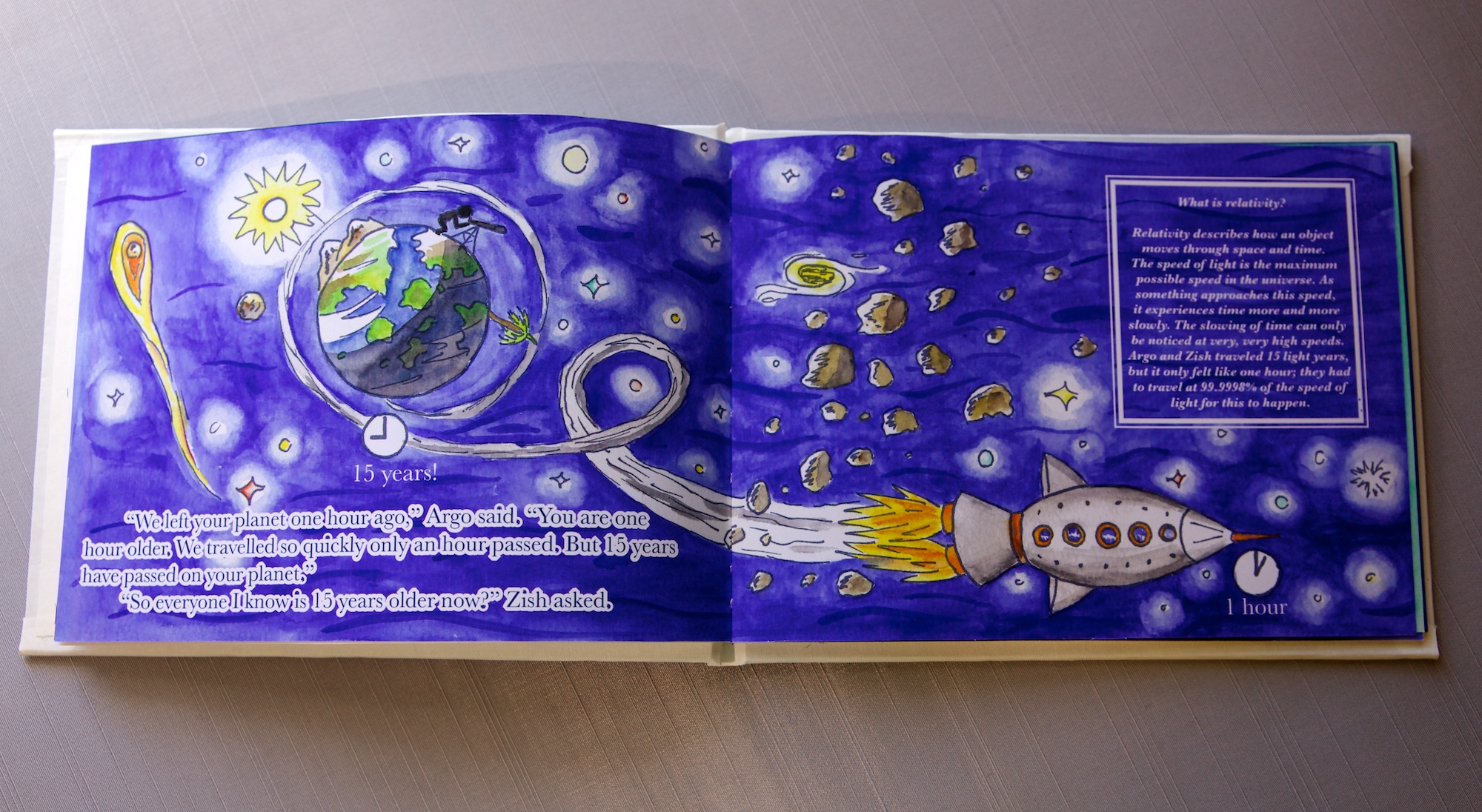
Finally I did a more formal binding of my Zish and Argo story. It’s a pretty simple binding with only a single 7 page signature, but I’m really pleased with the way it turned out. In the second picture below, you can see one of the spreads. All of the illustrations are digitized watercolor paintings.

SONY DSC SONY DSC

My Top 20 Best Science Fiction Novels

Following my post last week about my top 5 science fiction novels, I’ve been getting a lot of hits on search engines. I too scour the web for good scifi lists, so I thought I’d add my top 20 science fiction novels to the mix. I weighed a little towards including some less-common mentions, so while I enjoyed both “Hitchhiker’s Guide” and “Hothouse”, two incredibly different books, nobody needs help in hearing about “Hitchhiker’s Guide”. So without further ado, my top 20 science fiction novels in no particular order.

Top Five (see last  week for longer descriptions of each)

The Rest

  • The Moon is a Harsh Mistress (Robert Heinlein 1966)- The inhabitants of the moon attempt to revolt from the oppressive Earth with the help of a supercomputer named Mycroft. Mycroft is an awesome central character. The best of the grown-up Heinlein novels. 1967 Hugo Award winner.
  • The Demolished Man (Alfred Bester 1953)- How does one get away with murder when telepathy is common place? Fast moving and surprisingly modern, the winner of the first Hugo award.
  • The Absolute at Large (Karel Čapek 1922)- See a longer review I did here. The author hypothesizes that when the atom is split (a new concept at the time) that energy is released, as well as a pervasive religious fervor. As the atom-splitter spreads due to its phenomenal energy production, so too does the side effect of religiosity.
  • The Lathe of Heaven (Ursula LeGuin 1971)- When one man dreams, his dreams can become reality. He fears this awesome power; when he enters therapy, his therapist begins to use his gift, imagining he will fix the world.
  • Mathematicians in Love (Rudy Rucker 2006)- Totally awesome and wacky. Mathematics grads students compete to find the equation of everything, and win the affections of a cute girl. And there are enormous sentient venomous conch shells, intergalactic mathematicians, and parallel universes.
  • Worlds (Joe Haldeman 1981)- A woman from a communist orbiting asteroid visits New York City on a scholarship. I love everything by Haldeman, but this is my favorite after “Forever War”. Very heartfelt and emotionally gripping. The rare female protagonist, and done phenomenally. This is the first of a trilogy, but I think it’s the best and stands alone just fine.
  • The Door into Summer (Robert Heinlein 1957)- My favorite of Heinlein’s “children’s” books, which are all very intelligent, but have less of some of Heinlein’s more alarming interests like incest. A man is duped by his business partner, who steals the company and puts him into cold sleep. He awakens after 30 years, and tries to figure out how to get his life back. One of the main characters is the protagonist’s cat, always a plus.
  • Snow Crash (Neal Stephenson 1992)- cyberpunk done properly with a sense of humor. A pizza delivery man, Hiro Protagonist, and a 15-year-old girl start investigate the propagation of a mysterious internet drug, snow crash. The plot line of this one gripped me less than the excellent fun had with a future world.
  • Tau Zero (Poul Anderson 1970)- A crew on a near light speed ship is on a five-year journey to another planet. During the voyage, the deceleration mechanism is damaged. As they continue to go faster and faster, the time dilation grows and they travel farther. The best hard scifi book I’ve read.
  • A Fire Upon the Deep (Vernor Vinge 1992)- The best and most intelligent space opera I’ve read. Different laws of physics exist in different parts of the galaxy. People create a malevolent higher intelligence near the rim of the galaxy and must flee into the galaxy where the laws of physics preclude such an entity. They get stuck on a planet of sentient creatures composed of several animals in constant communication with one another. They are called the Tines, and they are hands-down the best alien I’ve read in scifi. Also read anything by Vernor Vinge. 1993 Hugo Award winner.
  • Stand on Zanzibar (John Brunner 1968)- At first I found this book a bit confusing; the chapters jump around to relatively random people doing random things as part of the world building. But after 50 pages or so you get your bearings. The world is over-populated, and child-limits have been instituted. The plot is complex and rich. The style is grimly funny. Hard to describe, and requires some effort to read, but one of the greats. 1969 Hugo Award winner.
  • Hothouse (Brian W. Aldiss 1962)- Also called “The Long Afternoon of Earth”. In the distant future, the sun is bigger and hotter, and one side of the earth always faces the sun. Plant life, with so much energy available, has evolved in many ways, and all but overruns this half of the earth. There are plant birds, plant predators, and plant just about everything. A small group of humans tries to survive in this near-apocalypse Earth. Chock full of great imaginings. Aldiss doesn’t have the most sparkling characters, but he has engaging concepts, somewhat like Asimov. “Helliconia Spring” is another worthy read by Aldiss, but it is somewhat longer.
  • The Caves of Steel (Isaac Asimov 1954)- My favorite Asimov book, partially because it is self-contained and relatively succinct. People of an overcrowded Earth live under steel domes, and never go outside. The story is set around the investigation of a murder.
  • The Windup Girl (Paolo Bacigalupi 2009)- The 2010 Hugo Award winner. A biopunk story set in Bangkok. After the world has been devastated by engineered illnesses and crop-plagues, society is finally mostly recovered. Carbon emissions are strictly limited, so energy-efficient methods are desirable. The main character is an employee working at a start-up energy company as a front, but for one of the bio-engineering firms that creates genetically modified species actually. A rich world that incorporates biology well.
  • Red Mars (Kim Stanley Robinson 1993)- A group of 100 brilliant hand-picked scientists is selected and sent to Mars to live there and begin terraforming it. These scientists are strong-minded, and don’t always agree how to go about things; political fractures form. The first book follows the political developments of the first 100 martians. “Red Mars” is followed by “Green Mars” and “Blue Mars” which occur over the course of a couple of centuries. Mars itself is the main character of the whole trilogy, and is described in the best scientific detail available at the time. Sometimes a bit long-winded, but very realistic, and an interesting exploration of terraforming.

Happy reading!!

Drawing Books: Andrew Loomis

I always find a good drawing book to be very motivating. When I draw, I do best when I have a good visual aid, especially when posing people. Alas, I have no models living in my attic to call upon for posing when the need arises. So a good book of poses is the best substitute I have.

Andrew Loomis was as illustrator in the middle part of the 20th century. He wrote several drawing instruction books as well. These books were very well-regarded and popular, but they went many years without being reprinted. Old copies of the books would sell for over $100 on eBay.

Happily, his books started being reprinted a couple of years ago. They are lovely hard-cover reproductions, available for about $25 each on Amazon.com. I believe four have been released:

  • Figure Drawing for All It’s Worth– A book about drawing the figure. I’ve found in the past many figure books are more men than women (which I always thought was strange). If anything, this book has more female figures, but men are covered as well, as well as various proportions, and the proportions of children.
  • Drawing the Head and Hands– About drawing the head and hands. As you’d expect, this covers the head and hands from all kinds of angles, for different ages and backgrounds.
  • Successful Drawing– I don’t have this one. I find its title vague. I like to imagine I can already draw. But if anyone has read it, I’d be curious to hear.
  • Creative Illustration– I just got this one, but I haven’t had a chance to go through it in much detail. This is the one I’ve been anticipating most, based upon the title. I have observed many heads and hands and figures, but illustration is a way of interpreting the scene to make it more engaging.

Book Review: The Absolute at Large (Čapek 1922)

The Absolute at Large was written in 1922 by Czech author Karel Čapek (free web translation to English here). It is about the advent of a machine called the Karburator. The Karburator split atoms into two parts: useful work and a mysterious force called the “absolute”. The absolute is a god force which causes intense religiosity in people, and allows them to perform miracles. As the Karburator spreads across the planet, so does the absolute, and the book describes what follows.

I really enjoyed this book, and I would highly recommend it. First, it’s smart science fiction. In 1922, forces such as radiation were pretty recent science. Radium was discovered in 1898. Čapek describes something very like fission well before its invention. Second, this book is subtly very funny. Through the book, Čapek lampoons religion, communism, and nationalism at least. Third, the book is a short and simple read. My copy was about 200 pages with large print and lots of white space. If you enjoy this book, you can try out Čapek’s possibly more famous work, R.U.R., the book in which the word “robot” was created (derived from the Czech word for serf labor). I haven’t gotten around to that one yet myself.

I had a special reaction to The Absolute at Large, which is largely set in Prague. I was lucky enough to spend a summer in Prague, during which time I was able to talk at length with older residents. The Absolute at Large captures a certain essence of the Czech spirit. The Czechs are cynical in a very witty way. They’ve had religion thrust upon them (read about Jan Hus, the Hussites, and the First Defenestration of Prague). They’ve had nationalities thrust upon them (read about the Second Defenestration of Prague). In 1922, Czechoslovakia had been an independent country for only 3 years following the fall of the Austria-Hungarian empire. Unlike the Poles, who seem to resist forcefully, and the Hungarians and their patriotic sorrow, the Czechs have resorted to humor to endure their less-than-dominant place in geopolitical events. A few years ago, the Czechs held a contest to vote for the greatest Czech ever. The Czechs voted for Jara Cimrman, a fictional man who had no official face (the sculpture had become smooth, they couldn’t find him in this photo of a few hundred, etc). However, fictional Cimrman was credited with many wonderful feats: he suggested the Panama Canal, he was briefly an obstetrician, he consulted with Zeppelin, Eiffel, Mendeleev and Curie. If you are ever in Prague, there is a free museum to Cimrman under the Petřín Tower.

The Absolute at Large has a similar sense of humor to Cimrmanology; Čapek lampoons the inevitable powers of the world and their effect on the Czechs. And how appropriate that the Karburator should be invented in Prague… perhaps Cimrman lent a hand.

Zish and Argo Artwork

My biggest goal over the holidays was to complete painting for the Zish and Argo book. Last night I finished the last painting! Hooray! Champagne! Zish and Argo has 13+ full size color illustrations, painted in water colors. The picture below shows the ones I finished during the holidays. For reference, they are about 8 inches tall. In the next couple of weeks, I will pull together the art and put up book details. The featured image shows the tentative cover that I just finished as well.

Tomorrow I head back north to new projects and adventures.

SONY DSC


Artists: Walter Crane

I love to go to art museums to new style ideas. On a recent trip to the Virginia Museum of Fine Arts (VMFA), I visited the art nouveau section and saw a piece by English artist Walter Crane:

Walter Crane plate at VMFA.

The plate mentioned that Walter Crane did children’s books.

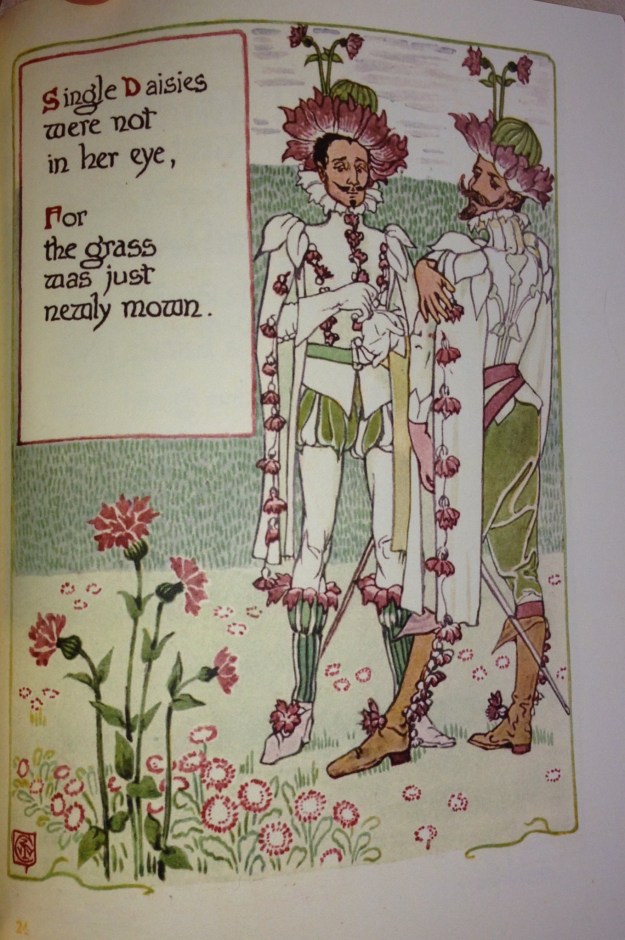
So I went home and ordered a couple of his books. A Floral Fantasy in an Old English Garden anthropomorphizes the flowers of the gardens in beautiful art nouveau fashion. Below is a photo of one of the pages. This page depicts bachelor’s buttons. All the little details, down to their boots, are done to match the characteristics of the plant. Another panel shows a battle between a thistle knight and a snapdragon. Walter Crane has several children’s books besides this one. Since Walter Crane died in 1915, his works have entered the creative commons, and they can be had very cheap, especially digitally.

photo

Walter Crane also did more adult works. Neptune’s Horses reminds me of the scene in Lord of the Rings where the elf summons up the waters to fend off the nazgul, but it was painted over a century before.

A little on watercoloring

This week I am spending most of my time painting the line-art from The Galactic Adventures of Zish and Argo. One of the things I really like about watercolors is that they travel well. I’m on the road for the next couple of weeks, but it is just as easy to paint here as it is at home. A major reason for the portability is the type of materials I use. I bought a Windsor-Newton field box set several years ago, pictured below. At $50, you might experience a bit of sticker shock. I’ve only recently had to start replacing pans; it lasts and lasts.

I have used the liquid watercolors as well. I find I enjoy the quick set up of the solid colors. There is no need to dole out paint as you go, and you only use what you need. Plus it’s easier to travel with. The solid paints can still deliver good intensity and brightness. I roll all my brushes up in a bamboo case like this one, and then I’m ready to go anywhere and paint anything. If you have a pigment-ink printer, you can economize on your watercolor paper by selectively choosing what you print. I discuss that more in an old entry, here.

I read a watercolor book a few years ago that I found helpful as well: Watercolor Tricks and Techniques, by Johnson. If you are curious, it is worth a look.

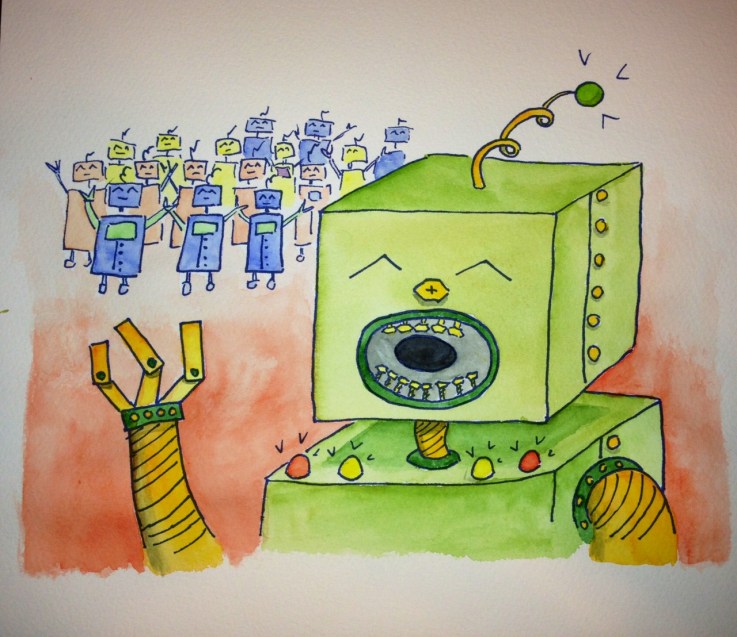
So there are 13 paintings for the core of the Zish and Argo book. I have 7.5 paintings done, so I’m over halfway! The Robotoids say hello!!robot

Paper engineering (AKA: pop ups!)

Everybody love a pop-up book. The well-executed ones are a thing of joy. I got a pop-up book as a kid about dinosaurs, which I didn’t care that much about, in French, which I didn’t read. I read that thing to its grave.

Recently, I see more pop-up books in stores, aimed at more than just children. These books are made by not artists, but paper engineers. As an engineer, I approve of this shift in language. Perhaps I should strive to be a word and paint engineer, rather than writer and illustrator. A few years ago, I bought Moby Dick, as done by paper engineer Sam Ita. Amazon lists a few of his books here. He even has a pop-up Xmas tree, if you’re still looking. His Moby Dick is wonderful, with whirling whirlpools and ships complete with rigging and a looking-glass.

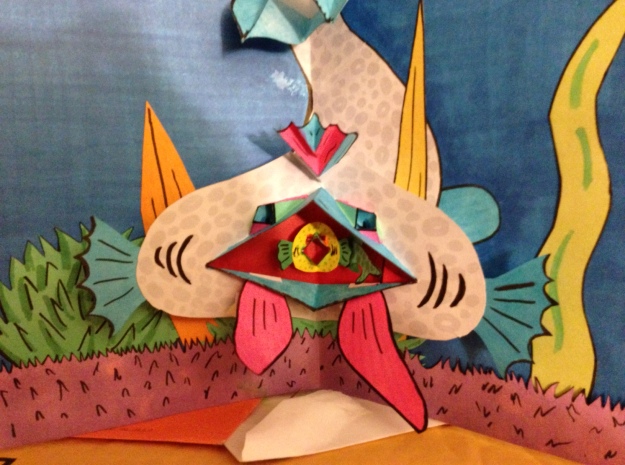
I have started my own attempts at pop-up (shown below). A fun project, but one on hold for now because I’m not sure how to put them together with any kind of efficiency. If you’re interested in learning about pop-ups, I have used a few books to guide my exploration:

popupHappy paper engineering!


Beautiful Books

I love a well-made book. There is something awesome about a book with golden edges and an embossed cover. I like pages with heft and texture, and books with color illustration. However I am also a great fan of classic science fiction, and 1960s scifi seems rarely to intersect with fine binding techniques. I often go to the used book stores and find paperbacks with yellow cracked pages and broken spines. The cover art is often wonderful, but these books are dying and falling apart. Many of these books have not been reprinted recently, or are offered only for outrageous prices as ebooks.

Lovely books were always a source of inspiration as a kid. This Tasha Tudor fairy tale book was my favorite (and was a big source of inspiration for my own collection of fairy tales). I hope with the rise in ebooks, we will see a rise in beautiful books. When you need not spend space on books, perhaps that space will be spent on books that are also art objects. Lately, I feel like I’ve been seeing more attention towards the appearance of books. Right now it’s more limited to literary classics, but I hope it will grow towards science fiction, which seems like it could benefit from such visualizations. Here are a few pretty books I’ve noticed:

  • Hiroshige, by Taschen (pictured above). This book is gorgeous. Bone clasps hold together the cover, and the book is bound in the traditional Japanese stab-binding style. The paper feel like it is cotton, and it really suits the art it bears. Also at $40, it isn’t insane, and it’s even cheaper on amazon.
  • Barnes and Noble Leatherbound Classics Series. There are a ton of books in this series, from Hitchhiker’s Guide to Arabian Nights to Foundation and Grimm’s Fairy Tales. One complaint: it’s very hard to judge the contents from the web. I found in person that the older out of copyright works had many more illustrations inside. I especially like their Arabian Nights. Most of these are around $20, so they are affordable.
  • Basically anything by Folio Society. I am particularly intrigued by their Foundation Trilogy, which has some fun-looking illustrations. Folio Society is a bit pricier, so I haven’t gotten anything from them yet.

I would love to hear about any other finds as well. Good hunting! (And here’s some lovely bookcases as well.)

Feminism and Science Fiction

My favorite book is easily The Left Hand of Darkness, by Ursula LeGuin. I like how the book questions what forms a culture. It explores how the people of Gethen conform their culture and customs to their hostile weather and their unusual gender conformation. Perhaps this is a case of nature versus nurture on the grand scale. I think Left Hand was the first book I read with feminist overtones. When I read it in high school, these overtones were a matter of curiosity. Now that I am fully into adulthood, I guess it’s odd to see how prevalent gender remains in our “post-feminist” society.

Curiously, every woman I have ever known to read Left Hand likes it to some degree. Many men dislike it, I suspect because it simply did not resonate. There is something so enviable about the Gethenians and their relationship with gender.

I don’t necessarily feel deprived as a female, but things are certainly different for us than they are for men. Yesterday, I read an article in Slate about a female member of the skeptic community who was harassed extensively after she spoke out about sexism in their community. Just the day before that, I saw a documentary discussing the depiction of women in the media called Miss Representation. This documentary discussed the lack of female protagonists in movies, and how movies that do have female protagonists have male-centric plots and are still only marketed to women. It discussed how few women there are in high positions in these companies, and how few female directors there still are.

I feel that science fiction feels similar biases. I am much more versed in classical scifi (50s-80s) than the more modern stuff, but women characters that aren’t sex puppets are few and far between. I reread Ringworld this summer, and a 200 year-old man is a serial philanderer with 20 something babes. Even Left Hand lacks a single female, although it’s certainly feminist.

Are the modern works better? My most recent read, “Wind Up Girl”, didn’t exactly break the mold. When I go to the store, I still see few female authors in science fiction; however fantasy seems dominated by women. Unfortunately, fantasy rarely captures my imagination. I’ve never met a woman besides myself who liked science fiction more than fantasy. I wonder if sci fi’s lack of interest in women is part of it. Are women just less interested in science? Feminism and science is a whole other discussion, alas.

Thoughts? Reactions? Suggested reading, sci fi, nonfiction, or otherwise?