Category Archives: Uncategorized

Uriah P. Levy: American badass and savior of Monticello

Uriah P. Levy was the first Jewish commodore of the Navy. He abolished corporal punishment in the Navy. He was the subject of six court-martial trials, a navy record. He bought Monticello after Thomas Jefferson’s death; he and his nephew preserved it for us today. When I ran across his story, I couldn’t believe I’d never heard of this remarkable man.

Levy ran away from home at age ten to sail, but returned home at 12 for his bar mitzvah. He fought in the War of 1812, and was imprisoned by the British. He chose the navy over more profitable merchant work; he knew the discrimination he would face, but felt an obligation to serve, for his country and for his fellow Jews.

In 1816, an anti-Semitic crewmate named Potter challenged Levy to a duel with pistols. They walked twenty paces, then Potter fired and missed. Levy had tried to talk Potter out of the duel; he fired into the air. Potter would not be placated. Four more times, they reloaded, Potter missed and Levy fired into the air. On the sixth round, Levy killed Potter. He was eventually found not guilty on charges of dueling and exonerated in his court-martial hearing. He had five more court-martial hearings in his career, each for incidents fueled by anti-Semitism.

Levy bought a decrepit Monticello in 1836, ten years after Jefferson’s death. In that day, Jefferson’s defense of religious freedom wasn’t held in high esteem; in 1840 a visiting Episcopal clergyman called Monticello a “fitting monument” to Jefferson. Levy’s family had fled the Spanish Inquisition in Portugal. He repaired the house and purchased land that had been sold to satisfy Jefferson’s debts to rebuild the estate.

Levy’s first commission in the navy was the first ship in the navy without floggings for discipline. Levy played a role in the passage 1850 anti-flogging bill in Congress.

Upon his death in 1862, Levy willed Monticello to the American people. His will was broken, and the property was divided amongst relatives. Monticello fell into disrepair. Animals were stabled in the house.

In 1879, Levy’s nephew Jefferson Levy bought the house. He restored it, and sold it to a memorial foundation in 1923. The 1943, the navy commissioned the U.S.S Levy.

I had never heard of Uriah Levy before I found his name in an essay, even after living in Monticello’s shadow for six years and attending Jefferson’s university. He bravely served the country even when his country didn’t serve him. His is a remarkable and American story, and we should tell it more often.
Book review: One Summer- America 1927 (Bill Bryson 2013)

Rating: 5/5

In One Summer, I learned a ton about a period I didn’t care about. I care now. I’m from St. Louis, and I didn’t care about The Spirit of St. Louis or Lindbergh. Last week, I saw his plane in the Smithsonian. I tried to imagine flying for 33 hours with a single engine, a pen and paper to chart my course, protected from the elements by canvas. I tried to imagine landing in Paris, the field mobbed with people, with a plane without any forward-facing windows. Apparently it was beyond the imagining of even his contemporaries–they favored multi-engine planes with multi-man crews. In that tiny plane, Lindbergh flew better than any of them, and his flight ignited an aeronautic industry in the US which had badly languished.

One Summer centers around the summer of 1927, the summer of Lindberg’s transatlantic flight, of Babe Ruth and Lou Gehrig’s home run battle, of the execution of Sacco and Vanzetti, and more. The summer of ’27 is the primary focus, but Bryson weaves in details from decades before and after, covering Warren Harding’s mega-corruption, Herbert Hoover’s relentless self-promotion, and Henry Ford’s remarkable stupidity and racism.

One Summer does what I wish my history classes would have– it gives not just the facts and the names, but a sense of the 1920s versus today. In one 20s baseball double-header, the first game lasted 50 minutes, and the second lasted an hour and 15 minutes. As a lifelong fan of baseball, I had no idea that baseball even could be so brief. Neither did any of my friends. I was shocked. On one hand, the 20’s reveled in public gatherings and the wonder of radio broadcasting Lindbergh’s return. On another, they suffered the anxiety of mass immigration, anarchist bombings, and prohibition.  In short, One Summer relates the wonder of a world rapidly transitioning from an isolated one to an interconnected one.

I can’t imagine who I wouldn’t recommend this book to. It’s light enough to fly by, but full of unconsidered things. In a world of ISIS and shitty politics and Mexican immigration, it’s somehow relieving that the ’20s dealt with Italian anarchists, the worthless Harding administration, and eastern European immigration. Those who don’t remember the past may or may not be doomed to repeat it, but remembering the past surely puts the present in context.

Some More Fun with Pop-Ups

I’ve written a few times about my interest in pop-ups on this blog. I’ve played around with making them and I’ve found some toys with which to make them better. But pop-ups can be hard, and after a lot of play, I found myself a little discouraged. I would try and try, but I wouldn’t seem to approach a working solution. I put my pop-ups aside for a bit.

Then, last weekend, I took a pop-up book class through a local club. The class was instructed by Carol Barton, who has written several pop-up instructional books, as well as produced several artistic pop-up books. We made dozens of pop-ups in the class, ranging from very simple to more complex. We talked about different kinds of folds and cuts. Some of my pop-ups worked, some didn’t. My classmates experimented too. Carol was an excellent teacher, helping us to think intuitively about the pop-up rather than strictly mathematically. I came out of the weekend feeling much more confident. I might still make mistakes, but I work toward a better product eventually.

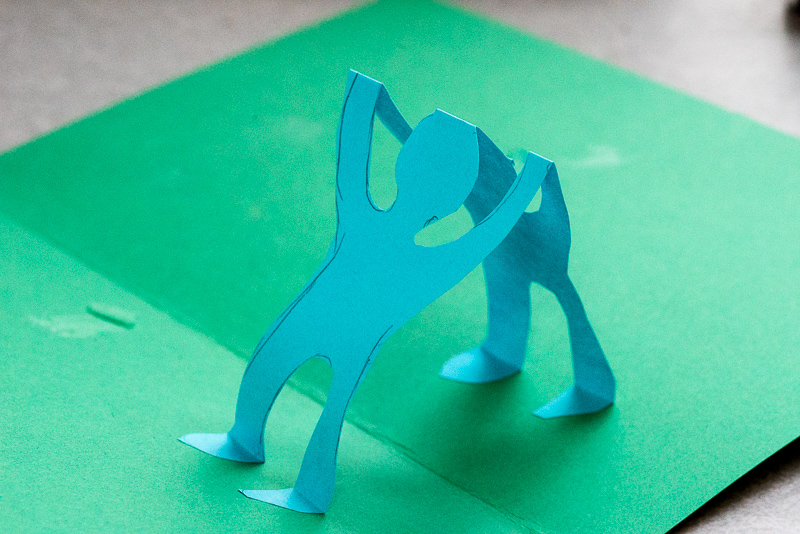
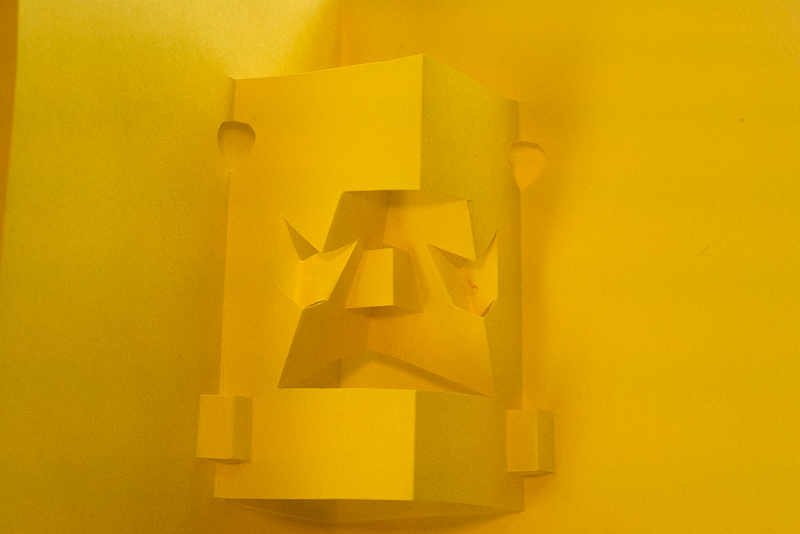
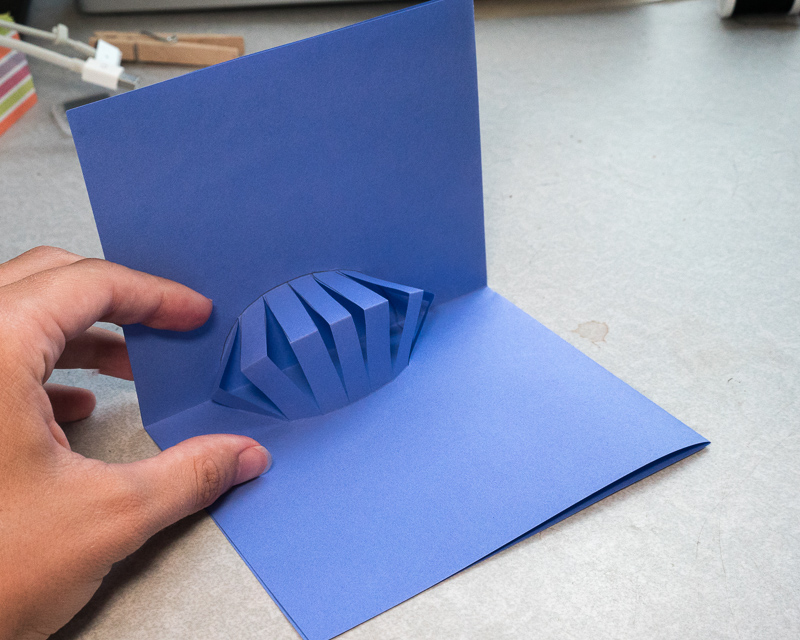
Below are some of my pop-ups. The two most complex pop-ups are ones I’ve worked on this last week. The last three ones I made in a few minutes in the class with scissors cutting by hand.

If you are interested in learning to make pop-ups, I recommend Carol’s books in the “Pocket Paper Engineer” series. They have excellent illustrations and explanations. Even better, they have pages for you to cut out and work on pre-designed pop-ups. These pages show you all the techniques of pop-up books, starting at the most simple and becoming more complex.

popups-00500

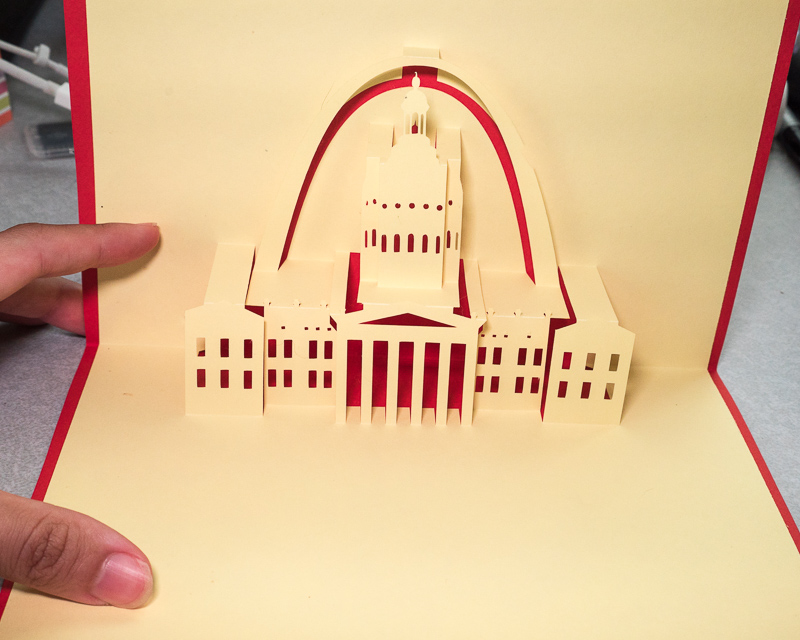
My big project this week: the Old Courthouse and the Arch in St. Louis. I programmed this in Illustrator and used my Silhouette Cameo to do the cuts.

popups-00499

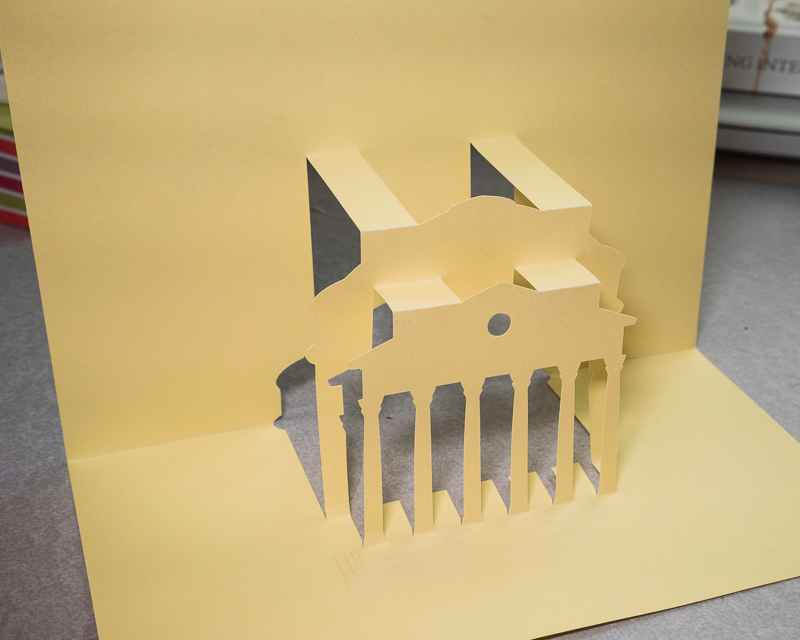
Preliminary work on a pop-up of UVA’s Rotunda.

popups-00491

A simple saddle pop-up, cut by hand in class.

popups-00489

A pop-up made of a series of box pop-ups. It looks fancier than it is– it took no planning and only a few moments of snipping and folding to make.

popups-00487

A series of box folds to make a very simple yet in my opinion really interesting pop-up.

A weekend of swimming

This weekend I went to Maryland and swam in the masters National meet. Other than a fun meet last year, it was the first time I’ve competed it over ten years.

I had a blast! I met some local swimmers. I swam good times. I watched a 98-year-old woman compete.

Swimming is a weird sport–what other sport comes so close to being a sense-depriving experience? You hear little. You see the lines on the bottom of the pool and your own arms. Maybe you see people on deck. You feel the water flow past you and the complaint of muscles. You taste chlorine. And you go. As you go, your mind dissolves a little. I reach the wall, and all that matters is the number on the clock. If I close my eyes, I feel the sensation of dizzy flight. When I push hard, I don’t feel pain, I feel a lack of self. Swimming is a mental absence best portrayed by Ryan Lochte. It’s meditation achieved by depriving the brain of the chemicals it needs to sustain distraction.

I don’t know if this post is super relevant to my overall blog. That’s okay for today. Not every moment is about projects and writing and striving. The moments of joy are the poles that hold up the tent. Not every day in the water is a moment of joy, but enough of them are. The little things– a good meal, a good friend, a good workout– these hold up the motivation. Sometimes they deserve their own attention. What a weekend.

DSC00256

Books and pictures and programs

These last few weeks have been a whirlwind, so in departure from something more organized, I think I’ll just list off a few of my projects. Hopefully some of them will inspire you to something; at the very least, I know I can come back here when my own motivation wanes (it always does, it always will, we just have to learn to re-energize it).

  • In the last few months, I’ve assembled a science fiction and fantasy anthology for my writing group. I did all the formatting and editing and layout. Last night we had a binding party in which we put together several handmade copies. Soon it will be available for the kindle (after a little more work), but here are pictures of the first bound copy of Bizarre Tales from the Three Notch’d RoadSONY DSC SONY DSC
  • I’m taking a watercolor painting class through a local art community. Everything I know now I taught myself, and I’m sure there are new things I ought to learn. The next Zish and Argo will be even more beautiful.
  • I’m taking the plunge and going pro with my photography. Check out my new website karenblahaphotography.com.
  • I’m learning database design, something I knew zero about before June. You can just pick up a new skill, if you give it time and realize that it will be a slog at times. I’m using this book by Michael Blaha, which as the name suggests, my dad wrote. Nearly 30 years of osmosis didn’t teach me anything, but two months with this book has been inspiringly instructive.
  • I’ve been learning the Adobe creative suite, using videos from Lynda.com. I learned InDesign for the anthology pictured above. I learned a ton about Illustrator after being unable to make even the simplest graphics in it. Although I’ve been using Photoshop for years, I’ve learned more about it in the last month than I have in the last ten years. Immensely eye-opening.
  • I made the switch from Aperture (the mac photo-managing software) to LightRoom (the Adobe photo-managing software). LightRoom ties into creative suite better, and Mac is not supporting Aperture sufficiently anymore. And I’m using Lynda.com videos to speed my adaptation to LightRoom too.
  • I discovered a wikipedia for classical music whose copyright has lapsed. Imslp.org has sheet music for hundreds of composers for dozens of instruments. It even has some free recordings. I am working on learning Gilbert and Sullivan’s H.M.S. Pinafore for piano, Grieg’s  Peer Gynt for piano, and Saint Saen’s Swan for viola. The only trouble is knowing which music you want!
  • I continue to work on short stories for my Clarion Write-a-thon goal. I’m on the second one, and I need to pick up the pace. Check out my profile page here.
  • And finally, I continue to work on my 100 scenes of Vironevaehn life. I’m up to 42 color illustrations.SONY DSC

Whew, that was a lot, and time to get back to it!

Vironevaeh on Mad Scientist Journal

Check out my story “Carnivorous Fog: Avoidance, Survival, and Eradication Strategies” on Mad Scientist Journal today. Mad Scientist Journal publishes stories in the form of fictitious scientific papers. This paper is set in the same place as my fairy tales, although at a different time. The inspiration for this story came from my Nanowrimo novel; the novel is sort of a wreck, but it gave me several fun ideas.

Most excitingly, this is the first thing I’ve published in the Vironevaehn universe, one that I started nearly 17 years ago. Hopefully it doesn’t take another 17 years for the next publication.

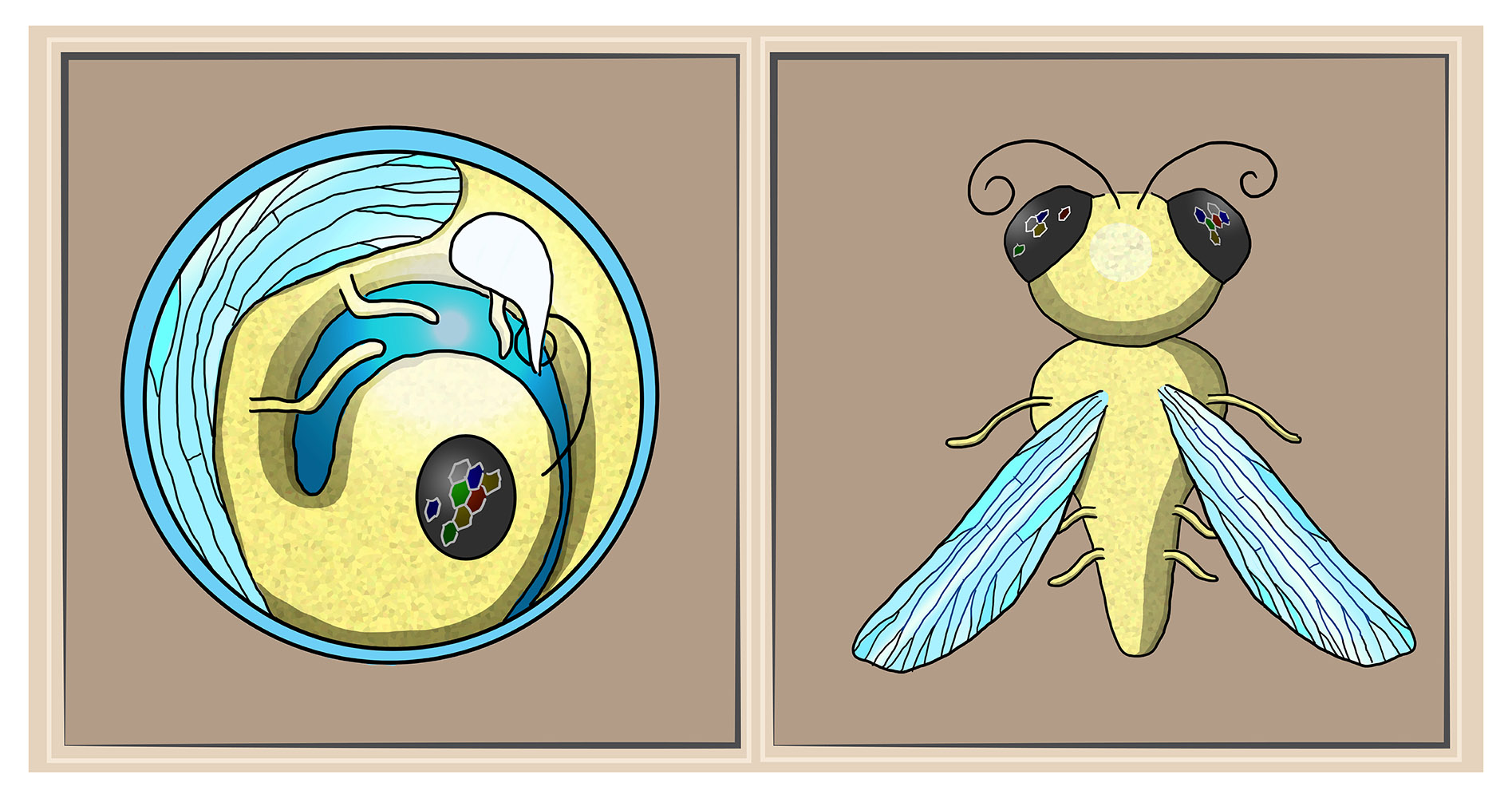
Here’s an accompanying illustration I did after the story. On the left is the “encapsulated” insect, while the free insect is on the right.

SONY DSC

SONY DSCMy newly reorganized office. The flat storage cabinet in the corner is a new and much-treasured addition. Now I can organize the flat stuff way better and also keep it safely away from cat feet (they have a sixth sense for stretching on the most expensive piece of paper). Great things are going to happen here. Too exciting not to share.

Publications and Ph.D.s

Some brief (and exciting) updates!

Check out my first story, “The Alchemist’s Contract”  here at Swords and Sorcery. I’m still adjusting to the notion that something I wrote has been published =).

Then check out this nice review at Black Gate (toward the bottom). It looks like an excellent resource on the recent happenings of medieval and high fantasy. (I’m usually more familiar with the science fiction end of the spectrum, so I’m new to this end– very cool!) Check out their main Black Gate page here.

And on a more personal note, I successfully defended my PhD dissertation on Friday. Hooray, I’m Dr. Vironevaeh! Happy Wednesday, all!

Writing prompt: “Mistaken identity”

Time: 10 minutes. Click here to go to my list of prompts.

“Mistaken identity” (this guy must look like a real jerk!)

START:

“I know what you did,” the man approached Ian.

“Pardon, have we met?”

The man lunged at Ian and shoved him. Then the world went black.

###

We he woke, there were rainbows across the sky. Ian slapped himself, and pinched himself, and all those little tricks you do to waken from dreaming. They didn’t work. Well, if he were dreaming, he might as well explore.

The ground was covered in a gray pulsing net. Waves undulated through it, like drops in a lake but fast, this way and that, coarsing across the hilly, bald land.

He saw a man on the far hill. He started toward him, but then he recognized him as the man who pushed him. He went the other way.

After some time, the gray mesh grew taller and crenelated. In the distance he saw a town. He walked to it, and the town was formed from the mesh. People, no, more like automatons, moved through the city, dancing a strange, architected dance that never stopped and never slowed.

Ian weaved through the automatons, who never even noticed him. He kept walking, and eventually the mesh grew sparse and there were flowers and grass.

A woman ran up to him. He extended his hand to shake. She punched him across the jaw. The world went dark.

###

When he opened his eyes again, there was only blackness. His face hurt, and he suspected this was not a dream. He felt around, sensing cold rocks. Was he blind? He stumbled along, sensing he should go somewhere, anywhere but here. Someone kicked him.

###

He woke up, floating in the clouds of a world with six moons in the sky. He swam through the ether, at one with life.

He saw the woman who had punched him.

“Wait, please talk to me at least before you hit me!”

She frowned, but she did not hit him.

Writing prompt: “I was playing in the snow when aliens walked out of the woods”

Time: 7 minutes. Click here to go to my list of prompts.

“I was playing in the snow when aliens walked out of the woods”

It was the first snow of the year. It wasn’t a very good snow, with patches of withered yellow grass poking through already, though it was only 10 in the morning. Still, my brother and I ran outside and threw ourselves into it. It melted quickly through our snow pants and gloves. Why is it that when snow is the warmest it’s the coldest? I tried to gather up a ball of snow to throw at my brother. It wouldn’t clump, and it just made my hands cold. Well, it was only December. The prime snow months were still ahead.

My brother ran out of the yard toward the common grounds. The retention pond, almost always empty, has sloped walls that are nice for sledding. He sets his sled on the edge, climbs aboard, and leans forward. Nothing happens. “Cruddy snow!” he shouts. It echoes. The trees are all glistening and dripping in the woods. At least it’s pretty.

Two forms approach us from the woods. I take my brother’s hand and try to pull him off the sled. In school, we learned about adults who hide in woods. They’re called molesters, and they’re bad people.

The men reach us before I can get my brother’s attention. They moved amazingly quickly, and now I am giving Miss Roth a little more respect. I had thought her characterization of molesters exaggerated and cartoonish, but indeed, they move with super human speed. They also look strange. Their skin is rubbery, and their eyes are large and shiny and black. They don’t seem to have elbows or knees, just wobbly limbs like and octopus. They flow along on these things with evil fluid grace. God truly looks down upon these men.

“Oh my god, aliens!” my brother shouts, beaming. “Pew, pew!”

“No, Jake, they’re molesters, and we have to get out of here before they get us.”

Jake shoves me away and runs toward the gray men. “Take me to your leader!”

“H-hell oh,” one of them says slowly. Miss Roth didn’t say anything about them not speaking English. Maybe Jake is on to something.