Tag Archives: inspiration

Today I sold my first story

Today I sold my first fiction story. It’s hard to express my thoughts and feelings. I will keep working hard, and I will eventually sell more, but today I am elated.

Below are some musings and reflections on what led me to today’s achievement. This is hardly to say that I am an expert after a single publication; it’s a list of things I think I did right that might be useful ideas for others. I have read many tips on getting published from experts. They doubtless have more experience than me, but they got published when the industry was really different. They have had years to gain some distance from the hard emotions associated with the process.

  • I learned to finish projects. I used to be good at big ideas and poor at execution. I made grand plans and I never finished anything. I dreamed but I didn’t labor. I credit grad school and aging for teaching me to finish and work on the long scale. The Fairy Tales collection featured on the side of this page was the first big project I finished; it took about a year.
  • I exposed my work. For some people, this is easy. It was very hard for me. To me, exposing my work involves more than having others read my work–it’s about hearing what they say about it. Unlike engineering, writing is subjective (which is terrifying!). If enough people say it’s bad, they’re likely right. As a first step, I started this blog, slightly over a year ago. Then I joined a local writing group.
  • I accepted critique. This is related to the point above. Of course I think my work is good, but sometimes it just isn’t. If one reader didn’t get the joke, maybe they’re a little dense. If several didn’t, the joke wasn’t properly conveyed. I’ve met a lot of other aspiring writers who are uncomfortable with this fact. It’s very hard. I wrote in a vacuum for years; sometimes I got it wrong. I got great critique at critters.org.
  • I wrote regularly. For the first several months of this blog, I posted three times a week. Three times a week I had to say something (semi) coherent. My writing group has a monthly theme, and I made myself write something every month. It wasn’t always good, but that was good motivation. Recently I’ve been writing at least one writing prompt a week and posting it here. This month I’ve been doing NaNoWriMo.
  • I submitted. And I submitted and I submitted. Stories are rejected for tons of reasons; inadequacy is just the tip. Many places accept only 1% of what they get. Some places only publish half a dozen stories a year. Some places are vague about what they are looking for (in my experience, beware the “we never get enough of x” statement). Sometimes they already have a story about a cat, or a story where the protagonist is disappointed, or a horror story, or an intimate first person story. Any of the above are reasons to get rejected. My story got rejected three times before it got accepted; it was the 32nd thing I submitted since the end of June. My favorite story has been rejected 8 times so far. Others in my writing group have excellent work that they have submitted and have had rejected. And then they stopped.
  • I researched those markets. I read what they said about themselves. I used places like The Submission Grinder and Duotrope to find out their response times. A lot of my rejections have come from sending pieces to unsuitable markets–it’s hard, but I got better at it.

But mostly, I am so happy. I worked hard and got very frustrated sometimes. This post is as much to motivate myself as anything, since the journey is hardly begun. I hope it will be useful to others as well.

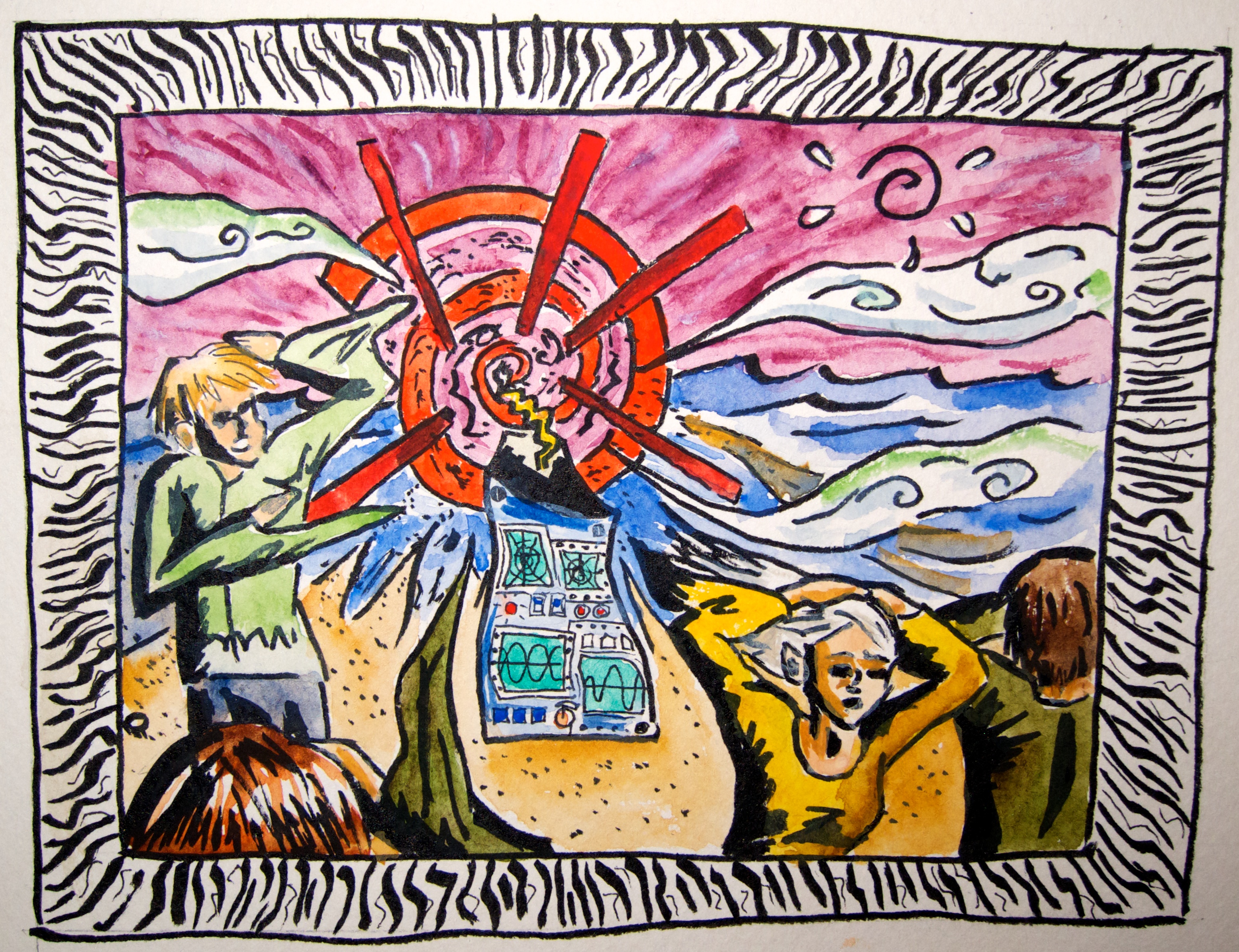
Writing prompt: “He tore off another sheet of paper and threw it in the bin”

Time: 7 minutes. Click here to go to my list of prompts.

“He tore off another sheet of paper and threw it in the bin”

He tore off another sheet of paper and threw it in the bin.

“This just isn’t working, I don’t know why I even bother! I’ll never reach 50,000 words!” He buried his head in his arms.

A clattering caused him to raise his head. The bin was tipped over. James looked at it with curiosity; he hadn’t heard the cat come in. The crumpled pieces of paper rolled out of the bin, one after another, with a strange sense of direction. That was odd.

The pieces uncrumpled themselves, and then crumpled together, forming some kind of an animal in amalgamation. An ostrich, he decided.

“You just need to have imagination!” He blinked. It was the paper ostrich that spoke. It had a buzzing voice, like air blown quickly over the edge of paper.

He looked into his coffee mug. What type was this?

“Put the mug away and get to work. We’re full of good ideas, and we’re here to put you to work. First, you will write about a radioactive raccoon that has been breaking into people’s trash. Then you will write about a woman’s struggle against the tyranny of cowboy aliens in the early American frontier. Then you will write about a colony of people who live inside the sun. Then they will all meet!”

“That’s insane,” James said.

“They are words, and you will write them! You weren’t doing any better before!”

“That’s true. That one about the sun sounds kind of cool.”

“Write, and the inspiration will come. How many words have you written in the month before this one?”

James didn’t reply. He always meant to get around to writing… there were just cool new bars opening, and concerts… Hmm… what would he write about a colony of people living inside the sun?

Why I’m doing National Novel Writing Month

This year I am doing National Novel Writing Month (NaNoWriMo) for the first time, in which you write 50,000 words in a month. I am also writing my PhD thesis (137 pages so far!), which must be done before the end of the month. I wake up in the middle of the night worrying about figures and citations. On top of that, I am TA-ing for 20 hours a week. So that sounds like I have enough to do–why I am I doing NaNoWriMo?

I was reluctant about scheduling away so much time at first. I really hate being busy. If I’m busy with work, I tend to see people less, just so I can maintain a little autonomy in my schedule. However, lately I’ve worked so hard on technical writing that I feel guilty doing fun stuff. In the last month, I’ve barely written fiction, I’ve barely been outside, I’ve barely seen friends, and I’ve barely worked on other hobbies. Whenever I picked up a book to read or a pen to draw, a little voice said “shouldn’t you be working on your dissertation?” I don’t work on my dissertation all the time, but it always weighs on me.

I still waste time. Everyone does. I still watch TV, I still read pointless websites. I decided that fun has to happen too. If fun won’t happen spontaneously, then scheduling something makes sense.

So– NaNoWriMo. I went to the kickoff event here Friday. Everybody was really friendly and energized. Several of my friends from my science fiction writing group do it. It’s fun to talk about writing when most of the time you sit and stare at it. It’s fun to feel an external incentive to write, when professional obligations push the other way. I’m not writing a novel, because I still have an unedited novel draft waiting for my attentions. I decided to write a few novellas, which are longer than short stories and shorter than novels. I look forward to what the rest of the month holds. Three days in, and I’m having fun writing. I might fail to reach 50,000, but I’ve already written 7200 words that I probably wouldn’t have without this challenge.

Writing: engineer style!

As I’ve mentioned a few times, I am currently trying to write a novel. It’s a lot of writing, and I have something of a history of starting and stopping projects. So I’m happy to report that I am still on the path and plodding along. Today I reached 23,000 words. I found estimates that trade paperbacks have 200-250 words per page. So that means my progress would fill 93-115 pages of a paperback. That’s kind of fun.

I am a mad procrastinator, but one of the ways I try to motivate myself is to allow certain writing related side activities. And because I am an engineer and a grad student, that distraction right now is…. excel sheets. Yeah. Below is a chart of my day-to-day progress. The slope gives my average words per day, so it can be fun seeing that change. When I reach a hitch, I get to go put my chapter’s word count into the chart and see what my daily word count is and my overall rate. What’s more exciting than fitting data?

writing progress


There are some websites I like to use as well when progress fails to appear. Written kitten is super cute. You get a picture of a kitten as a reward every so often. Because I need lots of motivation, I set it to every 100 words. If you need punishment more than reward, writeordie is quite popular. This blog had a decent summary of both.

I suppose this stuff doesn’t make the most exciting reading, but I hear it’s good to post about this stuff. Something about peer pressure? Plus since I’m writing all the time, I have less time to go read nifty things to post about. So, Happy Friday!

Writing: Maintaining Enthusiasm

Last week I started headlong into an attempt to write my first novel. This is not my first time trying to write novel, but another attempt to finish one. I suspect this isn’t an uncommon problem. It seems to be an enormous leap of faith to write something ~80,000 words long. You have to set aside that time, in the first place. And then what if it isn’t good enough, what did you do with all that time? I think in every past attempt I reached about 25k words and said, where exactly am I? This isn’t going to get read and then I will have an 80k time sink in my hands.

I think such worries never leave. But in other areas of my life I have been able to push through worries of failure. It’s that old cliché that lack of trying guarantees failure. Each time I try, I try to do it a little different. This time I wrote it first as a short story. Then I outlined it at a rough level. As I go I outline the next part in more detail. So far it seems to be working for me. I got to figure out who my characters were in the short story. I’ve also been trying to set more realistic writing goals. I used to write as much as possible on a day that felt good. That would leave me tired and sick of writing the next few days. Then when I’d come back, the material would be unfamiliar, and I’d spend time trying to pull myself back into the mindset.

It’s still early, but this time feels better and different. I just reached 8,000 words. The idea that I have 90% or so still remaining is really daunting. Each day will help. And really, what better to do than work to improve?

Some other possibly helpful posts, since what do I know… I keep quitting each time (I thought there used to be a related articles function,  but it isn’t showing itself… so I’ll link them myself):

Happy 16th Anniversary, Vironevaeh!

Sixteen years ago I first started writing about Vironevaeh, the extraterrestrial city that is the namesake for this website. In middle school I was that kid– I told everyone who would listen that I was an alien. I was so bizarre kids didn’t know how to bully me, not that they didn’t try. I happily kept inventing my world.

In high school I started to read the classics of sci-fi (my top 20 scifi books). Before that, I think Vironevaeh was an alter-ego–I had a different identity there, and knew different people. Advanced having of imaginary friends. The classics gave me a different perspective, the perspective of world-building. I’ve been slowly plugging away ever since. There’s a spreadsheet with a thousand years of history, some more densely detailed than others. There’s a list of the 1027 first Vironevaeh. There’s a ton of pointless info, as there is so much pointless info in life. But all of it was a labor of love, through all the years of perplexed looks.

For your delight, some of the works from over the years. It is good to pause at times and review the path. I’ve posted a lot more recent works on this blog; here are some oldies. Drawing for Vironevaeh forced me to push myself. (Many other illustrations are also available in Vironevaeh: Science Fiction Fairy Tales, which is free on the iPad.) Some things are worth the long-haul.

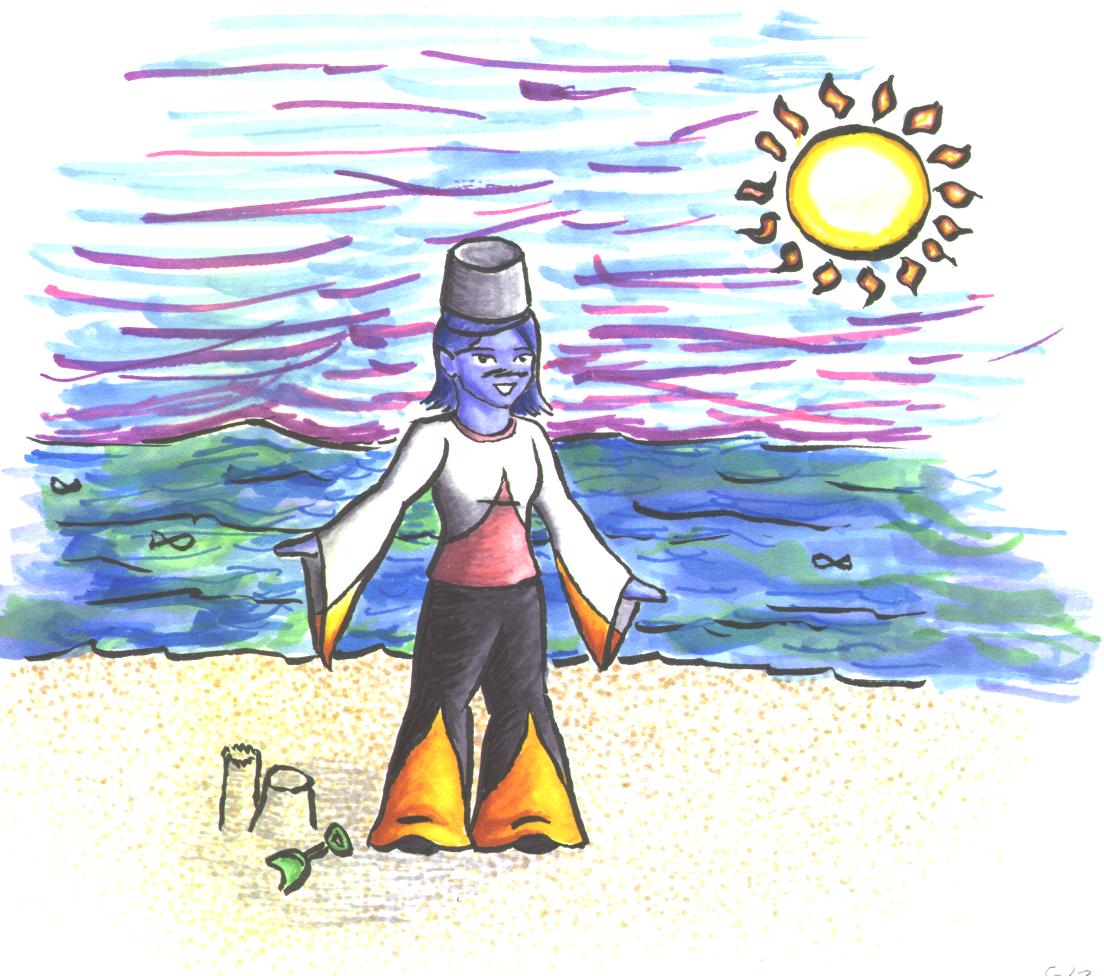
Jainus Aillette Torwin Trarce at beach_marker

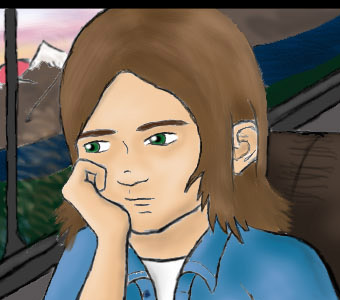
My alter-ego, Jainus. From 2004.

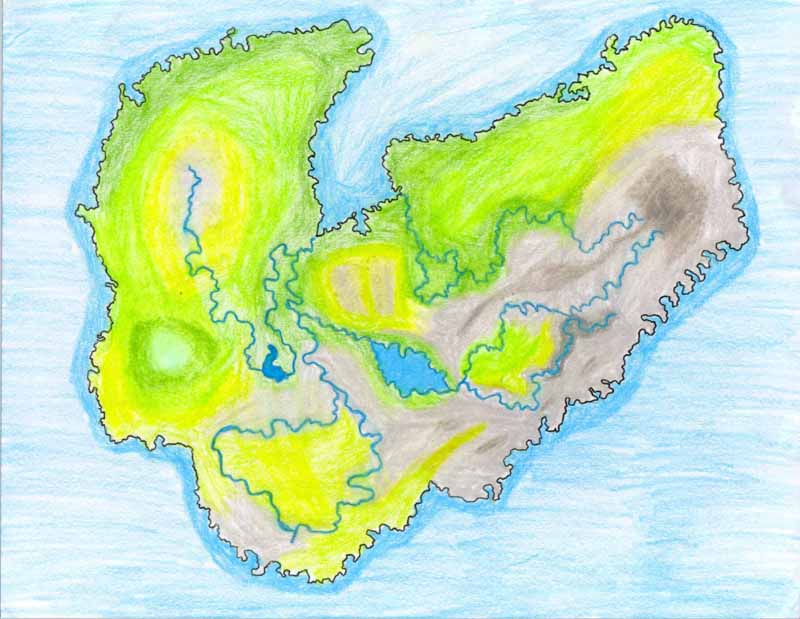
Vironevaeh relief map 800pix

Map of the island of Vironevaeh, from 2004 or before.

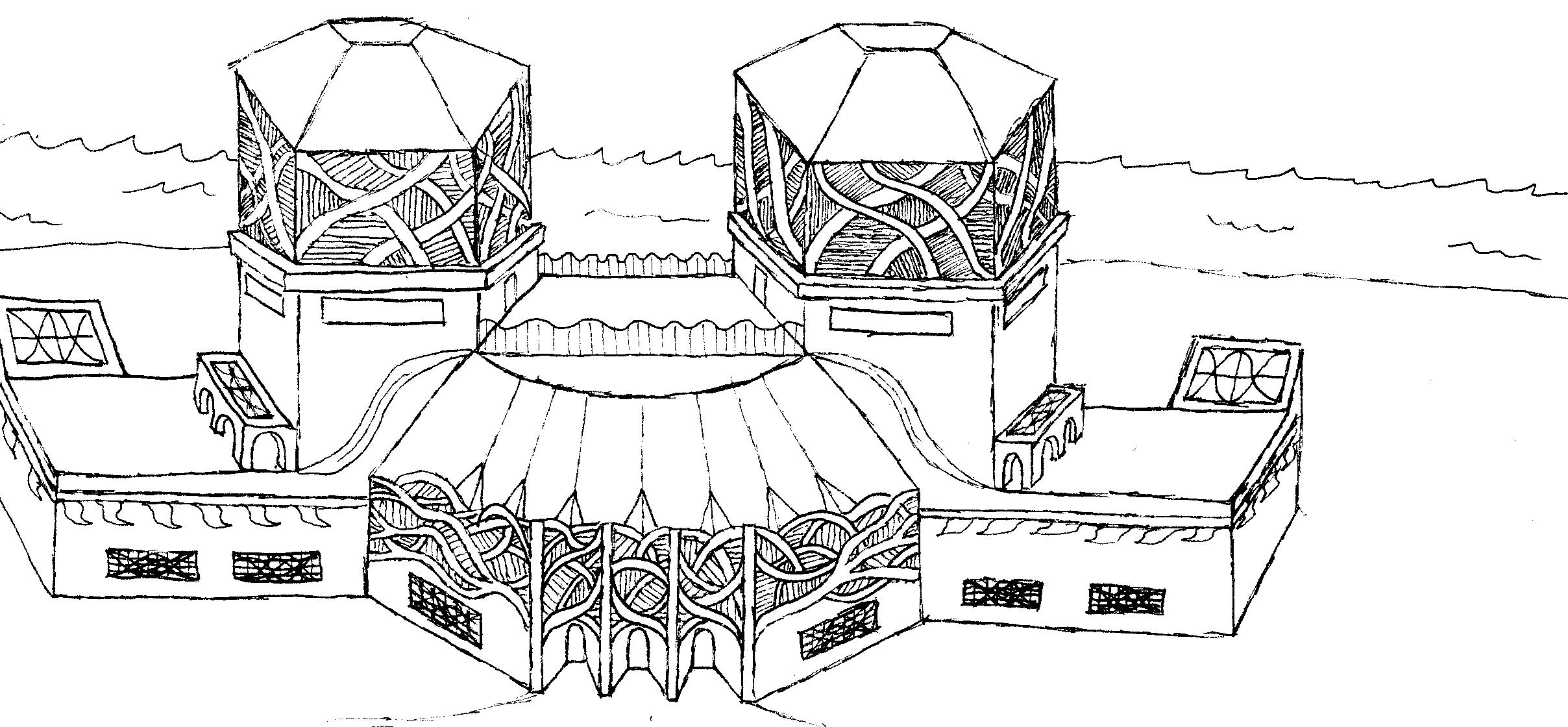
building Palace_at_Vironevaeh_Proper

Palace, 2003.

clothing1 v2

Clothing from one historical period, 2007.

ChibiTempest

One of Jainus’ sisters, 2001.

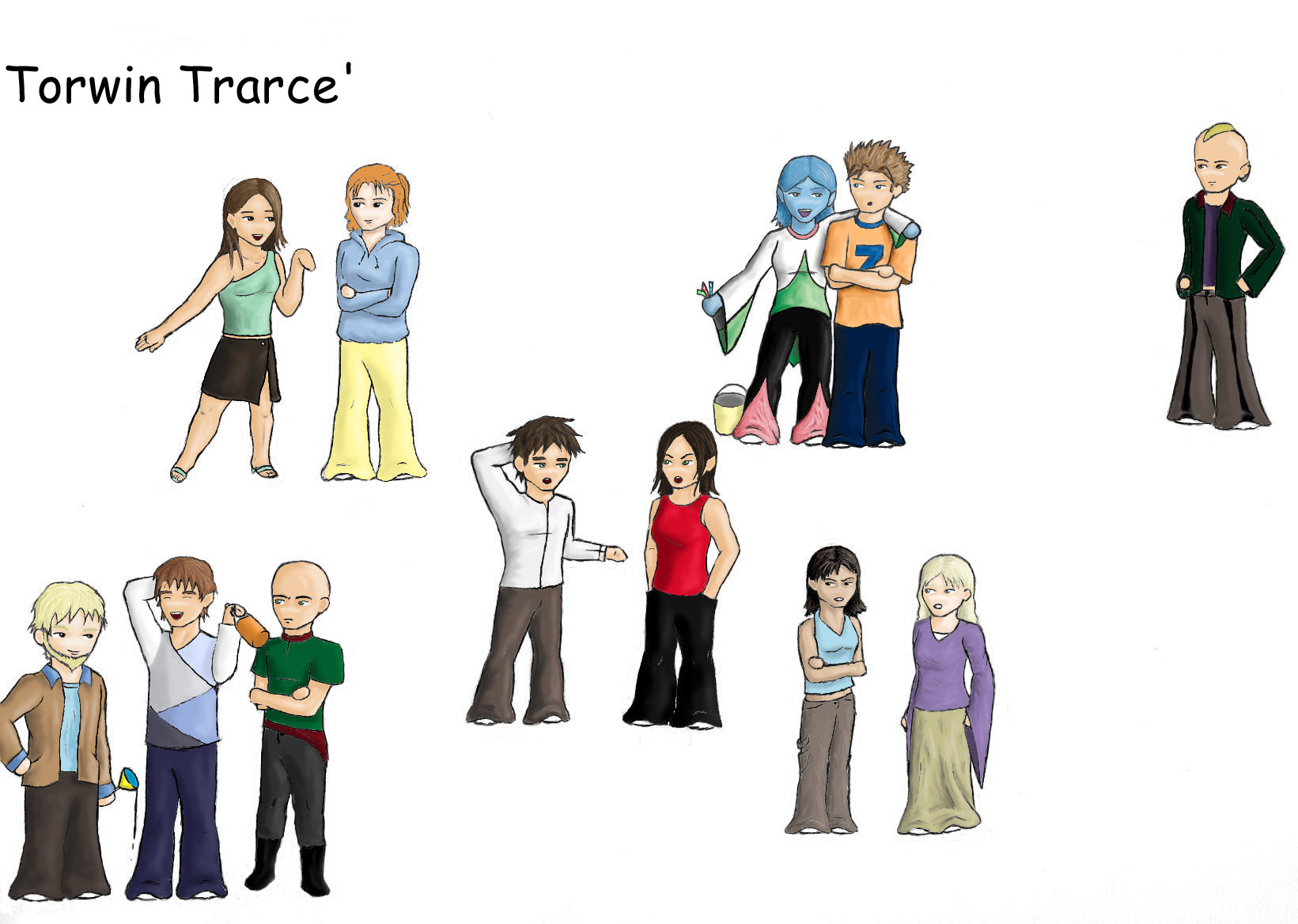
Torwin Trarce chibi pencil tablet

Jainus and her 11 siblings, 2004.

Kolo Kolo Whit in Color

Kolo, a notorious political traitor, 2004.

wormhole invention

Wormholes!, 2011.

Jait Anda Torwin_psd

One of the first Vironevaehns, 2004.


Sources of Sci-Fi Inspiration: City Culture of Prague

Setting is a critical element to most stories. It frames the actions of the characters and provides a rich and interesting backdrop. Often the environment motivates the character. As most portraits of people would be less interesting on a white backdrop, most stories of people would less interesting without the setting. New Orleans gives Ignatius a good playground in “A Confederacy of Dunces;” “White Fang” would be reduced hugely without the north, and “One Flew Over the Cuckoo’s Nest” would be slightly different without the asylum.

As a writer of science fiction, setting is both a problem and one of my favorite things. How do you draw in the culture and idiosyncrasies of a place that doesn’t exist? They have to be imagined, and imagined plausibly, by the writer. All of my favorite science fiction books have strong settings: In “The Left Hand of Darkness“, we learn about the sexual culture of a differently gendered humanoid species. Through their myths and traditions, we get to learn how they eat, how they like their weather, what is taboo, and what is an insult. In “A Canticle for Leibowitz“, we start at a Catholic abbey in post-apocalyptic New Mexico several centuries in the future. In “The Moon is a Harsh Mistress“, the setting is a lunar colony that feels bullied by earth. We learn about their principles, their marriages, and their aspirations. They can be a little closer to home, too. In “Holy Fire“, the protagonist travels from future San Francisco to future Munich to future Prague. Some sci-fi stays closer yet to home, but I find that I love crazy settings; thus I prefer Vernor Vinge’s “A Fire Upon the Deep” to his “Rainbow’s End“. (For others see my top 20 scifi books post.)

When I write my stories, I don’t want the settings to feel like the Midwestern United States plopped onto Mars or Alpha Centauri. I want them to feel like products of their interstellar, future environments. So I try to understand how settings influence culture currently and historically. I spent a summer in Prague, and in that brief time I tried to learn what I could about the culture. I tried to go where the Czechs go, eat what they ate, and read what they read. My host in town was a retired Czech professor who liked to talk (derisively) about the communist days. I worked half days at a chemistry lab out in suburban Prague. One of my coworkers smoked at her desk only feet from various chemicals and dressed like a 60-year-old teenager. I took frequent walks to Vyšehrad, an ancient fortress in Prague (pictured below).

I most appreciated the Czech sense of humor. As a country often conquered, the country developed a strange sense of absurdism. Under the Petrin Tower in Prague, there is a museum to Jara Cimrman, the best Czech man, who never existed. I can hardly say I understand everything there is to know about Prague and Czech culture, but a few months there certainly showed me a type of people I hadn’t seen before. Hopefully this will aid me in constructing a people we haven’t met before.

Some worthy Czech reading:

Side note: No post this past Friday; I broke my toe and then I had a lot of traveling to do this weekend. Happily, the toe is already much improved, and today it’s 80 F (25 C) out.

Learning about Graphic Novels and Publishing from Barbara Slate

As I mentioned in Monday’s post, I attended a talk by comic book writer Barbara Slate (at the VA Book Fest). She was one of the first female comic book writers, and has since branched out to her own graphic novels. After her talk I picked up one of them, “Getting Married and Other Mistakes“. It looks like a lot of fun, and like Slate herself, seems to have a nice sense of humor. She also has a book about how to write graphic novels.

She also spoke about the process of getting “Getting Married” published. She said that she was rejected about 60 times. I didn’t pay attention to that detail much that day. I wrote Monday about my own excitement, that I perhaps had a publisher interested in Zish and Argo. After further research, it looks like one of those pay-to-self-publish rackets, dressed up. I felt so duped! I was so excited, and they misled me. Fortunately, I figured it out quickly and for free. I channeled my frustration to overcome my fear of sending the manuscript off; on Monday after my realization I sent the manuscript to 5 places. Afterwards it occurred to me–if a woman like Slate who is familiar with the industry, knows publishing and knows people takes 60 rejections to place her book– then people aren’t going to be jumping out of bushes to publish me. It will take sober, dull work for me to get published, just like her. As it likely will for all of us. Please, may some eager publisher fall from the sky and praise me, but it’s not something I can expect or even take at face value. So last night I thought up a new story for Zish and Argo, and I will continue the slow marathon towards my goals.

The Joy of Maps

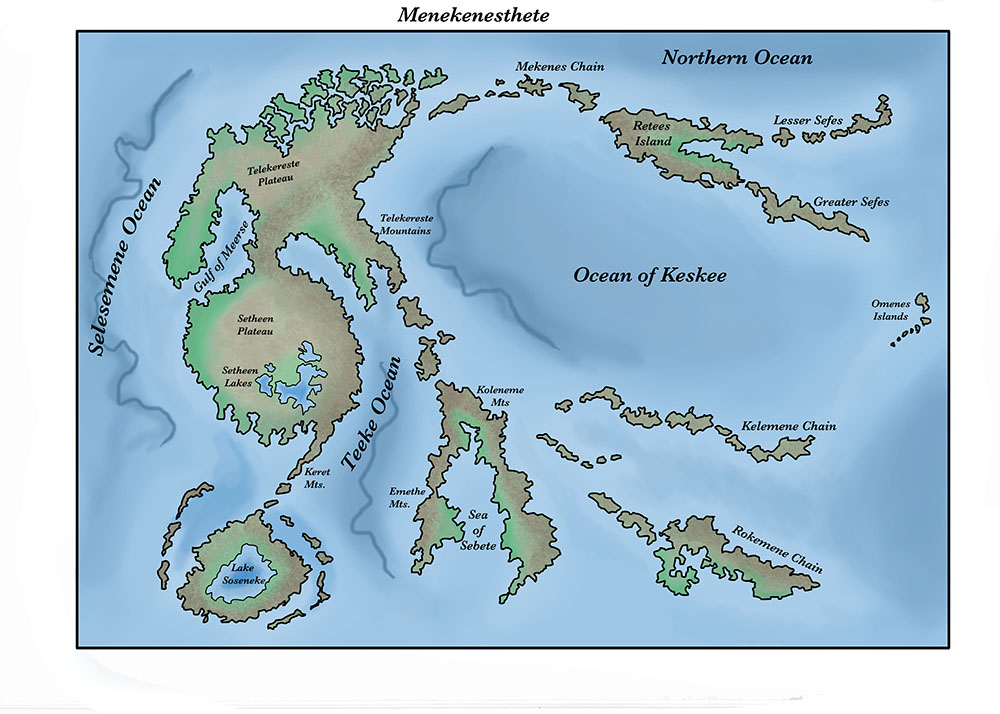
I love maps. Not the ones that are useful, really. The decorative ones, or the ones that accompany a novel. The useful ones have a sort of dryness to them. I was never a big Tolkien fan, but I liked his maps a lot. Vernor Vinge’s “A Fire Upon the Deep” has a map of the galaxy, and I found that added to my enjoyment. I like historical maps too; you get an insight into past culture that comes much more slowly from print. Old maps sometimes have amazingly different spellings and different borders (Capp Codd instead of Cape Cod, for example, on an old american map). Old city maps reveal the old structures that gave rise to the city of today. A few years ago, the university museum had an exhibition of old maps. A lot of these maps remain available online as well.

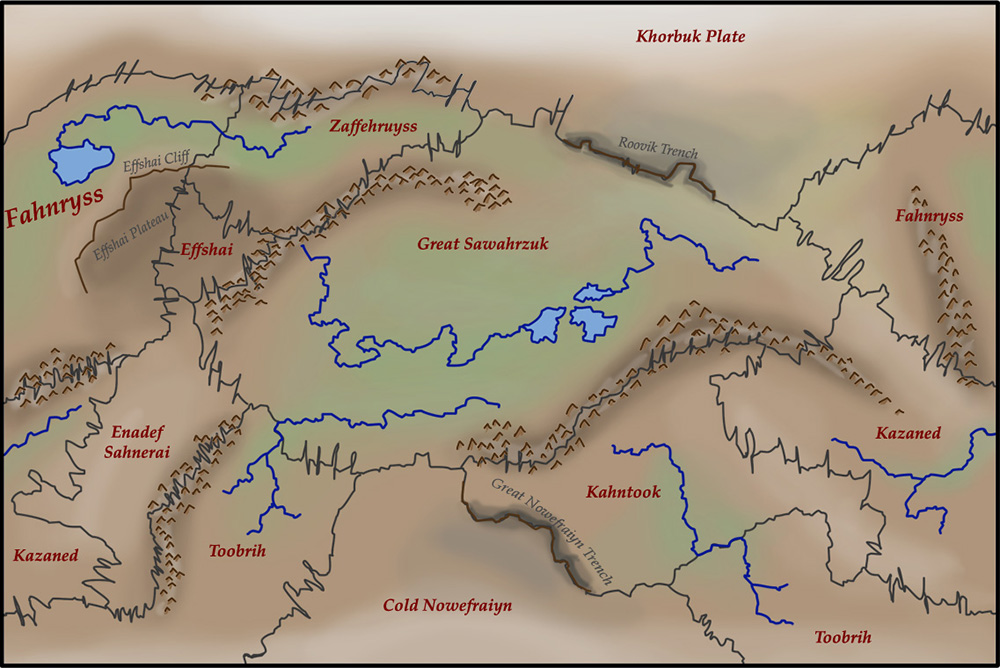
In school, I used to dream up exotic places and cultures. I’d sit at my desk and draw up a new world. I’d imagine the cultures of the various regions. How the geography might influence the overall culture. Of course how the various different planets would interact.

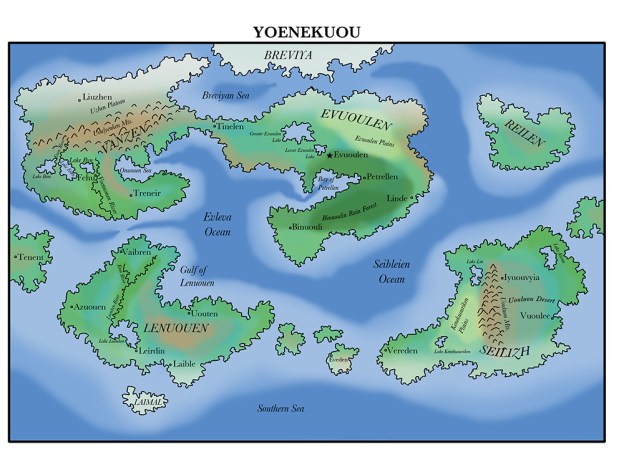
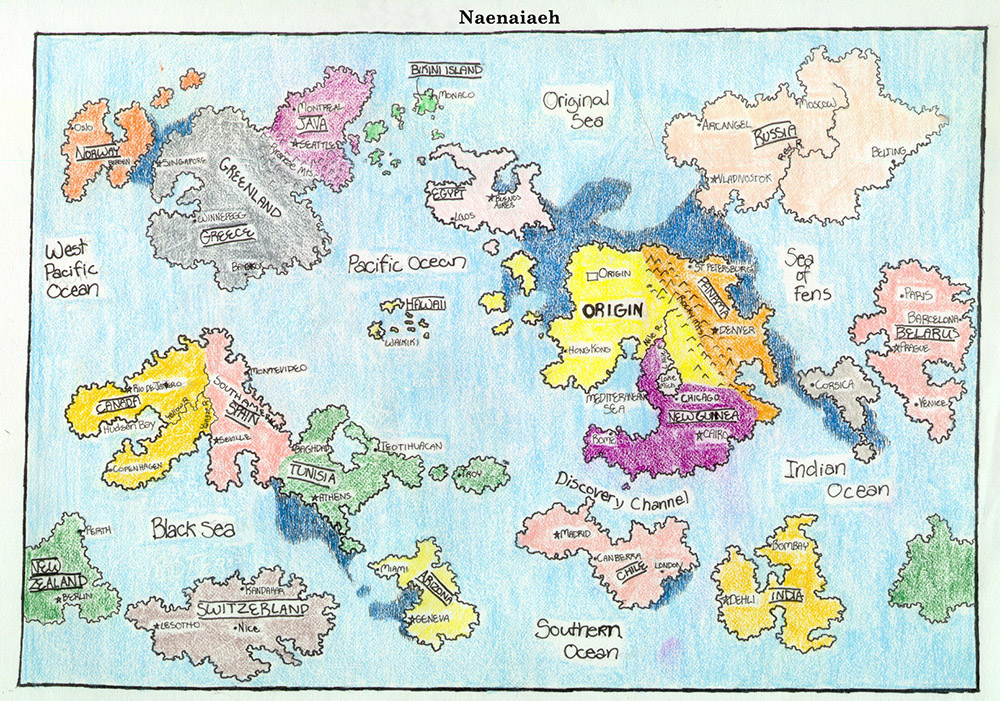
In many ways, Vironevaeh, the universe I’ve played in since I was 10, began because of a map. In 5th grade, we were required to invent a city and imagine what kind of climate, government, and culture it might have. Part of the assignment was to build a diorama of the city. I did a poor job on it (long-term projects weren’t a skill of mine at that time), but the seed had been planted. With the map, I had a connection to the place. Over the odd years of middle school I invented an alphabet, a planet, and several dozen playmate planets. Almost 16 years later, long after the death of that diorama, Vironevaeh lives on. The map of Naenaiaeh, below, is about 10 years old. I’ve been slowly making other maps over the years.

(Side note: I’m not sure if anyone checks this blog on its schedule; you may have noticed my schedule was awry last week. I try to post Monday-Wednesday-Friday. I missed a couple of posts last week due to three days of power outage (brr). But I had a lot of time sitting in front of a fire to dream and imagine new ones!)

map naenaiaeh

The sister planet to Vironevaeh. On Naenaiaeh, the people missed earth, and thus re-used the old names from home.

map silveriaeh

Silveriaeh, a planet of almost no water (I did so like the -aeh ending). Dark brown lines indicate fault lines, blue indicate rivers.

map Menekenesthete

Great kids books, great sources of inspiration

Whenever I go to a museum, I like to look at the kids book section. Often times, there are several really engaging and pretty books relevant to the museum’s collection. They’re often more fun and compact than the books in the adults section. I don’t need a coffee table book for every artist I like. I like to have little pieces of inspiration about my office, though. With my interest in writing children’s books, it’s even better.

The Smithsonian museums in DC have nice gift shops too. Many of the books are award-winning, and seeing them in person makes it easier to judge the book. Plus I don’t mind paying money to the Smithsonian. Below are a few of my finds:

  • Snowflake Bentley— A kid’s book biography of the guy who first photographed snowflakes (he has his own museum even). Beautifully illustrated, with a tone that appreciates science. If you like this book, there are also books of photos of snowflakes; those are great fun too. Below is one of the illustrations from the story (from childrensbookalmanac.com).

  • Oceanology— this one was in the Natural History Smithsonian. It’s a very interactive book written from the perspective of a teenager on “20,000 leagues under the sea”‘s the Nautilus. It’s written to resemble a logbook something like Darwin’s logbook from his journeys.
  • The Legend of the Lady Slipper–I found this one at the American Indian Museum (which, if you are ever in DC, has a great cafeteria). Like the cover, the illustrations have a lovely sense of movement, and nice colors. One of the artists is known for painting people dancing; this comes across in the people of the story, who are always in subtle motion.