Author Archives: Vironevaeh

Fun Science: Helium

Helium: filler of floating balloons, maker of high-pitched voices. But there are a lot of other interesting things about helium too!

First, helium makes our voices high because it is less dense than air, and thus the vocal chords vibrate more quickly. (Also fun: higher density gases, like sulfur hexafluoride, will correspondingly make the voice become very low. In this case, the practitioner must be upside-down, because right-side-up the gas will settle in the lungs, potentially causing asphyxiation.)

Helium is the second most common elements in the universe, but it’s pretty rare on earth. We get pretty much all of our helium during natural gas extraction, when it is trapped underground. Because it has such a low density, it basically escapes the atmosphere once it gets into the air. Helium is very common in the universe because it is formed by the fusion of hydrogen. Our sun and other stars are hydrogen to helium engines, pumping out tons os helium per second, though it doesn’t come to Earth. Most helium on earth comes from the radioactive decay of uranium, which emits helium.

Helium is a noble gas. This means that it naturally has the number of electrons to be stable without interactions with other atoms. Helium has the lowest boiling and melting points of any element, at 4K and 1K respectively. This is due to its stability. Liquids and solids are formed when atoms energetically interact with one another; helium has very little tendency toward this. Because of its stability, helium is used as a cryogenic gas. Helium is an essential part of an MRI machine, shown below. The helium is required to supercool the magnets, which increases the magnetic field and thus the resolution.
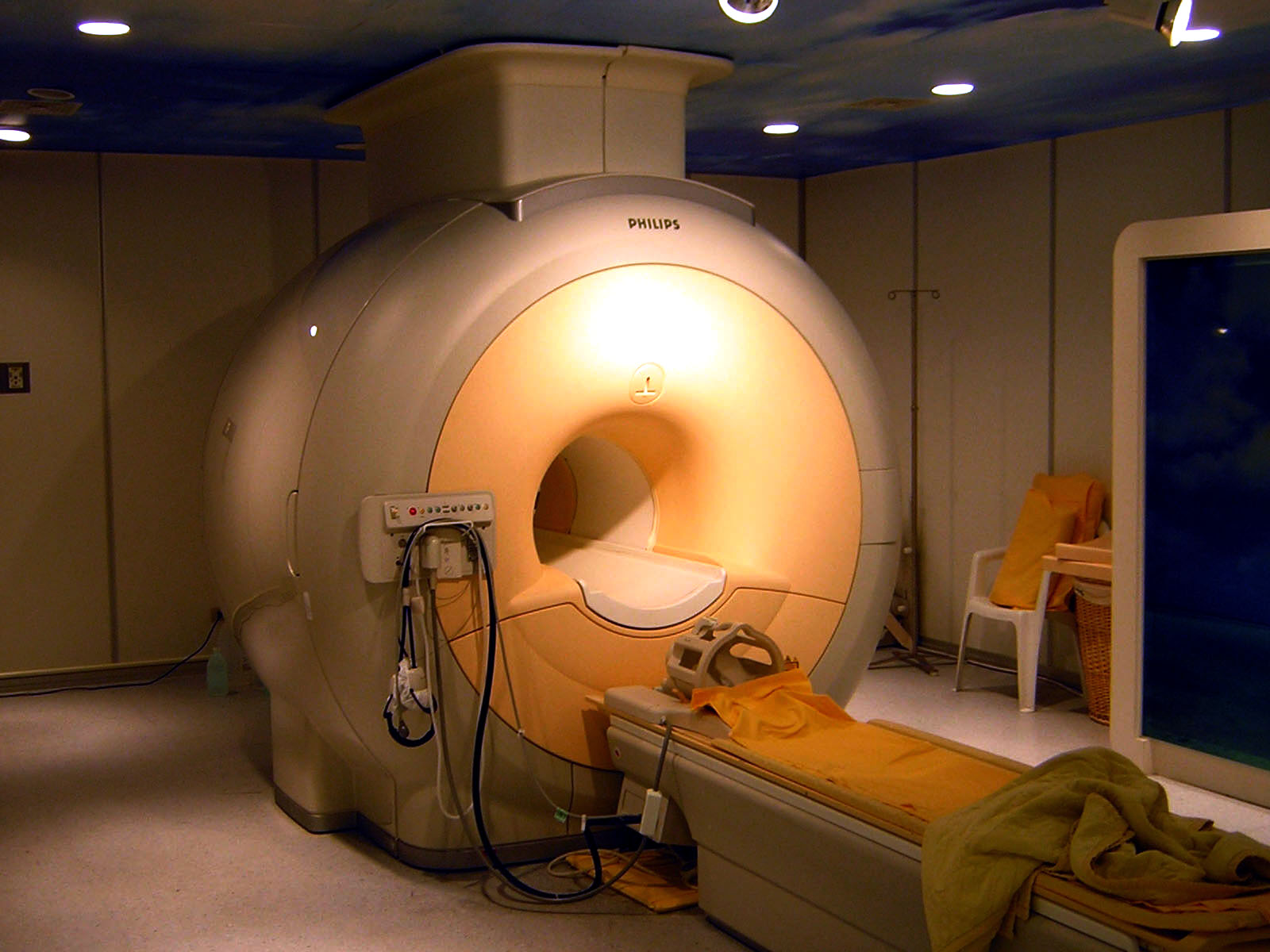
MRI for medical imaging.

The US is the largest supplier of hydrogen in the world. This is partially because congress signed an act to bleed down our helium reserve by 2015. However, some scientists have pointed out that helium is hard to come by, and we should conserve our helium. One source estimates that helium balloons should cost $100 dollars each, based upon the scarcity of helium. Another says they should be illegal.

So the next time you look at a blimp or a balloon, marvel at the substance that fills it. It’s really star stuff, and rare to boot!


More writing progress and uh… yellow flowers

I’ve been slogging away still at the novel draft. Today I crossed 40,000 words, which is definitely the farthest I’ve ever gotten in any attempt. So, big milestone.

But because news of word counts is decidedly dull, I’ll also append some photos of yellow flowers from over the years. It’s only appropriate because my office where I write is make-your-eyes-bleed bright yellow. I have even more yellow flower pics over in my flickr set (as always, fair-use). Have a bright day!

Book review: Dealing with Dragons (Patricia Wrede 1990)

There are no spoilers in this review beyond the first couple chapters.

Rating: 5/5

Dealing with Dragons is a humorous young adult fantasy book, the first in a four book series. I first read it when I was in middle school, and I just recently reread it. I enjoyed it greatly when I was younger and it was a fun little excursion now. I wanted to read something light that wouldn’t distract me too much from my own writing projects. This book was perfect for that.

The main character of the story is Cimorene, a smart and unconventional princess who is tired of the dullness of her life of embroidery and batting her eyelashes. To avoid a marriage to a dull prince, she leaves home to go live with dragons. In this universe, dragons keep princesses as helpers as a status symbol, and this is why princes are always saving princesses from dragons. Cimorene’s dragon sees the advantage to a sharper princess who can actually be a useful helper. Along the way, Cimorene learns about dragons, wizards, witches, and many magical things.

Many of the people Cimorene encounters are hung up on doing things the way they are expected to, often without any real additional reason. The story uses sly humorous references to familiar fairytales, such as sleeping beauty and St. George the dragon slayer, to explain why these various characters feel their obligations. Cimorene often succeeds because she thinks about the best course of action, she doesn’t just do what is expected.

For that reason, I think it would be a good book for kids, like it was for me. Kids get too hung up on how people will think of them, and not always with bad reason. Other kids can be eager to harshly deliver this message. In adulthood, what makes you different is usually valuable. Adults have to help kids resist the pressure to always conform. It’s also a good book for adults because it is a lovely and swift read. The whole book is only 212 pages long, and those are fast-moving pages. It would not be hard to finish this book in an evening.

Swimming at the Shore

Alas no, I am not swimming at the shore for some time. But I like to pretend that I might be soon, and so I wistfully mull through my photos. I love to swim, and anytime I visit non-lethal water, I want in. The next best option is photographing. The two mix poorly, but I try. Below are some lovely tropical beaches, and some gloomy beaches and some extremity-numbing fjord beaches.

As a point of pride, I did get in the fjord and swim to a dock about 30 feet out, but I was going numb. Because children are insane, several children also did and wondered why I minded. This summer I’m visiting the Outer Banks of NC, and hoping to try a little surfing.

Happy Friday!

SONY DSC

Playa del amor in Cabo San Lucas.

SONY DSC

Dungeness Spit on Olympic Peninsula in Washington State.

SONY DSC

Sunrise in the Outer Banks of North Carolina.

SONY DSC

The dunes of North Carolina at sunrise.

SONY DSC

Swimmin in fjord water in Solvorn, Norway.

SONY DSC

Shore birds of the gulf coast of Florida.

SONY DSC SONY DSC

Happy 50th Anniversary, Chaos

This month, the American Physics Society magazine, Physics Today, published an article about the 50th anniversary of the Lorenz model. At the link, you can read the entire article. In it, experts describe the history of chaos, Lorenz’s discovery of it, and some of the state of the field today, but with a great deal less technical jargon.

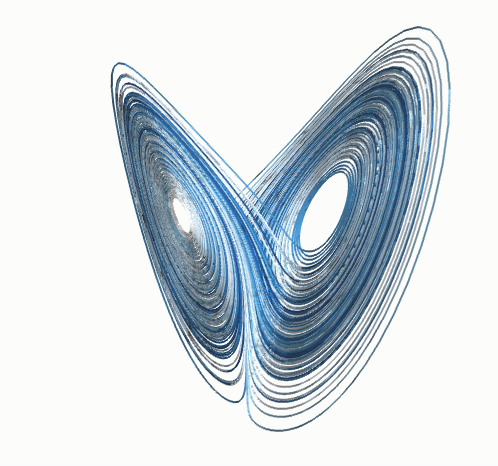
50 years ago, Edward Lorenz first captured the mathematical phenomena we now know as chaos, known popularly as the “butterfly effect“. Below is a picture from the Lorenz model exhibiting chaos. The idea of chaos boils down to highly structured behavior that cannot be predicted. No matter how precisely we measure, after some time we cannot know the state of the system. We can say that the system will stay in a certain region of weather; in the picture below, there are definitely places the trajectory does not visit. We observe this with weather models– the forecast is good for a couple of days, so-so for a couple of days after that, and completely inaccurate for any time farther in the future. Analogously, we can say that it will not be -100 C tomorrow. Appropriately, Lorenz’s discovery of chaos came about as he tried to develop a model for the weather. Chaos is all around us and can be observed in a number of systems.

the Lorenz system, which turned 50 this year

At this link, you can play with a fun Lorenz model java applet. The trick with the applet is choosing the right parameters. Try setting the “spread” to 0.1, the “variation” to 20, the “number of series” to 2, and the “refresh period” to 100. Then push the button “reset the parameters” and “restart”. This will start 2 trajectories in the Lorenz model that differ by only 0.1. You will quickly see the two paths diverge and become completely unrelated. If you reduce the “spread” to 0.01, the same thing will happen, though it will take longer. As long as the spread is more than 0, the two paths will eventually diverge.

This is why we cannot predict the state of a chaotic system, because our ability to measure the state of the system is inevitably flawed. If we could measure the state of the weather to 99.99999% accuracy, that 0.00001% inaccuracy would eventually lead to divergence. And you can imagine that getting 99.99999% accuracy is much harder and more expensive than 99.9% accuracy.

Did you know that Pluto’s orbit is chaotic? Or a double pendulum? Or the logistic model for population dynamics? So check out the Lorenz model, and happy chaos-ing.

Style: University of Virginia Lawn

There are three manmade UNESCO world heritage sites in the United States: The Liberty Bell, The Statue of Liberty, and The University of Virginia Lawn with Monticello. The UNESCO designation basically means there is something noteworthy of distinctive about the site. I happen to live near to the University of Virginia, so I get to take a lot of photos. (As of this post, I just discovered that all the modern photos on the lawn Wikipedia page are mine. I love to see where the creative commons take my works. Side note: check out my very large Flickr collection of mostly creative commons images.)

Many years ago, Benoit Mandelbrot, the creator of fractal geometry, visited the university to give a talk. He said it was like walking into the lion’s den of Euclidean geometry. I always liked this description; everything about the university is columns and arches and perspective points. Monticello and the University were laid out by Thomas Jefferson, who one gets the feeling never actually died living around here. He was the ambassador to France for a while, and greatly admired the architecture. He came back to the states with those architectural inspirations.

The UVA lawn, shown below, has the rotunda at one end (the second one… the first one burned down and blew up when a professor tried to save it with TNT) and is lined by ten pavilions. Between the pavilions are dorm rooms that distinguished fourth year students still live in. Each of the ten pavilions is architecturally different, and behind each is a garden in a different style which no doubt will be the topic of a future post. Pavilion 2 is pictured below. Professors still live in the pavilions. The pavilions were built in a strange order, to ensure that diminished funds would not diminish the scope of the project.

It’s very easy to find plenty of reading material on Jefferson and the University if you are interested, so I won’t try to write a tome here. However I’ll include a few of my pictures that may hopefully spark your interest.

SONY DSC DSC03036 SONY DSC SONY DSC SONY DSC SONY DSC SONY DSCpavilion 2

Monticello, i.e. the back of a nickel


Writing: engineer style!

As I’ve mentioned a few times, I am currently trying to write a novel. It’s a lot of writing, and I have something of a history of starting and stopping projects. So I’m happy to report that I am still on the path and plodding along. Today I reached 23,000 words. I found estimates that trade paperbacks have 200-250 words per page. So that means my progress would fill 93-115 pages of a paperback. That’s kind of fun.

I am a mad procrastinator, but one of the ways I try to motivate myself is to allow certain writing related side activities. And because I am an engineer and a grad student, that distraction right now is…. excel sheets. Yeah. Below is a chart of my day-to-day progress. The slope gives my average words per day, so it can be fun seeing that change. When I reach a hitch, I get to go put my chapter’s word count into the chart and see what my daily word count is and my overall rate. What’s more exciting than fitting data?

writing progress


There are some websites I like to use as well when progress fails to appear. Written kitten is super cute. You get a picture of a kitten as a reward every so often. Because I need lots of motivation, I set it to every 100 words. If you need punishment more than reward, writeordie is quite popular. This blog had a decent summary of both.

I suppose this stuff doesn’t make the most exciting reading, but I hear it’s good to post about this stuff. Something about peer pressure? Plus since I’m writing all the time, I have less time to go read nifty things to post about. So, Happy Friday!

Join the bone marrow registry from your couch

A couple of weeks ago I read about a shot-putter at University of New Hampshire named Cameron Lyle. He is giving bone marrow to a critically ill 28-year-old; unfortunately because he is a senior, donation will end his shot-putting career at the school. I’m glad to hear that the guy didn’t even think of it as a question. He knew he had to donate.

Lyle was found for donation because he was in the bone marrow donor registry, as part of a drive run by UNH. I was really glad to hear this. Perhaps I just don’t get out enough, but at my two universities, I’ve never heard of such things.

How to join

In this post, I wanted to make sure that people knew that it is so easy to join the registry at marrow.org. It’s free (if you are under age 45), and involves no needles unless you match, which happens for about 1 in 540 people. You sign up on the marrow.org website. This is basically giving them your address, and a contact’s address so they don’t lose you in the future. A pack of q-tips come in the mail. You swab them in your cheeks, and send them back. And then you’re in the registry.

What to expect if you get selected, from my experience

I donated marrow several years ago to a family member. Most times, but not always, stem cells are induced into the bloodstream through a series of shots. Then when the stem cells are in your blood, you hook up to a machine which takes the stem cells out and puts the rest of your blood back in you. That separation process is called pheresis, and if you’ve ever given plasma, it’s a similar procedure. An out needle in one arm, and an in needle in the other. The biggest problem with this method, as one who experienced it, is using the restroom, because they want you well-hydrated and it takes a while. For young people, the stem-cell shots can cause some aches. I turned into the princess and the pea, sleeping on all the pillows in my house for a couple of days, but apparently that isn’t typical.

Sometimes they still do the old-fashioned big needle in the hip bone marrow transplant method. They often show this procedure on TV shows, but it’s less common than the stem cell donation I described above. It sounds like the shot-putter might be doing a marrow transplant, which would explain why he can’t shot put for a few weeks.

The point

But basically, it something that you can do for free with very little inconvenience. In the unlikely event you get selected, it’s still not terribly involved. Minorities and people of mixed background are especially needed. There are FAQs and other info at marrow.org, too. Hopefully this will give you the info and motivation to join the registry, or encourage others to join.

Fun Science: Why’s platinum so special?

In science, we tend only to learn about a small subset of the elements that populate our world. This is not unreasonable, since 96% of our bodies are composed of just hydrogen, water, carbon, and nitrogen. But there are over a hundred more elements, and they often influence life outside our bodies in ways we don’t hear about. So in today’s post I will talk about platinum.

Platinum is one of the rarest metals in the Earth’s crust. Only 192 tonnes of it are mined annually, where 2700 tonnes of gold are mined annually. When the economy is doing well, platinum can be twice as expensive as gold. So what’s so valuable about it?

Platinum is used a lot in jewelry. Platinum has the appearance of silver, but it doesn’t oxidize and become tarnished like silver. It’s harder than gold, and its rarity can be appealing.

But it’s the chemical properties of platinum that set it apart. Platinum is a great catalyst. This means that platinum facilitates chemical reactions, but is not consumed as the reaction proceeds. The catalytic converter in your car is a platinum catalyst. The catalytic converter helps eliminate a variety of undesirable compounds such as carbon monoxide, nitrous oxides, and incompletely combusted hydrocarbons. Platinum is also a critical part of current hydrogen fuel cells; it splits hydrogen into protons and electrons.

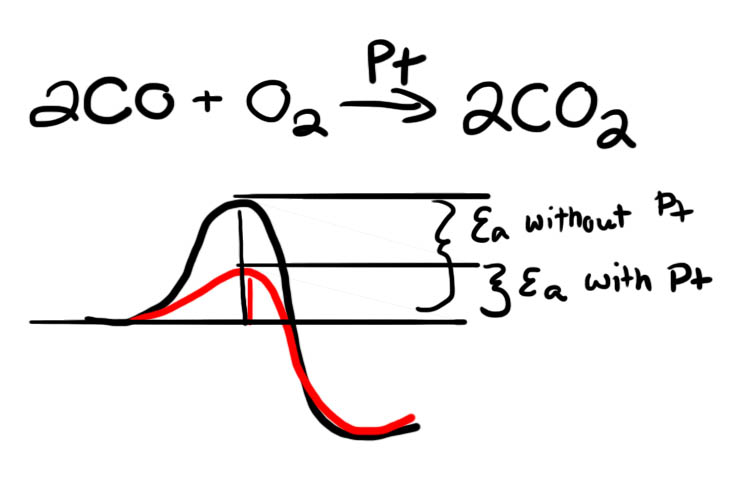
Platinum doesn’t force reactions to occur, but it makes them easier by reducing the energy required. The image below shows the reaction of carbon monoxide (CO) to carbon dioxide (CO2). The chart at the bottom shows the potential energy before, during and after the reaction. Imagine a ball rolling along the red curve (with platinum) and the black curve (without platinum). The ball on the black curve will need more speed to get over the hump. Any given ball is more likely to get over the red hump. Likewise, the presence of platinum lets CO get over the hump to become CO2. Platinum does this for all kinds of reactions.

activation energy

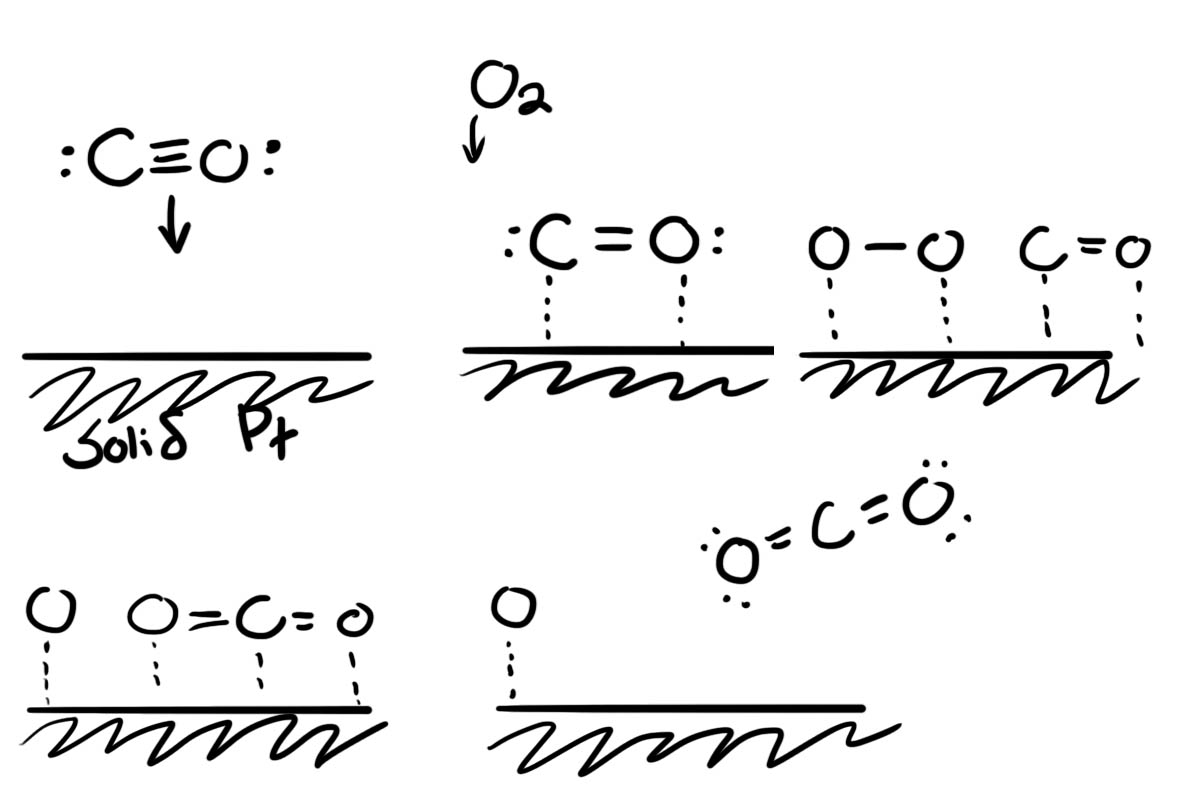
The reaction takes less energy because once a molecule bonds to the surface of platinum, the bonds within the molecule are a little weaker. Molecules like O-O and H-H can split into singletons, something they would never do off the surface. Below I show an example reaction for CO to COon platinum. This diagram is meant to be illustrative, a possible mechanism for the reaction and to show how platinum helps out. In reality these reactions occur very quickly, and careers can be spent figuring out exact reaction mechanisms.

catalysis


Platinum is a bit like velcro. Molecules become hooked to the surface, do their reaction, and unstick. If molecules stick and then refuse to unstick, this is called catalyst poisoning, and it’s a big issue in fuel cells. Like velcro, once the hooks are occupied, they can’t do anything else. Platinum is a good catalyst because a lot of things (like hydrocarbons) want to stick to it, but they don’t stick too hard. Other metals either are not attractive enough, or they are too attractive. Platinum is so valuable because, besides being rare, its properties happen to be balanced just right for the reactions we want.


Progress and things

Just a quick update today. I made a few changes to the site, and I will make a few more over the next weeks. As I approach 100 posts, I have more content to organize, and more ways to organize it. So now there is a “Fun Science” tab, which lists and categorizes my science posts. Now I’m excited to do some more science posts.

I continue to make great progress on the novel draft (fingers crossed). Yesterday I reached 15,000 words and finished the 10th chapter. I am a fan of short chapters. I first wrote it last summer as a too-long short story. At the time, I intended it to be part of a collection of illustrated short stories. Below is the illustration I had finished for that story.

Happy Friday!

CaveCrime-small