Tag Archives: Illustration

Science Fiction Worldbuilding

One thing I love about science fiction is worldbuilding. When you go to a new place, you take in the architecture, the language, the food, the weather, how someone enters a house, how someone insults another person… These things exist in any culture, but they vary, sometimes radically. In science fiction, the creator tries to imagine these things in a logical and consistent manner for a time that hasn’t happened yet, for planets unknown, with the very constants of life such as gravity and oxygen subject to change. And yet the end product, when successful, is similar to travel–we visit a place that is deeply familiar in the fundamental ways and yet different in ways that provoke thought.

(Some people think that there is too much worldbuilding–I don’t agree. I think the author can tell too much of their own personal worldbuilding process and not consider the reader enough. However, I speak from a place of no authority, so take my opinion for what it is worth.)

In the last few weeks, I’ve been working on illustrations of street life in my city inspired by Hiroshige’s 100 views of Edo. Even after 17 years working on this world, I see many new things this way.

SONY DSC

On the hill in the background is the outline of an old storm tower, shaped a bit like a lighthouse. The old fortifications stood high on the hills with thick walls to withstand the storms.SONY DSC

The view west from a storm tower, to give early warning of storms. In the early days of the city, storms caused flash flooding and devastation.SONY DSCGleaming cities often have unsavory hidden parts, sometimes literally lurking around the corner.

So far I’ve done about 20 illustrations. I’d like to do at least 100. In each one I feel more comfortable with previous details. I’ve looked up references of European and Moroccan and Japanese architecture (mostly the European showing in these three samples). Now I’ve started incorporating old sketches over a decade old. The city feels all the more real to me (it’s great inspiration for story ideas and details), and the work is great fun.

 

Progress and things

Just a quick update today. I made a few changes to the site, and I will make a few more over the next weeks. As I approach 100 posts, I have more content to organize, and more ways to organize it. So now there is a “Fun Science” tab, which lists and categorizes my science posts. Now I’m excited to do some more science posts.

I continue to make great progress on the novel draft (fingers crossed). Yesterday I reached 15,000 words and finished the 10th chapter. I am a fan of short chapters. I first wrote it last summer as a too-long short story. At the time, I intended it to be part of a collection of illustrated short stories. Below is the illustration I had finished for that story.

Happy Friday!

CaveCrime-small

Vironevaeh: Hiroshige Influence

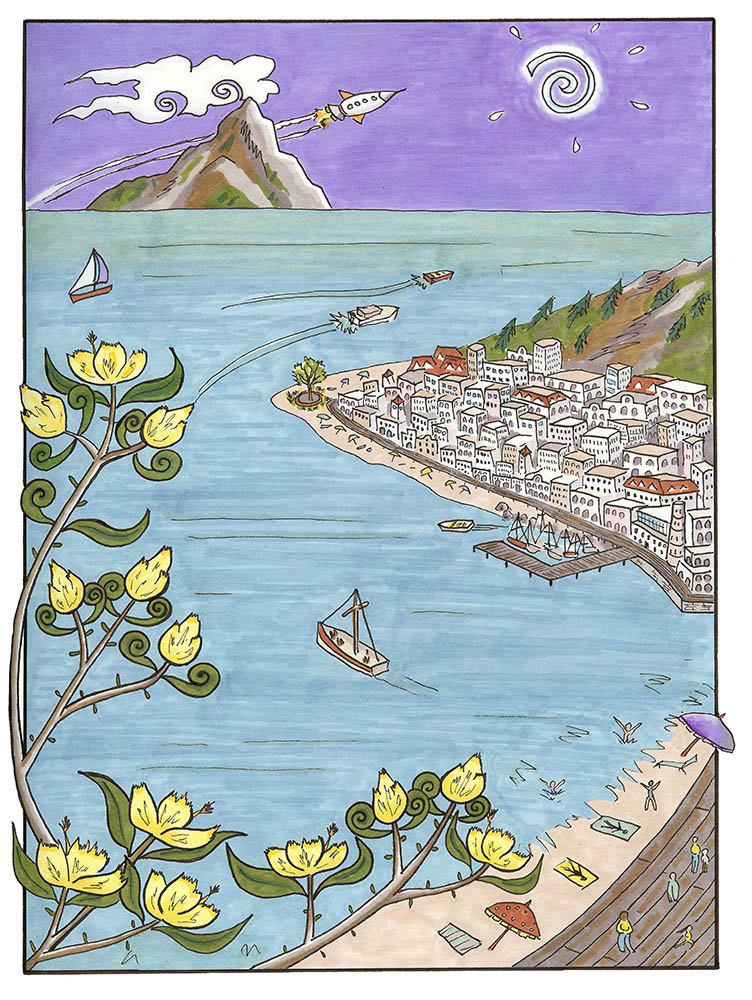
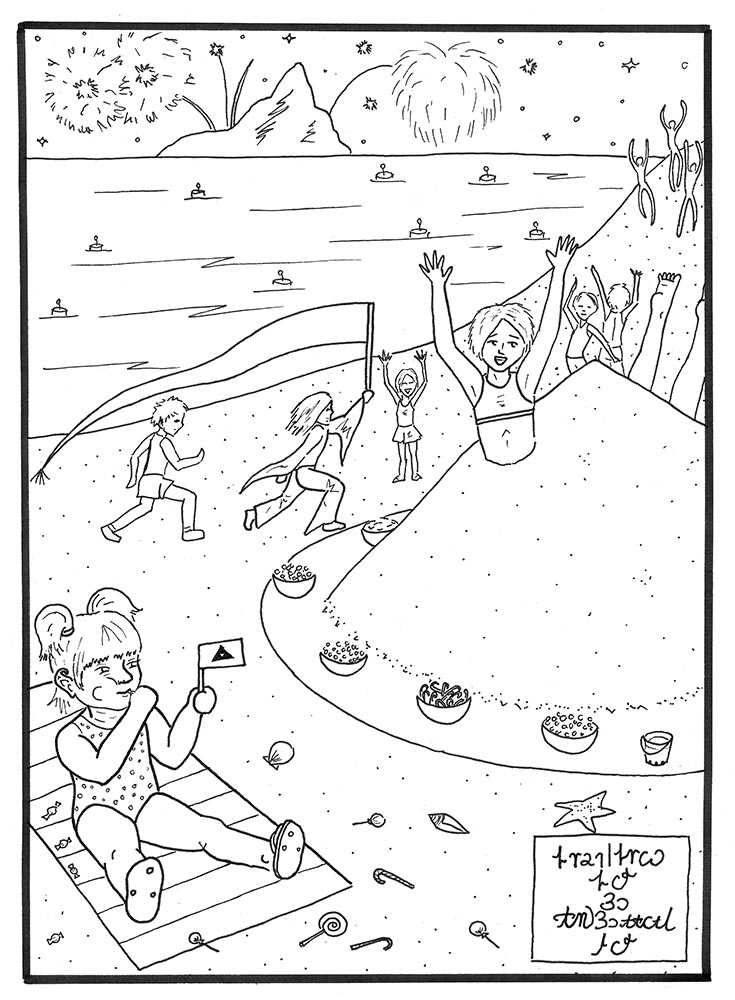
A few weeks ago, I wrote about the paintings of Japanese artist Hiroshige. So I got inspired and tried my hand at something along those lines, something like a science fiction Hiroshige. The drawings are set in the world of Vironevaeh: Science Fiction Fairy Tales (which, btw, is free on iPad =) ).

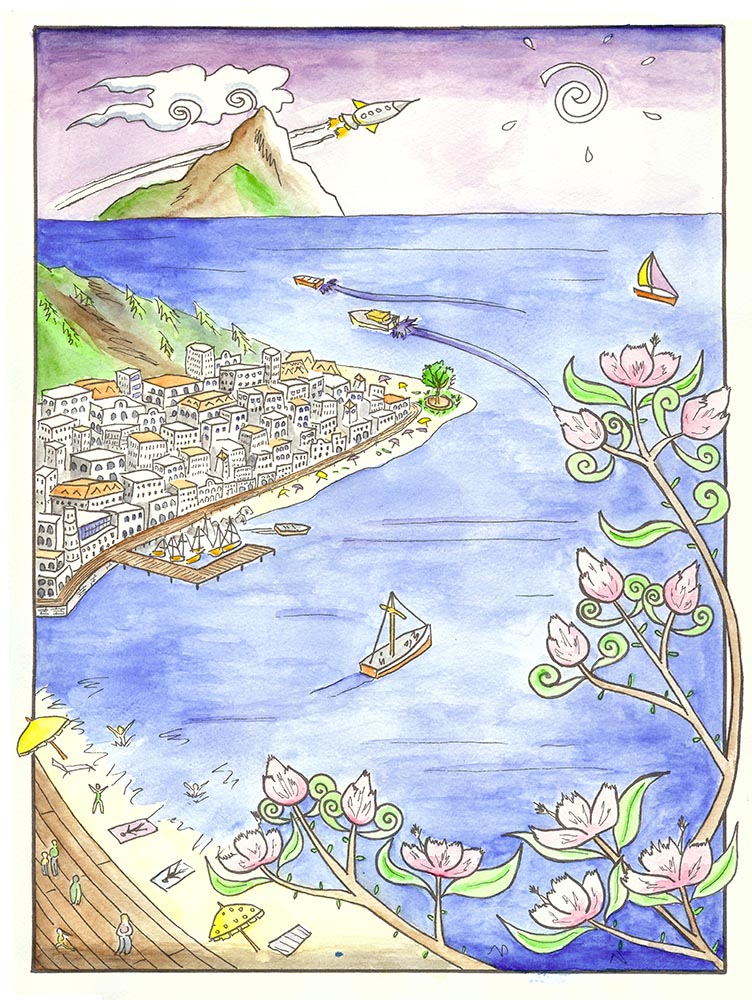
The first, done in watercolor, shows the city of Vironevaeh on the North Bay with Mt. Viro-Vit in the background. The second is a tweaked version done in markers. The third is the linework for another, depicting a Vironevaehn holiday called Digurtian Day. The Digurtian Day celebration is labeled in Vironevaehn. Many of the Hiroshige paintings are labeled in Japanese, so it felt fun to channel that spirit.

Happy Friday! I’m off to the Virginia Festival of the Book!

viro-city-watercolor-smaller

viro-city-marker-smaller viro-digurtian day-medium

The Joy of Maps

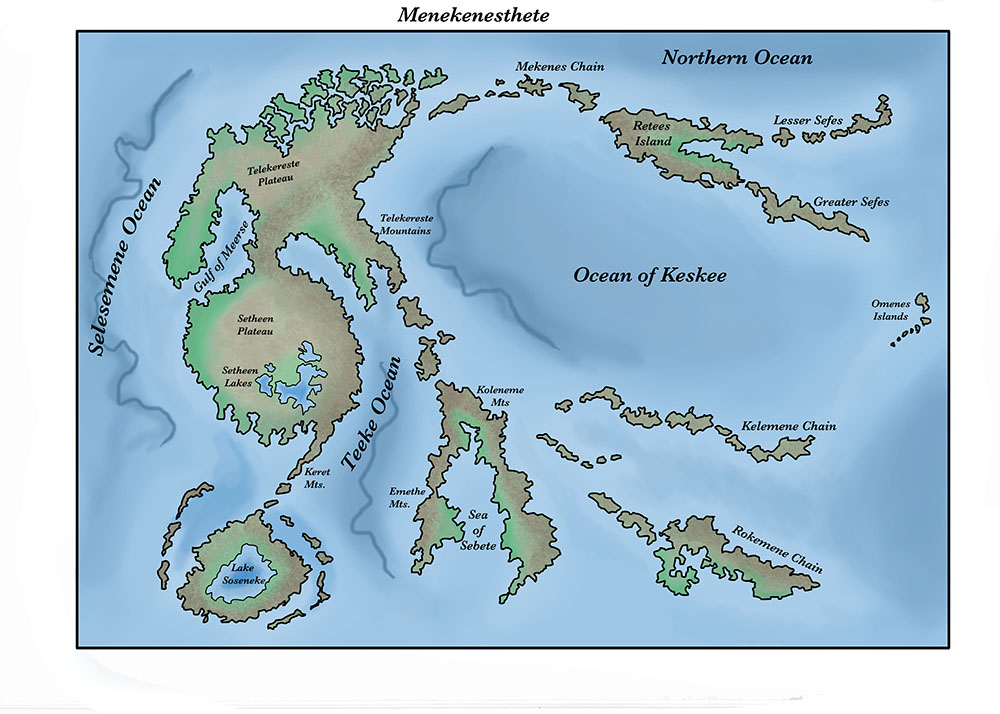
I love maps. Not the ones that are useful, really. The decorative ones, or the ones that accompany a novel. The useful ones have a sort of dryness to them. I was never a big Tolkien fan, but I liked his maps a lot. Vernor Vinge’s “A Fire Upon the Deep” has a map of the galaxy, and I found that added to my enjoyment. I like historical maps too; you get an insight into past culture that comes much more slowly from print. Old maps sometimes have amazingly different spellings and different borders (Capp Codd instead of Cape Cod, for example, on an old american map). Old city maps reveal the old structures that gave rise to the city of today. A few years ago, the university museum had an exhibition of old maps. A lot of these maps remain available online as well.

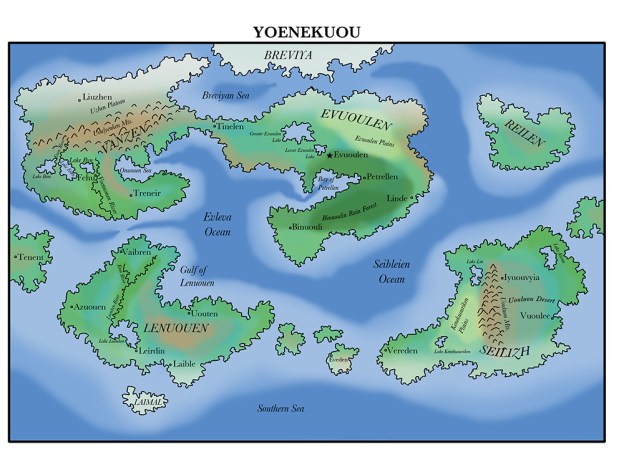
In school, I used to dream up exotic places and cultures. I’d sit at my desk and draw up a new world. I’d imagine the cultures of the various regions. How the geography might influence the overall culture. Of course how the various different planets would interact.

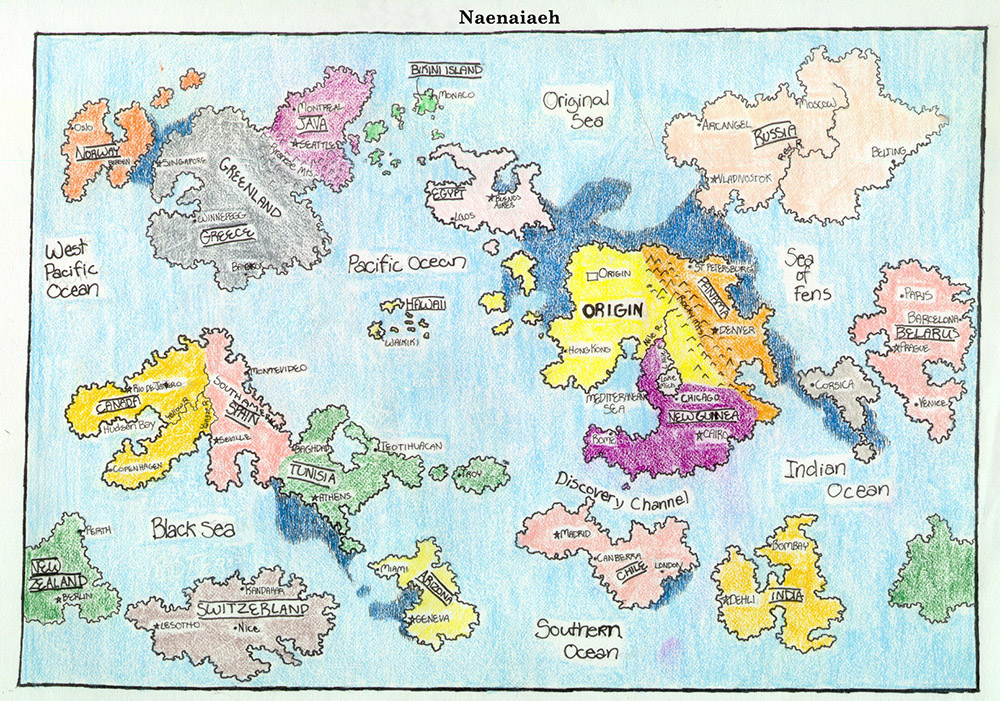
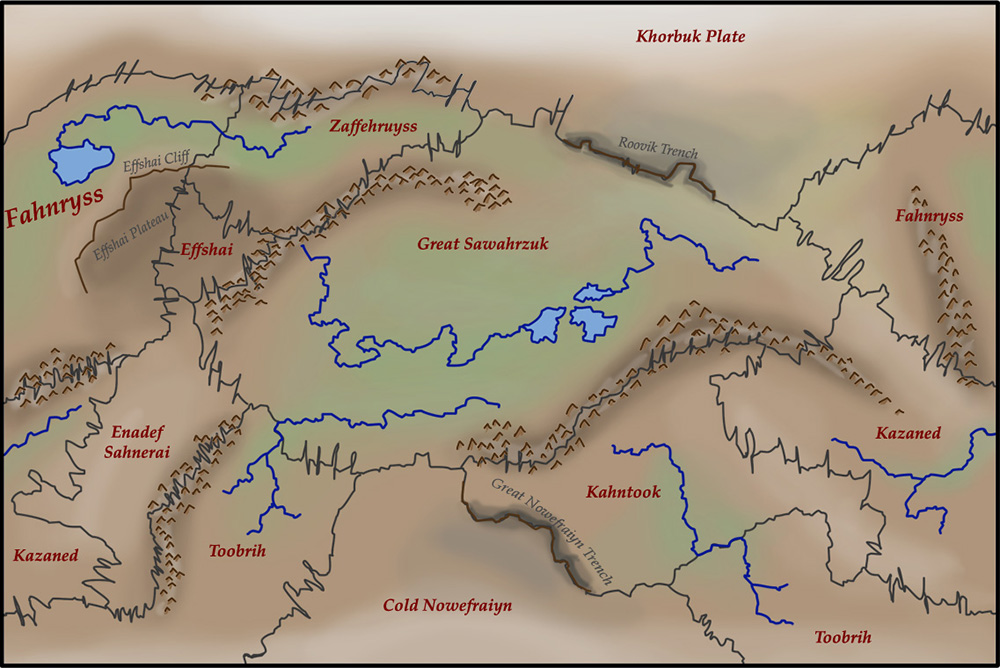
In many ways, Vironevaeh, the universe I’ve played in since I was 10, began because of a map. In 5th grade, we were required to invent a city and imagine what kind of climate, government, and culture it might have. Part of the assignment was to build a diorama of the city. I did a poor job on it (long-term projects weren’t a skill of mine at that time), but the seed had been planted. With the map, I had a connection to the place. Over the odd years of middle school I invented an alphabet, a planet, and several dozen playmate planets. Almost 16 years later, long after the death of that diorama, Vironevaeh lives on. The map of Naenaiaeh, below, is about 10 years old. I’ve been slowly making other maps over the years.

(Side note: I’m not sure if anyone checks this blog on its schedule; you may have noticed my schedule was awry last week. I try to post Monday-Wednesday-Friday. I missed a couple of posts last week due to three days of power outage (brr). But I had a lot of time sitting in front of a fire to dream and imagine new ones!)

map naenaiaeh

The sister planet to Vironevaeh. On Naenaiaeh, the people missed earth, and thus re-used the old names from home.

map silveriaeh

Silveriaeh, a planet of almost no water (I did so like the -aeh ending). Dark brown lines indicate fault lines, blue indicate rivers.

map Menekenesthete

Japanese Art: Hiroshige

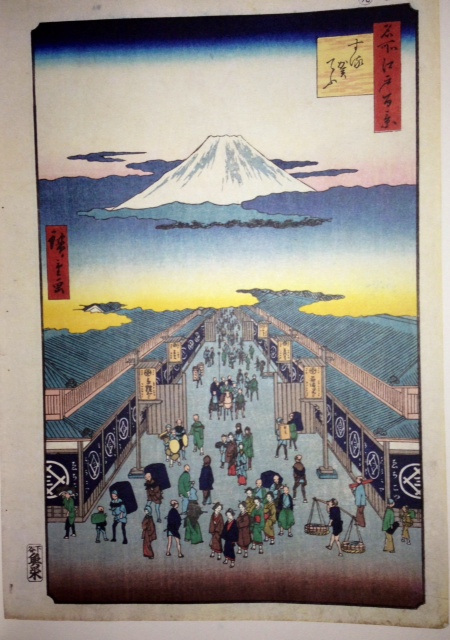
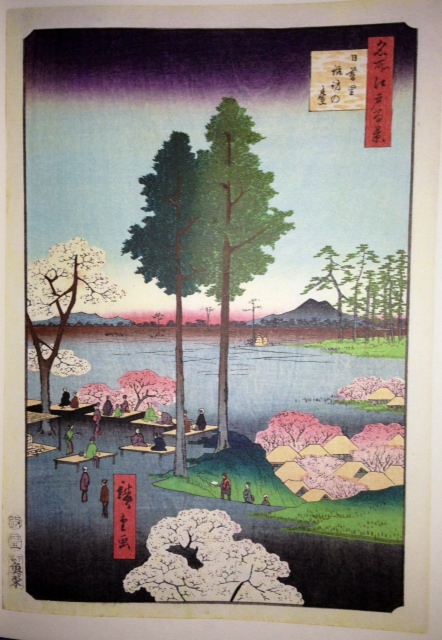
I have a beautifully bound book of the paintings of Edo by Hiroshige I found a few years ago. Since that acquisition, I have grown fond of the style of Hiroshige. He is an artist in the ukiyo-e style, or woodblock prints of daily life from 1800s Japan. The composition style is quite different from contemporary western works. A lot of Hiroshige’s works can be found online as part of the public domain. Wikipedia has a number of images in its gallery.

Vincent van Gogh drew stylistic inspiration from the works of Hiroshige. Below are nearly identical paintings by van Gogh (right) and Hiroshige (left). Many of van Gogh’s paintings have composition reminiscent of the ukiyo-e style.

Below are three of my favorite paintings from “one hundred famous views of Edo”.

photo photo1 photo2

Great kids books, great sources of inspiration

Whenever I go to a museum, I like to look at the kids book section. Often times, there are several really engaging and pretty books relevant to the museum’s collection. They’re often more fun and compact than the books in the adults section. I don’t need a coffee table book for every artist I like. I like to have little pieces of inspiration about my office, though. With my interest in writing children’s books, it’s even better.

The Smithsonian museums in DC have nice gift shops too. Many of the books are award-winning, and seeing them in person makes it easier to judge the book. Plus I don’t mind paying money to the Smithsonian. Below are a few of my finds:

  • Snowflake Bentley— A kid’s book biography of the guy who first photographed snowflakes (he has his own museum even). Beautifully illustrated, with a tone that appreciates science. If you like this book, there are also books of photos of snowflakes; those are great fun too. Below is one of the illustrations from the story (from childrensbookalmanac.com).

  • Oceanology— this one was in the Natural History Smithsonian. It’s a very interactive book written from the perspective of a teenager on “20,000 leagues under the sea”‘s the Nautilus. It’s written to resemble a logbook something like Darwin’s logbook from his journeys.
  • The Legend of the Lady Slipper–I found this one at the American Indian Museum (which, if you are ever in DC, has a great cafeteria). Like the cover, the illustrations have a lovely sense of movement, and nice colors. One of the artists is known for painting people dancing; this comes across in the people of the story, who are always in subtle motion.

Drawing Books: Andrew Loomis

I always find a good drawing book to be very motivating. When I draw, I do best when I have a good visual aid, especially when posing people. Alas, I have no models living in my attic to call upon for posing when the need arises. So a good book of poses is the best substitute I have.

Andrew Loomis was as illustrator in the middle part of the 20th century. He wrote several drawing instruction books as well. These books were very well-regarded and popular, but they went many years without being reprinted. Old copies of the books would sell for over $100 on eBay.

Happily, his books started being reprinted a couple of years ago. They are lovely hard-cover reproductions, available for about $25 each on Amazon.com. I believe four have been released:

  • Figure Drawing for All It’s Worth– A book about drawing the figure. I’ve found in the past many figure books are more men than women (which I always thought was strange). If anything, this book has more female figures, but men are covered as well, as well as various proportions, and the proportions of children.
  • Drawing the Head and Hands– About drawing the head and hands. As you’d expect, this covers the head and hands from all kinds of angles, for different ages and backgrounds.
  • Successful Drawing– I don’t have this one. I find its title vague. I like to imagine I can already draw. But if anyone has read it, I’d be curious to hear.
  • Creative Illustration– I just got this one, but I haven’t had a chance to go through it in much detail. This is the one I’ve been anticipating most, based upon the title. I have observed many heads and hands and figures, but illustration is a way of interpreting the scene to make it more engaging.

Zish and Argo Artwork

My biggest goal over the holidays was to complete painting for the Zish and Argo book. Last night I finished the last painting! Hooray! Champagne! Zish and Argo has 13+ full size color illustrations, painted in water colors. The picture below shows the ones I finished during the holidays. For reference, they are about 8 inches tall. In the next couple of weeks, I will pull together the art and put up book details. The featured image shows the tentative cover that I just finished as well.

Tomorrow I head back north to new projects and adventures.

SONY DSC


Artists: Walter Crane

I love to go to art museums to new style ideas. On a recent trip to the Virginia Museum of Fine Arts (VMFA), I visited the art nouveau section and saw a piece by English artist Walter Crane:

Walter Crane plate at VMFA.

The plate mentioned that Walter Crane did children’s books.

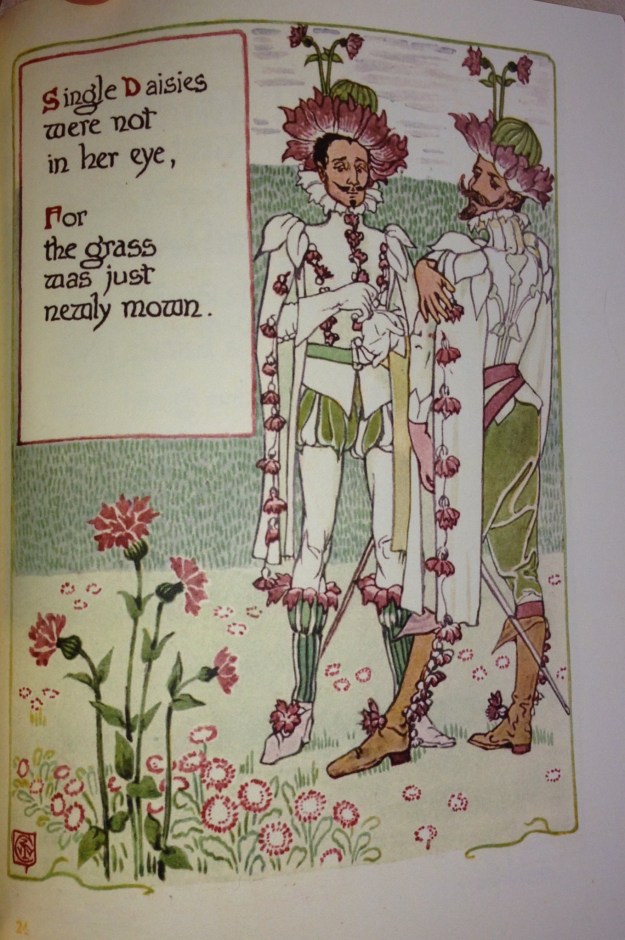
So I went home and ordered a couple of his books. A Floral Fantasy in an Old English Garden anthropomorphizes the flowers of the gardens in beautiful art nouveau fashion. Below is a photo of one of the pages. This page depicts bachelor’s buttons. All the little details, down to their boots, are done to match the characteristics of the plant. Another panel shows a battle between a thistle knight and a snapdragon. Walter Crane has several children’s books besides this one. Since Walter Crane died in 1915, his works have entered the creative commons, and they can be had very cheap, especially digitally.

photo

Walter Crane also did more adult works. Neptune’s Horses reminds me of the scene in Lord of the Rings where the elf summons up the waters to fend off the nazgul, but it was painted over a century before.

Soviet Holiday Cards

Boingboing had a cool post yesterday about Soviet “Christmas” cards. Actually most of the cards say “s novum godom”– “to the new year”. I love all the science and rocketry themes. I also find it interesting how many things we associate with Christmas have been co-opted for a holiday the soviets found safer: New Year’s. You can find the original website for the cards here. Below are a few of my favorites, which can all be found at www.mazaika.com/postcard01.htm.