Tag Archives: photography

Sports photography: Great fun, great challenge

I love the Olympics. It’s the best time to view water polo and women’s sports. I marvel at the myriad body shapes and talents. I love the history of the events. I am an Olympics nerd, and this time every four years I watch a LOT of TV.

The beautiful HD video that streams into our homes every day masks the difficulty that is sports photography. Sports photography is the most challenging type of photography I’ve encountered. Subjects move quickly, and you can’t always get very close to them. For indoor events, available light is limited, strange in color, or multi-colored. The subject can approach quickly making depth-of-field an issue. My favorite sports, water sports, have a couple extra layers of difficulty: the camera dislikes water, and half the game happens under it. I’m still not as good at sports photography as I’d like to be.

Below are a few of my favorite sports images from over the years. Some are very old and maybe not as good as newer ones, but I remember the feeling I got capturing them. I remember how I fought for good images with my low-ISO camera and my poor-quality zoom. I spent hours in post-processing working to get what I could.

If you’re interested in sports photography, college events are great practice grounds. You can often get closer than at pro events and catch unusual sports too. Be aware of the camera policies in place, however. When I moved to Virginia, I was dismayed to find that the ACC allows no lenses over 3 inches in length, at least for football. If you can get close to the action, beware for your body and your camera. I developed a great reflex for shielding the camera from splashes during water polo games.

And without further ado, some of my favorite sports images.

This slideshow requires JavaScript.

Western Ghost Towns: St. Elmo, Colorado and Chloride, New Mexico

The west contains amazing variety. You can see lava fieldsslot canyons, and dunes of white sand. There’s 400 years of Spanish history, and thousands of years of native history from multiple cultures. Artifacts in the hills and deserts of the west will stay put for a long time. The Animas River Spill led to coverage of abandoned mines in the west, remnants of the 1880s mining boom. This article at least suggests 150,000 abandoned mines, 4,000 of them uranium mines. On a happier note, many of the old mining settlements survive in some form today.

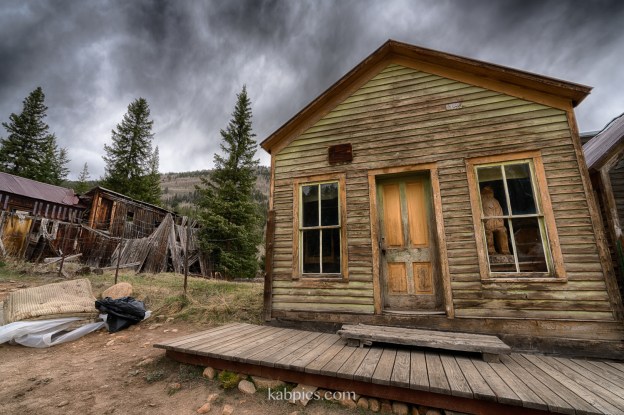
St. Elmo, Colorado is a beautiful little mountain town with nature and scenery. Its wooden buildings have been preserved very well, and are well-suited to photography.

Chloride, New Mexico, had one of the most excellent and unique museums I have visited. Mr. Edmund at the Pioneer Store Museum has spent decades of his life cleaning and documenting the store and the town history. He gave us a wonderful personal tour for over an hour.

St. Elmo, Colorado

St. Elmo is in a remote valley of central Colorado near the Arkansas River headwaters. We stopped by en-route from Great Sand Dunes National Park to Pike’s Peak. St. Elmo is a quintessential mountain ghost town, with beautiful timber construction, moody skies, and looming snowy mountains. Its population peaked at around 2,000 people. St. Elmo had gold and silver mining (over 150 claims in St. Elmo alone). It was near the Historic Alpine Tunnel, an engineering marvel, built in the 1880s and still the highest rail tunnel in the country. (If you want to see that, that requires some walking.)

When the railroad stopped maintaining the rail line in 1910, the town faded. One family stuck around, and today a lot of buildings survive in lovely condition. St. Elmo has mountain biking, an adorable-looking Bed and Breakfast, ATV trails, and more. Also nearby is Mt. Princeton Hot Springs, which looked inviting.

This slideshow requires JavaScript.

Chloride, New Mexico

How can you not adore a name like Chloride for a mining town? Chloride was named for its silver chloride deposits, and was a silver town. At its peak, it reached a population of 3,000 with 9 saloons. (Today, it has 11 residents.) The town collapsed when President McKinley made gold the monetary standard, and silver prices plummeted. Chloride had 42 mines, a crushing plant, and a smelter.

The general store continued on after the mining bust. In 1923, it was boarded up while the son went east to study. He studied physics and moved to California, so the store sat unmolested (except by bats) for 70 years. It is a time capsule rich with history. You can peruse the signatures in the post office book. The museum manager, who restored the building and its contents himself, will show and tell you about the many fascinating items within the store. There are purchase records, old bottles of whiskey, packages of gum, nails, ladies hats, and even a dynamite detonator.

Today, one mine is still active nearby, mining zeolites, which are cool, but a tale for another time.

This slideshow requires JavaScript.


Chaco Canyon: New Mexico’s ancient convention center

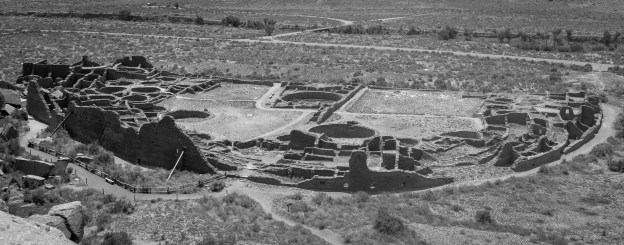
Chaco Culture National Historic Park is in remote northwest New Mexico. The drive will take you on twenty miles of dirt roads and beyond cell range. But in this most remote reach of New Mexico lies the crossroads of an ancient culture. In Chaco Culture National Historic Park lies 3,614 recorded archaeological sites, including many massive great houses. The largest, Pueblo Bonito,  has roughly 800 rooms; visitors may walk through the doors and rooms of Pueblo Bonito. The Chaco Culture also built astronomical features into many of their works; some windows align perfectly with the sun on solstice, and some decorations align with phases of the moon.

When Chaco was discovered in modernity, it was thought to be a vast city. Having walked through it, it feels that way. It feels like it could hold thousands. But archaeological evidence suggests otherwise—there is little garbage, and few burials. Massive Pueblo Bonito may have housed only 70 people on a permanent basis. The guides at the park suggest that Chaco might have been a meeting ground, used for trade and weddings and astronomical ceremonies for a small portion of the year. Remnants of cacao from 1200 miles south have been found at Pueblo Bonito. The bones of macaws, native to eastern Mexico, have been found at Pueblo del Arroyo. They apparently didn’t flourish; only the bones of adults were found. So the astonishing quantity of ruins at Chaco Culture Park may be the remnants of an ancient convention center.

Chaco offers an amazing range of ruins, from the many-roomed grand houses to petroglyphs to astronomical markers to ancient stairs and roads. Like Mesa Verde National Park, not so far to the north, the whole site was abandoned in the 1300s, well before European influence. Like Mesa Verde, archaeologists don’t know exactly why the people left. There is evidence of an ancient drought. Some argue for catastrophic deforestation after all the building at Chaco (because all that construction took a terrific amount of timber, some of which still remains in the structures), though there is not consensus.

I grew up in St. Louis, a town once called Mound City for the mounds left by the ancient Mississippian culture. The massive city at Cahokia was also abandoned around the year 1300. A city of 15,000 abandoned, around the population of London at the time, and we don’t know why. It’s easy to live in the United States and think of it as the new world. But these amazing works of ancient people live on quietly. The inconvenient mounds of St. Louis were largely destroyed; those who did so may not have even realized their origin. But the remnants of the Pueblo culture at Chaco remain, mostly protected by their isolation over the years. Though the journey today is easier than it ever has been, Chaco is still hours from the interstate and quiet. As I took in the ruins, I was filled with the same wonder and questions that Cahokia Mounds always presented. Places like Chaco and Cahokia are reminders of humanity—no matter the size of the structures we build, one day people will view the barren remnants and wonder about us. We will walk the same valleys and cliffs, touch the same stones, but we won’t know each others names or voices or values. Ruins like Chaco remind of us of our place in the universe, and how beautiful and belittling that can be.


This slideshow requires JavaScript.

This slideshow requires JavaScript.

160611-chaco-canyon-0717

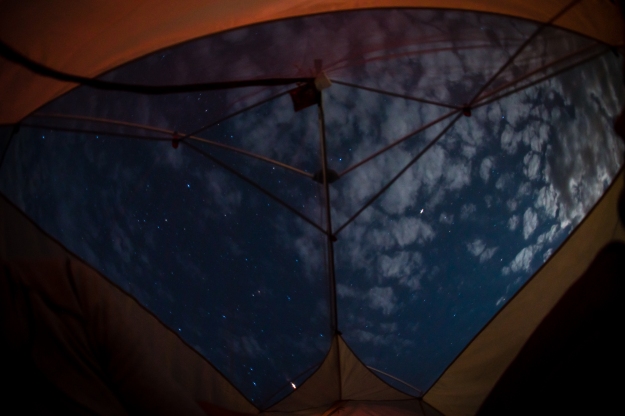
The stars through my tent at Chaco Culture Park. Chaco is one of the night sky parks, where the darkness of the sky is specifically preserved through lighting choices and such. In light of the ancient Pueblo interests in astronomy, it seems appropriate.

160612-chaco-canyon-0877_HDR_1

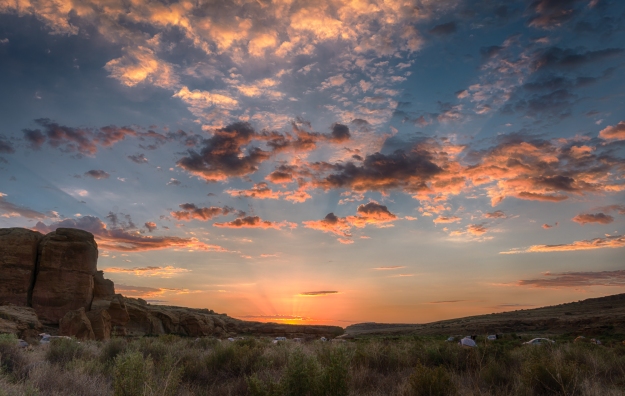
Sunrise at the camp site.

One year a New Mexican

A year ago this week, I arrived in the Land of Enchantment and called myself a New Mexican. Since then, I’ve seen a lot and learned a lot, much of it I have posted here at this blog. More than I could ever fit into a single post. So instead, I include 24 of the 24,000 pictures I’ve taken since I moved to this lovely state. They are images of architecture, culture, geography, wildlife, weather,industry, and celebration from all around New Mexico.

Happy anniversary to me. New Mexico, I can’t wait to see what you show me in the next year.

This slideshow requires JavaScript.

HDR: Nik Software is now free!

Last week I posted about using software to merge HDR or High Dynamic Range images. Well, just a few days ago, that software went from $150 to free. So that means an awesome refund for me, and even more incentive to try Nik Software for everybody else. Nik Software includes an HDR merger and a variety of effects ranging from black and white to faux vintage. I’ve had the package for three weeks, and I’m still finding new and exciting aspects.

I spent the weekend in northern New Mexico and Taos. I’m behind on everything, but I still couldn’t wait to assemble a few images. Without comment, here they are below. Happy photo editing!

High Dynamic Range photography: beyond Photoshop

Have you ever taken a picture where the brightest areas were lost to white and the darkest areas were lost to black? It’s an old photographic challenge with fun new solutions.

For over a century, photographers have used clever techniques to incorporate large brightness ranges in images.  Ansel Adams used dodging and burning to compress the dynamic range of film to the smaller range possible on paper. For challenging scientific shots, scientists produced film with three layers, each capturing a different film speed. Today, given multiple exposures of a scene, computers can auto-merge the best parts of each image in a process called tone mapping. The resulting shot has become known as an HDR or High Dynamic Range image. In just the last decade, the process has become much simpler and more useful.

Photoshop is the most famous of the merging softwares, but it isn’t the best. For years, I wrestled with Photoshop’s clunky and artificial looking HDR outputs. If you think of HDR as a pejorative, Photoshop may be why. Fortunately, there are other pieces of software out there that do a better job. I recently purchased the Nik Software package, which includes HDR Efex 2. I have several hundred old captures that I gave up on in Photoshop that are new and exciting and beautiful again. If you’ve ever tried making HDR images and felt disappointed, you should check out the market again. The results from HDR Efex and Photomatix are glorious. Happy tone mapping!

A note to Mac users: as of March 2016, the HDR Efex plug-in for Lightroom does not always work. I had to email the company and get them to send me a module file. Their email was detailed enough to suggest that this bug is common. With the module file, it was an easy fix, so contact the company if you too encounter this challenge.


HDR Efex (left) and Photoshop (right)

In the case of the cave image, I vastly prefer the HDR Efex image. The Photoshop controls aren’t intuitive, and even their built in presets mostly look awful. Some of the Nik presets are too extreme for my usual preference, but many of them look great immediately. In the case of the waterfall image, I prefer the HDR Efex image, but I don’t dislike the Photoshop image. The light is more exciting in the HDR Efex image, and I did it quickly and easily.


I’ve had HDR Efex for about three weeks. The first two weeks are free with a fully functional trial copy. Below are some of the images I’ve assembled. I’m pretty happy with it so far, especially after years of feeling uninspired by Photoshop’s HDR function. Happy photographing!

This slideshow requires JavaScript.


New Mexican travel post cards

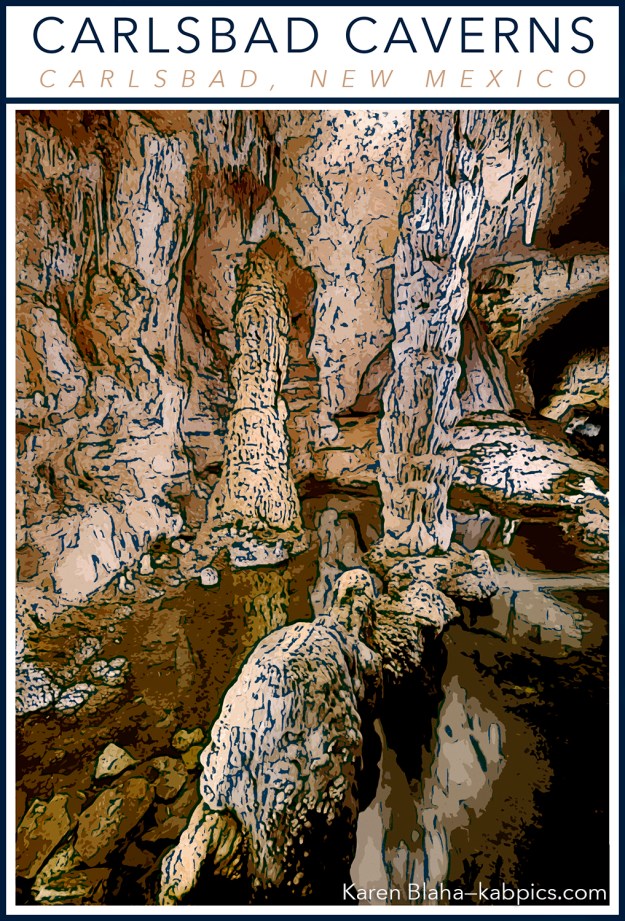
I love the old-fashioned posterized postcards that many of the national parks have. Whenever I visit a park, I go hunt for postcards. I have a wall of 4×6 frames of postcards. Whether they are the old WPA posters from the 30s or the modern versions, I adore them.

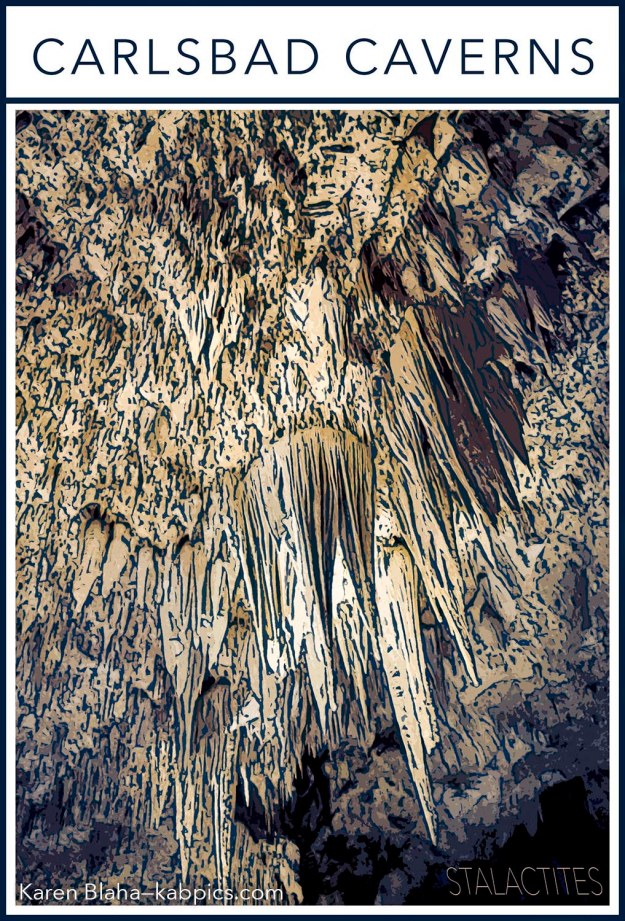
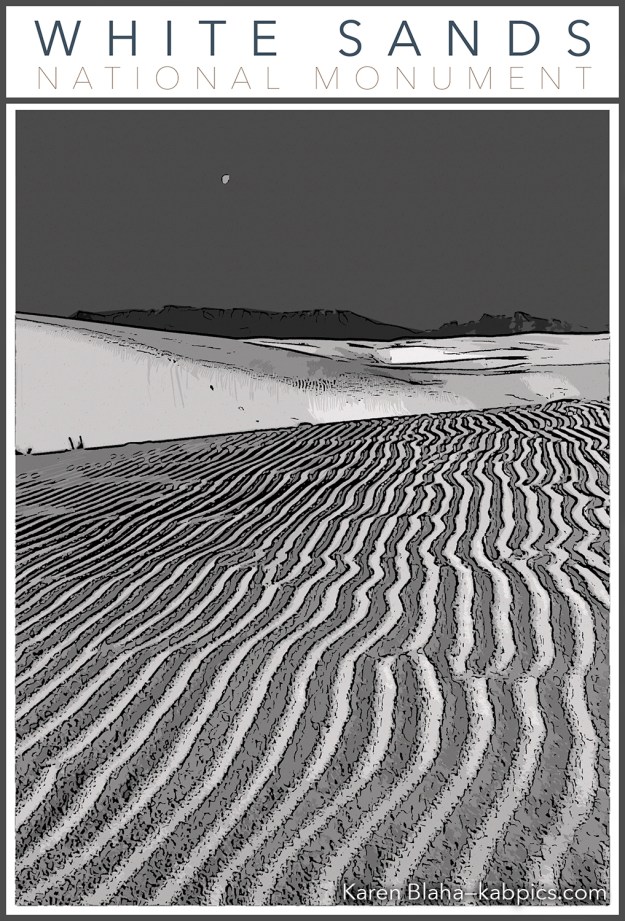
Sometimes, I would go to a park, and they wouldn’t have any. So naturally, I had to make my own. Now I do it everywhere I go. Below are from my grand trip last weekend through southeast New Mexico. Carlsbad Caverns National Park, Salinas Pueblo Missions National Monument, and White Sands National Monument. I also visited Three Rivers Petroglyph Site, a BLM property, and River of Fires BLM site, but no postcards there as of yet.

Happy travels!

Canyonlands National Park Island in the Sky district. Near Moab, Utah.Canyonlands National Park Island in the Sky district. Near Moab, Utah.Canyonlands National Park Island in the Sky district. Near Moab, Utah.Canyonlands National Park Island in the Sky district. Near Moab, Utah.Canyonlands National Park Island in the Sky district. Near Moab, Utah.Canyonlands National Park Island in the Sky district. Near Moab, Utah.

Science Fiction and the West: Part 2

The western landscape is absurd. There are massive towers of rock, ancient ruins, and strange colors. There are fields of lava and dunes of drywall. In a recent post, I talked about how the west evokes much of the science fiction I read. Well, I went driving again, and I found more science fiction in the west. Specifically…


Underground kingdoms

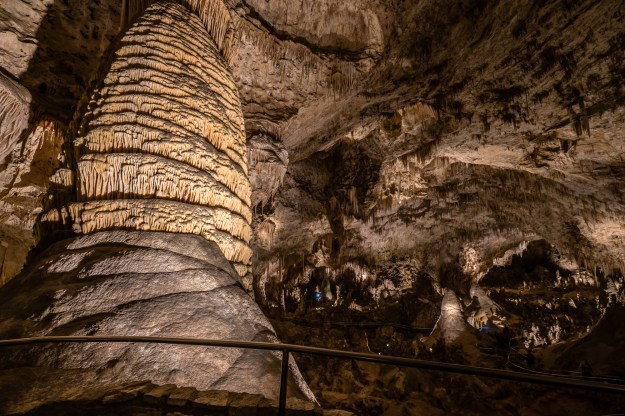
Carlsbad Caverns lie under southeast New Mexico. At any moment, I imagined that goblins would pour out of the ceiling and down columns around me. Carlsbad evokes visions of Journey to the Center of the Earth, Cthulhu, and Middle Earth. Right now, the elevators at Carlsbad are offline, so you must walk down into the gaping natural entrance. If you are a science fiction enthusiast, it’s hard to escape the feeling that you are on a journey to somewhere of lore.

160227-carlsbad-a7r2-5573

The Great Room in Carlsbad Caverns.


Strange pieces of history

There are some silos out west that look exactly like daleks. This one is by the city of Alamogordo. Nearby, I found a scrap yard full of derelict missiles and circuitry. Seriously, where does one find a silo shaped like a scifi creature next to cruise missiles other than science fiction and the west? (Okay, maybe the Ural Mountains.)

At first, it seemed rather extraordinary to find a missile sitting in a scrap yard a mile outside a mid-sized city, but this is the storage yard for the New Mexico Museum of Space History.

Still, I prefer to think that giant daleks roam New Mexico, and they have missiles!

This slideshow requires JavaScript.


A real life Canticle for Leibowitz

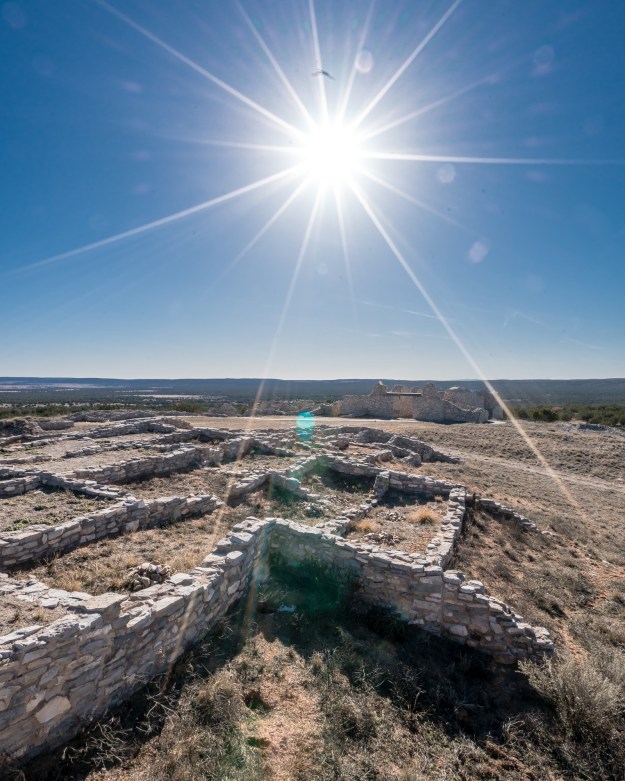
East of Albuquerque is the Salinas Mission National Monument, a set of three missions from the 1600s. The sites were inhabited by pueblo indians going back centuries. After the Spaniards arrived, they built missions to convert the indians. They also functioned as part of the salt trade, which is where the name “Salinas” comes from. After the pueblo revolted in the late 1600s, the sites were forgotten, and only rediscovered in the mid 1800s.

I visited the Gran Quivira site this weekend. It contains a pueblo village that once held 2000 people, a completed church, and an extremely large incomplete church that was in construction at the time of the revolt. From the site, you can see for miles around. There are a few ranches, but few other signs of inhabitance.

As I mentioned in my last post, I just reread A Canticle for Leibowitz. And wow did Gran Quivira evoke the book. The ruins of a church next to a town, just like the abbey next to the town of Sanly Bowitz. From the site, one could see a pilgrim traveling the road. Overhead, the sun bakes all. Okay, so the book was set in Utah, but it felt real to me!

160225-gran-quivira-5229

Salinas Mission National Monument–the Gran Quivira Site.


White Sands

Have I written about this place enough? It’s a bunch of dunes literally made from powdered drywall. I think I’m in love. It’s Tatooine, Mars, Arrakis, and Vulcan.

This slideshow requires JavaScript.


And that was all in just one long weekend. If my former state of Virginia was for lovers, then New Mexico is for romance.


Altering reality in wide angle

Wide-angle lenses are lenses that, as the name suggests, capture a wide angle of view. They’re great for fitting a wide scene into a single shot. A wide-angle lens can catch a long parade marching down the street, spreading to left and right; it can catch a massive sprawling mountain range.

Wide-angle lenses can be tricky, too. Humans don’t see in wide angle, so these images are distorted and unnatural to our eyes. Sometimes, that’s a feature.


Wide Angle to make something feel large

Large things loom. Whether that large object is your parents when you’re a child, a huge skyscraper, or a thunder cloud, big objects have a sense of hanging over you. Wide-angle lenses can capture that sense, even for modestly-sized objects.

Below is a shrine at the Albuquerque Botanical Garden Japanese Garden. It’s maybe 15 feet wide and 15 feet high. But with the help of wide angle, it can fill a whole frame. The top frame is as a 16mm wide-angle lens captures the shot. All the lines that should be straight are curved, because this lens is a type of wide-angle lens called a “fisheye”. This could be the desired effect, or you can correct the curvature, as in the second picture. This time, I was pursuing the second image. Sometimes, the other is the goal. That’s one cool thing about digital photography–both are available in any given image.
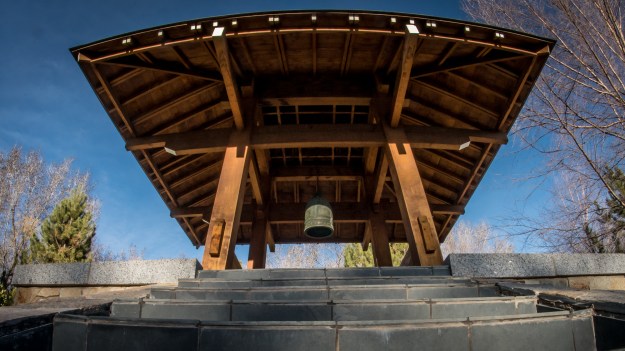
The shrine at the Japanese Garden

Shrine at the ABQ Biopark Japanese Garden, with fisheye distortion uncorrected.
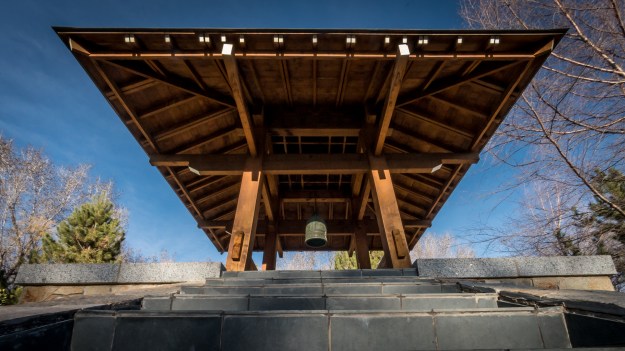
The shrine at the Japanese Garden

With corrected perspective.


Wide Angle to capture a wide scene

This one’s obvious, but still awesome. Some images need a lot of space. Sometimes, you can get a wide-angle image by stitching several traditional images together. But as in the top image, only a single capture can catch the ducks taking flight.

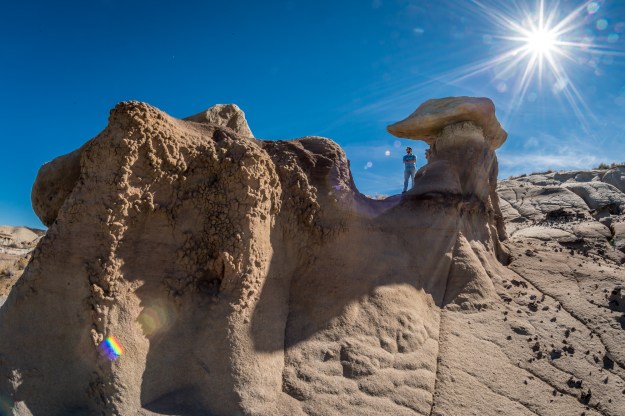
In the bottom image, the angular distortion from the fisheye lens is fine uncorrected, because there are no straight lines on that rock to betray the distortion. And the wide angle here allowed me to get the sun in the frame. The distortion to the sun here is called a “sunstar.” You can get them by shooting with small apertures, which leads to light diffraction. Here’s a nice brief article if you want to learn more about sunstars.
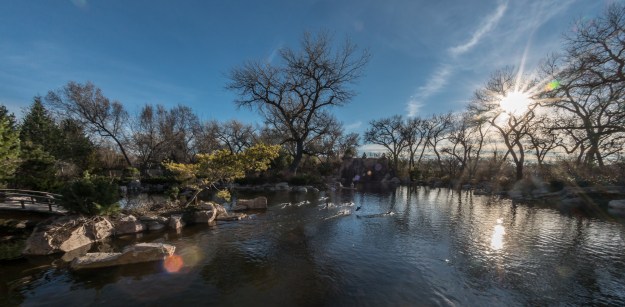
ABQ Biopark Japanese Garden wide angle, ducks taking flight

The pond at the Japanese Garden

Bisti Badlands and Sun Star

A rock formation at Bisti Badlands


Wide Angle for composition

Wide-angle lenses give a photographer different options in guiding the viewer’s eye in a photograph. You may have heard that long lenses compress depth, thus why they are pleasing for portraits. Wide lenses exaggerate depth. The righthand side-view mirror on cars is slightly wide-angle. This is why “objects may be closer than they appear.” Your side-view mirror has exaggerated the sense of depth.

Additionally, wide-angle lenses can focus on nearby objects. My 85mm lens has a minimum focal distance of 1 meter. My 70-200 varies from 1 meter to 1.5 meters. My fisheye can focus nearly up to the point I bump into the subject.

Both of these factors give the photographer different creative freedoms when composing with a wide-angle lens.

In the first image, I found this hanging rock fascinating. I put my lens right next to this rock when I shot, but because of the exaggerated depth, it doesn’t feel as claustrophobic as the shot was. The rocks in the background are only a few feet away, but they feel more distance. Here, I also employ the wide angle to make the rock loom large. That hanging arm was no more than 3 feet long.

In the second image, the ability to get close to the statue in the foreground meant I could fill more of the frame with it. And I can fit the building comfortably in the background. So I can make a relatively small object the same size in the capture as a large object.
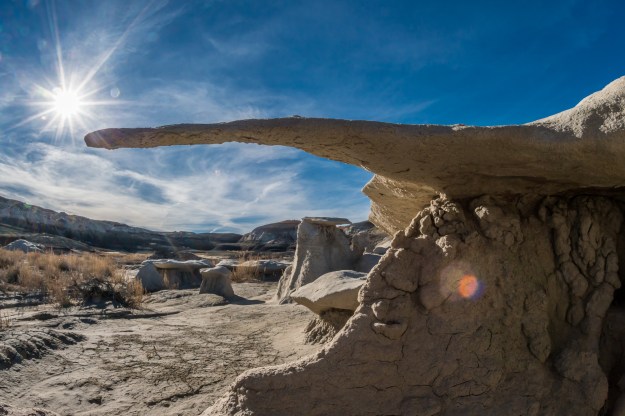
Rock formations in the Bisti Badlands

Rocks and sun at Bisti Badlands

160217-UNM-campus-4711

University of New Mexico campus, and statue of school mascot, the Lobo


Did I miss anything? I love a good photo discussion, so let me know!

Science Fiction and the West: Part 1

Three events inspired this post: 1) I reread A Canticle for Leibowitz, set in future Utah, for the first time since moving west, 2) a member of my scifi club out east joined wordpress (check out his blog here), and 3) I visited the fantastic Bisti Wilderness Area in northwest New Mexico. All at once, I was reminded of sharing the west with friends out east, and confronted with the west in future fiction and the west’s natural absurdity.

I pondered my bookshelf. The genre is not as teeming with western themes as one might think of a genre that grew up side-by-side with the cowboys and indians craze. There’s Joe Haldeman’s Worlds, which briefly depicts a future lawless Nevada. I thought of an Ursula Vernon short story and a series by R.S. Belcher that I have yet to read. But nothing else. It seemed odd. Then I saw all the books about Mars—in many ways, they are books about the west. Kim Stanley Robinson’s Mars trilogy, Philip K. Dick’s hallucinogenic Martian books, Heinlein’s Stranger in a Strange Land… whenever Mars is a character, it feels a lot like the west.

And it’s no surprise that the Mars of fiction feels like the west. John Carter was filmed in southern UtahTotal Recall filmed in Nevada. Robison Crusoe on Mars filmed in Arizona and Death Valley. It’s more than just superficial: NASA has tested rovers at White Sands National Monument, because the dunes are similar to those on Mars. NASA even brought a piece of rock to Mars from New Mexico on the rover for calibration purposes.

This post is just the first on this topic. I’ve lived in the west for six months now. I’ve traveled it only a little. I need to read the science fiction of the west, the science fiction of Mars, and to experience the natural surreality of this land. But for now, I leave you with the science fiction west.

This slideshow requires JavaScript.