Science Fiction and the West: Part 2

The western landscape is absurd. There are massive towers of rock, ancient ruins, and strange colors. There are fields of lava and dunes of drywall. In a recent post, I talked about how the west evokes much of the science fiction I read. Well, I went driving again, and I found more science fiction in the west. Specifically…


Underground kingdoms

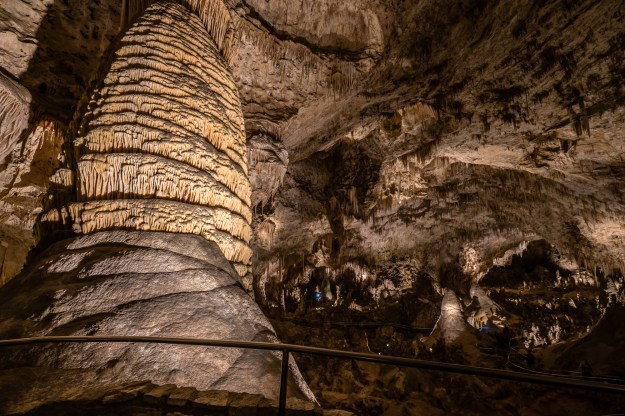
Carlsbad Caverns lie under southeast New Mexico. At any moment, I imagined that goblins would pour out of the ceiling and down columns around me. Carlsbad evokes visions of Journey to the Center of the Earth, Cthulhu, and Middle Earth. Right now, the elevators at Carlsbad are offline, so you must walk down into the gaping natural entrance. If you are a science fiction enthusiast, it’s hard to escape the feeling that you are on a journey to somewhere of lore.
160227-carlsbad-a7r2-5573

The Great Room in Carlsbad Caverns.


Strange pieces of history

There are some silos out west that look exactly like daleks. This one is by the city of Alamogordo. Nearby, I found a scrap yard full of derelict missiles and circuitry. Seriously, where does one find a silo shaped like a scifi creature next to cruise missiles other than science fiction and the west? (Okay, maybe the Ural Mountains.)

At first, it seemed rather extraordinary to find a missile sitting in a scrap yard a mile outside a mid-sized city, but this is the storage yard for the New Mexico Museum of Space History.

Still, I prefer to think that giant daleks roam New Mexico, and they have missiles!

This slideshow requires JavaScript.


A real life Canticle for Leibowitz

East of Albuquerque is the Salinas Mission National Monument, a set of three missions from the 1600s. The sites were inhabited by pueblo indians going back centuries. After the Spaniards arrived, they built missions to convert the indians. They also functioned as part of the salt trade, which is where the name “Salinas” comes from. After the pueblo revolted in the late 1600s, the sites were forgotten, and only rediscovered in the mid 1800s.

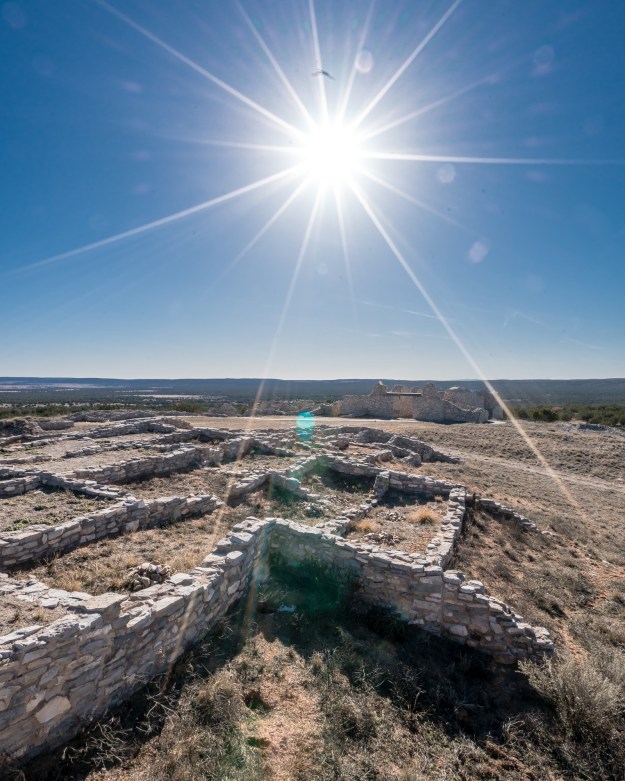
I visited the Gran Quivira site this weekend. It contains a pueblo village that once held 2000 people, a completed church, and an extremely large incomplete church that was in construction at the time of the revolt. From the site, you can see for miles around. There are a few ranches, but few other signs of inhabitance.

As I mentioned in my last post, I just reread A Canticle for Leibowitz. And wow did Gran Quivira evoke the book. The ruins of a church next to a town, just like the abbey next to the town of Sanly Bowitz. From the site, one could see a pilgrim traveling the road. Overhead, the sun bakes all. Okay, so the book was set in Utah, but it felt real to me!
160225-gran-quivira-5229

Salinas Mission National Monument–the Gran Quivira Site.


White Sands

Have I written about this place enough? It’s a bunch of dunes literally made from powdered drywall. I think I’m in love. It’s Tatooine, Mars, Arrakis, and Vulcan.

This slideshow requires JavaScript.


And that was all in just one long weekend. If my former state of Virginia was for lovers, then New Mexico is for romance.

 

Altering reality in wide angle

Wide-angle lenses are lenses that, as the name suggests, capture a wide angle of view. They’re great for fitting a wide scene into a single shot. A wide-angle lens can catch a long parade marching down the street, spreading to left and right; it can catch a massive sprawling mountain range.

Wide-angle lenses can be tricky, too. Humans don’t see in wide angle, so these images are distorted and unnatural to our eyes. Sometimes, that’s a feature.


Wide Angle to make something feel large

Large things loom. Whether that large object is your parents when you’re a child, a huge skyscraper, or a thunder cloud, big objects have a sense of hanging over you. Wide-angle lenses can capture that sense, even for modestly-sized objects.

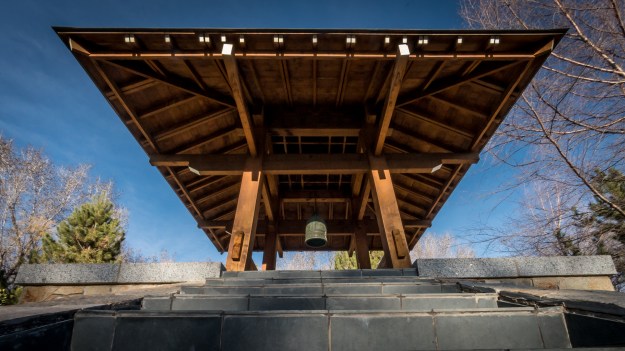
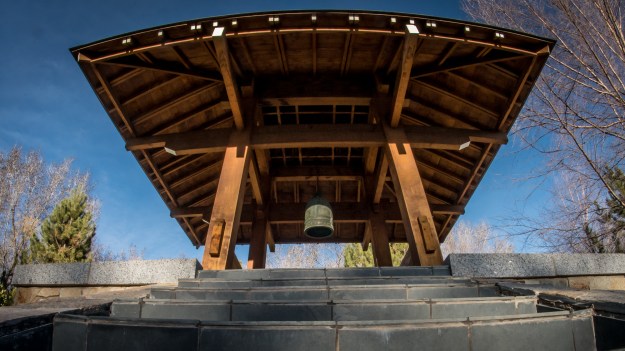
Below is a shrine at the Albuquerque Botanical Garden Japanese Garden. It’s maybe 15 feet wide and 15 feet high. But with the help of wide angle, it can fill a whole frame. The top frame is as a 16mm wide-angle lens captures the shot. All the lines that should be straight are curved, because this lens is a type of wide-angle lens called a “fisheye”. This could be the desired effect, or you can correct the curvature, as in the second picture. This time, I was pursuing the second image. Sometimes, the other is the goal. That’s one cool thing about digital photography–both are available in any given image.

The shrine at the Japanese Garden

Shrine at the ABQ Biopark Japanese Garden, with fisheye distortion uncorrected.

The shrine at the Japanese Garden

With corrected perspective.


Wide Angle to capture a wide scene

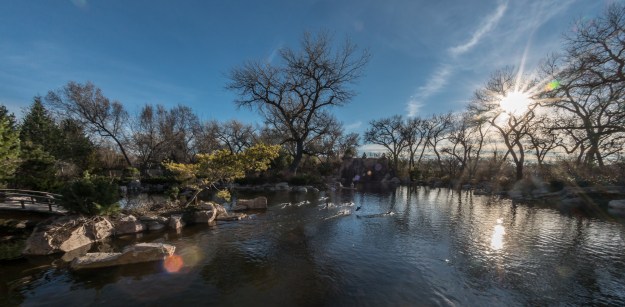
This one’s obvious, but still awesome. Some images need a lot of space. Sometimes, you can get a wide-angle image by stitching several traditional images together. But as in the top image, only a single capture can catch the ducks taking flight.

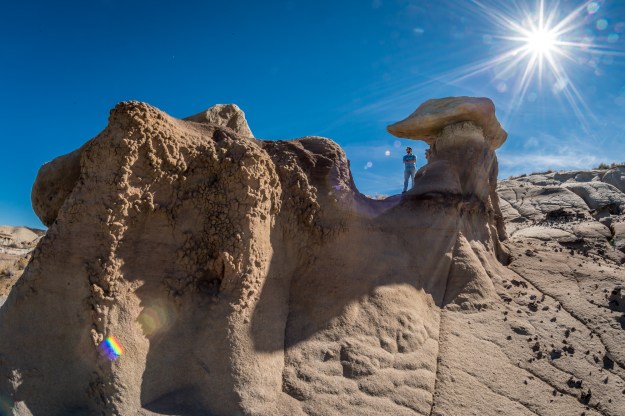
In the bottom image, the angular distortion from the fisheye lens is fine uncorrected, because there are no straight lines on that rock to betray the distortion. And the wide angle here allowed me to get the sun in the frame. The distortion to the sun here is called a “sunstar.” You can get them by shooting with small apertures, which leads to light diffraction. Here’s a nice brief article if you want to learn more about sunstars.

ABQ Biopark Japanese Garden wide angle, ducks taking flight

The pond at the Japanese Garden

Bisti Badlands and Sun Star

A rock formation at Bisti Badlands


Wide Angle for composition

Wide-angle lenses give a photographer different options in guiding the viewer’s eye in a photograph. You may have heard that long lenses compress depth, thus why they are pleasing for portraits. Wide lenses exaggerate depth. The righthand side-view mirror on cars is slightly wide-angle. This is why “objects may be closer than they appear.” Your side-view mirror has exaggerated the sense of depth.

Additionally, wide-angle lenses can focus on nearby objects. My 85mm lens has a minimum focal distance of 1 meter. My 70-200 varies from 1 meter to 1.5 meters. My fisheye can focus nearly up to the point I bump into the subject.

Both of these factors give the photographer different creative freedoms when composing with a wide-angle lens.

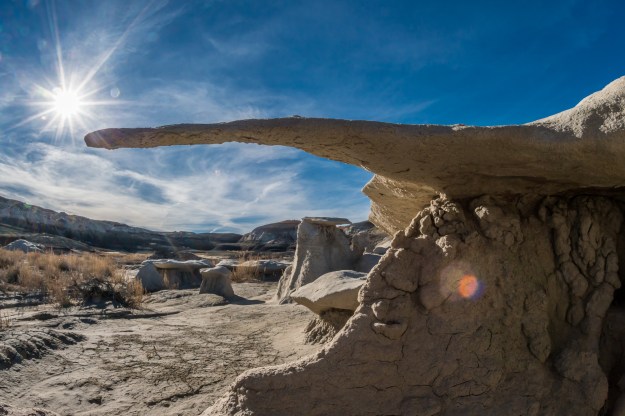
In the first image, I found this hanging rock fascinating. I put my lens right next to this rock when I shot, but because of the exaggerated depth, it doesn’t feel as claustrophobic as the shot was. The rocks in the background are only a few feet away, but they feel more distance. Here, I also employ the wide angle to make the rock loom large. That hanging arm was no more than 3 feet long.

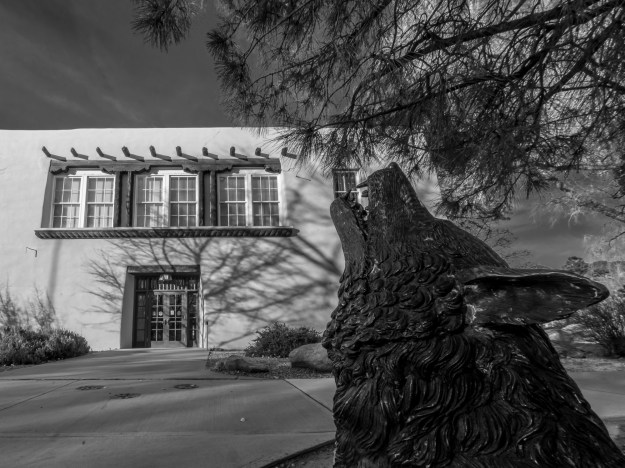
In the second image, the ability to get close to the statue in the foreground meant I could fill more of the frame with it. And I can fit the building comfortably in the background. So I can make a relatively small object the same size in the capture as a large object.

Rock formations in the Bisti Badlands

Rocks and sun at Bisti Badlands

160217-UNM-campus-4711

University of New Mexico campus, and statue of school mascot, the Lobo


Did I miss anything? I love a good photo discussion, so let me know!

Science Fiction and the West: Part 1

Three events inspired this post: 1) I reread A Canticle for Leibowitz, set in future Utah, for the first time since moving west, 2) a member of my scifi club out east joined wordpress (check out his blog here), and 3) I visited the fantastic Bisti Wilderness Area in northwest New Mexico. All at once, I was reminded of sharing the west with friends out east, and confronted with the west in future fiction and the west’s natural absurdity.

I pondered my bookshelf. The genre is not as teeming with western themes as one might think of a genre that grew up side-by-side with the cowboys and indians craze. There’s Joe Haldeman’s Worlds, which briefly depicts a future lawless Nevada. I thought of an Ursula Vernon short story and a series by R.S. Belcher that I have yet to read. But nothing else. It seemed odd. Then I saw all the books about Mars—in many ways, they are books about the west. Kim Stanley Robinson’s Mars trilogy, Philip K. Dick’s hallucinogenic Martian books, Heinlein’s Stranger in a Strange Land… whenever Mars is a character, it feels a lot like the west.

And it’s no surprise that the Mars of fiction feels like the west. John Carter was filmed in southern UtahTotal Recall filmed in Nevada. Robison Crusoe on Mars filmed in Arizona and Death Valley. It’s more than just superficial: NASA has tested rovers at White Sands National Monument, because the dunes are similar to those on Mars. NASA even brought a piece of rock to Mars from New Mexico on the rover for calibration purposes.

This post is just the first on this topic. I’ve lived in the west for six months now. I’ve traveled it only a little. I need to read the science fiction of the west, the science fiction of Mars, and to experience the natural surreality of this land. But for now, I leave you with the science fiction west.

This slideshow requires JavaScript.

Writing prompt: Don’t Cry Over Spilled Milk Day

Time: 10 minutes. Click here to go to my list of prompts.

“Don’t cry over spilled milk day” (Inspired by this list of silly holidays.)

The warning message on my phone had been accurately dire. Only the charred beams of the house remained. I saw Bella and Sadie out in the yard, doting upon a firefighter with a bag of treats. I pulled up behind the firetruck.

“It’s a total loss, ma’am,” one of the firefighters approached me, bearing forms.

“So the message said,” I sighed. “Do you know what caused it?”

“Electrical short, we think. We won’t know until the simulation results are in, and they run overnight. You probably know what I’m going to ask next.” He looked apprehensive. He glanced at the dogs, and back to me.

“I back up every week,” I said.

He relaxed noticeably. “Thank goodness. You don’t know how many fires I see where the family hasn’t backed up in five years. It’s devastating.”

“I bet.”

“Do you know how to initiate the rebuild?” he asked. I shook my head and he walked me through the process.

“By next week, your house will be back at the state of your last back-up. A few details might be less current, say you hadn’t scanned a closet for a while. The insurance will put you up at a hotel until it’s ready.”

I looked over the ruins of my home, ruins of my memories. In a week, they’d all be back. Maybe not the same piece of paper I’d received at graduation, not the same toy my dogs loved to fight over. But nearly. I sighed.

“Are you all right ma’am? It’s a lot to take in,” the fire fighter said.

“No use crying over spilled milk.”

Photo theme: Quarter Windows & Side Mirrors

Last weekend, I attended the 25th annual SuperNationals Car Show in Albuquerque. It was a sea of chrome and gleaming paint. There were silly low-riders, beautiful antiques, and fine-art automotive sculptures.

So amongst all that overstimulation, I tried to stick to a few themes. And one of them is the subject of this post: Quarter Windows and Side Mirrors. Quarter windows are the small (usually triangular) windows in front of the front windows. On old cars, they could swivel open to allow airflow.

The shining chrome of the quarter window tracing around the silvery side mirror–that’s a theme I will see again and again. There’s a lot to play with. Reflections in the flat glass, warped reflections in the chrome, angles, lines, light. This is what I have for now. To be continued…

This slideshow requires JavaScript.

Writing prompt: create a vacuum day

Time: 10 minutes. Click here to go to my list of prompts.

“Create a vacuum day” (Inspired by this list of silly holidays.)


“Aren’t you the asshole that wiped out Charlottesville?” the woman said, spotting me from across the diner. She walked over.

“Well, technically no, it wasn’t me,” I rubbed my arm. I felt eyes study me from all around.

“Your work then. Whatever. I didn’t think I’d ever see you in person, or at least not without a fake beard.”

“I’m not ashamed of what happened,” I said. “Regretful, yeah, but not ashamed.”

“How do you work that out? Wiping out thousands of homes and businesses because you did something stupid?”

She looked genuinely curious. I was used to being berated. But maybe she would understand. I launched into the speech I’d recited in my head so many times. The speech no one ever let me speak. “Have you ever seen a vacuum chamber setup? A real, scientific one? For trying to create nothing, the suckers are enormous. And chock full of specialized equipment, like pumps that can literally be destroyed if they have to push thousands of atoms rather than tens. Frankly, I thought it was all a mess. I thought I could do better,”

She cocked her head to the side. She looked like she thought I was nuts, but she didn’t look angry.

“It was a wild idea,” I continued. “So wild I didn’t tell my advisor. But I didn’t need to tell him, I had the materials to get it done on the cheap.”

“Yea, yea, yea,” she waved her hand. “You decided to make a black hole in one instead, I watch the news. And trust me, no matter how you tell that part, it won’t sound clever to someone who lost a house to it.”

I looked away. “I can’t do anything about that now. I ran simulation after simulation that looked fine. I still don’t know what happened.”

“You got it wrong.”

“I really don’t think I did,” I said. “And I’m not afraid to be wrong—really, go find my undergraduate biology professor. I don’t have any data, it all got destroyed, but something other than just a black hole happened that day.”

She frowned. “You got it wrong. Apparently you are afraid to admit it. How sad that you can’t even see that.”

She walked away.

“Excuse me,” an elderly woman with a colorful scarf said from a booth nearby. “I can’t help but have overheard your conversation. And I have a theory about what went wrong that I’ve entertained for a while. Are you willing to try to reproduce your experiment?”


Photography: Patterns

Every now and again, it’s fun to rummage through your old photos and look for categories. Pictures of bicycles, pictures of cats, pictures of cats, pictures that are purple… you get the idea. But it does take a while. So today, I rummaged through my photos for pictures of patterns.

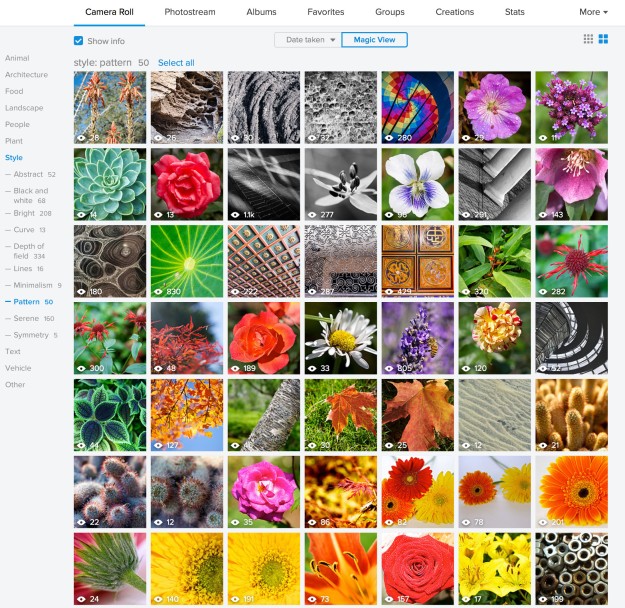
I was inspired by Flickr’s new organizational features. Under the new “camera roll” is the magic view, which allows you to look at various pre-determined categories according to Flickr. There’s various kinds of animals, landscapes, and people categories. My favorite is the style. Below is my “pattern” category. Not every image hits the nail on the head, but it’s a cool way of looking through your photos. I’ve got over 7000 on Flickr, so I can see photos with similar attributes across the years. Some of the categories were ones I already had thought of, but some were new ideas.patterns

So, some of my favorite pattern pictures!

Western skies: Lenticular clouds

The western sky is as vast as the western landscape (that I have admired in so many other posts). It’s full of dramatic colors and exotic clouds. And because I am a geek, I bought a book about collecting clouds, The Cloud Collector’s Handbook.

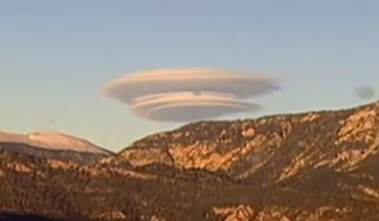
I was inspired to buy this book after seeing several lenticular clouds. Lenticular clouds, sometimes mistaken for UFOs, look like giant horizontal lens in the sky, thus the name. They’re beautiful. Here in New Mexico, I see them over the tops of mountains, just hovering there. Unlike other clouds, lenticular clouds tend to stay in one place. That’s because lenticular clouds have an interesting formation mechanism.

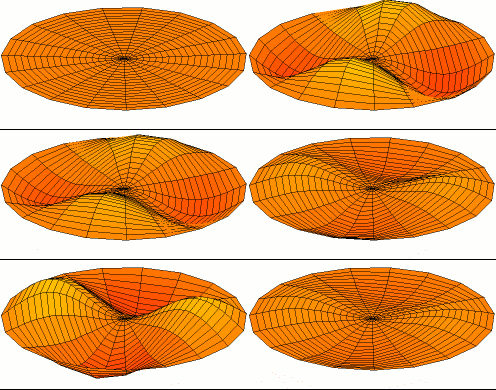
Do you remember standing waves from your high school physics days? Lenticular clouds are a grand natural example of them. In our class, we bobbed a metal sphere up and down in water, and depending upon the shape of the container, waves would either travel or “stand.” In a traveling wave, the maxima travels across space; in a standing wave, the maxima is stationary. Standing waves are resonance patterns–if you recall the famous Tacoma Narrows bridge collapse, that was a result of a standing wave pattern.

drum_vibration_mode21

Standing wave example in the surface of a drum (Wikipedia). Note that the maxima doesn’t travel in space, it just oscillates in magnitude.

So, lenticular clouds are standing wave patterns in the sky, made visible by the condensation of water. They stay put because that’s what standing waves do. They tend to form over mountains or hills because these structures disrupt the movement of airflow and cause eddies that sometimes lead to lenticular clouds. If you have ever watched a flowing river and observed a whorl behind a log or rock, well, a lenticular cloud is like that, but in the sky. Pilots avoid them because of the strong winds that create them. Though they look serene, they are not!

Below are some great example pictures that aren’t mine. This time of year, lenticular clouds are rarer, and I was too busy gawking this summer to take pictures. So as the spring winds and summer rains of the west approach, keep on the lookout for lenticular clouds. I will be!


Writing prompt: Hugging Day

Time: 10 minutes. Click here to go to my list of prompts.

“Hugging Day” (Inspired by this list of silly holidays.)


Every species we knew said the Zagadins were the most caring and advanced species in the galaxy. When we finally managed to encounter them, it was with a sense of excitement. At last, we were friends with the cool species.

Cool be damned, thought the military—the Zagadins had technology, and they liked to share. For decades, other species had been able to travel faster than us, able to make ships we could only dream of. And when we asked for or demanded their technologies, they shrugged (or whatever a shrug was to their species) and said it came from the Zagadins. We could finally fleece the galaxy’s biggest hippy chumps and become king of the ant hill.

The Zagadins diplomatic arrival was all over the News Nets. They wanted to meet everyone! Secretary of state, president, secretary of the navy, senators, mayors, professors—for them, it was the more the merrier. They wouldn’t hear of restricting the event. Thousands of people came.

And the Zagadins introduced themselves with their cultural tradition—hugging. The military knew they had these hippies now. Everyone at the arrival got a hug from a Zagadin. And as promised, the Zagadins sent the government files full of technology afterwards.

But a strange thing happened. Those who had met the Zagadins didn’t care about using the technology to conquer. They just wanted to hug, and then the people they hugged became peaceful as well.

We asked other species. They shrugged some more. That’s how the Zagadins work. Their hugs transmit resequencing retroviruses that promote peacefulness. The Zagadins won’t meet a species until they work out the retroviruses necessary. Perhaps it’s a little invasive, but let’s hug it out, the aliens said.

A few hugless humans remained, and they were horrified. They fled to Io and founded a hugless colony. But they should really loosen up. Too bad they can’t hug it out.


Painting with dark: books of night-themed art to inspire the high ISO photographer

Photography means “painting with light.” But how much light? Today, cameras are more light sensitive than ever, with ISOs up to 400,000 or even 4,000,000. Some have described cameras that can take video by the light of a candle as “painting with dark.” After discussing these advancements at a photo event yesterday, I found myself thinking about how that affects an image. If light is the exception rather than the rule, what kind of images could I create?

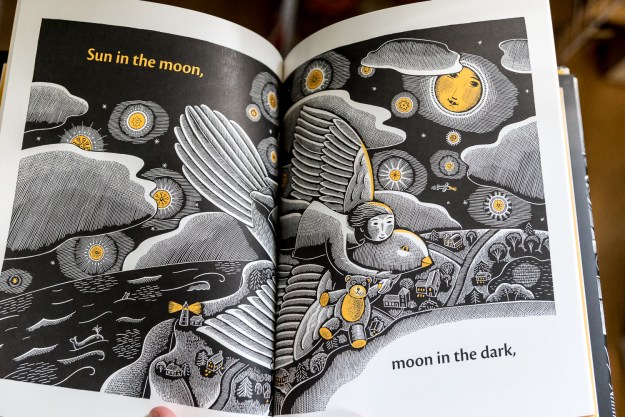
So I visited my bookshelf! And I found two art books themed around darkness and nighttime. In a future post, I’ll have to see how these inspiring books guided me. After all, it’s a great time of year to find guidance in darkness.

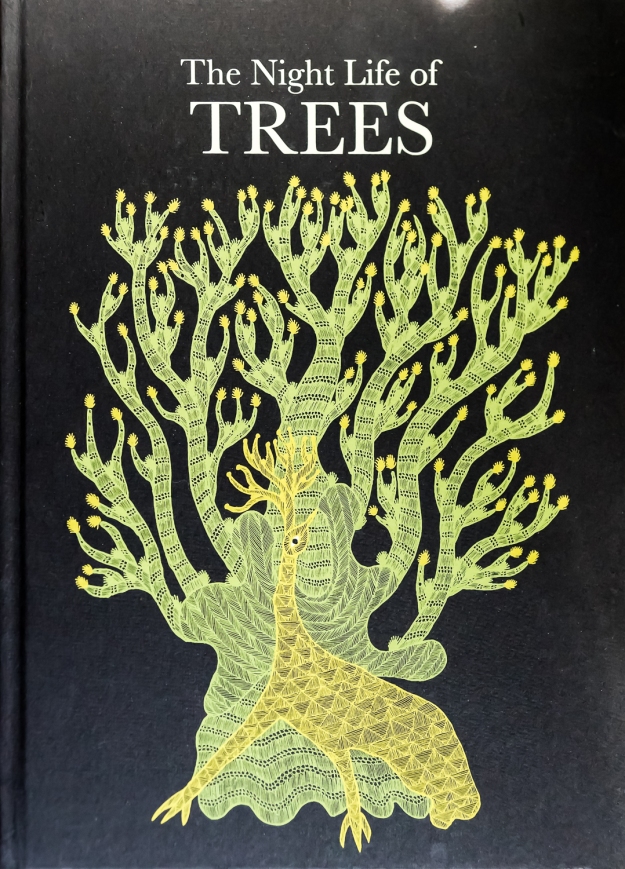
The Night Life of Trees by Bhajju Shyam, Durga Bai, and Ram Singh Urveti

This book is from Tara Books, a company that does beautiful and imaginative books. I also recommend Waterlife by Rambharos Jha, which I wrote about in a previous post. Both Night Life and Waterlife are silk-screen print books, which gives the colors and ink a life that other printing methods don’t match. Both books also smell amazing. (This sounds weird, but they just do. I don’t know whether it’s the ink, the paper, or both.)

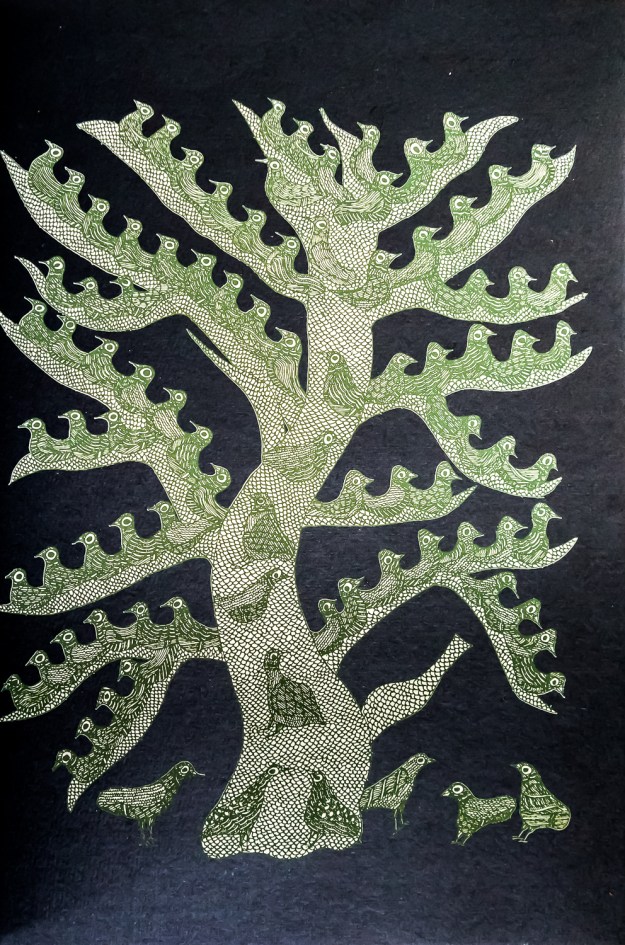
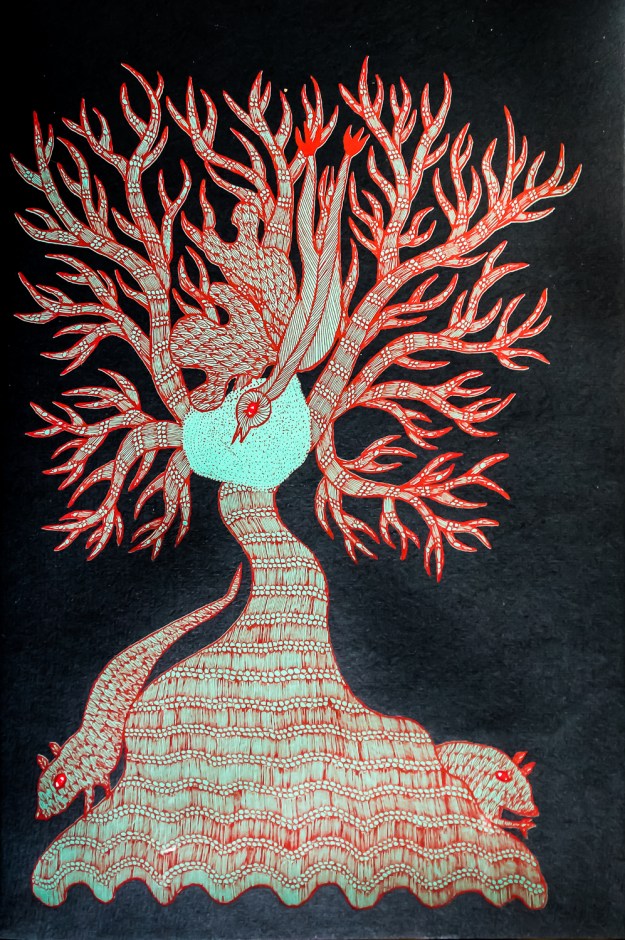
The Night Life of Trees is full of illustrations depicting just that—trees at night and what goes on in them. The images are screen prints on black paper, allowing the book to “paint with darkness” in a way that other books just can’t. Check out the beautiful images below.

160118-books-9437160118-books-9439160118-books-9438


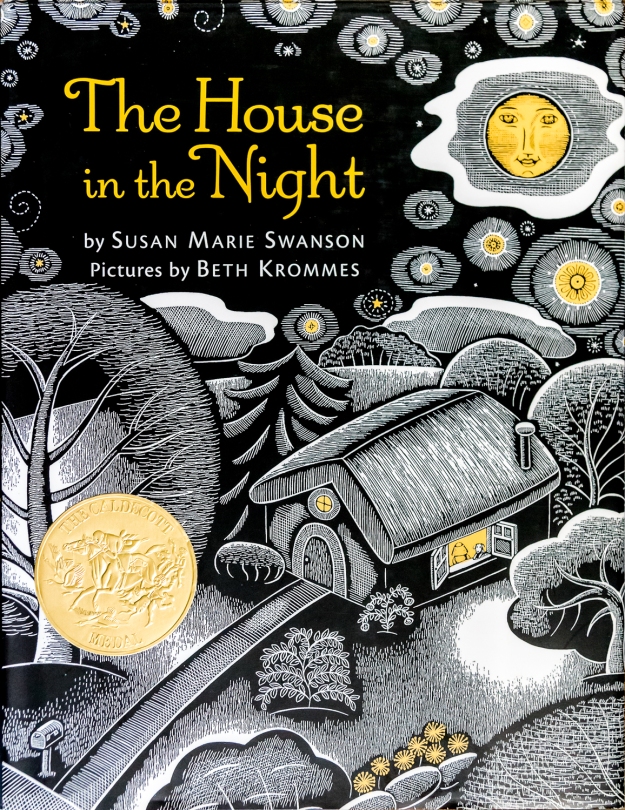
The House in the Night
by Susan Marie Swanson

A children’s book with awesome art. Sometimes kids books have the best art because they keep it simple. This book is literally about light at night. I don’t think that needs too much explanation. Just check out the art, which incidentally mimics the woodcut style that I discussed last week.

160118-books-9440160118-books-9441